
Nigredo · Mythos · Chapter 8 of 48
1.1.8. The Fisher-King Wound
What if the armour that once helped a person survive later prevents success, intimacy and feeling from reaching them?
Watch the chapter discussion
The Wound That Shapes Your Life
The book
The chapter in brief
The Fisher-King Wound uses the Grail legend as a map of conditioning. Percival, trained for achievement and violence, encounters a king whose power and wealth cannot relieve his hidden pain. The question that might heal the kingdom is not asked, and the opportunity is lost.
The chapter interprets the wound as emotional hardening: duty, status and toughness may become substitutes for feeling and relationship. Its response is recognition rather than conquest—questioning inherited identities, noticing hostility towards vulnerability and recovering the capacity to be affected. This is a symbolic and contemplative account, not a clinical model or diagnosis.
Video guide
Can the successful self admit that its protection has become a prison?
The recording begins in a driveway after the conventional game has apparently been won: the desired work, car and home are present, yet fulfilment is not. This contradiction becomes the modern Fisher-King moment. Rather than treating dissatisfaction as proof of a single hidden cause, the video adopts it as an entrance into the chapter’s mythic interpretation.
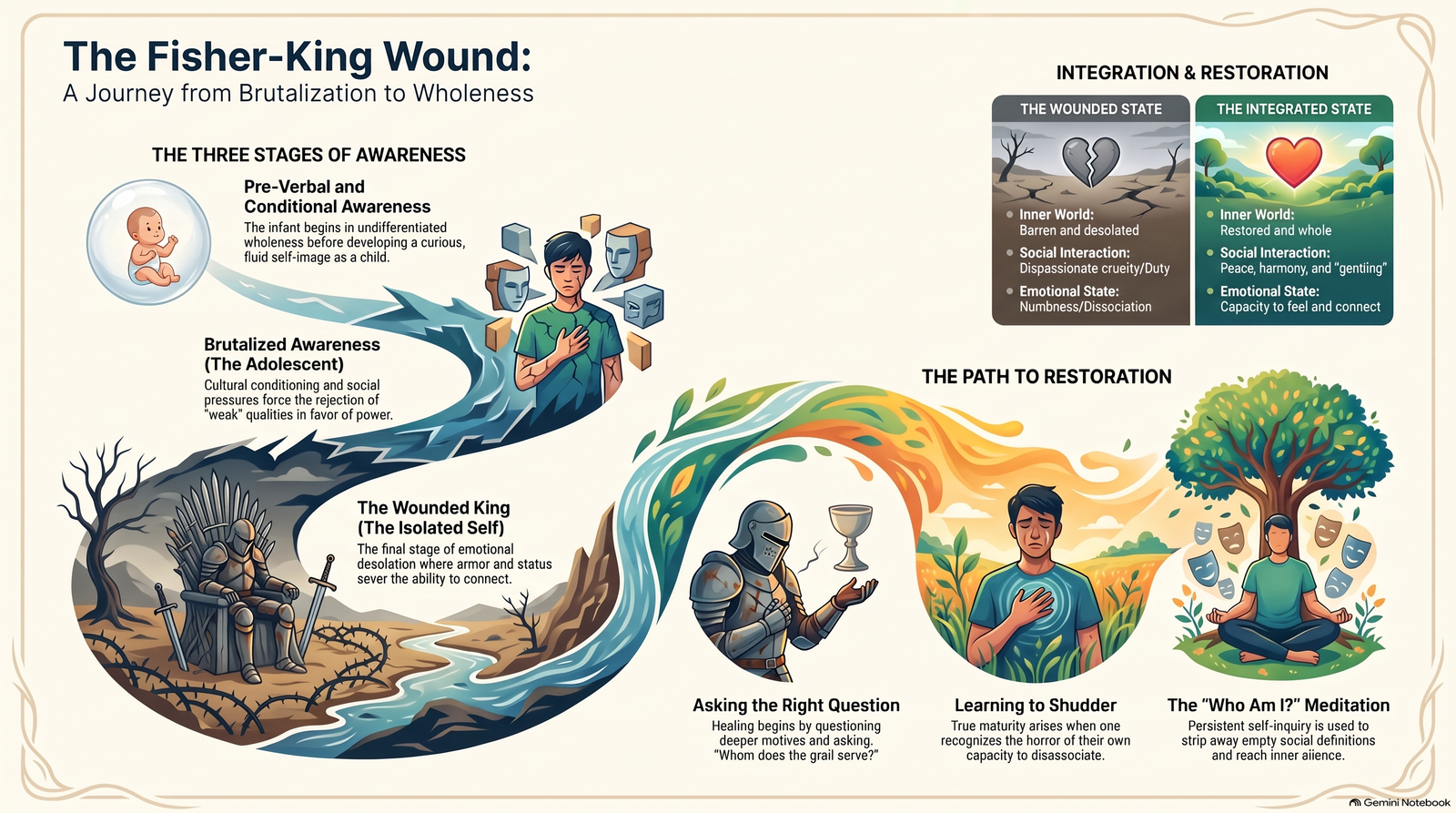
To explain the wound, the hosts propose a four-part developmental story. An infant begins in undifferentiated wholeness; a child develops a fluid sense of self; an adolescent learns to reject vulnerable qualities; and the successful adult becomes the wounded king, powerful outwardly but emotionally desolate. The sequence is evocative, not a validated developmental theory. Infant experience cannot be directly reported, children do not develop uniformly, and emotional reserve may arise from many personal, cultural and clinical conditions.
The Arthurian material then gives the pattern a narrative body. The king’s groin wound symbolises damage to generativity: the capacity to create, renew and bring life into the kingdom. The surrounding feast intensifies the paradox—abundance exists, yet its keeper cannot participate. Percival sees the suffering but, trained in restraint and propriety, does not ask, “Whom does the Grail serve?” Silence preserves etiquette while the wasteland remains.
The video calls the social mechanism behind the armour “habitual brutalisation”. It focuses especially on expectations placed on boys and men, while acknowledging that emotional suppression and enforced toughness are not confined to one gender. This is best read as a critique of rigid roles, not as a claim that men, mothers, soldiers, executives or whole cultures share one psychology. The discussion’s sweeping examples are rhetorical and should not be used to label individuals.
“Resentment of the innocent” describes a possible reaction to qualities a person was once forced to reject: another person’s softness, curiosity or uncomplicated joy can feel irritating because it touches what has been disowned. The idea may prompt useful self-observation, but irritation has many explanations. It does not establish a concealed trauma, and the language of “psychopathy” used briefly in the recording is neither an assessment nor an appropriate shorthand for emotional restraint or harsh conduct.
Restoration begins with “learning to shudder”: becoming able to feel the human cost of one’s numbness, rationalisations or harmful actions. The phrase carries moral force, but healing need not require self-condemnation or overwhelming exposure. Where trauma or dissociation is present, gradual work with suitable professional support may be safer than forcing a cathartic confrontation.
The final practice repeatedly asks “Who am I?” and examines each answer—occupation, role, nationality, status—as contingent rather than an unchanging self. In the chapter’s Buddhist frame, this is an enquiry into emptiness; in ordinary psychological terms, it can loosen an identity that has become too narrow. The practice does not prove that personal history, responsibilities or relationships are unreal, and anyone who finds self-enquiry destabilising can stop and return to grounded support.
Argument map
How the discussion moves
Success feels barren
The outward checklist is complete, but the expected sense of aliveness or fulfilment does not arrive.
Armour becomes identity
Social approval rewards control and toughness until protection can no longer be removed when intimacy requires it.
The king embodies the cost
Power remains, while pain, sterility and the surrounding wasteland symbolise a loss of generativity and connection.
Percival misses the question
Training in restraint and attraction to the feast prevent the direct encounter that the myth makes necessary.
The rejected returns as anger
Vulnerability and innocence in other people may provoke the person who had to exile those qualities from themselves.
Feeling interrupts the pattern
“Learning to shudder” names the recovery of moral and emotional responsiveness, ideally without coercion or self-punishment.
Identity becomes a question
“Who am I?” turns inherited roles into objects of enquiry and leaves space for a less defended way of relating.
Book and video
The source and its expansion
The written chapter establishes
Percival and the wounded king, brutalisation through duty, resentment of innocence, “learning to shudder” and the “Who am I?” enquiry.
The video expands
A four-stage story of awareness, the armour as both defence and cage, the groin wound as lost generativity, and modern images of status without participation.
The synthesis proposes
A socially rewarded identity may preserve function while narrowing feeling, creativity and relationship; healing begins when the pattern can be questioned.
The evidence boundary
The discussion does not establish a universal developmental sequence, diagnose PTSD or prove that success, masculinity or emotional reserve arises from one wound.
Clickable chapters
Navigate the video
These supplied markers ascend correctly. The final duration was unavailable for an independent end-time check, so duration metadata and VideoObject structured data are omitted.
Terms for orientation
Expandable glossary
Fisher King
Percival
Grail
Chesed
Dissociation
Learning to shudder
Resentment of the innocent
Emptiness
Continue within the website
Related course pathways
- 1.1.7. The Call to Adventure The preceding chapter considers the restlessness that may begin an enquiry.
- Mythos — Part One of Nigredo The section landing page for all twelve chapters.
- 1.1.9 The Rebis & Rejection of Identity The next chapter turns towards divided identity and the alchemical image of reconciliation.
- Nigredo The course landing page.
Context beyond the course
External reference points
- NHS — PTSD (post-traumatic stress disorder) Clinical context for symptoms, causes, assessment, treatment and routes to support.
- NHS — Dissociative disorders A clinical account of dissociation, associated symptoms and available support.
- American Psychological Association — Guidelines for Psychological Practice with Boys and Men Professional context for gender socialisation, restrictive norms and psychological practice.
- Robert A. Johnson — He: Understanding Masculine Psychology A Jungian reading of the Fisher-King material cited by the chapter; availability may be limited by borrowing controls.
A three-minute reflection
Where does the armour remain on?
Choose one ordinary setting in which you become more defended—work, family, conflict or asking for help. Name what the protection makes possible, what it prevents, and one small sign that it is safe enough to soften by five per cent. No disclosure or confrontation is required.
Keep the exercise observational. If it evokes traumatic memories, marked dissociation or overwhelming distress, stop and return to a grounding activity or appropriate support.