
Nigredo · Mythos · Chapter 10 of 48
1.1.10 The Shadow & The Lost Infant
What happens when a preferred identity can survive only by rejecting parts of experience and locating them in someone else?
Watch the chapter discussion
Why You Project Your Darkness
The book
The chapter in brief
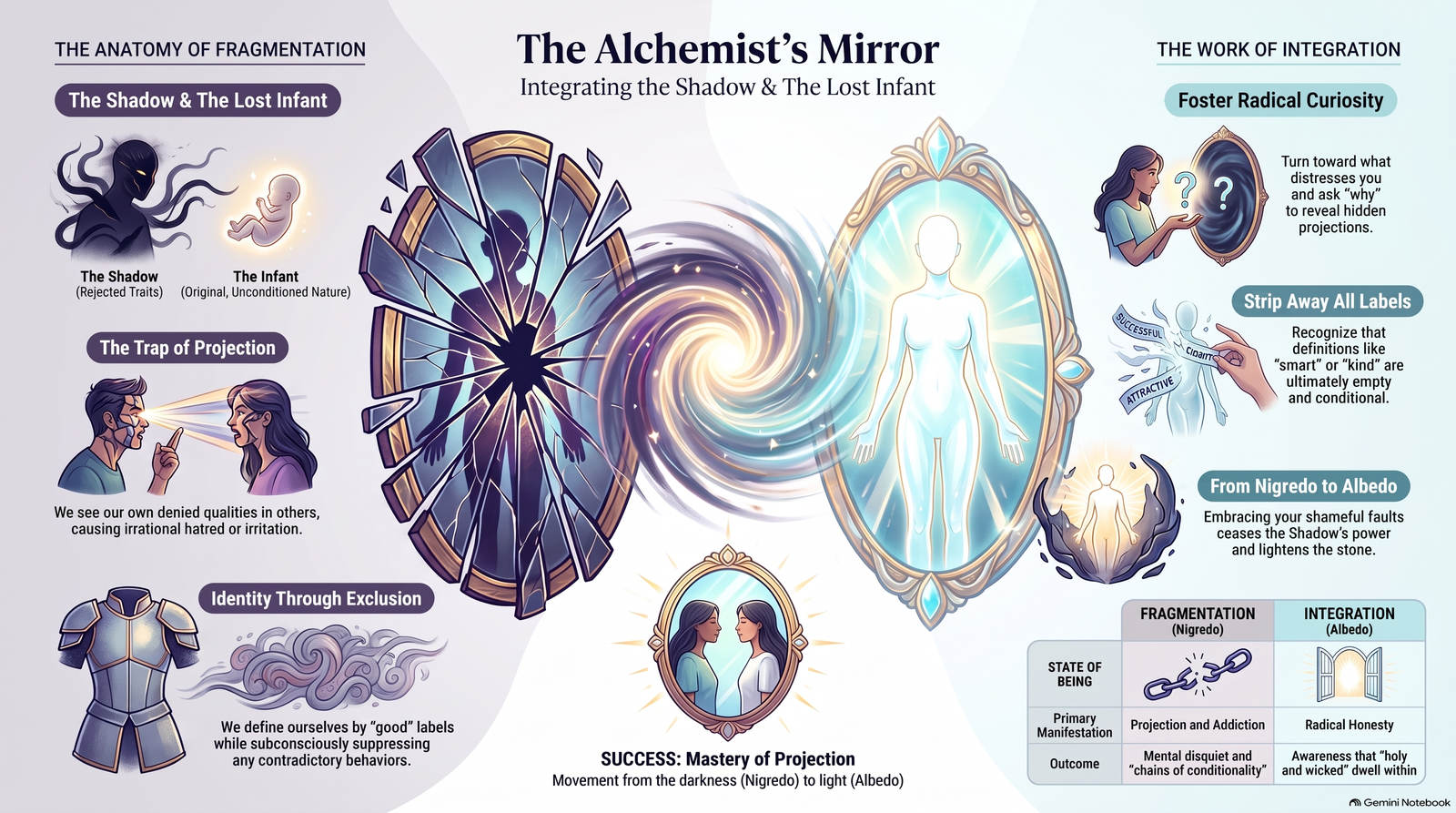
The Shadow & The Lost Infant asks how ordinary identity-building can exclude qualities that do not fit a preferred self-image. The chapter uses the Jungian Shadow to describe rejected traits and projection to describe the tendency to encounter those traits in others. Its practical movement is from judgement towards curiosity: irritation may become an occasion to examine one’s own assumptions rather than immediate proof about another person.
The “lost infant” is the author’s image for a simpler, less defended awareness set aside during adaptation to adulthood. Within Nigredo, both figures serve an alchemical movement towards integration. They are symbolic and psychological lenses, not literal inner beings, clinical diagnoses or a claim that every childhood difficulty has one cause.
Video guide
Can what is rejected be met without being obeyed?
The recording begins by turning Jung’s familiar image of “making the darkness conscious” into a demanding question. If a functioning adult identity is assembled by selecting acceptable qualities and excluding others, how can the person become less divided without collapsing into shame or acting out whatever has been disowned? The video names that division Nigredo: not proof of pathology, but the point at which a polished self-description no longer explains the conflicts beneath it.
The Shadow is presented as the accumulation of qualities that contradict the conscious story—greed behind an identity of generosity, dependency behind fierce independence, or anger beneath compulsory niceness. Projection then moves the enquiry into relationship. A disliked quality may be attributed too readily to someone else, and the intensity of the reaction can reveal something worth examining. Yet intensity is not evidence that every criticism is projection: another person may genuinely behave badly, and discernment, boundaries and accountability remain necessary.
The discussion’s most useful method is “radical curiosity”. Rather than declaring oneself good or bad, the viewer is invited to ask what a reaction protects, which cherished label it threatens and whether the excluded opposite also belongs to the range of human possibility. The video’s image of an “inner parliament” captures integration well: aggression, dependency or vulnerability may be acknowledged without being given control. Wholeness is therefore different from indulgence, moral equivalence or the removal of restraint.
The lost infant extends the argument beyond rejected darkness. It represents openness and vulnerability relinquished when safety or approval seemed to require an armoured adult personality. The video connects this with the Fisher-King wound and describes a gradual “tracking back” through acquired labels. This is an evocative interpretation, not a standard Jungian diagnosis or a universal account of childhood development. Childhood adaptation varies widely, and recollection does not by itself establish a hidden betrayal or trauma.
The movement from Nigredo towards Albedo is finally described as reduced reactivity: conflict has fewer hidden hooks because contradictory qualities can be recognised within oneself. The recording sometimes frames despair as part of an awakening process. That should be read cautiously. Depression, hopelessness, hallucinations and threatening voices have many possible causes and are not reliable signs of spiritual progress; persistent or severe symptoms merit appropriate professional assessment and support.
The practical challenge is modest but exacting: hold a self-image lightly enough to notice what it excludes, meet discomfort with curiosity, and retain ethical judgement while withdrawing unnecessary projection. The aim is not perfection or a return to literal infancy. It is a less defended participation in ordinary life.
Argument map
How the discussion moves
Adaptation divides experience
A workable adult identity is built by favouring some qualities and pushing incompatible ones outside the preferred self-story.
The Shadow gathers the excluded
Jungian language gives symbolic form to traits, affects and possibilities that conscious identity is reluctant to acknowledge.
Projection relocates the conflict
What cannot be admitted inwardly may seem especially vivid in another person, although not every accurate criticism is projection.
Curiosity interrupts reaction
Asking what a response protects creates space between an emotional trigger and the judgement or action that usually follows.
Human possibility widens
Recognising capacities for generosity and selfishness weakens moral self-idealisation without erasing responsibility or difference.
The lost infant names another loss
The video imagines original openness as protected beneath the adult defences once built for safety, approval and belonging.
Integration reduces hidden hooks
Contradictory qualities can be acknowledged and governed, allowing conflict to be met with less compulsion and projection.
Albedo appears as lightening
The next stage is anticipated not as perfection, but as a gradual lessening of inner warfare and defensive reactivity.
Book and video
The source and its expansion
The written chapter establishes
Self-defining labels, confirmation bias, the Shadow, projection, curiosity, the lost child and the symbolic lightening from Nigredo towards Albedo.
The video expands
The social pruning involved in adulthood, an “inner parliament”, the Fisher-King wound, midlife crisis and the difference between perfection and wholeness.
The synthesis proposes
A defended virtue often conceals an excluded contrary, while integration makes that contrary conscious without granting it authority.
The evidence boundary
Shadow work can be a reflective framework; it does not prove hidden trauma, explain every conflict or replace clinical assessment and care.
Clickable chapters
Navigate the video
All supplied markers ascend correctly and fall within the verified final duration of 40:21.
Terms for orientation
Expandable glossary
Shadow
Projection
Lost infant
Integration
Confirmation bias
Duality
Radical curiosity
Fisher-King wound
Nigredo
Albedo
Continue within the website
Related course pathways
- 1.1.9 The Rebis & Rejection of Identity The preceding chapter questions fixed identity and prepares the movement from rejected opposites towards psychological integration.
- Mythos — Part One of Nigredo The section landing page for all twelve chapters.
- 1.1.11 The Dark Night of the Soul The next chapter examines spiritual darkness while requiring care not to confuse contemplative language with mental illness.
- The Shadow A wider course essay on the Jungian language of rejected qualities and their integration.
- Nigredo The course landing page.
Context beyond the course
External reference points
- The Society of Analytical Psychology — resources on Jungian psychology A professional UK resource for locating the chapter’s Shadow language within the wider field of analytical psychology rather than treating it as a universal clinical model.
- APA Dictionary of Psychology — projection A concise psychological reference for comparing the established term with the video’s broader use in ordinary conflict and self-examination.
- NHS — raising low self-esteem Grounded guidance on examining self-beliefs, childhood influences and self-criticism without interpreting distress as an alchemical necessity.
A two-minute reflection
From accusation to information
Recall one minor irritation from an ordinary day—not a dangerous, abusive or traumatic situation. Name the observable event without judging the person. Then ask: “Which part of my self-image felt challenged, and what else might explain my reaction?”
Finish by naming one boundary or practical response that remains appropriate. The purpose is to add self-knowledge to judgement, not to excuse harmful conduct or assume every criticism is projection.