
Dialogues IV · Episode 05
Your Age Is Not a Diagnosis | Dialogues IV
Age changes the field of possibility—but it should never become a one-word explanation that ends curiosity.
Watch here, or continue on YouTube with comments. Open on YouTube ↗
The central question
When does age help clinical judgement—and when does it quietly replace it?
A pain that would provoke investigation in a younger adult may be met in later life with a shrug: “It’s just your age.” This episode asks what is lost when chronological age, a genuine risk factor, is allowed to stand in for a specific account of what is happening in a particular body.
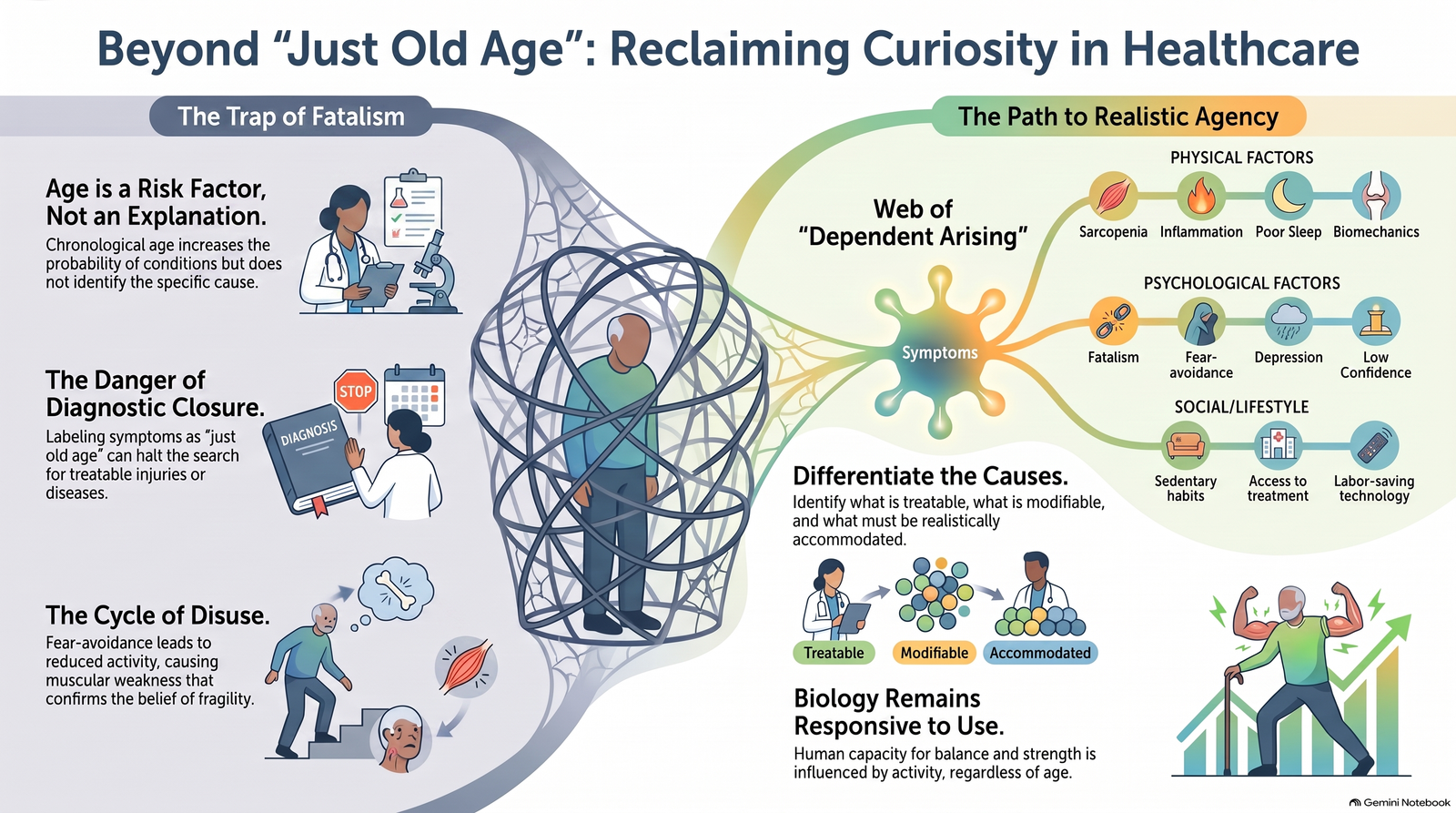
The argument is not that biological ageing is unreal. Nor does it claim that pain, disease or disability can be reversed by belief. Its target is diagnostic closure: the moment a broad probability hardens into a verdict and curiosity gives way to resignation. Osteoarthritis, sarcopenia, inflammatory disease, previous injury, sleep disturbance, medication effects and reduced conditioning are not interchangeable. Each has its own causes, limits and possible responses.
The discussion then examines how language may help shape what happens after a consultation. Research on age stereotypes suggests associations between more positive self-perceptions of ageing and later health outcomes, while nocebo research shows that negative expectation can amplify symptoms in some settings. Fear of pain can also encourage avoidance; avoidance may reduce capacity and confidence; and ordinary movement can then become harder, appearing to confirm the original belief in inevitable decline.
Dependent arising supplies the philosophical lens. “Old age” is treated not as a single, self-existing cause but as a name placed over a changing web of biological, psychological and social conditions. Some factors are treatable, some modifiable, some require adaptation and some must be accepted. The practical challenge is to distinguish them without promising total control—and without surrendering realistic agency too soon.
How to read this episode: the scientific studies discussed do not show that attitude alone determines lifespan, pain or disability. Levy’s longevity finding is observational and cannot establish a single causal pathway; nocebo effects are context-dependent; and Benedetti’s experiments support a role for cholecystokinin in experimentally induced nocebo hyperalgesia without proving that a clinician’s words directly create structural disease. The Buddhist account of dependent arising is used as an interpretive model, not as an established biomedical mechanism. Persistent or changing pain, weakness or loss of function deserves appropriate professional assessment.
Argument map
Six movements through the episode
The unequal consultation
The same symptom may invite a search for mechanism in youth but be attributed more quickly to age in later life.
Risk is not explanation
Age alters probability, yet it does not by itself identify the particular injury, disease or conditioned process causing a symptom.
Stereotypes enter the body
Cultural expectations about ageing may influence stress, behaviour and health, although the research does not reduce biology to mindset.
Expectation can amplify pain
Nocebo research shows that anticipated harm can worsen experienced symptoms through active psychological and physiological processes.
Avoidance becomes evidence
Fear can reduce movement; reduced activity can weaken capacity; greater difficulty may then seem to prove that decline was inevitable.
Differentiate the web
Dependent arising reframes the label as interacting conditions, reopening the question of treatment, modification, accommodation and acceptance.
Navigate the discussion
Chapter points
- 00:00Your Age Is Not a Diagnosis
- 00:30When “It’s Just Your Age” Replaces a Diagnosis
- 04:30Ageing Stereotypes and the Biology of Expectation
- 11:05The Nocebo Effect: When Expectation Amplifies Pain
- 15:30Anxiety, CCK and the Neurochemistry of Suggested Harm
- 20:45Fear of Movement, Disuse and Self-Fulfilling Decline
- 21:45Dependent Arising and the Causes Behind “Old Age”
- 22:55Age, Agency and the Refusal to Surrender Curiosity
Key language
Glossary
Age as a risk factor
Chronological age is associated with changing probabilities for many conditions and with real biological changes. A risk factor helps estimate what may be more likely; it does not, by itself, identify the mechanism responsible for a particular person’s symptom. The episode argues for using age as context without allowing it to become the whole explanation.
Diagnostic closure
The ending of diagnostic inquiry after an explanation has been accepted. Closure is necessary in ordinary practice, but it can become premature when a broad label such as “old age” discourages attention to treatable illness, contributing factors or useful adaptation. The episode criticises premature closure, not every clinical judgement that a symptom reflects age-related change.
Age stereotype embodiment
Becca Levy’s theory that age stereotypes are absorbed from culture, become self-relevant as people grow older and can influence health through psychological, behavioural and physiological pathways. Evidence includes longitudinal associations, but these findings do not mean that individual beliefs are the sole cause of health outcomes or that illness reflects a failure to think positively.
Nocebo effect
The worsening of symptoms or adverse experiences associated with negative expectations and contextual cues. Nocebo effects can be physiologically real and are not the same as pretence. Their size and mechanism vary across settings, and they do not imply that expectation alone produces every symptom or causes structural disease.
Hyperalgesia
Increased sensitivity to a stimulus that is normally painful. The episode discusses experimentally induced nocebo hyperalgesia: pain amplification associated with an expectation of greater pain. This is different from claiming that pain has no bodily basis, and it should not be used to dismiss a person’s symptoms as “all in the mind”.
Cholecystokinin (CCK)
A peptide with roles in the digestive and nervous systems. Benedetti and colleagues found that the CCK antagonist proglumide reduced experimentally induced nocebo hyperalgesia, supporting a mediating role for CCK-related pathways. The episode’s language of a verbal suggestion “creating CCK” is a vivid simplification rather than a direct measurement of a doctor’s words turning into disease.
Fear-avoidance model
A model of chronic pain in which catastrophic interpretation can lead to pain-related fear, avoidance and reduced activity, contributing in some people to disability, distress and physical deconditioning. It is a model of one possible pathway, not a judgement that all reduced activity is irrational or self-imposed.
Kinesiophobia
Excessive and debilitating fear that movement or activity will cause pain or reinjury. The term is used in pain research and rehabilitation, but caution is needed: avoiding movement may sometimes be appropriate, and changes in activity should reflect the person’s condition and qualified clinical advice.
Disuse and deconditioning
Losses in strength, endurance, balance or functional capacity associated with reduced use or activity. These changes may interact with illness, pain, environment and social circumstances. The episode uses disuse to challenge fatalism, not to blame people whose activity is constrained by disability, poverty, unsafe surroundings, caring duties or inadequate treatment.
Dependent arising
The Buddhist principle that phenomena arise through causes and conditions rather than from a single independent essence. Here it offers a way to analyse “old age” as a changing web of biology, behaviour, expectation, environment and access to care. This is a philosophical interpretation, not a substitute for biomedical investigation.
Śūnyatā (emptiness)
In Mahāyāna Buddhism, emptiness is the absence of independent, intrinsic existence. It does not mean that pain, ageing or disability are imaginary. Applied cautiously here, it means that the label “old age” does not exhaust the many conditions producing a person’s present experience.
Realistic agency
The capacity to participate in care without pretending to control every outcome. The episode divides possible responses into what may be treated, what may be modified, what can be accommodated and what must be accepted. Agency therefore includes adaptation and informed acceptance as well as intervention.
A question to carry forward
What has the label left unexplained?
The next time you hear “it is just age”—whether from another person or in your own inner speech—pause before either rejecting or accepting it. Ask four quieter questions: What specific process is actually known? What might be treatable? What might be modifiable or accommodated? And what may need to be accepted? The aim is not to manufacture optimism or self-diagnose. It is simply to keep probability from becoming a verdict before the relevant causes have been considered.
Continue the series