
Nigredo · Mythos · Chapter 12 of 48
1.1.12 The Seed of Nirvāṇa
If the Dark Night loosens an old identity, what—if anything—remains available beneath the meanings that have fallen away?
Watch the chapter discussion
What Happens After the Dark Night of the Soul
The book
The chapter in brief
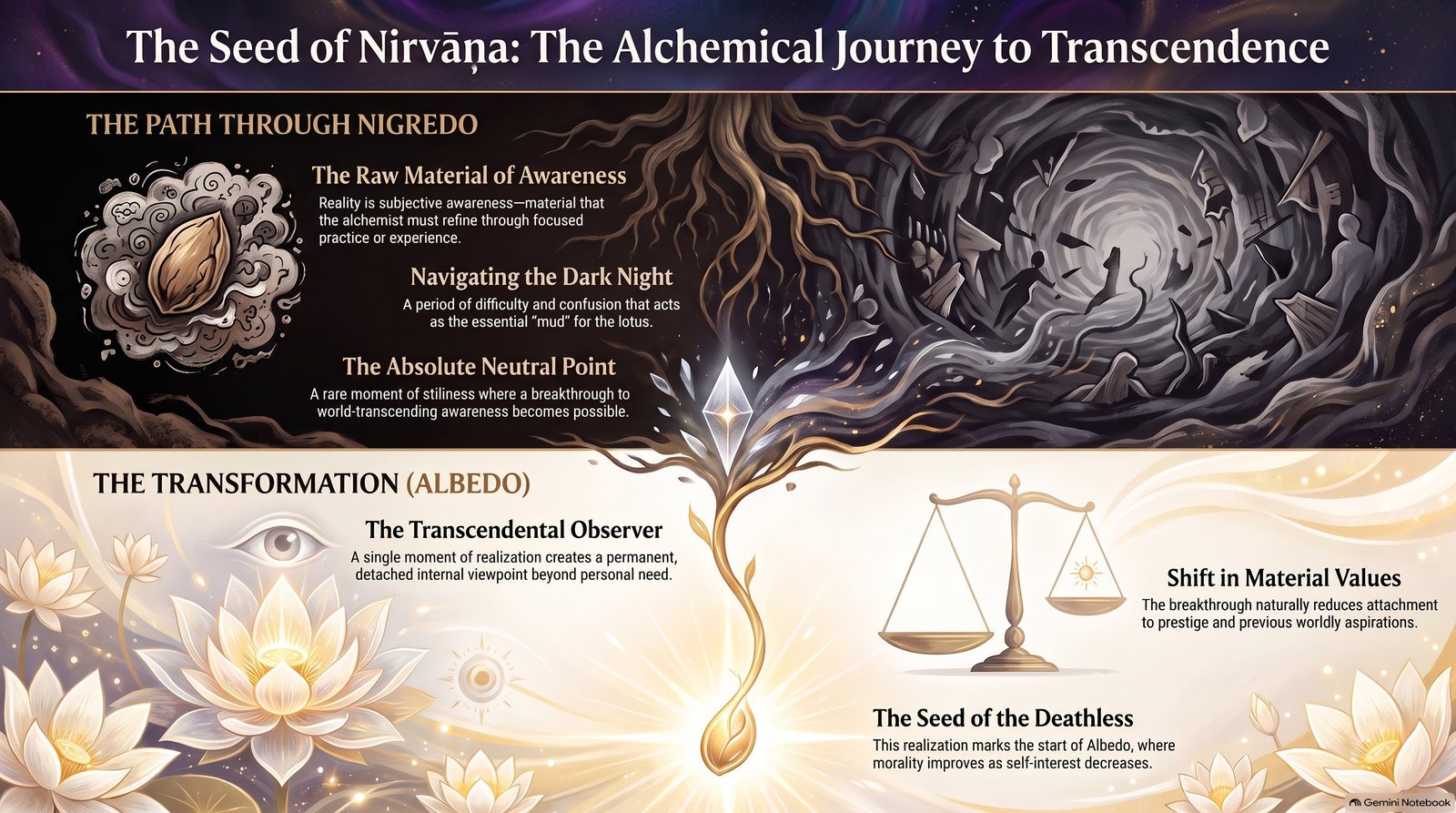
The Seed of Nirvāṇa brings the Mythos section of Nigredo to its threshold. The raw material is no longer imagined as something outside the practitioner: it is subjective awareness itself. The chapter proposes that, through meditative tranquillity, sudden insight or an exhausting crisis, awareness may briefly reach a neutral point that changes how experience is interpreted.
That moment is called the seed of the deathless and the beginning of Albedo. Its later fruits are described as a less self-interested viewpoint, reduced attachment to status, clearer moral orientation and a more equanimous relation to the world. These are claims within the author’s alchemical synthesis. They should not be treated as a universal sequence, a scientific account of consciousness or confirmation that a powerful experience constitutes Buddhist attainment.
Video guide
From raw awareness to the seed of the deathless
The recording begins with the lotus: a clean flower rooted in mud. Nigredo is not presented merely as an obstacle before transformation, but as its material. The “raw material” is the unbidden field of thoughts, sensations, habits and reactions from which the work must begin. The philosopher’s stone is therefore shifted from laboratory substance to inner symbol—an explicitly modern psychological and spiritual reinterpretation of alchemy.
The discussion then asks what counts as reality. It usefully distinguishes the world from anyone’s experience of it: pain, attention, mood, memory and interpretation make an event personally lived. But the chapter’s stronger sentence that objective reality is a myth remains a philosophical position, not an empirical result. Likewise, private experience is not the same as solipsism. In philosophy, solipsism is the much stronger problem of whether anything beyond one’s own mind can be known or meaningfully affirmed.
The chapter offers three routes to an “absolute neutral point”: samatha or tranquillity practice, brilliant insight and terrifying experience. The video renders this point as the still hub of a turning wheel. A fleeting change in perspective may indeed be memorable and consequential; the further claim that it provides permanent access to a timeless observer belongs to the course’s contemplative map and cannot be inferred from intensity alone.
After the glimpse comes integration. The account is deliberately less glamorous here: mood and conduct may take weeks or months to change, familiar ambitions may lose their force, and the resulting interval can be confusing. The internal observer is presented as a less reactive viewpoint from which choices are less dominated by personal need. “Naturally moralistic” is best read as the chapter’s ethical aspiration, not a guarantee that insight makes someone wise, harmless or beyond correction.
The video also expands a warning about psychoactive drugs. It compares an induced peak experience with arriving on a mountain by helicopter rather than developing the capacities needed for the climb. The analogy communicates the importance of preparation and integration, but psychedelic states should not simply be equated with Buddhist jhāna, and the transcript’s proposed pathway from breakthrough to addiction is not an established general mechanism. Substances vary considerably, risks depend on person, setting and drug, and vulnerable people may experience serious destabilisation.
Finally, the seed marks a symbolic passage towards Albedo. “Nirvāṇa”, “the deathless”, karma and the fetters are drawn into an alchemical vocabulary of lessened grasping. In Buddhist traditions these terms have specific and varied doctrinal settings. The video’s “indifference” is most charitable when understood as equanimity—reduced compulsive reactivity while care and discernment remain—not apathy, neglect or emotional numbing.
Argument map
How the discussion moves
Awareness is the raw material
The work begins with the unruly mixture of perception, thought, emotion and conditioning already present.
Experience is perspectival
Events are encountered through a particular body, history and interpretation, so lived realities are never identical.
Meaning alters experience
Changing an interpretation can change a person’s response without changing every external fact or making reality optional.
A neutral point interrupts habit
Meditation, insight or crisis is said to disclose a brief viewpoint less entangled in immediate attraction and aversion.
The glimpse becomes an observer
The chapter interprets the event as leaving a durable reference point from which self-interest can be seen more clearly.
Integration takes time
Values and motivation may reorganise slowly; intensity does not remove confusion or ordinary developmental work.
The seed changes ethical direction
Reduced grasping is expected to lessen reactive conduct and make wiser action more available.
Albedo begins, not ends, the work
The Mythos section closes at a threshold: the seed has appeared, but it still requires refinement and testing in life.
Book and video
The source and its expansion
The written chapter establishes
Subjective awareness as raw material, a momentary world-transcending breakthrough, the internal observer and the seed that begins Albedo.
The video expands
The lotus and mud, white-bear experiment, virtual-reality headset, still wheel, traffic drone, mountain helicopter and theatre metaphors.
The synthesis proposes
A brief release from habitual meaning can become an ethical reference point, reducing attachment and changing how ordinary events are lived.
The evidence boundary
Phenomenology does not establish solipsism; intensity does not prove transcendence; psychedelics are not equivalent to jhāna; and insight does not guarantee morality.
Clickable chapters
Navigate the video
The nine supplied markers ascend correctly and fit within the supplied final runtime of 38:39.
Terms for orientation
Expandable glossary
Raw material
Philosopher’s stone
Subjective experience
Solipsism
Samatha
Jhāna
Nirvāṇa / Nibbāna
Internal observer
Karma
Albedo
Equanimity
Continue within the website
Related course pathways
- 1.1.11 The Dark Night of the SoulThe preceding chapter examines doubt, lost meaning and the loosening of a defended identity.
- Mythos — Part One of NigredoThe completed twelve-chapter section in which the course’s symbolic journey is established.
- 1.2.1 The RealitiesThe next course chapter begins the Dharma section by examining reality and perception through a different lens.
- NigredoThe course landing page and wider structure of the blackening.
- Nigredo — the bookThe complete volume, chapter contents, study material and publication details.
Context beyond the course
External reference points
- Internet Encyclopedia of Philosophy — Solipsism and the Problem of Other MindsA philosophical account separating the privacy of experience from the stronger solipsistic doctrine and examining its conceptual difficulties.
- SuttaCentral — Saṃyutta Nikāya 43.14A short early Buddhist text using “the deathless” for the unconditioned; useful context for the chapter’s borrowing of this traditional epithet.
- Stanford Encyclopedia of Philosophy — BuddhaAcademic orientation to early Buddhist accounts of suffering, non-self, karma, meditation and nirvāṇa.
- US National Institute on Drug Abuse — Psychedelic and Dissociative DrugsA research overview of effects, possible therapeutic uses and risks, including uncertainty and vulnerability to psychiatric destabilisation.
- NHS — Overview of psychosisPlain-language information about hallucinations, delusions, disordered thinking and when to seek assessment and support.
A grounded reflection
Distinguish the event from the meaning
Choose one ordinary, non-urgent event from the past week. Write two sentences: “What happened that another person could have observed?” and “What meaning did I add?” Then name one alternative interpretation that is both kinder and consistent with the known facts.
Notice whether the alternative changes your bodily or emotional response. The aim is not to declare the event unreal, suppress justified concern or manufacture positivity. It is to see where interpretation participates in experience while practical reality and responsibility remain intact.