
Nigredo · Mythos · Chapter 9 of 48
1.1.9 The Rebis & Rejection of Identity
If identity is assembled from history, culture and opposition, what remains when its fixed boundaries are no longer defended?
Watch the chapter discussion
Why Your Identity Isn’t Real
The book
The chapter in brief
The Rebis & Rejection of Identity turns the enquiry inward. It asks how far a person’s apparently solid identity is made from culture, personal history, habits and the labels through which experience is organised. Nigredo becomes the recognition that the conditioned self cannot, by its usual strategies, supply the freedom it seeks.
The Rebis—the alchemical figure in which contrasted qualities share one body—serves as an image of reconciliation. The chapter relates this to dependent opposites, the Buddhist middle way, the Shadow and a choice between familiar conditionality and an unknown form of integration. It offers a contemplative synthesis, not a historical consensus about the emblem or a demand to erase ordinary personhood.
Video guide
What changes when the self is treated as a construction?
The recording begins with the Rebis as a deliberately unsettling image: two crowned heads, solar and lunar associations and one exposed body. It reads the emblem as a map of completeness, then immediately adds the cost. Integration cannot occur while the person treats one familiar, socially approved identity as their permanent essence.
Identity is first described as a costume woven from biography and culture. Name, work, preferences, status and social approval are real features of conventional life, but they vary with circumstance and do not amount to an unchanging core. The claim that identity “isn’t real” is therefore best understood as a challenge to permanence and independence—not as a denial that persons, histories, duties or consequences exist.
The discussion distinguishes “Apparent Reality”, the shared social field of value and recognition, from the inward examination of “Subjective Reality”. When achievement and validation become hollow, the alchemist turns towards the reactions through which the self continuously protects itself. The video calls this a “condition of selfness”. Its language can sound morally absolute; a gentler reading notices self-protection without turning the enquiry into hostility towards oneself.
Nigredo then appears as a crisis in the ego’s problem-solving authority. The video stresses discipline and the Noble Eightfold Path, but its summary is selective: in Buddhism, the path is broader than self-correction and conventionally includes wisdom, ethical conduct and mental cultivation. Nor does Buddhist not-self require a person to become socially inert or indifferent to ordinary responsibilities.
The examples of rich and poor, up and down, good and bad expose the relational character of many concepts. The video sometimes moves too quickly from this linguistic dependence to the claim that reality itself is a seamless unity. The first point is easy to demonstrate; the second is a metaphysical or contemplative interpretation. The Rebis holds the tension rather than supplying empirical proof of it.
This distinction also matters for the emblem’s gendered imagery. In early modern alchemy, the joined masculine and feminine figure belongs to a historical symbolic vocabulary. The chapter uses it to unsettle one-sided ideals and represent reconciliation. It should not be converted into a fixed account of contemporary sex, gender, personality or psychological health, and “hermaphroditic” here describes inherited iconography rather than a person.
The Diamond Sūtra provides the video’s sharpest comparison. Its recurrent pattern refuses to reify names and categories: beings are to be helped without grasping a permanent being or self. That supports an enquiry into conceptual fixation, but the recording’s formula that a being both “exists and does not exist” is an explanatory paraphrase, not a direct quotation or a complete statement of Buddhist two-truths philosophy.
The final image is a door that can be knocked upon but not forced open. This moves the chapter from analysis to surrender: preparation can question conditioning and expose contradiction, yet the ego cannot possess its own transcendence as another achievement. The claim that the door can never close expresses the author’s spiritual model; experiences of insight in practice vary and should not be measured against a dramatic point-of-no-return narrative.
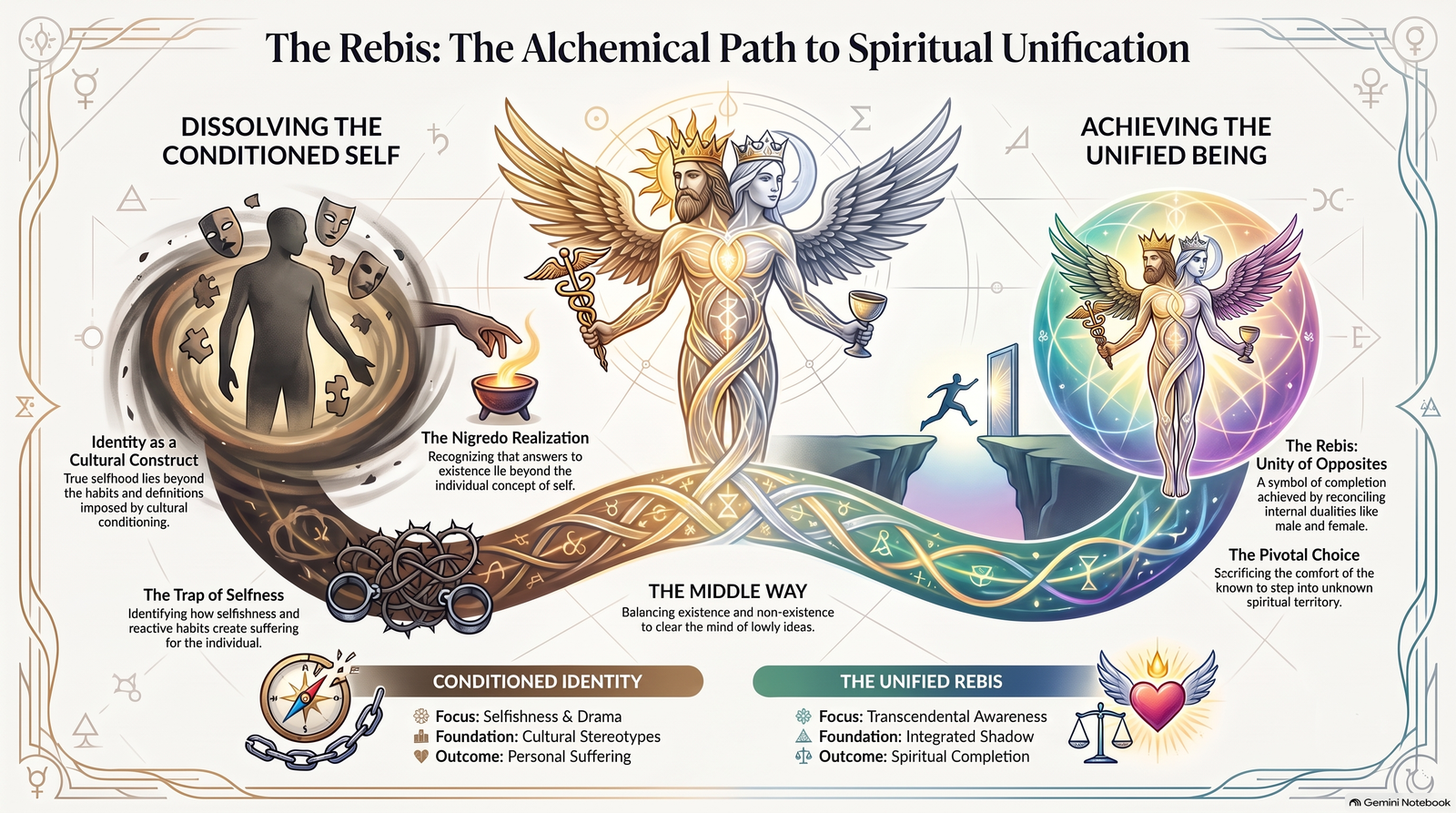
Argument map
How the discussion moves
The emblem makes a demand
The Rebis presents contrasted qualities within one figure and turns rejection into the problem to be examined.
Identity loses solidity
Culture, biography, roles and preferences are recognised as conditions of identity rather than proof of a permanent essence.
Attention turns inward
External validation becomes less persuasive, revealing the reactions through which the self maintains its position.
Nigredo exposes the impasse
The conditioned self cannot simply add another achievement and thereby move beyond its own conditioning.
Opposites prove relational
Rich and poor, up and down, self and other acquire meaning through contrast and dependence.
The Rebis reframes completion
Wholeness is imagined as a capacity to relate divided qualities, not the victory of one preferred pole.
The middle way loosens fixation
Buddhist language helps question reified beings without collapsing conventional life into simple non-existence.
The door cannot be conquered
Practice prepares the ground, while transformation remains something the acquisitive self cannot force or own.
Book and video
The source and its expansion
The written chapter establishes
Conditioned identity, “selfness”, the interdependence of opposites, the Rebis, the Diamond Sūtra comparison and the unopenable door.
The video expands
A modern account of social validation, egoic protagonism, Shadow rejection, the Fisher-King connection and “karma-less” influence.
The synthesis proposes
A defended identity creates conflict by excluding its opposites; integration begins when labels can be used without being mistaken for essence.
The evidence boundary
The emblem does not prove a universal psychology, non-duality, a fixed gender model or an irreversible spiritual transformation.
Clickable chapters
Navigate the video
All supplied markers ascend correctly and fall within the verified final duration of 34:55.
Terms for orientation
Expandable glossary
Rebis
Conditioned identity
Duality
Middle way
Diamond Sūtra
Shadow
Noble Eightfold Path
Multiplication
Continue within the website
Related course pathways
- 1.1.8. The Fisher-King Wound The preceding chapter considers emotional armour, division and the wound for which the Rebis becomes a symbolic response.
- Mythos — Part One of Nigredo The section landing page for all twelve chapters.
- 1.1.10 The Shadow & The Lost Infant The next chapter follows rejected identity into the Shadow and the image of the lost infant.
- Nigredo The course landing page.
Context beyond the course
External reference points
- University of Glasgow Library — an alchemical manuscript and the Rosarium philosophorum Historical context for the influential sixteenth-century emblematic alchemical work and its later reception.
- 84000 — The Sūtra on the Perfection of Wisdom “The Diamond Cutter” A complete scholarly translation of the Diamond Sūtra for checking the chapter’s Buddhist comparison against the source text.
- Robert A. Johnson — He: Understanding Masculine Psychology The Jungian Fisher-King interpretation cited by the preceding chapter, useful for tracing the course’s transition from wound to integration; borrowing controls may apply.
A three-minute reflection
Use the label; loosen the grip
Choose one harmless sentence you use to define yourself: “I am the responsible one”, “I am rational”, “I am independent” or another label of your own. Ask what the label helps you do, what contrasting quality it makes difficult to admit, and whether both qualities can be present without either becoming your whole identity.
Keep the exercise ordinary and specific. The aim is not to destroy a functioning sense of self, but to notice when a useful description has become a defended boundary.