
Nigredo · Dharma · Chapter 13 of 48
1.2.1. The Realities
We never meet reality without perception. But does that make the world a construction—or show why we must distinguish experience from what experience is about?
Watch the chapter discussion
Is Reality Just Perception?
The book
The chapter in brief
The Realities opens Nigredo’s Dharma section by moving from mythic narrative to a technical map of experience. It proposes that what feels real arises through perception and awareness, then distinguishes the familiar world of people, objects and concepts—“apparent reality”—from the conditioned processes through which experience occurs.
The chapter adopts Theravāda Abhidhamma as its principal chassis: a detailed analysis of consciousness, mental factors and material phenomena intended to help identify the conditions of suffering and the route beyond them. The map is practical and selective, not a final description of the universe. The course’s further alchemical correspondences are Dr Simon Robinson’s interpretive synthesis and should not be mistaken for claims made by Buddhist texts, historical alchemists or modern physics.
Video guide
The experience of a world—and the map beneath it
The recording starts with a deceptively direct question: how do you know what is real? Its governing formula—reality as perception plus awareness—centres the first-person fact that anything experienced is experienced from somewhere. Colour, solidity, meaning and threat do not arrive as an uninterpreted copy of the world; they appear through sensory and cognitive processes.
That insight does not by itself establish that objective reality is a myth. Philosophers disagree about whether perception gives direct access to mind-independent objects, represents them indirectly or should be understood in another way. The possibility of illusion and hallucination creates a serious problem for theories of perception, but a compelling experience can be subjectively real while its apparent object is absent. “This is happening to me” and “this accurately reports the shared environment” are different judgements.
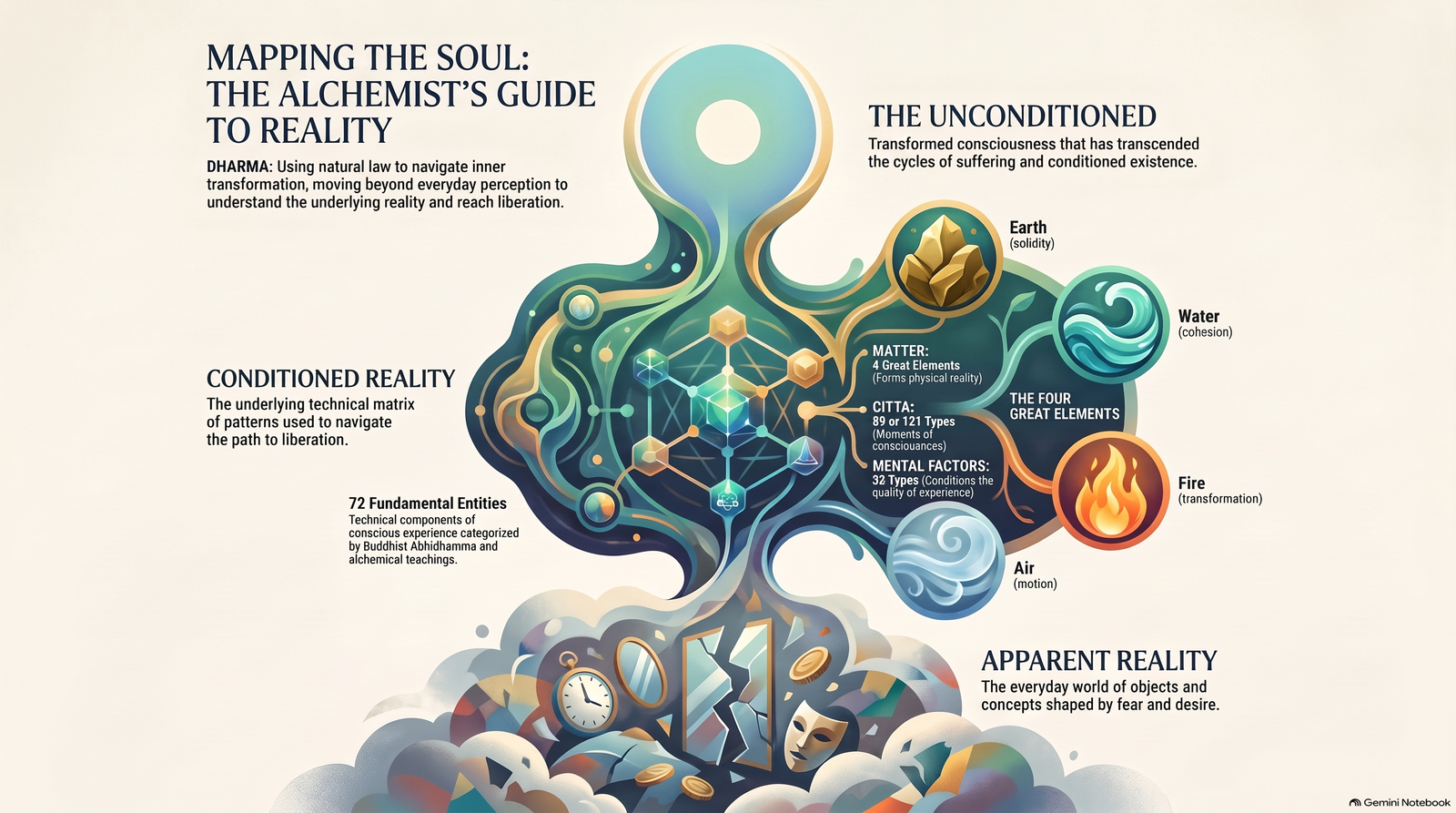
The apple and the spoon illustrate apparent reality: the useful, emotionally charged world organised into things, persons and concepts. Calling the apple a construction need not deny fruit, atoms or consequences. It draws attention to the mind’s rapid synthesis of colour, shape, texture, memory and language into a familiar object. The computer-interface metaphor is helpful if it remains a metaphor; neither the chapter nor The Matrix demonstrates that existence is literally a simulation.
Conditioned reality is introduced as the underlying network of events and relations from which those familiar appearances arise. Here the video turns towards Abhidhamma classifications: citta or moments of consciousness, cetasikas or associated mental factors, and rūpa or material phenomena. The numerical schemes belong to particular Theravāda analytical traditions. They are not a periodic table confirmed by neuroscience, and “ancient quantum physics” is an analogy in the recording rather than a historical or scientific equivalence.
The four great elements are likewise qualities or functions, not the modern chemical elements: earth concerns hardness or resistance, water cohesion, fire temperature and maturation, and air motion or pressure. The video’s language of solidity, binding, transformation and movement captures part of this functional reading. Terms such as entropy, energy systems and thermodynamics are modern comparisons and should not be read back into the early Buddhist sources.
The staircase then moves from ordinary sense-sphere experience towards refined absorption and formless attainments. Absorption in music, sport or coding can illuminate narrowed and sustained attention, but it is not automatically the same as Buddhist jhāna. More importantly, the unconditioned is not simply the highest level of the staircase. In Buddhist accounts, Nibbāna is not another conditioned sphere of consciousness or an enlarged object within the same system.
The philosopher’s stone finally becomes the alchemist’s own capacity to know and reinterpret experience. This is the course’s modern contemplative use of an alchemical image, not a neutral definition of the stone across alchemical history. Its practical force is modest but valuable: patterns can be examined, reactions need not be identities, and a map earns its place only when it reduces confusion rather than furnishing a more elaborate conceptual prison.
Argument map
How the inquiry unfolds
Experience is first-person
Whatever is known appears through perception and awareness from a situated point of view.
Perspective is not proof of unreality
Mediation complicates claims to certainty without demonstrating that no mind-independent world exists.
Apparent reality organises a world
Sensations, memories and concepts are gathered into useful objects, people and meanings.
Conditioning lies beneath appearance
The course looks below familiar things towards the changing processes that make experience possible.
Abhidhamma supplies a chassis
Consciousness, mental factors and material qualities provide a Buddhist analytical vocabulary.
The elements name functions
Earth, water, fire and air describe resistance, cohesion, temperature and motion—not chemical substances.
Refined states remain conditioned
Concentrated and formless experience should not be collapsed into the unconditioned.
The map must serve release
Classification matters only insofar as it helps reveal attachment, reactivity and possible freedom.
Book and video
The source and its expansion
The written chapter establishes
Apparent and conditioned reality, sense and form spheres, Abhidhamma as a practical map, and subjective awareness as the course’s philosopher’s stone.
The video expands
The apple, computer interface, prison blueprint, periodic table, staircase, smoke and butterfly metaphors, along with the four great elements.
The synthesis proposes
Seeing experience as constructed and conditioned can loosen automatic identification and make deliberate transformation possible.
The evidence boundary
Subjectivity does not prove idealism; Abhidhamma is not quantum physics; flow is not necessarily jhāna; and Nibbāna is not simply a higher consciousness level.
Clickable chapters
Navigate the video
Seven supplied markers fit within the final runtime of 29:25. The supplied 33:40 marker was omitted because it falls 4:15 after the video ends; the final valid marker includes the concluding movement beyond the map.
Terms for orientation
Expandable glossary
Dhamma / Dharma
Apparent reality
Conditioned reality
Abhidhamma / Abhidharma
Citta
Cetasika
Rūpa
Four great elements
Sense, form and formless spheres
The unconditioned
Philosopher’s stone
Continue within the website
Related course pathways
- 1.1.12 The Seed of NirvāṇaThe preceding chapter closes Mythos by presenting a shift in perspective as the seed of the deathless.
- Dharma — Part Two of NigredoThe twelve-chapter section that develops the course’s technical map of mind, matter, conditioning and liberation.
- 1.2.2. The Matrix of Conditioned RealityThe next chapter examines the proposed architecture of conditioned experience in greater detail.
- 1.1.1 The LandscapeAn earlier introduction to subjective experience, interpretation and the course’s alchemical frame.
- NigredoThe course landing page and wider structure of the blackening.
Context beyond the course
External reference points
- Stanford Encyclopedia of Philosophy — The Problem of PerceptionA detailed philosophical guide to direct realism, illusion, hallucination and competing accounts of perceptual experience.
- Stanford Encyclopedia of Philosophy — AbhidharmaAn academic overview of the diverse Buddhist analytical traditions, their history and their accounts of experience.
- SuttaCentral — Mahāhatthipadopama Sutta (MN 28)An early Buddhist discourse that analyses the four great elements in the body and external world, providing canonical context for the chapter’s elemental vocabulary.
- NHS — Overview of psychosisPlain-language guidance on hallucinations, delusions, disordered thinking and when professional support may be needed.
A two-minute inquiry
Separate sensation, recognition and meaning
Choose an ordinary object near you. First name only what is immediately sensed: colour, edge, texture, weight, sound. Then notice recognition: the name of the object and what it is for. Finally notice meaning: whether it is yours, useful, attractive, irritating or connected with a memory.
The exercise does not prove that the object is unreal. It shows how quickly sensory qualities, concepts and personal significance arrive together as one apparently simple experience.