
Nigredo · Mythos · Chapter 1 of 48
1.1.1. The Landscape
Before transformation can be mapped, the chapter asks what we mean by reality, identity and the changing experience to which both names refer.
Watch the chapter discussion
What Is Reality, Really?
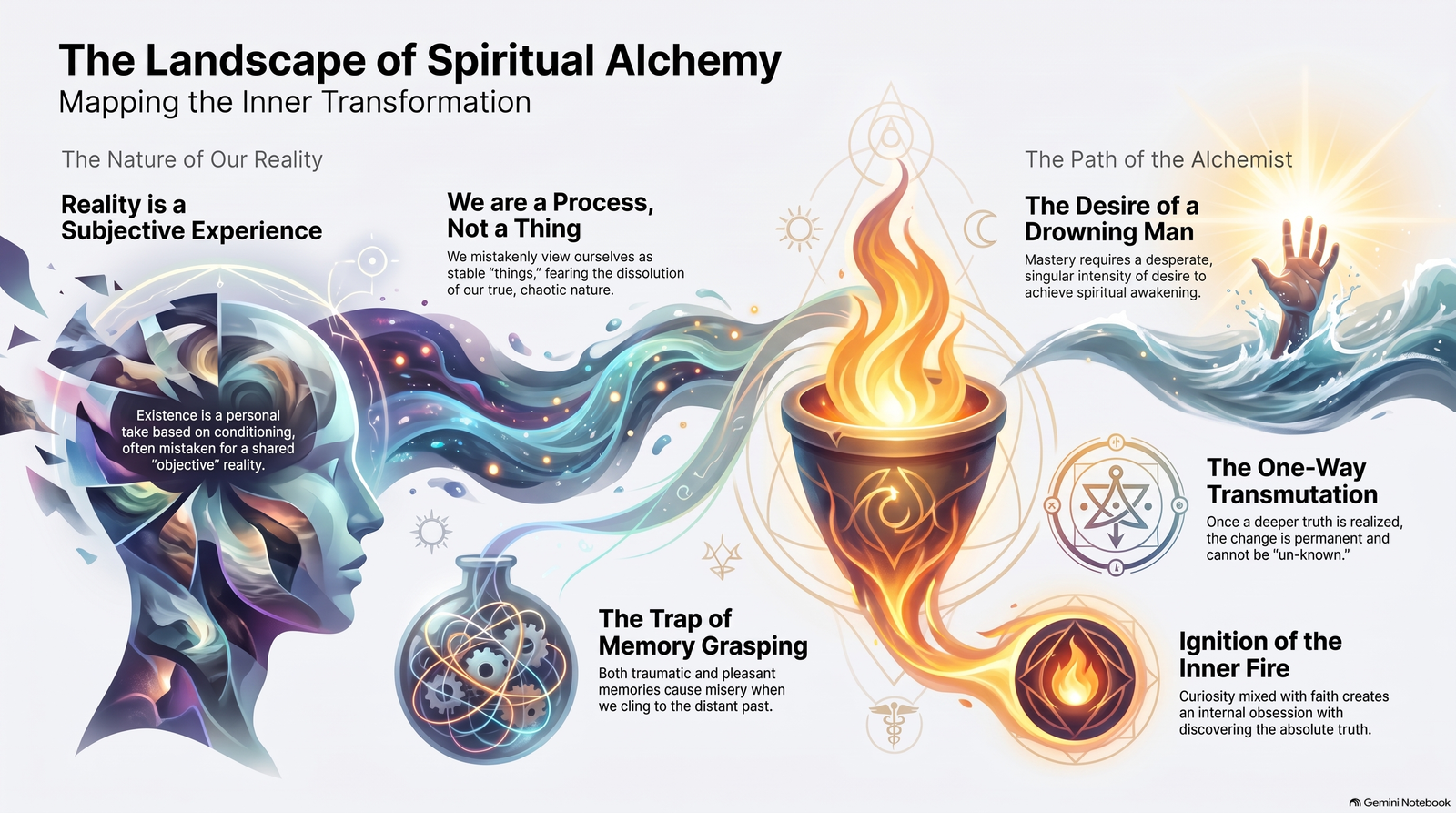
The book
The chapter in brief
The Landscape opens the Mythos section by defining spiritual alchemy as an inward work of transformation. It introduces three ideas that will recur throughout Nigredo: experience is always encountered from a first-person perspective; the apparently stable self may be better examined as an evolving process; and clinging to identity or memory can intensify suffering.
The chapter places alchemical language beside Buddhism, Gnosticism, Sufism and Kabbalah as part of Dr Simon Robinson’s personal synthesis. These traditions have distinct histories and should not be treated as interchangeable. Its severe imagery — the drowning person, the bleak terrain and the inner fire — is best read as a statement of existential seriousness, not as an instruction to seek suffering or abandon ordinary care.
Video guide
Is the self a thing, or an ongoing process?
The recording begins with the chapter’s deliberately extreme image: a person must want awakening as urgently as a drowning person wants air. The hosts initially resist its severity, then interpret it as a metaphor for the motivation required to question deeply established habits. From there, they distinguish the course’s spiritual alchemy from laboratory chemistry and present it as a modern model of inward transformation. The promised liberation — especially freedom from fear — belongs to the chapter’s spiritual horizon, not to a result that the video can guarantee.
The central enquiry concerns subjective experience. The example of colour asks how two people can use the same word while being unable to compare the private quality of what each sees. Language, measurement and shared practices allow us to coordinate, but the recording sometimes pushes this insight too far by calling objective reality merely a consensus. Scientific objectivity is not a vote: it depends on public methods, reproducible observations and correction by evidence, even though every observer also has a first-person life.
The discussion then turns from perception to personal identity. The self is pictured as a whirlpool rather than a rock: recognisable and continuous, yet constituted by change. This is an evocative analogy, close to several process philosophies and resonant with Buddhist analysis, but it does not by itself prove that a person is unreal or that consciousness survives death. The same care is needed when the hosts describe memories as anchors. Memory may sustain grief or nostalgia, but it also supports learning, relationship and identity; the practical question is whether a particular way of holding memory is helpful, not whether the past should be discarded.
The recording closes with curiosity, patience and an “inner fire” for truth. Its most useful challenge is therefore modest: can we notice where a fixed story about ourselves obscures present change? That question can be explored without manufacturing hardship, treating distress as spiritual evidence or forcing the different traditions named in the episode into a single universal system.
Argument map
How the discussion moves
Intensity at the threshold
The drowning-person image opens a debate about commitment, discomfort and whether severe language illuminates or excludes.
Alchemy turned inward
The episode defines its subject as a contemporary spiritual model of transformation rather than historical laboratory practice.
The privacy of experience
The colour example separates shared vocabulary from the first-person quality of seeing and feeling.
Agreement and objectivity
Language and measurement make a common world workable, although shared method is more than social consensus alone.
Process beneath identity
The whirlpool image recasts the self as continuity within change rather than an isolated, unalterable substance.
How memory is held
Trauma and nostalgia introduce the possibility that grasping at a past identity can create present suffering.
Curiosity without self-harm
The conclusion retains commitment and patience while warning against deliberately making life harder in pursuit of transformation.
Book and video
Two treatments of the same terrain
The written chapter establishes
The course vocabulary of subjective reality, self-as-process, memory grasping, transmutation and the motivating image of inner fire.
The video expands
The private experience of colour, the whirlpool analogy, the language of operating systems and The Matrix as a modern narrative frame.
The synthesis proposes
Resonances among alchemical, Buddhist and other mystical maps without demonstrating that they share one origin or mechanism.
The evidence boundary
Claims about rebirth, permanent transmutation, fearlessness and the spiritual meaning of distress remain doctrinal, interpretive or speculative.
Clickable chapters
Navigate the video
The supplied markers below fall within the confirmed 28:44 duration. A supplied “Closing Reflections” marker at 30:20 has been omitted because it falls after the video ends.
Terms for orientation
Expandable glossary
Nigredo
Spiritual alchemy
Subjective experience
Objectivity
Qualia
Consensus reality
Process view of the self
Anattā (not-self)
Becoming
Transmutation
Memory grasping
Inner fire
Continue within the website
Related course pathways
- 1.0.1. Introduction to NigredoThe threshold to the volume and its organising image of blackening.
- Mythos — Part One of NigredoThe section landing page for all twelve symbolic and mythic chapters.
- 1.1.2. The AlchemistThe next chapter turns from the terrain to the person drawn to examine it.
- Nigredo (book)An overview of the revised volume, its forty-eight chapters and supporting material.
- A Course in Modern AlchemyThe wider structure linking Nigredo, Albedo, Citrinitas and Rubedo.
Context beyond the course
External reference points
- Stanford Encyclopedia of Philosophy — Personal IdentityA scholarly survey of competing answers to what persons are and how they persist through change.
- Internet Encyclopedia of Philosophy — Process PhilosophyBackground for philosophical approaches that emphasise becoming and change rather than static substance.
- SuttaCentral — SN 22.59, The Characteristic of Not-SelfA modern translation of an early Buddhist discourse central to discussions of the changing aggregates and not-self.
- NHS — Treatment for depression in adultsEvidence-based UK guidance that keeps clinical depression distinct from the video’s spiritual interpretation of suffering.
A two-minute observation
Name, experience, change
Choose an ordinary object nearby. First notice its shared name and use: the facts another person could readily check. Then notice the private details of your present experience — colour, texture, association or mood. Finally, look for one small change: shifting light, a new angle or a change in attention.
No conclusion is required. The exercise simply distinguishes public description, personal experience and ongoing change without treating any one of them as the whole of reality.