
Nigredo · Mythos · Chapter 11 of 48
1.1.11 The Dark Night of the Soul
When familiar meanings cease to hold, is the darkness evidence of transformation—or a form of distress requiring a different kind of care?
Watch the chapter discussion
What the Dark Night of the Soul Really Is
The book
The chapter in brief
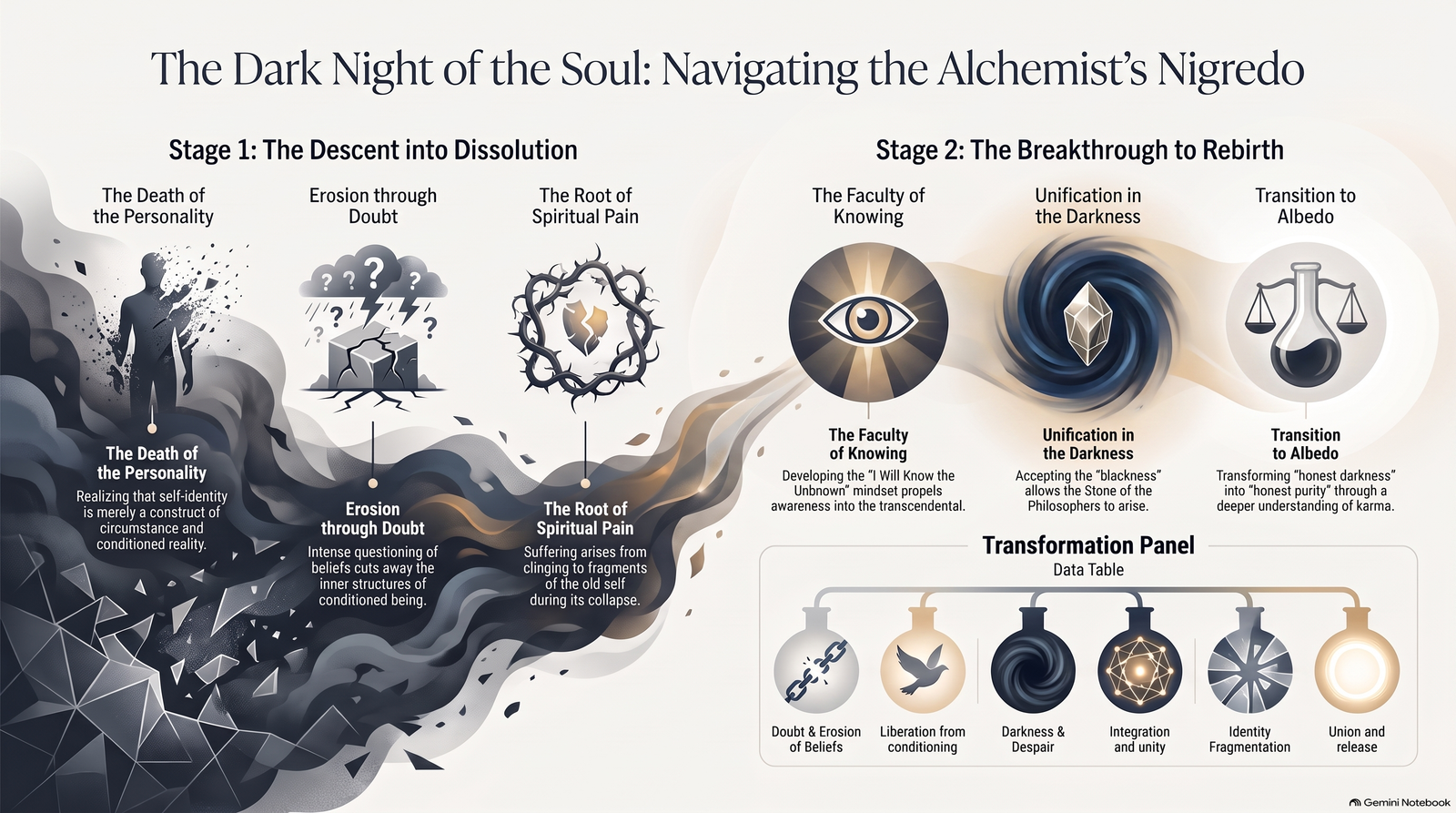
The Dark Night of the Soul places lost certainty within the blackening of Nigredo. Doubt erodes a personality understood as conditioned and provisional; faith means not dogmatic certainty but a minimal trust that a different way of understanding may be possible. The chapter calls the emerging willingness to enter that uncertainty the “Faculty of I Will Know the Unknown”.
Its movement is from fragmentation and clinging towards a less defended relation to identity. Darkness becomes more workable when it is no longer fought as proof of failure. This is the author’s alchemical synthesis, not a clinical account of depression, a universal spiritual stage or a claim that suffering necessarily produces awakening.
Video guide
What remains when the old story no longer works?
The recording opens in Dante’s dark wood: the straight way has been lost and no replacement route is visible. It uses that image to distinguish the Dark Night from an ordinary setback. The crisis concerns the organising story itself—career, status, virtue, belonging or another identity that once made experience coherent. When those structures lose authority, the person may still perform familiar roles while no longer believing that they answer the deeper question of who they are.
The video’s “Faculty of I Will Know the Unknown” is translated into plain language as a growing distrust of conditioned reality. Its playful description as a “cosmic BS detector” captures the appeal of the idea, but the faculty is part of the course’s own vocabulary rather than an established psychological or contemplative category. Disillusionment can prompt valuable enquiry; it can also arise through grief, burnout, depression, trauma, illness or other circumstances that spiritual language alone cannot identify.
Doubt is then reframed as a cutting instrument. It loosens inherited beliefs and preferred definitions, but initially leaves a painful interval in which the old account has failed and the unknown offers no secure replacement. The transcript calls this the “death shudders” of personality. Read symbolically, the phrase concerns weakening identification, not bodily death, self-harm or the destruction of ordinary functioning.
The turning point is a modest form of faith: not certainty about a doctrine, but enough confidence to remain open to a possibility beyond the false known. The video argues that relief arrives when personality can still function as a useful social costume without being defended as the whole person. The breakthrough is therefore not loss of personality. It is a loosening of attachment to definitions that previously demanded continual protection.
The philosopher’s stone first appears here as “unified darkness”. Fragmented struggle becomes a more honest ground because the conflict between experience and self-image has quietened. The subsequent movement towards Albedo is described as transforming honest darkness into honest purity. Karma is used primarily as cause and effect: clearer attention to intention and consequence becomes possible when experience is less dominated by the question “Why is this happening to me?”
The recording closes by mapping doubt, darkness, faith and identity from their painful manifestations towards possible transformations. That map is best treated as interpretive, not predictive. Depression does not reliably create integration, fragmentation does not prove ego dissolution, and crisis is not required for spiritual development. A symbolic frame may help someone articulate experience; it should never delay practical, relational or clinical support.
Argument map
How the discussion moves
The straight way is lost
Familiar goals and explanations cease to organise experience, leaving the person without a convincing map.
Identity is recognised as conditioned
Roles and labels appear less like an essence and more like a costume assembled through history and circumstance.
Doubt cuts the old attachments
Questioning can free perception from inherited structures, while also producing a painful interval of uncertainty.
Clinging intensifies the conflict
The video locates much of the pain in defending a self-description that experience can no longer sustain.
Minimal faith keeps possibility open
A small trust that another understanding may exist provides a bridge without requiring absolute belief.
Personality becomes a tool
Relief comes not from becoming blank, but from using roles without treating them as the whole of identity.
Darkness becomes more unified
When inner resistance quietens, an honest but difficult ground may replace fragmentation and performance.
Albedo begins as practical clarity
Attention turns towards causes, consequences and conduct rather than using a dramatic experience as proof of arrival.
Book and video
The source and its expansion
The written chapter establishes
The erosion of conditioned identity, doubt as a cutting force, minimal faith, surrender, unified darkness and the first movement towards Albedo.
The video expands
Dante’s wood, the social costume, a career-based example, the monkey-trap analogy, the phoenix and the image of rock bottom as solid ground.
The synthesis proposes
A crisis becomes transformative when clinging to a fixed personality loosens and uncertainty can be met without immediately rebuilding the old story.
The evidence boundary
The model may organise reflection; it cannot establish why distress is occurring, predict its outcome or confirm spiritual attainment.
Clickable chapters
Navigate the video
The supplied markers ascend correctly. The final runtime was not independently available, so no duration claim or VideoObject data has been added.
Terms for orientation
Expandable glossary
Dark Night of the Soul
Nigredo
Conditioned reality
Faculty of I Will Know the Unknown
Faith
Ego dissolution
Philosopher’s stone
Albedo
Karma
Spiritual emergency
Continue within the website
Related course pathways
- 1.1.10 The Shadow & The Lost InfantThe preceding chapter considers rejected qualities and projection before the broader structures of identity begin to fail.
- Mythos — Part One of NigredoThe section landing page for all twelve chapters.
- 1.1.12 The Seed of NirvāṇaThe next chapter asks what may become perceptible when familiar identity and interpretation loosen.
- NigredoThe course landing page and wider structure of the blackening.
- Nigredo — the bookThe complete volume, chapter contents, study material and publication details.
Context beyond the course
External reference points
- St John of the Cross — Dark Night of the SoulAn English translation of the historical contemplative text behind the phrase, useful for distinguishing its original religious setting from broader modern usage.
- Encyclopaedia Britannica — St John of the CrossBiographical and historical orientation to the sixteenth-century Carmelite mystic and the works associated with the “dark night”.
- NHS — mental health information and supportPractical routes to information and help when low mood, distress or loss of function may require more than a spiritual interpretation.
- NHS 111 onlineUrgent guidance in England when help is needed but the situation is not immediately life-threatening; call 999 in an emergency.
A grounded reflection
Separate the event, the story and the need
Choose one manageable uncertainty—not a crisis. Write three short lines: “What has actually happened?”, “What conclusion am I drawing about myself?” and “What practical support or action is needed today?”
The aim is neither to force meaning nor to surrender judgement. It is to loosen one identity-story while remaining anchored in observable circumstances, ordinary responsibilities and available support. Stop if the exercise increases distress.