
Albedo · Object · Chapter 29 of 48
2.3.5. Māra
What happens when genuine insight is not rejected by the ego, but recruited to build a more persuasive spiritual identity?
Chapter video
When insight becomes material for identity
Book orientation
The chapter in brief
This chapter turns from obvious obstruction to a subtler danger: the appropriation of clarity by a new spiritual self-image. Māra is presented as “the binder”—both a figure within Buddhist cosmology and, in the chapter’s alchemical reading, a name for fascination, identification and pride. A four-stage capture loop follows insight through appropriation, narrative and outward performance, while recognition, restraint and a provisional refusal of identity are offered as counter-measures. The discussion distinguishes Māra from Yama and yakṣas, then anticipates the following chapter’s Dark Night. This psychological and developmental architecture is Dr Simon Robinson’s synthesis. Buddhist texts and later traditions contain several overlapping accounts of Māra; they do not reduce him to one modern psychological mechanism or establish one universal sequence of spiritual development.
Transcript-led guide
The trap that arrives dressed as success
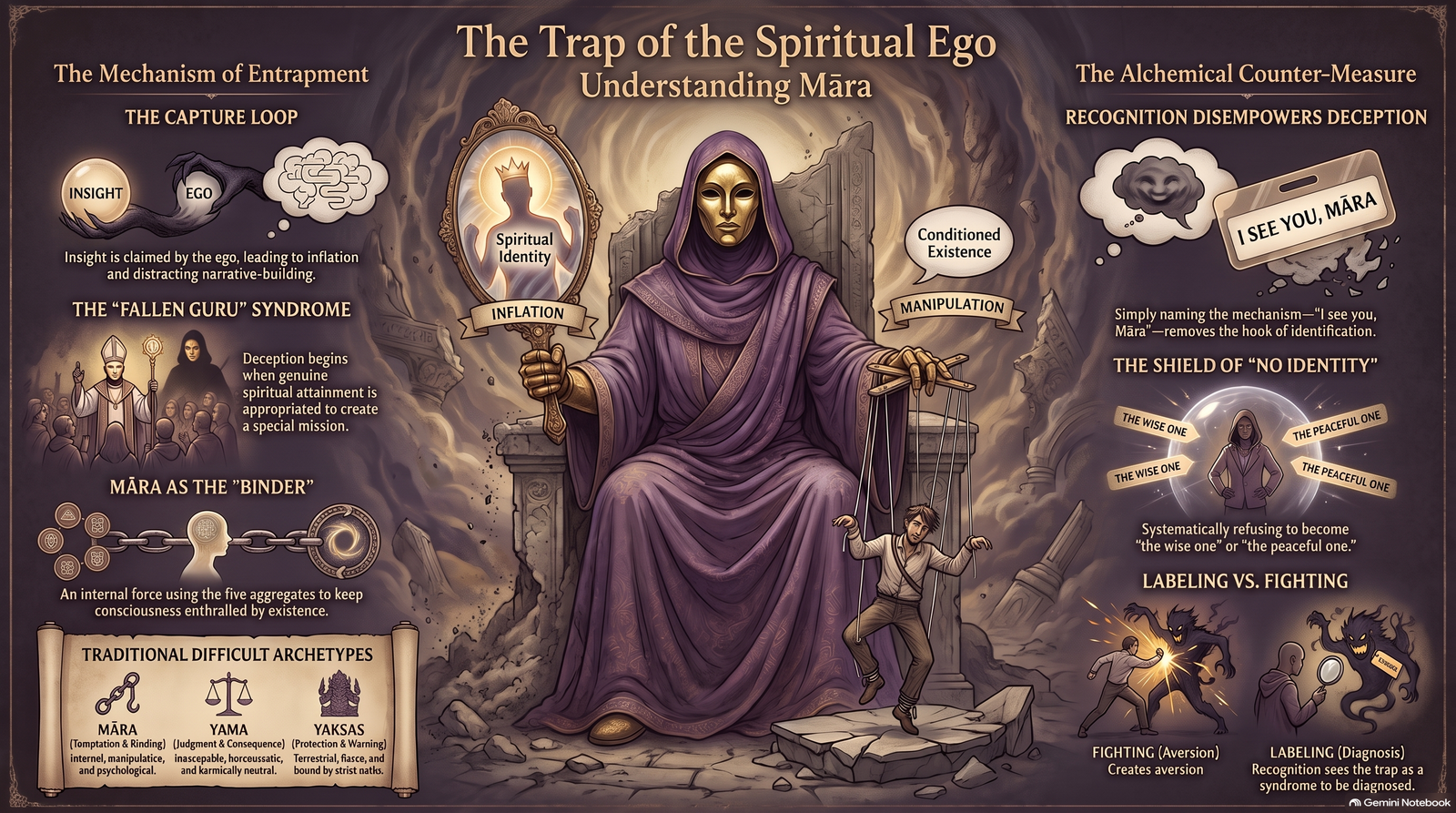
The recording opens with its central paradox: resistance does not necessarily disappear when discipline and insight deepen. It may become harder to recognise because it begins to speak in the language of clarity, purpose and attainment. The smooth golden mask in the source image supplies the governing symbol. The danger does not look degraded; it resembles the practitioner’s highest aspiration. The video therefore asks how a real opening can become the raw material for certainty, specialness and role-playing without implying that every confidence, insight or wish to teach is pathological.
To clarify the antagonist, the discussion separates Māra from Yama and yakṣas. Yama is treated as an image of death and consequence, while yakṣas are described as fierce, place-associated beings whose roles vary across South Asian traditions. Māra is then read as the force that keeps attention attached to conditioned experience. The five aggregates—form, feeling, perception, formations and consciousness—provide one Buddhist framework for analysing that attachment. A compliment and a social-media feed illustrate how sensation becomes interpretation, impulse and identity. The attention-economy analogy is illuminating, but it is an analogy: neither the canonical aggregates nor Māra are scientific models of dopamine, algorithms or the nervous system.
The middle of the recording maps the capture loop in practical detail. A flash of peace or insight is followed by ownership: “I am the one who sees.” Ownership hardens into a narrative of mission; narrative seeks an audience; repeated performance becomes a spiritual role. The proposed responses are recognition, non-identification, grounding and silence. In this frame, “I see you, Māra” is not an assertion that every difficult thought is a supernatural attack. It is a compact label intended to interrupt identification. The Upaniṣadic phrase neti neti—“not this, not this”—is borrowed as another interrupt; it should not be mistaken for a distinctively Buddhist formula.
The final movement considers subtler attachment to light, bliss, spaciousness or a peaceful void, and the conceit that a particular “someone” has attained freedom. A provisional stance of “no identity” is offered as a safeguard against turning transient experience into a permanent title. The practical challenge is modest but exacting: let an experience inform conduct before turning it into a story about who one has become. The transition into the Dark Night then raises an essential boundary. Panic, despair, emptiness or loss of meaning cannot safely be interpreted as proof that spiritual work is succeeding; they may have many causes and deserve ordinary support and professional assessment when severe, persistent or impairing.
Argument map
How the recording moves
Success becomes the new risk
The opening reverses the usual expectation: a breakthrough can become dangerous when the mind converts it into evidence of specialness.
The antagonist is reclassified
Māra is distinguished from punishment and territorial threat, then interpreted as the binding force of fascination and identification.
Experience becomes identity
The five aggregates and an attention-economy analogy show how a passing stimulus can become a story about a solid, valued or threatened self.
The capture loop closes
Insight passes through ownership, private certainty, interpretive overreach and selective disclosure before hardening into a spiritual role.
Recognition removes the hook
Labelling the pattern, grounding and delaying public performance are offered as ways to retain the insight without feeding a new persona.
Refined states remain conditioned
Light, bliss, voidness and spacious consciousness are treated as experiences that can still be appropriated or mistaken for final liberation.
The question turns towards silence
The recording ends by asking whether growth would retain its value if it could no longer be displayed, narrated or used to secure an identity.
Book–video relationship
Tradition, expansion and synthesis
The chapter establishes
Māra becomes the name for the co-option of insight by pride, with a capture loop and “no identity” offered as protective structures.
The video expands
The golden mask, social-media algorithm, immune-response and fallen-teacher analogies make the mechanism vivid and extend it beyond formal spiritual settings.
The synthesis connects
Early Buddhist imagery, later taxonomies, Upaniṣadic negation and modern psychological language are combined. Their conjunction is interpretive, not one inherited doctrine.
Video chapters
Navigate the discussion
- 00:00Opening: The Real Danger Begins
- 02:10What Māra Actually Is
- 06:40The Ego Doesn’t Die—It Adapts
- 11:20The Capture Loop Explained
- 17:30Spiritual Pride and Identity Formation
- 23:10Māra vs Yama vs Yakṣas
- 29:40Recognition as Defence: “I See You”
- 35:20The Trap of Higher States: Light, Void, Bliss
- 41:10The “No Identity” Safeguard
- 46:30Transition into the Dark Night
Glossary
Terms used in this chapter
Māra
The four Māras
Five aggregates (khandhas or skandhas)
Saṃsāra
Māna
Spiritual inflation
The capture loop
Neti neti
No identity
Jhāna
Nibbāna
Yama and yakṣa
Dark Night
Related pathways
Continue within the course
- 2.3.4. Brahma’s ChariotThe preceding chapter cultivates loving-kindness, compassion, appreciative joy and equanimity before this chapter examines how virtue itself can be claimed by identity.
- 2.3.6. The Dark Night of the SpiritThe next chapter develops the transition anticipated by the recording, with careful distinction between contemplative interpretation and mental-health assessment.
- 2.1.10. A New Kind of DemonProvides the course’s earlier framework for reading demonic imagery as patterns within experience without erasing its religious history.
- 2.1.12. The Master of the TempleReturns to claims of authority and attainment, where humility, interpretation and the danger of adopting a completed spiritual role become especially important.
- Object — Part Three of Albedo | Spiritual Alchemy Course | Dr Simon RobinsonReturn to the section directory and its twelve chapters on the nature of reality.
Reference points
Texts and context
- Dhammapada 7–8: The PairsThe paired verses behind the chapter’s opening epigraph, contrasting vulnerability to Māra with sense restraint, moderation, faith and effort.
- Saṃyutta Nikāya 4.25: Māra’s DaughtersAn early Buddhist narrative in which Māra and his daughters personify distraction, craving and attempted obstruction without collapsing the story into modern psychology.
- Saṃyutta Nikāya 5.10: VajirāA canonical example of a nun recognising Māra and answering with an analysis of the person in terms of conditioned aggregates.
- James W. Boyd, “Symbols of Evil in Buddhism”A scholarly study of the plurality of Māra symbols and the later four-Māras formula, useful for placing the chapter’s unified mechanism in historical context.
- Vonk and Visser, “An Exploration of Spiritual Superiority”Peer-reviewed psychological research on self-enhancement associated with spiritual training; relevant context, but not proof of the chapter’s complete developmental sequence.
Question to carry forward
What remains if the insight cannot become a title?
Recall one ordinary moment when something became clearer—in work, a relationship or practice. Without judging the experience, ask: “What changed in my next action, and what part became a story about the kind of person I am?” You need not erase the story or label yourself proud. Simply distinguish behavioural change from identity-building. If the inquiry becomes destabilising, leave it and return to ordinary surroundings, activity and conversation.