
Albedo · Object · Chapter 35 of 48
2.3.11. The Appointed
A genuine shift may loosen an old identity while immediately offering the ego a more flattering one: the person who has been chosen.
Chapter video
Why feeling “chosen” becomes a trap
Book orientation
The chapter in brief
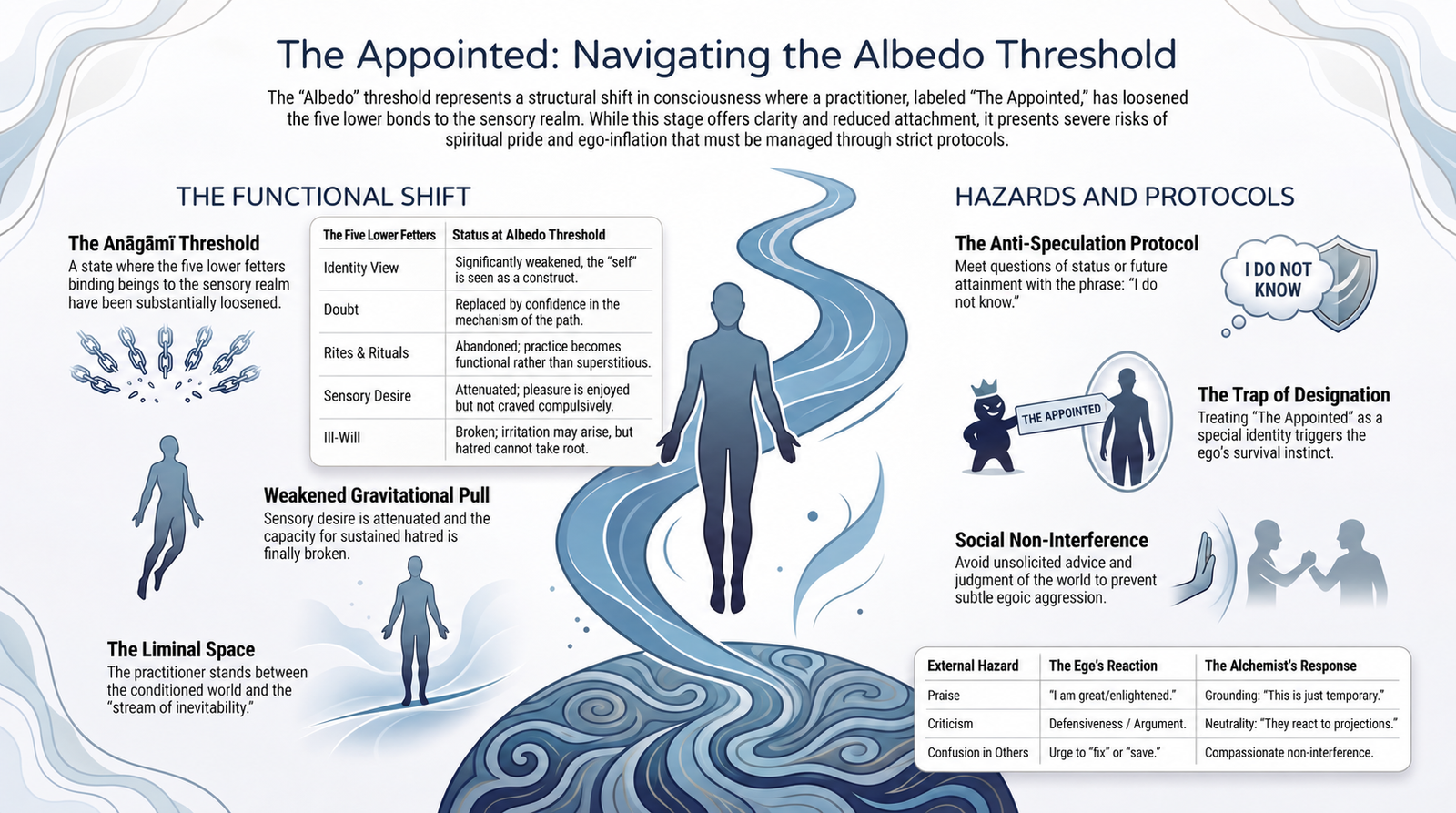
This chapter names a quiet threshold near the end of Albedo. The worldly pull has weakened, habitual greed and ill-will carry less force, and the path may feel less reversible. “The appointed” is offered as a diagnostic description of changed conditions, not a rank, mandate or superior identity. The chapter places this state beside the Buddhist Anāgāmī, or Non-Returner, and then concentrates on the danger created by the comparison: the mind may turn insight into a story of election. Its practical safeguards are restraint in giving advice, care around praise, compassionate non-interference and an anti-speculation response—“I do not know”—when the mind tries to certify its own status. These correspondences belong to Dr Simon Robinson’s alchemical synthesis rather than to a consensus shared by every Buddhist or Christian tradition.
Transcript-led guide
Surviving the identity built from success
The recording begins with a paradox. Long practice may produce a real reduction in inner noise, defensiveness and compulsive reaction, yet that relief can become material for a subtler self. The phrase “the appointed” deliberately sounds grandiose because it exposes this danger. The video repeatedly insists that it is not a badge of election. It is a provisional label for a change in the organisation of experience: the old gravitational pull is weaker, but the work is unfinished.
To describe that threshold, the recording turns to the Theravāda map of the Anāgāmī, or Non-Returner, and the five lower fetters: identity view, doubt, attachment to rules and observances, sensual desire and ill-will. The video explains these psychologically, presenting identity as constructed, confidence as tested trust rather than blind belief, and ritual as functional practice rather than magical transaction. Its language of weakening, however, is broader than the classical technical definition. Early Buddhist texts describe non-returning through the abandonment of the five lower fetters; a modern alchemical analogy cannot by itself establish that traditional attainment.
The central danger is designation. As soon as a change is named, the aggregates can reorganise around the designation: “I am awakened”, “I am different” or “I have been chosen”. The recording calls this a skandha reaction. The point is not that every use of first-person language is deluded, but that a fluid condition can harden into a role demanding recognition and defence. The recommended antidote is neither self-denigration nor denial of change. It is humour, provisional language and a refusal to treat the map as a certificate.
The same discipline enters the social field. Insight does not create a licence to correct other people. Unsolicited advice may disguise a wish to display understanding; alienation may become contempt for those judged “unconscious”; praise may feed the identity that criticism failed to revive. The recording therefore recommends compassionate non-interference: remain available, respond when genuinely asked, and resist turning another person’s difficulty into a stage for one’s wisdom. This is an ethical orientation, not a rule against necessary safeguarding, honest disagreement, professional responsibility or ordinary help.
The final safeguard is the anti-speculation protocol. Questions such as “What level am I?” or “What happens after death?” are met with “I do not know”. In the video, this phrase interrupts the mind’s attempt to build a spiritual dashboard from uncertain experience. It does not reject study, evidence or careful self-examination; it refuses premature certainty about claims that exceed what can presently be known. The proposed “status fast” applies this for a week by declining to score one’s spiritual progress.
The closing image is a high plateau. The air is clearer and the valley quieter, but the plateau is not the summit and should not become a permanent home. The chapter’s deepest challenge is therefore modest: let a genuine change alter conduct without turning it into an entitlement. The measure is not how exceptional the practitioner feels, but whether advice becomes less intrusive, praise less intoxicating, uncertainty more tolerable and ordinary relationships less organised around spiritual status.
Argument map
How the recording moves
Success creates a new risk
A real reduction in reactivity can become the foundation of a more refined and difficult-to-detect spiritual identity.
The threshold is named
“The appointed” is introduced as a functional description of changed conditions rather than a title of superiority.
The Buddhist map is applied
The five lower fetters provide a vocabulary for identity, doubt, ritual attachment, sensual compulsion and ill-will.
Designation rebuilds the self
The mind converts a fluid shift into the claim that someone special has arrived, been elected or deserves recognition.
The social field tests insight
Advice, alienation and praise reveal whether understanding has softened conduct or merely acquired a spiritual vocabulary.
Not-knowing interrupts measurement
The anti-speculation protocol returns attention from imagined rank and future attainment to present observation.
The plateau is not the summit
Albedo offers clarity and rest, but the refusal to settle there keeps the wider work of transformation open.
Book–video relationship
Text, expansion and qualification
The chapter establishes
The Appointed is a provisional grade-label whose chief danger is conversion into pride, status and certainty.
The video expands
Clinical analogies, family and workplace examples, the spiritual dashboard and the status fast make the social and psychological traps concrete.
The guide qualifies
The traditional definition of non-returning is distinguished from the course’s looser correspondence, and non-interference is separated from neglect.
Video chapters
Navigate the discussion
- 00:00Opening: The Threshold of Albedo
- 02:10What Does “The Appointed” Mean?
- 06:00The Anāgāmī Stage Explained
- 10:40The Five Lower Fetters
- 15:20Why the Journey Isn’t Finished
- 20:10The Trap of Being “Chosen”
- 25:30Spiritual Ego and the Skandha Reaction
- 30:20Social Hazards: Advice, Praise, Alienation
- 35:40The Anti-Speculation Protocol
- 40:10Living Without Knowing Your Status
- 44:00Closing: The End of Albedo
Glossary
Terms used in the chapter and recording
The Appointed
Anāgāmī
Five lower fetters
Identity view
Rules and observances
Skandha reaction
Spiritual ego
Compassionate non-interference
Anti-speculation protocol
Status fast
Conceit
Liminal space
Related pathways
Continue within the course
- 2.3.10. ThaumaturgyThe preceding chapter asks how reduced self-reference changes action, conflict and the temptation to claim unusual power.
- 2.3.12. TouristThe following chapter tests whether detachment has become freedom, disengagement or another place from which to observe life.
- 2.2.12. The AnagāmīProvides the course’s earlier account of non-returning, sensual desire, ill-will and the distinction between Buddhist doctrine and alchemical correspondence.
- 2.1.10. A New Kind of DemonIntroduces the way an apparent insight can be appropriated by the aggregates and converted into a new identity.
- Object — Part Three of Albedo | Spiritual Alchemy Course | Dr Simon RobinsonReturn to the section directory and its twelve chapters on the nature of reality.
Reference points
Texts behind the comparison
- Majjhima Nikāya 64: The Longer Discourse with MāluṅkyaputtaAn early Buddhist text that names the five lower fetters and describes a path for giving them up. It is the clearest reference point for distinguishing the canonical model from the chapter’s broader language of loosening.
- Aṅguttara Nikāya 10.13: FettersA concise canonical list of the five lower and five higher fetters. It helps locate the chapter’s claim that work remains after the lower set has ended.
- Saṃyutta Nikāya 22.89: KhemakaDistinguishes not regarding any aggregate as “I am this” from the subtler residual conceit “I am”. This bears directly on the chapter’s warning that a special identity can reform after fixed self-view has weakened.
- The Gospel of Thomas, Saying 49, Lambdin translationThe source for the chapter’s opening language of the solitary and elect. The saying belongs to the non-canonical Gospel of Thomas; the course’s connection between election and the Albedo threshold is an interpretive synthesis.
Question to carry forward
When does a description become an identity?
Recall one recent moment in which a useful description—calm, insightful, experienced, wounded, different—began to feel like something you had to protect. Without deciding whether the description was true or false, ask what conduct followed from defending it. Did it make listening easier, or did it create pressure to advise, compare, withdraw or appear consistent? Let the answer remain ordinary and provisional. “I do not know yet” is a complete response; this is reflection, not a test of status.