
Dialogues IV · Episode 01
Padmasambhava’s Map of the Locationless Mind | Dialogues IV
The path appears to lead somewhere—until practice begins to dissolve the traveller, the terrain and the need to arrive.
Watch here, or continue on YouTube with comments. Open on YouTube ↗
The central question
What remains of a spiritual path when even the traveller cannot be located?
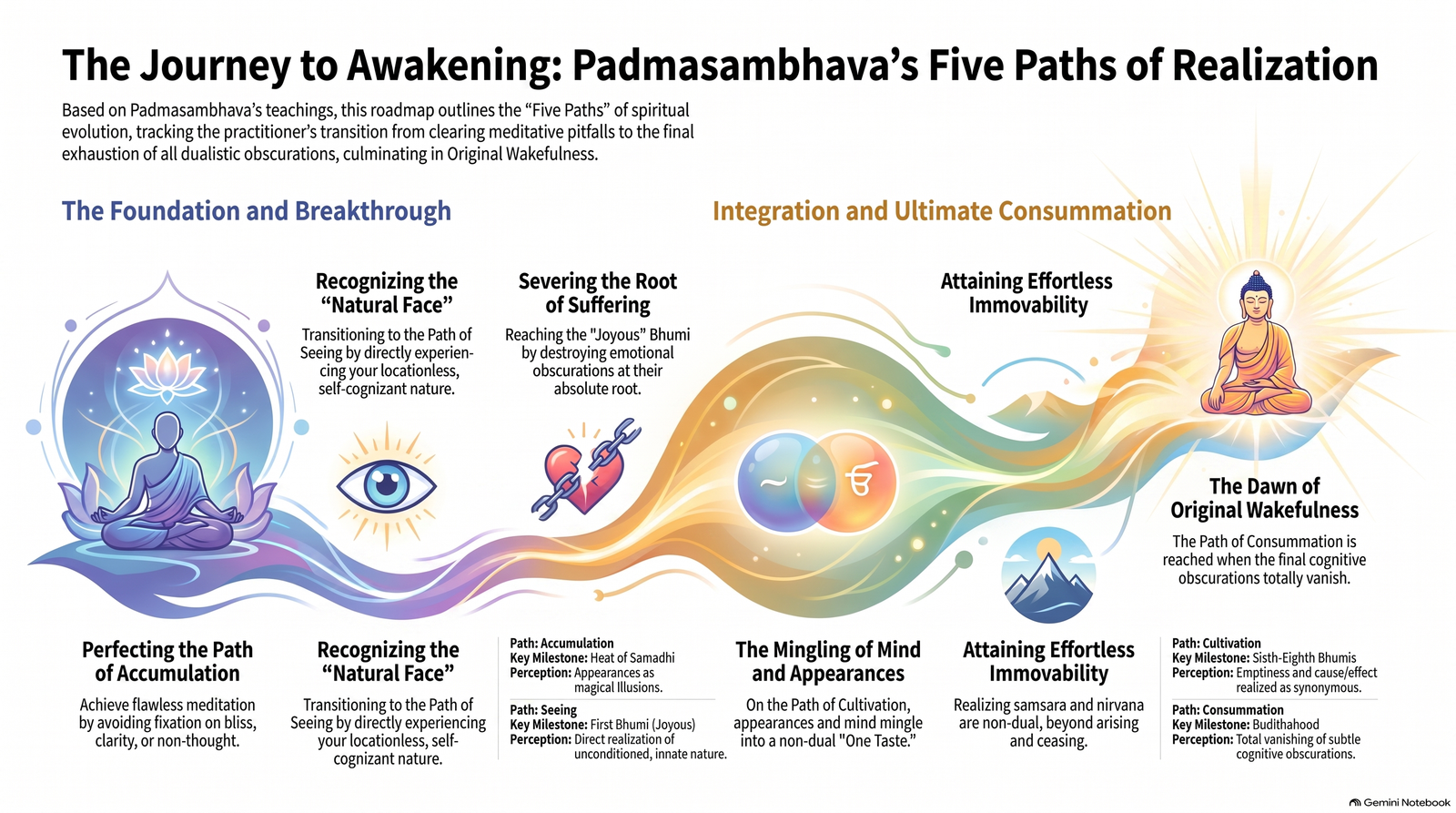
This opening episode of Dialogues IV explores a Nyingma and Dzogchen presentation of the Buddhist five paths through instructions traditionally attributed to Padmasambhava. Its governing reversal is simple but demanding: awakening is not described as the acquisition of an exceptional object. It is a progressive release of fixation—including fixation upon the meditative experiences that can look most convincing.
The discussion begins with bliss, clarity and non-thought. These temporary experiences may accompany concentrated practice, yet the episode treats attachment to them as another form of grasping: a meditator constructs an identity around having reached a special state. The image of keeping the concert ticket instead of hearing the music captures the problem. The map then turns towards the “warmth” associated with preparation, the meeting of calm abiding and insight, and the path of seeing, where the nature of mind is described as both locationless and cognisant.
From there, the account moves through the first bodhisattva bhūmi and into the long path of cultivation. Formal meditation and ordinary activity no longer appear as wholly separate, but habits of subject and object are said to linger. Emptiness is therefore not treated as blank non-existence: because things lack independent essence, causes, conditions and relationships can function. The sixth and eighth bhūmis become markers within this process of familiarisation, while the final language of “original wakefulness” points to buddhahood as uncovering rather than manufacture.
The episode’s challenge is not to use this intricate scheme as a certificate of attainment. It is to ask whether a map can orient practice without becoming a new possession of the self—and whether the wish to arrive may eventually be one of the things that has to be released.
How to read this episode: this is a traditional contemplative map, not an empirically verified model of the brain or a method for confirming anyone’s spiritual attainment. Accounts of Padmasambhava, Yeshe Tsogyal and treasure revelation belong to Nyingma lineage tradition and should not be confused with independently established history. The recording also contains two verbal slips: the warning about fixation is Padmasambhava’s in the source under discussion, not Pema Chödrön’s; and the eighth bhūmi called “Immovable” is conventionally Acalā, not Akṣobhya. Buddhist schools and texts also differ in how precisely they map the two obscurations onto the paths and bhūmis.
Argument map
Six movements through the episode
A map of subtraction
The five paths overturn the ordinary model of progress: the work is framed as releasing obscuration, not adding a spiritual identity.
The beautiful traps
Bliss, clarity and non-thought may arise in meditation, but grasping at them restores the division between an achiever and an achieved state.
Warmth before seeing
Calm abiding and insight approach a threshold at which conceptual understanding is said to give way to direct seeing.
No centre to defend
The path of seeing presents mind as unfindable yet cognisant, loosening the apparently solid geometry of self and world.
Familiarity in ordinary life
The path of cultivation works on the remaining habit of objectivity as emptiness and dependent origination are understood together.
Effort gives way
At the “Immovable” threshold practice is described as spontaneous; consummation names the eventual exhaustion of obscuration.
Navigate the discussion
Confirmed chapter points
Only the supplied final marker is included here; the list is deliberately minimal rather than reconstructing unverified timings.
Key language
Glossary
Five paths
A widely used Indo-Tibetan Buddhist framework comprising accumulation, preparation or joining, seeing, cultivation or meditation, and no-more-learning or consummation. The source discussed in the episode says that the five are “included within three”, compressing the preliminary pair before emphasising seeing, cultivation and consummation. This is a presentation of practice, not a measurable scale.
Padmasambhava
A foundational tantric master in Tibetan Buddhist tradition, especially revered by the Nyingma school as Guru Rinpoche. Traditional narratives place his activity in eighth-century Tibet and attribute extensive instructions to him. The precise historical layers of his biography, later revelation traditions and attributed texts should be distinguished from the devotional and doctrinal authority they hold within lineages.
Dzogchen
Usually translated as “Great Perfection”, Dzogchen names a body of teachings and practices especially important in Nyingma Buddhism and Bön. Its language often emphasises direct recognition of the nature of awareness and the release of contrivance. The episode interprets its terms through a broader five-path structure; not every Tibetan school maps these systems identically.
Nyams: bliss, clarity and non-thought
Nyams are temporary meditative experiences. Bliss, vivid clarity and reduced conceptual thought can feel decisive, but Tibetan practice literature often warns against confusing such experiences with stable realisation. The episode’s point is not that calm or clarity is harmful; it is that attachment to an experience can turn it into another object of identity and pursuit.
Śamatha and vipaśyanā
Śamatha refers to calm abiding or mental stability; vipaśyanā to insight or clear seeing into the nature of experience. Their precise methods and relationship vary across Buddhist traditions. In the map used here, their union helps explain the transition from preparatory practice towards direct, non-conceptual insight.
Warmth or “heat”
“Warmth” is traditionally one of four stages on the path of preparation or joining, before the path of seeing. It is likened to heat appearing before a fire catches. The episode sometimes folds preparation into accumulation in keeping with its compressed source presentation; in standard five-path accounts, the two remain distinct.
Path of seeing
The third of the standard five paths, conventionally associated in Mahāyāna systems with a first direct, non-conceptual realisation of emptiness and entry into the first bodhisattva bhūmi. “Seeing” here is technical contemplative language, not ordinary visual perception and not a status that an outside observer can certify from a person’s claims or behaviour.
Bhūmi
Literally a “ground” or “level”. Mahāyāna Buddhism commonly describes ten bodhisattva bhūmis. The first is Perfect Joy, the sixth is often translated as Manifest or Face-to-Face, and the eighth as Immovable. Different sources explain what is purified at each level in different ways, so the episode’s correspondences should be read as one map rather than a universal taxonomy.
Locationless and self-cognisant
The episode uses this pairing for awareness that cannot be found as a bounded object in a particular place yet is not mere blankness. “Self-cognisant” translates contested Tibetan philosophical language and does not mean a permanent metaphysical self. Some Tibetan schools accept forms of reflexive awareness; others analyse the matter differently.
Śūnyatā (emptiness)
In Mahāyāna Buddhism, emptiness is the absence of independent, intrinsic existence. It is not simply nothingness. Because phenomena arise through causes, conditions, parts and conceptual designation, they can function without possessing a fixed essence. The episode links this insight to dependent origination while avoiding both solidifying things and denying their conventional effects.
Dependent origination
The principle that phenomena arise in dependence upon causes and conditions. Buddhist traditions elaborate it in several contexts, from the arising of suffering to the dependence of all phenomena. In Madhyamaka thought, dependent origination is central to explaining emptiness: what exists dependently does not exist through an isolated essence of its own.
The two obscurations
Mahāyāna texts often distinguish afflictive obscurations, associated with the disturbing emotions and liberation from cyclic existence, from cognitive obscurations, associated with impediments to complete buddhahood. Traditions disagree about their precise scope and the stages at which they are abandoned. The episode’s tree-root metaphor is explanatory rather than a universally agreed chronology.
Acalā, the “Immovable” eighth bhūmi
Acalā is the conventional Sanskrit name of the eighth bodhisattva ground, commonly rendered “Immovable”. The episode’s “Akṣobhya” is a verbal confusion with another Sanskrit name also associated with immovability. The eighth bhūmi is often linked with irreversibility and effortlessness, but it is not itself identical with final buddhahood.
Rnam shes and ye shes
Rnam shes commonly translates Sanskrit vijñāna, discriminating consciousness; ye shes translates jñāna, primordial wisdom or original wakefulness. The contrast is important in Tibetan Buddhist vocabulary, but it should not be reduced to a simple opposition between a bad everyday brain and a hidden supermind.
A two-minute inquiry
Where is the next thought?
Sit or stand as you are and let one ordinary thought appear. Without suppressing it or trying to make the mind blank, ask where the thought is located. Does it have an edge, a centre or a measurable distance from the sound nearest to you? Notice what can be found and what remains uncertain. Then return to the room without drawing a conclusion. This is a question to test in experience, not evidence of attainment.
Continue the series