
Dialogues IV · Episode 02
Why Addiction Can Feel Like Survival
When distress becomes unmanageable, predictable relief can feel less like pleasure than an emergency exit.
Watch here, or continue on YouTube with chapters and comments. Open on YouTube ↗
The central question
What if addiction begins as an attempt to make distress survivable?
This episode replaces a moralising story of weak will and pleasure-seeking with a more compassionate—but still incomplete—question: what pain, agitation or uncertainty might a substance or compulsive behaviour be trying to regulate?
The discussion describes a “short circuit” between distress and relief. The ordinary route asks a person to tolerate uncertainty, seek help, repair relationships or slowly build regulation. The addictive route can offer a rapid and unusually predictable change of state. What initially functions as protection may then narrow life, intensify withdrawal and shame, and become fused with identity.
From there, the episode brings Edward J. Khantzian’s self-medication hypothesis into conversation with Ellen Langer’s work on the illusion of control, Acceptance and Commitment Therapy, and Buddhist images of the five hindrances and the raft. Its final movement asks whether labels can remain useful without becoming prisons: not “I am a fixed thing”, but “this is a process occurring now”.
Evidence status: self-medication is one influential account of some substance use, not a complete theory of addiction. “Pseudo-jhāna” and the chemical “short circuit” are interpretive metaphors, not recognised diagnoses or scientific equivalences. Substance effects vary across individuals, contexts, dose and pattern of use; the episode’s substance-to-distress pairings should not be used for self-diagnosis or drug selection.
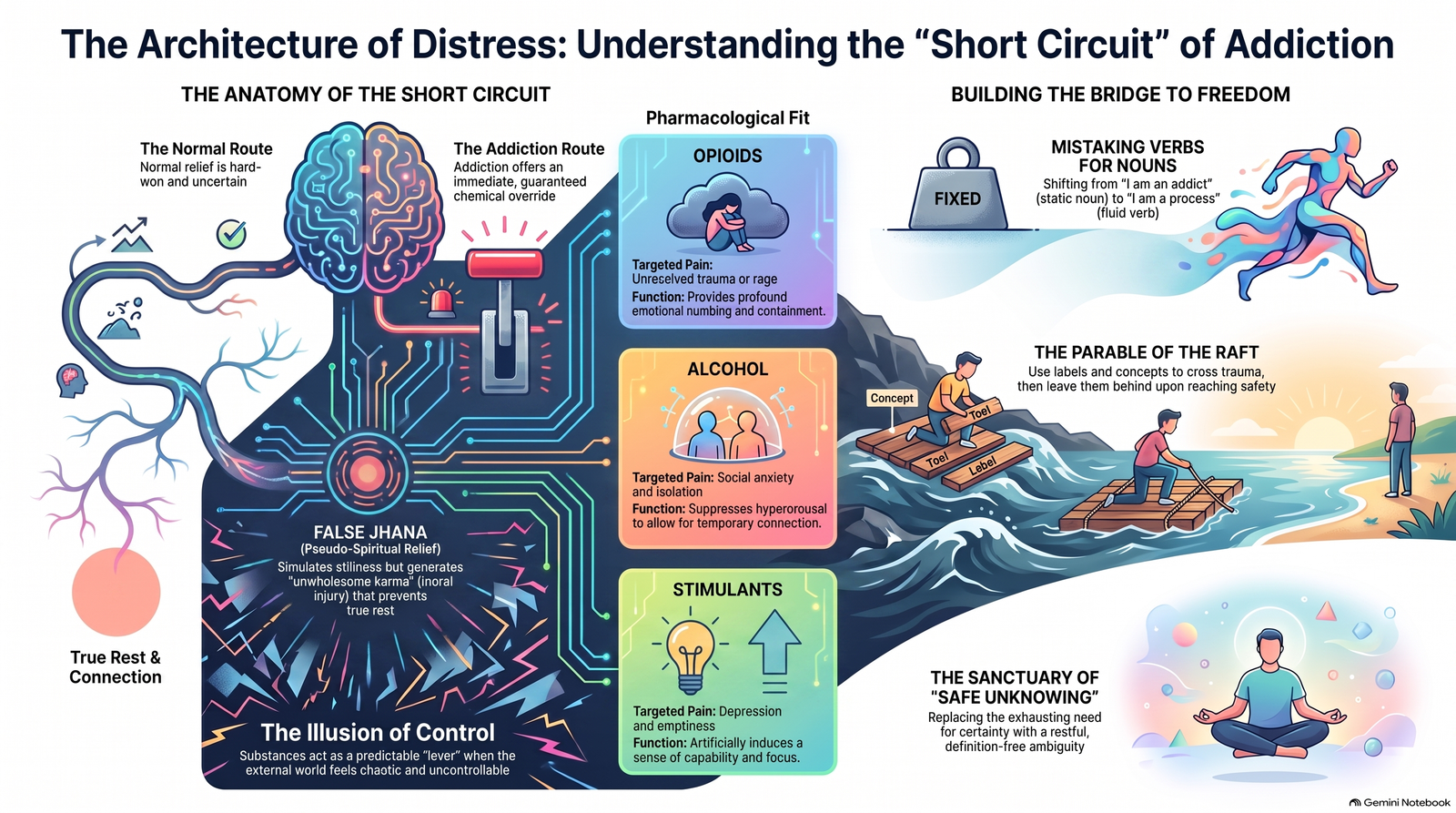
Argument map
Six movements from short circuit to open ground
Distress asks for action
Pain and concern create an unsettled state that ordinarily leads toward problem-solving, connection or support—routes whose rewards are delayed and uncertain.
Relief becomes a lever
A substance or behaviour can change experience quickly and predictably. The episode calls this a short circuit: the alarm quietens while its source may remain.
The relief may be specific
Khantzian’s hypothesis proposes that some people select substances partly for how their effects answer particular painful states. Evidence is mixed and addiction is multifactorial.
Predictability imitates control
The reliable lever can feel safer than vulnerable relationships or uncertain recovery. Over time, tolerance, withdrawal and consequences reduce rather than enlarge autonomy.
Relief is not liberation
The comparison with meditative absorption illuminates a longing for release from agitation. It remains metaphorical: intoxication and Buddhist jhāna are not equivalent states.
The noun returns to a verb
Shame can harden a condition into identity. Defusion, impermanence and the raft suggest a gentler movement: use a label when useful, then loosen the grip.
Navigate the discussion
Chapters
Selecting a chapter opens the published video at that point on YouTube.
- 00:00Addiction Beyond the Pleasure-Seeking Myth
- 03:05Empathy, Distress and the Chemical Short Circuit
- 07:40Self-Medication as an Attempt to Find Relief
- 10:25Predictability and the Illusion of Control
- 13:35Withdrawal and the Loss of Autonomy
- 16:25Addiction as a Simulation of Profound Relief
- 19:35The Five Hindrances and the Longing to Feel Safe
- 23:35Shame, Ethical Conflict and Moral Injury
- 28:25When a Condition Becomes an Identity
- 31:15Cognitive Defusion, Impermanence and the Raft
- 34:05Leaving the Heavy Nouns Behind
Key language
Glossary
Self-medication hypothesis
Edward J. Khantzian’s proposal that some substance use reflects an attempt to relieve painful affect or problems in self-regulation, and that a substance may be selected partly for its characteristic effects. Research offers support in some settings and limitations in others; it is not a universal explanation.
Pharmacological fit
The proposed correspondence between a person’s particular distress and the effects they seek from a substance. The term describes a hypothesis about patterns of selection, not a safe or clinically recommended matching process.
Illusion of control
Ellen Langer’s term for overestimating one’s influence over outcomes that are substantially or wholly determined by chance. The episode extends the idea metaphorically to the attraction of a predictable change in internal state.
Withdrawal and negative reinforcement
Withdrawal is the physical or psychological response that can follow reduction or cessation after repeated use. Negative reinforcement occurs when a behaviour strengthens because it removes or reduces an aversive state; continued use may increasingly be driven by relief from distress or withdrawal rather than pursuit of pleasure.
The five hindrances
In early Buddhist teaching: sensual desire, ill will, sloth and torpor, restlessness and remorse, and doubt. They are presented as conditions that obstruct meditation and clarity. The episode uses their traditional similes to evoke the felt burden of mental unrest.
Jhāna and “pseudo-jhāna”
Jhāna refers to meditative absorption in Buddhist traditions. “Pseudo-jhāna” is the episode’s metaphor for chemically induced relief that may superficially resemble escape from the hindrances. It is not a standard Buddhist category, clinical term or claim of neurological equivalence.
Sīla and karma
Sīla means ethical conduct or discipline. Karma in Buddhism centres on intentional action and its consequences; it is broader than guilt or a “cosmic scoreboard”. The episode interprets concealment, conflict and remorse through this ethical lens without reducing Buddhist karma to modern psychology.
Moral injury
A term for enduring psychological, social or spiritual distress after actions, failures to act, witnessing or betrayal that violate deeply held moral beliefs. It is not itself a formal psychiatric diagnosis, and it should not be assumed whenever addiction involves shame or regret.
Default mode network (DMN)
A set of interacting brain regions often associated with internally directed and self-referential processing. The episode links it strongly to shame and moral injury; those specific causal and physiological claims are more definite than the evidence presented warrants.
Acceptance and Commitment Therapy (ACT)
A contextual behavioural therapy that develops psychological flexibility through processes including acceptance, present-moment awareness, values, committed action, cognitive defusion and self-as-context. It is a structured therapeutic approach, not simply positive reframing.
Cognitive defusion
An ACT process that changes one’s relationship to thoughts so they are experienced as mental events rather than literal commands or complete definitions of the self. The correct term is defusion, not “diffusion”.
Impermanence and the raft
Anicca is the Buddhist teaching that conditioned phenomena change. In the Alagaddūpama Sutta (MN 22), the Dhamma is compared to a raft used for crossing rather than clung to afterward. Here, labels and conceptual frameworks are treated as provisional supports.
A language experiment
Let the noun become a process
Choose one familiar self-description—perhaps “I am anxious”, “I am weak” or “I am broken”. Without arguing with it, add two small frames: “I am noticing the thought that…” and “…is present just now.” Notice whether the description becomes less total. The aim is not to deny pain or manufacture optimism, but to restore a little space between a changing experience and the whole of a person.
Support matters more than interpretation
This brief reflection is not addiction treatment and is unsuitable as a way to manage withdrawal. If alcohol or drug use is affecting your life or health, speak with a GP or specialist service. NHS guidance is available for drug addiction support and local alcohol support services. Abrupt withdrawal from alcohol or benzodiazepines can be medically dangerous; seek qualified advice rather than attempting it alone.
Continue the series