
Dialogues IV · Episode 07
Cybernetic Alchemy for the Ego Glitch | Dialogues IV
Could the same digital culture that reinforces a defensive self-model also carry the maps that help us recognise its construction?
Watch here, or continue on YouTube with comments. Open on YouTube ↗
The central question
Can a machine built to capture attention become a place where identity loosens?
This episode imagines the course, its books and its video catalogue as a “cybernetic monastery”: a distributed curriculum designed for people whose first language may be neuroscience, virtual reality, simulation theory or the irony of internet culture rather than traditional contemplative symbolism.
The inquiry begins with the “ego glitch”—not as a literal defect in the brain, but as a deliberately provocative name for the way a self-model can become transparent to the person inhabiting it. The default mode network, Thomas Metzinger’s phenomenal self-model and predictive accounts of perception offer different ways of asking why the constructed character of experience is so difficult to see. The episode then turns to Julian Jaynes and David Abram to speculate about inner speech, literacy and the historical inward movement of human attention.
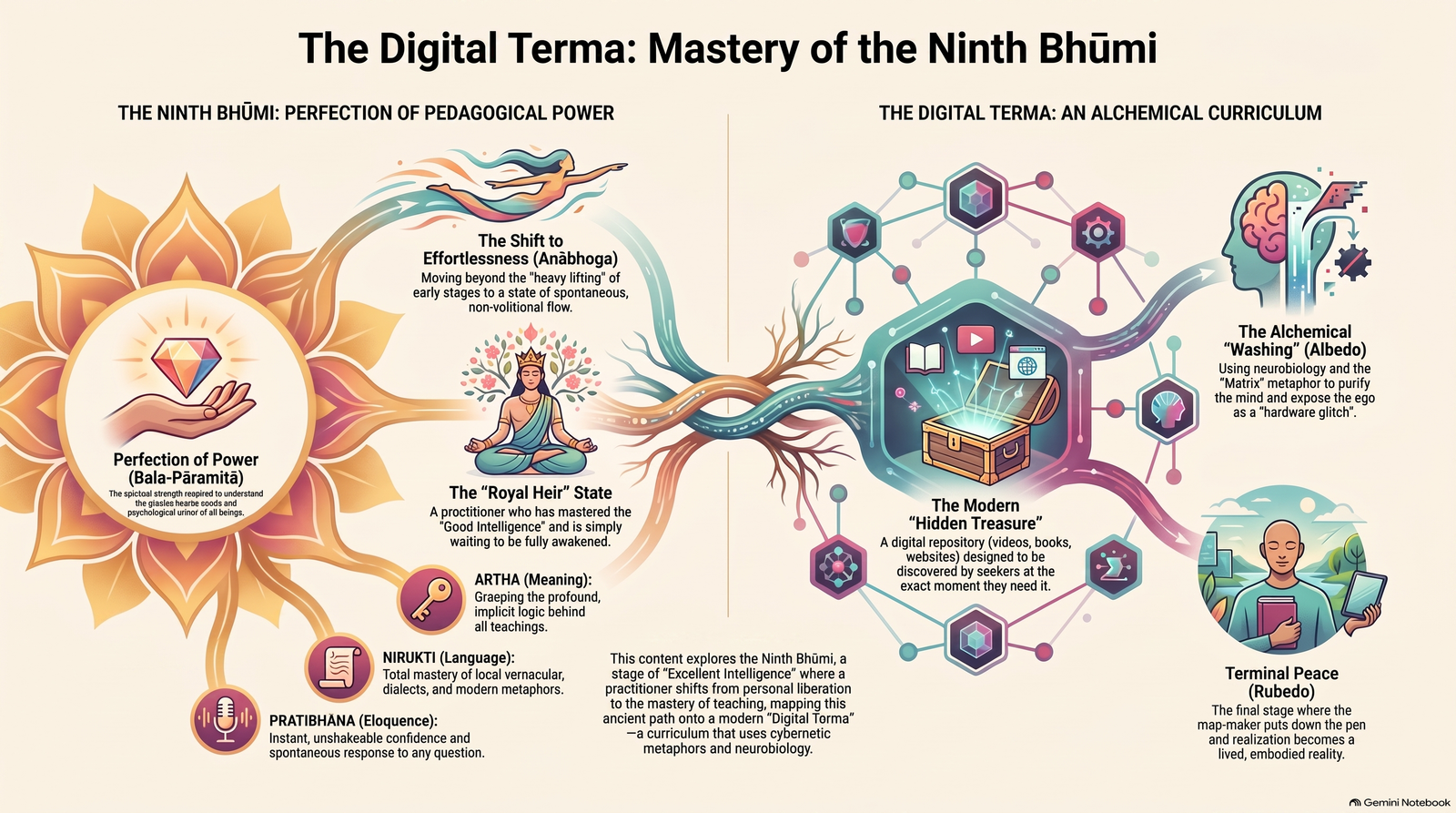
Alchemy supplies the organising architecture. Nigredo disrupts confidence in the familiar model; Albedo washes and clarifies; Citrinitas converts insight into usable discernment; Rubedo names a return in which understanding must be lived rather than endlessly represented. The sequence is presented as an interpretive curriculum, not as a neuroscientific mechanism or a universally valid map of development.
The final movement joins two images. The ninth bhūmi, Sādhumatī, traditionally emphasises exceptional discernment and the capacity to teach according to the needs of different beings. The Tibetan treasure tradition preserves teachings for conditions in which they can become useful. “Digital terma” brings these images together: leave the raft online, relinquish possession of it, and allow future seekers to encounter the material without requiring the map-maker to remain at its centre.
How to read this episode: the scientific and traditional materials have different evidential status. The default mode network participates in self-referential thought, autobiographical processing and mind-wandering, but it is not a single “ego centre”. Metzinger’s phenomenal self-model is a philosophical theory, while Jaynes’s account of bicameral mentality and claims that alphabetic literacy transformed consciousness remain controversial historical hypotheses. REBUS was proposed specifically as a model of psychedelic brain action; extending it to meditation or spiritual development is speculative. The bhūmis and terma belong to Buddhist doctrinal and religious traditions and cannot establish an individual’s attainment. The infographic below maps the episode’s synthesis; it does not independently validate it.
Argument map
Six movements through the episode
The transparent interface
Like an invisible virtual-reality headset, a self-model may organise experience so successfully that its constructed character disappears from view.
Prediction becomes prison
Predictive models are necessary for perception and survival, yet rigid high-level expectations can repeatedly force unfamiliar experience into familiar grooves.
Language turns inward
Jaynes and Abram support a speculative history in which inner speech and alphabetic literacy help relocate meaning from a participatory world into an interior narrator.
Alchemy as curriculum
The four alchemical colours organise a progression from disruption and clarification towards illumination, embodiment and ordinary life beyond the map.
Teaching in the local tongue
The ninth bhūmi becomes an image of communication that understands dispositions, meaning, language and response rather than merely repeating inherited formulas.
The raft remains online
The “digital terma” preserves a discoverable body of material while asking its creator to relinquish ownership, endless effort and the need to control its reception.
Navigate the discussion
Chapter points
- 00:00When the Mind Feels Like a Hardware Glitch
- 02:55The Default Mode Network and the Defensive Self
- 05:25Metzinger, Virtual Reality and the Transparent Self
- 09:40Julian Jaynes and the Bicameral Mind
- 13:15Did the Alphabet Change Human Consciousness?
- 16:25Building a Cybernetic College of Alchemy
- 17:20Nigredo and Albedo: Breaking the Ego’s Model
- 21:50Citrinitas, Rubedo and Living Beyond the Map
- 24:00REBUS, Predictive Processing and Rigid Beliefs
- 29:25The Ninth Bhūmi and Speaking the Internet’s Language
- 34:00When Spiritual Effort Becomes the Final Obstacle
- 40:10The Digital Terma: Leaving the Raft Online
Key language
Glossary
“Ego glitch”
The episode’s intentionally provocative metaphor for a self-model that is useful for organising experience yet becomes a source of rigidity when mistaken for a fixed, independent identity. It is not a neurological diagnosis, and the self-related processes discussed are not simply errors that a healthy brain could remove.
Default mode network (DMN)
A group of interacting brain regions often studied in relation to internally directed cognition, autobiographical memory, self-referential processing and mind-wandering. Its activity varies with task and context. Calling it “the ego” compresses many neural and psychological processes into a memorable but scientifically imprecise label.
Phenomenal self-model (PSM)
Thomas Metzinger’s philosophical account of the representational structure through which a system experiences itself as an embodied subject. The model is described as “transparent” when the person experiences its content as reality without experiencing the modelling process that presents it.
Predictive processing and priors
A broad family of theories in which perception and action involve predictions meeting incoming signals. “Priors” are existing expectations or probability-weighted assumptions. The episode uses a landscape of deepening grooves to picture rigid priors; this is an explanatory metaphor, not a literal map of brain tissue.
Bicameral-mind hypothesis
Julian Jaynes’s proposal that some ancient people experienced guidance now associated with introspective thought as externally authoritative voices, and that a modern form of consciousness developed historically. The theory is influential in cultural discussion but highly contested and is not an established account of the neurological origin of consciousness.
REBUS
“Relaxed Beliefs Under Psychedelics”, a theoretical model proposed by Robin Carhart-Harris and Karl Friston. It suggests that psychedelics may reduce the precision assigned to high-level priors and increase sensitivity to bottom-up information. The episode’s extension of this model to contemplative or alchemical transformation is analogical and requires separate evidence.
The four alchemical stages
Nigredo (blackening), Albedo (whitening), Citrinitas (yellowing) and Rubedo (reddening) form the course’s broad architecture of dissolution, clarification, illumination and integration. Their use here is symbolic and educational rather than a claim that historical alchemical texts describe one uniform psychological sequence.
Sādhumatī, the ninth bhūmi
The ninth of the ten bodhisattva grounds in Mahāyāna Buddhism, often translated as “Good Intelligence” or “Excellent Intelligence”. Traditional descriptions emphasise subtle discernment and an extraordinary capacity to expound Dharma. It is a doctrinal stage of the bodhisattva path, not a clinical category or status that this page assigns to any living person.
Four analytical knowledges (pratisaṃvid)
Traditional forms of unhindered knowledge concerned, in varying translations and classifications, with phenomena or teachings, their meanings, language or expression, and inspired eloquence. The episode reads them as a model of responsive pedagogy. They should not be reduced to modern marketing technique or algorithmic optimisation.
Anābhoga
Effortless or non-deliberative activity attributed in Mahāyāna accounts to advanced bodhisattva practice. The episode contrasts it with the deliberate striving required earlier on a path. Effortlessness here does not mean passivity, lack of ethical responsibility or a biological state in which action consumes no energy.
Terma and “digital terma”
Terma are “treasure” teachings within Tibetan Buddhist traditions, associated especially with Nyingma histories of concealment and later revelation. “Digital terma” is the episode’s modern analogy for material placed online to be found under future conditions. A searchable archive is not thereby equivalent to a traditionally authenticated treasure revelation.
A question to carry forward
Which part of the map helps—and which part now asks to be carried?
Choose one idea, practice, book or digital tool that has genuinely helped you understand yourself. Notice the difference between using it and defending it. What does it still allow you to see? Where has it become a filter through which every new experience must pass? Keep what remains useful, but imagine leaving the map on the shore for a moment and meeting the next ordinary task without consulting it.
Continue the series