
Dialogues IV · Episode 08
The Physics of a Frictionless Mind | Dialogues IV
What remains of work, care and creativity when the inner manager grows quiet—and action no longer feels like a struggle against oneself?
Watch here, or continue on YouTube with comments. Open on YouTube ↗
The central question
Can intense productivity become quieter without becoming passive?
The episode begins with an unusual conjunction: sustained creative output, little subjective sense of strain, and a deliberately sceptical question about whether such ease has any relationship to the ninth bodhisattva ground, traditionally called Sādhumatī or “Good Intelligence”. Rather than treating productivity as evidence of attainment, the discussion uses the question to examine the difference between action, effort and the story of a doer.
Psychological flow provides the first lens. When attention is absorbed, time-monitoring and self-evaluation may recede while skilled activity continues. Research on meditation and the default mode network supplies a second, narrower comparison: experienced meditators can show altered activity and connectivity in regions associated with mind-wandering and self-referential processing. Neither body of research demonstrates the disappearance of an ego, verifies a spiritual stage or makes biological work energetically free.
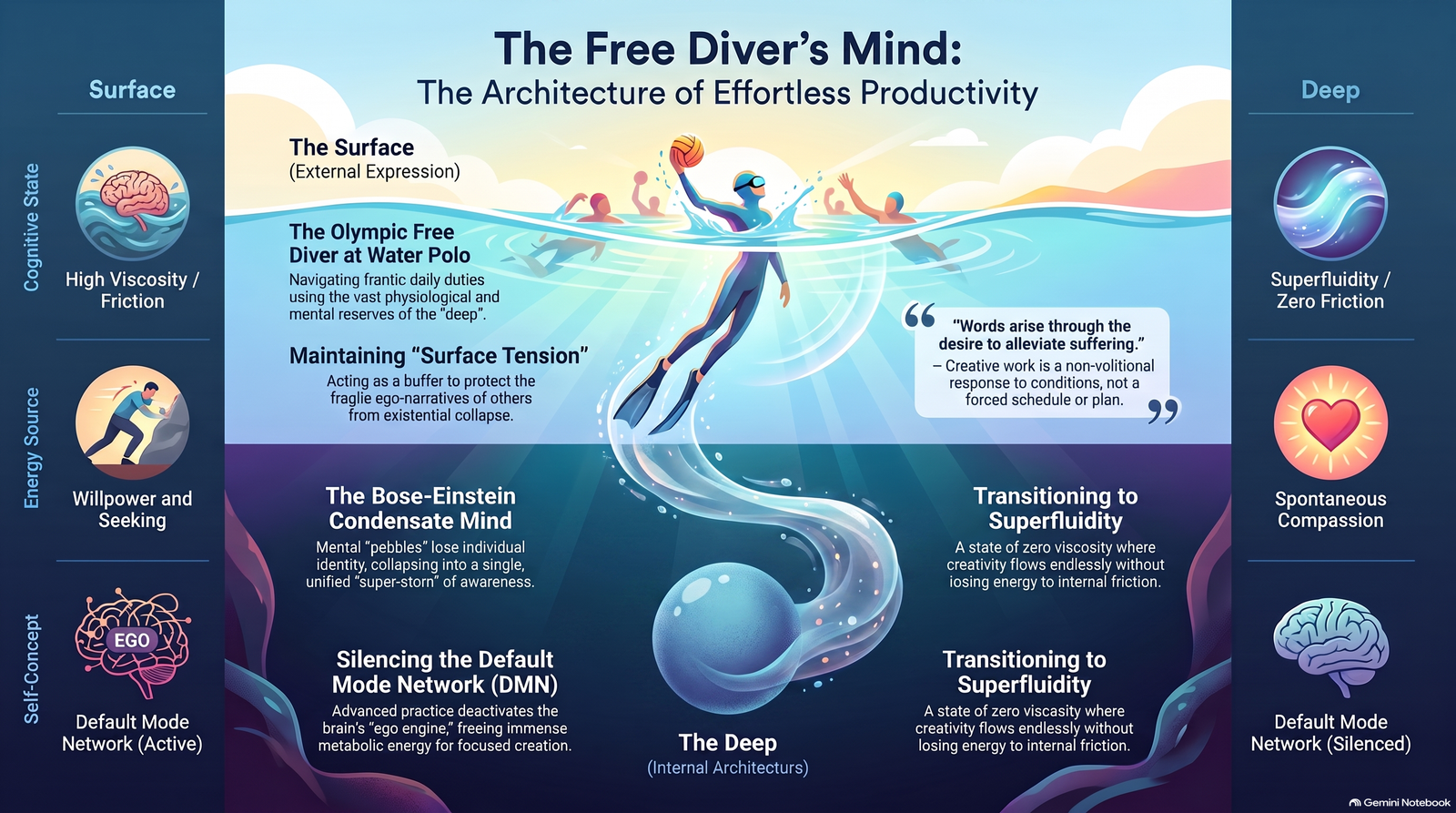
The episode’s boldest image comes from physics. Separate concepts are pictured as rough pebbles becoming smooth, then as atoms entering a Bose–Einstein condensate; superfluidity becomes a metaphor for a mind with less internal drag. The analogy is imaginative rather than explanatory. A human brain does not become a quantum condensate, and a report of cognitive ease is not evidence of zero physical cost.
The free diver playing water polo gives the inquiry its human scale. Depth does not abolish the surface: ordinary obligations, other people’s defences and the body’s limits remain. What changes is the proposed source of movement. When self-protection and spiritual seeking loosen, compassion, duty and responsiveness may become more prominent than ambition. The episode closes by asking whether a frictionless society would become more creative—or lose the anxious pressures on which much collective striving depends.
How to read this episode: productivity cannot diagnose a bhūmi, enlightenment, mania or any other spiritual or clinical state. The ninth bhūmi belongs to a Mahāyāna doctrinal map; “skandha demons” is the episode’s shorthand for traditional warnings about mistaking unusual experiences for attainment. Flow and transient hypofrontality are psychological and neuroscientific proposals, while the default mode network is not a single “ego centre”. Bose–Einstein condensation and superfluidity describe physical systems and function here only as metaphors. A reduced feeling of effort does not remove the body’s need for sleep, food, recovery or care.
Argument map
Six movements through the episode
Ease raises a question
A period of substantial output with little felt strain prompts an inquiry into effort, but the episode’s initial scepticism prevents achievement from becoming a certificate of awakening.
The firewall of doubt
Traditional warnings about spiritual inflation are recast as a psychological safeguard: an unusual state may be meaningful without the interpretation placed upon it being true.
Flow quietens supervision
Absorbed activity can reduce self-conscious monitoring. Skilled action continues, suggesting that the narrator of effort need not be the sole author of performance.
Physics supplies a metaphor
Bose–Einstein condensation and superfluidity picture conceptual boundaries softening and energy no longer being lost to internal resistance—not a literal transformation of the brain.
Compassion supplies direction
If self and other are less rigidly divided, creative work can be understood as a response to suffering rather than a project of self-construction or personal proof.
The seeker loses fuel
When saṃsāra and nirvāṇa are no longer imagined as two separate destinations, the spiritual engine may cease trying to escape the present and return to ordinary care.
Navigate the discussion
Chapter points
- 00:00What Would a Frictionless Mind Feel Like?
- 04:10The Ninth Bhūmi and the Problem of Spiritual Attainment
- 08:34Skandha Demons, Grandiosity and the Psychological Firewall
- 11:32Flow States and the Biology of Effortless Action
- 15:09Transient Hypofrontality and the Vanishing Inner Critic
- 18:49Superfluidity: A Physics Metaphor for Non-Dual Mind
- 22:50If There Is No Ego, What Still Motivates Action?
- 24:15Compassion and the Bodhisattva Ideal
- 26:10The Default Mode Network and the Freediver Mind
- 27:15When the Spiritual Fire Runs Out
- 29:10Saṃsāra, Nirvāṇa and the End of Seeking
- 32:05What Would a Frictionless Society Become?
Key language
Glossary
Sādhumatī, the ninth bhūmi
The ninth of the ten bodhisattva grounds in Mahāyāna Buddhism, often translated as “Good Intelligence” or “Excellent Intelligence”. Traditional accounts associate it with discriminating knowledge and an exceptional ability to communicate Dharma. It is a doctrinal stage, not a category that productivity or creative fluency can establish.
Skandha-māra and “skandha demons”
Skandha-māra names the obstructive or death-bound character of the five aggregates in some Buddhist classifications of Māra. The episode also echoes the Śūraṅgama Sūtra’s warnings about distortions that can arise around meditative experience. “Skandha demons” is therefore a loose English shorthand, not one uniform diagnostic category.
Flow
A state of deep absorption in an activity, often involving concentrated attention, reduced self-consciousness and an altered sense of time. Flow can make demanding work feel unusually smooth, but it does not by itself explain spiritual development or remove physiological cost.
Transient hypofrontality
A proposed account in which some altered or absorbed states temporarily reduce aspects of prefrontal processing, potentially changing time-awareness, explicit self-monitoring and cognitive control. It is a hypothesis used to interpret some experiences of flow, not a complete or universally accepted mechanism.
Default mode network (DMN)
A set of interacting brain regions studied in relation to internally directed thought, autobiographical memory, future simulation and aspects of self-referential processing. Meditation research has reported differences in its activity and connectivity, but the DMN is not simply “the ego” and is not an expendable error system.
Bose–Einstein condensate (BEC)
A state of matter formed under extreme conditions in which many bosons occupy the same quantum state and display collective quantum behaviour. Descriptions such as “one super-atom” can be useful introductions but are simplifications. Nothing in this episode suggests that contemplative consciousness literally becomes a BEC.
Superfluidity
A phase of matter with extraordinary flow properties, including effectively vanishing viscosity under appropriate conditions. Bose–Einstein condensation and superfluidity are related in important systems but are not interchangeable labels. The episode borrows “zero friction” as a metaphor for reduced psychological resistance.
Bodhicitta and spontaneous compassion
Bodhicitta is the aspiration and orientation towards awakening for the benefit of beings. The episode proposes that when self-protective narration weakens, creative action may arise more readily as compassion. This is a philosophical and contemplative interpretation, not a measurable law of motivation.
Surface tension
The episode’s metaphor for the tact and restraint required when one person’s way of understanding reality could unsettle another person’s protective meanings. It should not be mistaken for mind-reading or a literal energetic field between people.
Terror management theory
A psychological theory proposing that awareness of mortality helps motivate investment in cultural worldviews, self-esteem and meaning systems. The episode connects this with social defensiveness. That connection is interpretive, and the theory does not imply that every identity, institution or creative achievement is merely a defence against death.
Yuganaddha: the union of calm and insight
A term for union or yoking, used in Buddhist contexts for the integration of śamatha (calm abiding) and vipaśyanā (insight). The “secret alchemist’s fire” is the source dialogue’s personal metaphor for sustained contemplative restlessness, not a standard Buddhist definition of yuganaddha.
The equality of saṃsāra and nirvāṇa
In Madhyamaka thought, Nāgārjuna’s radical analysis undermines the idea that saṃsāra and nirvāṇa possess separate inherent natures. This does not mean that suffering and liberation are conventionally identical or that ethical distinctions cease to matter; it challenges reifying either as an independent destination.
A question to carry forward
Where is the work—and where is the friction added to the work?
Choose one ordinary task that feels effortful. Without trying to become effortless, distinguish three layers: the physical energy the task genuinely requires; the planning or skill needed to do it well; and the commentary about what the task says about “me”. Notice whether the third layer helps. Let it soften if it can, while preserving the first two and the body’s need for rest.
Continue the series