
Dialogues II · Episode 11
The Red Pill as Spiritual Purge | Dialogues II
The promise of truth becomes an image of subtraction: not acquiring a better self, but losing the world that made the old self seem certain.
The central question
What if awakening is imagined less as a revelation received than as a world relinquished?
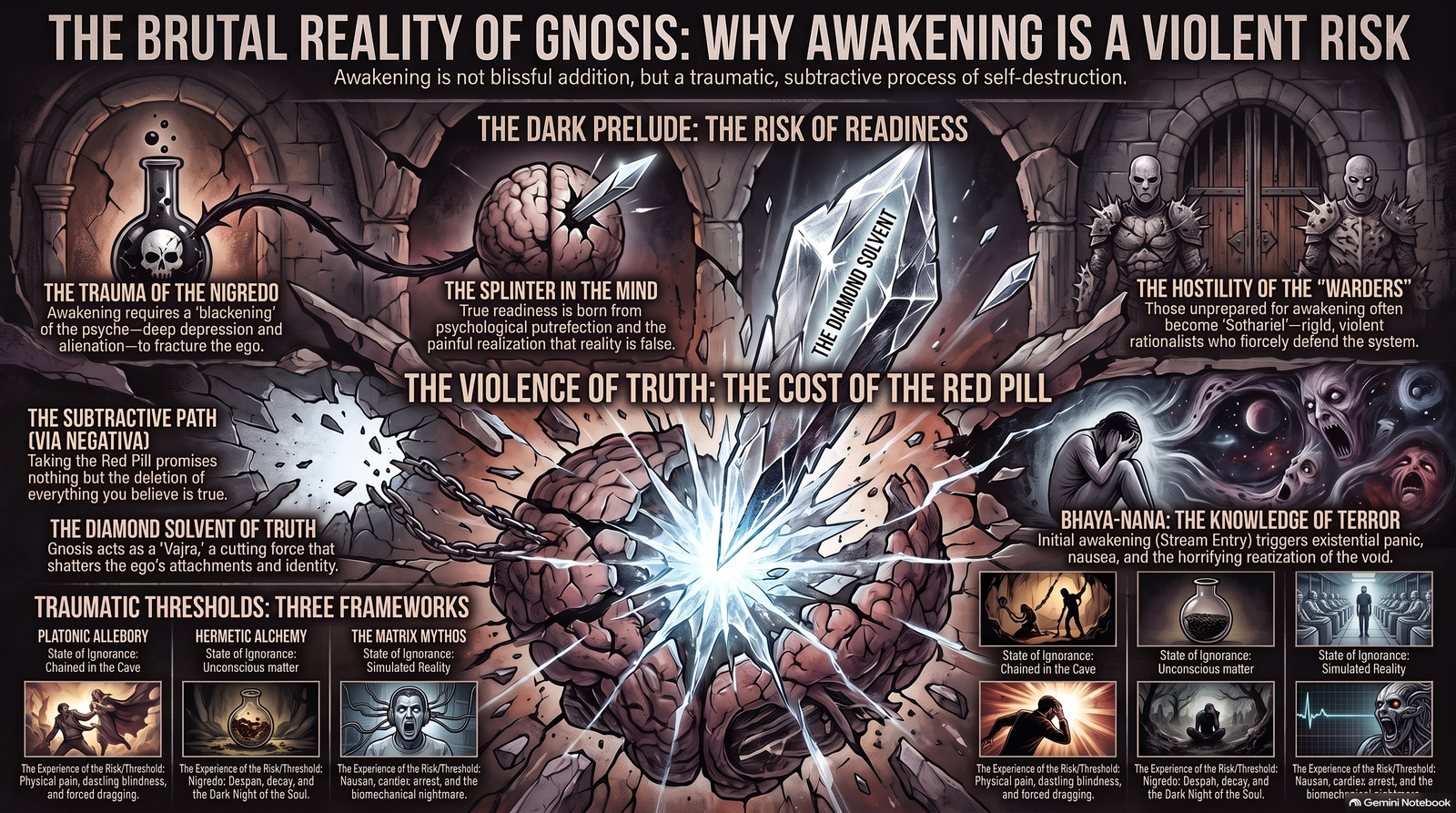
Episode 10 brought Neo to the threshold. This episode stays with the red pill, the liquid mirror and the brutal awakening in the pod, reading that short sequence as an image of gnosis: the direct knowledge that makes an inherited account of reality impossible to inhabit in quite the same way. Its governing claim is deliberately severe. Truth does not give Neo a superior identity or a more impressive collection of beliefs. It removes the apparent world that had allowed Thomas Anderson to seem secure.
The discussion begins by questioning the language of choice. Neo can reach for the red pill because a “splinter in the mind” has already made the ordinary world intolerable. Nigredo, the dark night and karmic readiness become ways of interpreting that prior fracture. The episode then moves through Plato’s Cave and the social defence of consensus, before turning to apophatic Christianity and the Upaniṣadic formula neti neti. Across these different traditions, subtraction becomes the central motif: remove the mistaken identification rather than decorate it with spiritual ideas.
The film gives this motif a body. The cracked mirror heals, liquefies and crosses the boundary of Neo’s skin. The episode places that image beside the Śūraṅgama Sūtra’s interrogation of where mind can be located. The analogy reverses the everyday assumption: perhaps experience is not contained inside a little observer, but the observer, body and room appear within experience. Neo’s expulsion from the pod is then compared with Theravāda descriptions of dissolution, fearfulness and disenchantment, and with stream-entry as an irreversible change in view.
The episode finally asks whether escape is really the end. If the familiar world is recognised as constructed, might liberation mature as a conscious return to relationship, play and form? That movement from rupture towards return anticipates an important distinction: one can use a film to illuminate the felt cost of relinquishing certainty without turning trauma into a qualification for awakening, terror into proof of attainment, or other people into enemies of truth.
Argument map
From the fracture of certainty to a chosen return
The choice begins before the pills
Neo’s reach for truth is presented as the visible result of an earlier dissatisfaction that has already weakened the authority of his world.
Nigredo names the loss of form
Alchemical blackening supplies a metaphor for disillusionment, although suffering or psychological collapse should not be treated as a spiritual prerequisite.
Systems preserve their own reality
Plato’s cave, the Matrix and qlippothic shells are used to ask why people and institutions defend familiar structures when uncertainty feels threatening.
Truth works by subtraction
Via negativa and neti neti turn Morpheus’s “nothing more” into a warning that awakening removes mistaken identifications rather than enlarging the ego.
The mirror dissolves the boundary
The liquid surface becomes an image of the mind’s unlocatability, shifting the question from what consciousness contains to where experience itself appears.
Escape opens into return
The pod scene dramatises terror and irreversible disorientation, but the closing question asks whether freedom ultimately returns to the world with greater care and play.
How the sources are used
Four lenses with different kinds of authority
The film
The red pill, liquid mirror and pod are elements of a cinematic narrative. The spiritual architecture drawn from them is an interpretation, not a confirmed account of the filmmakers’ single intended meaning.
Western traditions
Plato, Christian apophasis, alchemical Nigredo and Kabbalistic shell imagery provide historically distinct vocabularies for ignorance, negation, dissolution and concealment; they are not one doctrine.
Buddhist and Hindu texts
The Śūraṅgama Sūtra, Theravāda insight maps, stream-entry and neti neti arise in different traditions. The episode brings them into comparison without establishing equivalence.
The alchemical synthesis
“Karmic readiness” and the “diamond solvent” are interpretive formulations within the dialogue: memorable maps for the cost of truth, not clinical, scientific or universally doctrinal categories.
Chapters
The complete journey
- 00:00The Red Pill as an Occult Manual
- 02:20Why the Red Pill Is Not Really a Choice
- 05:15Nigredo, Breakdown, and Karmic Readiness
- 08:30The Purge of False Reality
- 11:10Plato’s Cave and the Violence of Truth
- 15:00Why People Defend the Illusion
- 18:40Kabbalah, Shells, and the Fear of Light
- 22:20“Nothing More”: Awakening as Subtraction
- 25:20Via Negativa, Neti Neti, and the Diamond Solvent
- 28:20The Liquid Mirror and the Non-Local Mind
- 31:20Stream-Entry, Terror, and the Loss of Self
- 33:10Returning to the Cave as Architect
- 34:07Closing Reflection
Study guide
Terms, distinctions and reference points
Glossary
Gnosis
From the Greek for knowledge. In several religious and esoteric settings, gnosis means a transformative or saving knowledge that is directly realised rather than merely accepted as information. The episode uses it broadly for an irreversible recognition that changes one’s relation to the apparent world; this is not a claim that The Matrix reproduces a single historical Gnostic system.
Nigredo
The “blackening” of alchemical matter, associated with decomposition and the breaking down of a previous form. Later psychological and spiritual interpretations use Nigredo as a symbol of disorientation, grief or the collapse of identity. It is an analogy, not a clinical category, and distress is not evidence that an alchemical or spiritual transformation is occurring.
Karmic readiness
The episode’s phrase for conditions that make a person receptive to a path or question before a conscious decision is made. In Buddhist traditions, karma refers primarily to intentional action and its consequences, not to a fixed destiny or a requirement to be traumatised. Here the phrase belongs to the dialogue’s synthesis rather than to a standard diagnostic doctrine.
Via negativa
The “negative way” in Christian theology: approaching God by denying the adequacy of finite descriptions rather than defining the divine through positive attributes alone. The episode compares this movement of un-saying with the red pill’s subtractive promise. It should not be collapsed into Buddhist emptiness or the Upaniṣadic method of neti neti.
Neti neti
A Sanskrit expression meaning “not this, not this”, associated especially with the Bṛhadāraṇyaka Upaniṣad. It negates limited identifications or descriptions of the ultimate. The episode uses it as a conceptual scalpel for identity, but its Vedāntic setting differs from Buddhist accounts of no-self and Christian apophatic theology.
Vajra and the “diamond solvent”
Vajra can mean thunderbolt or diamond and is a major symbol in Indian and Tibetan Buddhist traditions, often conveying indestructibility and irresistible power. “Diamond solvent” is the episode’s own paradoxical metaphor for truth that cuts through false identification; it is not a standard translation or traditional name for the vajra.
Qlippoth and Satariel
Qlippoth means “shells” or “husks” in later Kabbalistic discourse. Satariel is a spelling found particularly in modern occult mappings of those shells. The episode uses the imagery for concealment and defensive rigidity. This symbolic use should not be treated as a uniform teaching across Jewish Kabbalah, nor as a label for people who value evidence or scepticism.
The Śūraṅgama Sūtra and the location of mind
An influential Mahāyāna scripture in East Asian Buddhism. Early in the text, Ānanda proposes several locations for his knowing mind and the Buddha challenges each one. The episode links that inquiry to the liquid mirror. The further claim that Neo is “inside mind” is a cinematic-philosophical interpretation, not a direct quotation from the sūtra.
Stream-entry and identity view
In Theravāda Buddhism, a stream-enterer (sotāpanna) has entered the irreversible path to liberation. Traditional lists associate this with abandoning identity view, doubt and misapprehension of rules and observances. Identity view concerns clinging to the aggregates as self; it does not mean that ordinary personality, memory or ethical responsibility is violently erased.
Bhaṅga-ñāṇa and bhaya-ñāṇa
In influential Theravāda maps of insight, knowledge of dissolution (bhaṅga-ñāṇa) is followed by awareness or knowledge of fearfulness (bhayatupaṭṭhāna-ñāṇa, often shortened in discussion to bhaya-ñāṇa). These are technical contemplative categories, not general names for panic, existential distress or every frightening meditation experience.
Nibbida
A Pāli term often translated as disenchantment, revulsion or turning away. Within insight maps, it concerns the fading of fascination with conditioned formations after their unsatisfactory nature is seen. “Disenchantment” can avoid the misleading suggestion of ordinary disgust. The episode’s comparison with Neo’s pod experience remains cinematic analogy.
Returning to the cave
In Plato’s allegory, the liberated prisoner returns to the cave and is poorly received by those still accustomed to shadows. The episode transforms return into a closing question: after recognising construction, can one re-enter form through love and play rather than unconscious captivity? This is the dialogue’s synthesis, not a settled conclusion shared by all the traditions invoked.
Related reading on this site
- The Matrix as a Roadmap to AwakeningEpisode 10 follows the splinter in the mind, the white rabbit and the red-pill threshold that this episode now crosses.
- 1.1.11 The Dark Night of the SoulPlaces the dialogue’s language of blackening and loss within the wider Nigredo course.
- 3.3.5. The Allegory of the CaveDevelops Plato’s movement from shadows to difficult sight, and the ethical problem of returning.
- The gross fettersProvides the site’s wider account of the early fetters referenced in the comparison with stream-entry.
- Padmasambhava’s Map of the Locationless Mind | Dialogues IVA later dialogue that makes the unlocatability of mind its central inquiry rather than a cinematic overlay.
- 3.2.12. Returning to SaṃsāraExtends the closing possibility that freedom may express itself through conscious return rather than permanent escape.
External reference points
- Plato, Republic, Book VII — MIT Classics ArchiveThe primary philosophical source for the cave, painful adjustment to light and return to those still watching shadows.
- Meister Eckhart — Stanford Encyclopedia of PhilosophyA scholarly guide to Eckhart’s apophaticism, detachment and the stripping away of finite images and attachments.
- The Shurangama Sutra, Volume One — Buddhist Text Translation SocietyA translation with commentary showing the sequential challenges to Ānanda’s proposed locations of the mind.
- Mahasi Sayadaw, The Progress of InsightA modern Theravāda presentation of dissolution, fearfulness, misery, disenchantment and the later movement towards equanimity.
A grounded reflection
Notice what a familiar object already asks you to believe
Choose one ordinary object near you: a key, mug, book or phone. For a minute, notice the practical story that makes it what it is—its name, purpose, owner, value and place in your routine. Then notice its colour, weight, texture and changing sensations without trying to make the object unreal. Let both levels remain together: the useful story and the immediate appearance. Ask quietly, “Which part is given, and which part do I continuously add?”
Continue the sequence