
Dialogues II · Episode 12
Why Your Mind Bends the Spoon | Dialogues II
A famous impossible spoon becomes an inquiry into how mind, naming and perception make a continuous world feel solid.
The central question
If a thing cannot be found apart from its parts, relations and perception, what exactly makes it the thing we encounter?
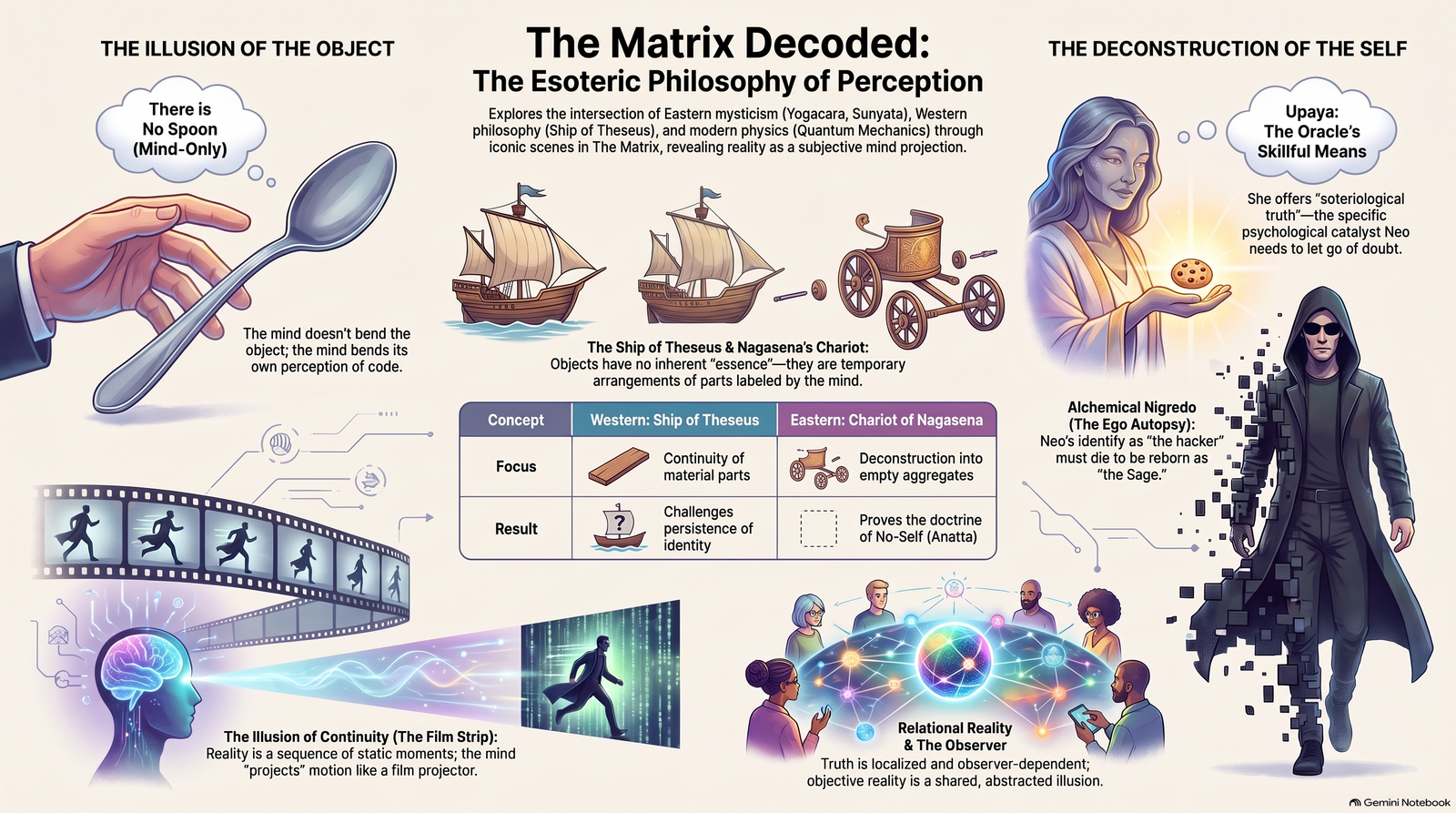
A child bends a spoon in The Matrix and tells Neo that the decisive change is not in the metal but in himself. This episode treats the scene as a compact philosophical experiment. The spoon remains useful, visible and consequential within the film, yet its apparent solidity depends upon code, perception and the mind’s habit of dividing experience into an observer here and an object there. The question is not simply whether matter is unreal. It is how a world of stable things is assembled, named and believed.
The discussion first places the scene beside Yogācāra or Cittamātra accounts of experience. It then turns to the Śūraṅgama Sūtra’s distinction between transient “guests” and the unmoving “host” of awareness, and to Huineng’s intervention in the argument over whether wind or flag is moving. These materials do not all formulate one doctrine, but together they challenge the reflex to locate reality wholly in an independent object outside the act of knowing.
From there, the episode shifts from mind to designation. The Ship of Theseus asks how identity survives replacement through time; Nāgasena’s chariot asks where identity can be found among assembled parts. Muybridge’s photographs of a running horse then supply a visual bridge to Buddhist momentariness: continuity may be experienced as seamless even when analysis reveals a succession of events. The spoon, chariot, ship and moving horse each expose a different contribution made by memory, language and cognitive synthesis.
The final movement returns to Neo and the Oracle. Skillful means and alchemical Nigredo become ways of reading a statement that is functionally transformative without being a simple report of fixed fact. Relational quantum mechanics is then introduced as a modern comparison. This is also where the episode’s most important boundary appears: quantum theory can question observer-independent physical states, but it does not establish that consciousness invents macroscopic reality, that mutually incompatible personal beliefs are equally true, or that belief alone can change matter.
Argument map
Six ways the solid world becomes less simple
The spoon is a threshold object
Because Neo and the spoon share the Matrix’s code, the scene can dramatise the instability of the boundary between perceiver and perceived.
Mind-only is not private fantasy
Yogācāra redirects attention towards cognition and the structure of experience; it need not imply that an individual ego dreams every other being into existence.
Guest and host change the emphasis
Moving forms, sensations and thoughts are contrasted with awareness of their movement, loosening the automatic identification of knowing with what is known.
A name gathers dependent parts
Ship and chariot show that a useful identity may be conventionally applied without an independent essence being discovered inside the assembled object.
Continuity may be constructed
Sequential photographs and doctrines of momentariness invite the question of how memory and perception compose change into apparently continuous motion.
Relation does not mean wish-creation
The Oracle and relational physics both complicate a view from nowhere, but neither licenses the claim that any personally useful story becomes physical fact.
How the sources are used
A cinematic experiment across several distinct traditions
The film
The spoon child, Oracle and Construct belong to a fictional world in which bodies and objects are code. They make metaphysical questions vivid, but do not demonstrate paranormal powers or simulation theory.
Buddhist philosophy and texts
Yogācāra, the Śūraṅgama Sūtra, Huineng, Nāgasena, momentariness, skillful means and the bhūmis arise in different textual and doctrinal settings. The page keeps those differences visible.
Alchemy and Western philosophy
Nigredo and the Ship of Theseus supply different models of dissolution: one symbolic and transformative, the other a problem about persistence and identity. Neither is a scientific theory of matter.
Photography and physics
Muybridge reveals motion through sequences of images. Relational quantum mechanics concerns physical facts relative to interacting systems. Both are used analogically, not as experimental confirmation of Buddhist doctrine.
Chapters
The complete journey
- 00:00Opening: There Is No Spoon
- 02:00The Matrix as a Map of Perception
- 04:40Eighth Bhūmi or Foundational Emptiness?
- 06:50Yogācāra and Mind-Only Reality
- 09:30The Guest, the Host, and Seeing Nature
- 13:10The Flag, the Wind, and the Moving Mind
- 16:00The Spoon as a Projection
- 19:10Ship of Theseus and Nāgasena’s Chariot
- 23:30Cinema, Motion, and Momentariness
- 28:00Why Reality Feels Continuous
- 31:20The Oracle and Skillful Means
- 35:10Nigredo, Ego, and Psychological Rebirth
- 38:30Observer-Dependent Reality
- 41:00Final Reflection: What Are You Still Agreeing To?
Study guide
Terms, distinctions and reference points
Glossary
Emptiness (śūnyatā)
In Buddhist philosophy, emptiness commonly indicates that phenomena lack an independent, permanent essence and arise dependently. It is not a statement that nothing appears, functions or matters. The spoon can be empty of inherent “spoon-nature” while remaining a usable conventional object; within the film, it is additionally dependent on computer code.
Yogācāra and Cittamātra
Yogācāra is a major Indian Mahāyāna tradition concerned with cognition, perception, consciousness and liberation. Cittamātra, “mind-only”, is associated with strands of Yogācāra interpretation. Scholars and Buddhist traditions disagree over whether its claims are best read as metaphysical idealism, phenomenological analysis or a soteriological strategy. It should not be casually equated with the private ego creating an external universe.
The eighth bhūmi
The bhūmis are stages of the bodhisattva path in Mahāyāna literature. The eighth is often called the Immovable. It is associated with non-regression and advanced, effortless activity in particular path systems. A fictional feat of spoon-bending does not identify the child as an eighth-bhūmi bodhisattva, and the episode ultimately treats the scene as a more foundational lesson in emptiness and non-separation.
Guest, host and seeing-nature
The Śūraṅgama Sūtra contrasts changing “guest-dust” with a host that does not come and go, and examines whether seeing itself moves when the body or visible object moves. The episode uses this imagery to distinguish transient contents from awareness. These are teachings within an influential East Asian Buddhist text, not laboratory findings about a separable substance called consciousness.
Huineng, the wind and the flag
In the Platform Sūtra tradition, two monastics dispute whether a flag or the wind is moving; Huineng says their minds are moving. The exchange redirects attention from competing external explanations to the activity of discrimination. It need not deny conventional wind, flags or causation, and the episode’s connection with code inside the Matrix is interpretive.
Ship of Theseus
A classical puzzle, reported by Plutarch, about a ship whose parts are replaced over time. If none of the original timbers remains, in what does the identity of the ship consist? The problem concerns persistence, naming and criteria of identity. It resembles Buddhist analyses in useful ways but developed in a different philosophical setting.
Nāgasena’s chariot
In the Milindapañha, Nāgasena asks King Milinda whether the chariot is its pole, axle, wheels, body, reins or some combination apart from them. “Chariot” is understood as a conventional designation dependent upon components. The analogy supports an analysis of personal identity; it does not claim that conventional persons or vehicles are useless or wholly nonexistent.
Momentariness (kṣaṇikavāda)
A family of Buddhist doctrines according to which conditioned phenomena arise and cease moment by moment. Different Buddhist schools formulate the theory differently. The episode compares it with successive film frames and Muybridge’s photographs, but photographic sequences illustrate analytical decomposition rather than proving a metaphysical doctrine of instantaneous events.
Skillful means (upāya)
A Mahāyāna concept for teachings or methods adapted to a being’s circumstances and capacity. The Oracle’s words are read as functionally tailored rather than as a neutral prediction. Calling this “skillful means” is a comparison made by the episode, not a claim that the film’s character has Buddhist religious authority.
Nigredo and Albedo
Nigredo, the blackening, and Albedo, the whitening, name phases within alchemical processes and later symbolic interpretations of psychological transformation. This episode associates the destabilisation of Neo’s inherited identity with Nigredo and the clarification of the Construct with Albedo. Those are interpretive correspondences; psychological crisis is not proof of spiritual progress, and alchemical stages are not equivalent to Buddhist attainments.
Relational quantum mechanics
An interpretation developed by Carlo Rovelli in which values of physical quantities and facts are relative to interactions between physical systems; there is no privileged observer-observed division. It does not say that every belief is true, that human consciousness collapses reality through intention, or that an Oracle can make contradictory propositions equally correct. The episode’s application to Neo and Morpheus is philosophical analogy rather than a result derived from quantum theory.
Related reading on this site
- The Red Pill as Spiritual PurgeEpisode 11 crosses the threshold of apparent reality; this episode examines how the world beyond it is still assembled through code, perception and designation.
- EmptinessPlaces the episode’s central term within the website’s broader account of dependent and ungraspable phenomena.
- The Parable of the Buddha’s ChariotExtends the analysis of a named whole that cannot be isolated from its parts and conditions.
- 1.2.2. The Matrix of Conditioned RealityDevelops the distinction between apparent form and the conditions that sustain its appearance.
- Albedo — Part TwoProvides the wider course setting for whitening, clarification and the reflective analysis symbolised by the Construct.
- Why Reality Lasts 17 Mind Moments | Dialogues IVA later dialogue returns to momentariness and apparent continuity through a different Abhidhamma-inflected lens.
External reference points
- Yogācāra — Stanford Encyclopedia of PhilosophyA scholarly overview of Yogācāra’s texts, accounts of cognition, three natures and debates surrounding mind-only.
- The Seeing Nature — Shurangama Sutra with CommentaryThe textual sequence used in the episode to distinguish the movement of head and objects from the activity of seeing.
- Wind, flag and mind — The Sixth Patriarch’s SutraA translation with commentary containing Huineng’s intervention in the dispute about movement.
- Nāgasena and the chariot — MilindapañhaThe primary dialogue in which King Milinda is asked to locate a chariot among its components.
- Muybridge, Attitudes of Animals in Motion — The MetThe sequential photographic study that supplies the episode’s bridge between discrete images and experienced movement.
- Carlo Rovelli, “Relational Quantum Mechanics”The original 1996 paper proposing that quantum theory describes information physical systems have about one another without a privileged observer.
A grounded reflection
Find the object without making it disappear
Place an ordinary spoon on a table. Notice its colour, reflections, coolness, weight and practical use. Then ask where its identity resides: in the metal, its shape, its function, its history, the word “spoon”, or the relation among all of these. Do not try to deny the object or physically bend it. Let two truths remain together: the spoon reliably functions in ordinary life, and no isolated, permanent essence of “spoon” is found apart from parts, conditions, perception and designation.
Continue the sequence