
Nigredo · Subject · Chapter 38 of 48
1.4.2. The Fall
What if leaving an inherited world is neither simple progress nor simple failure, but the difficult beginning of responsibility?
Watch the chapter discussion
Why the Fall Is Necessary
The book
The chapter in brief
The Fall interprets departure from an inherited worldview as a necessary, though risky, movement into self-determination. Childhood dependence on external authority gives way to a more sharply defined sense of self, personal choice and responsibility. Within Dr Robinson’s modern alchemical map, rebellion and pride can therefore open development while also strengthening separation, self-interest and harmful habits.
The chapter combines this symbolic account with autobiographical reflection on intoxicants, a dream of a collapsing spiral staircase and the Tarot Tower. It concludes through solve et coagula: inherited structures are dissolved before a more deliberate understanding can be formed. This is a personal psychological-spiritual reading of biblical and alchemical imagery, not the sole meaning of Genesis, a universal developmental law or evidence that destabilisation is required for awakening.
Video guide
Why must innocence give way to responsibility?
The recording opens by reversing the familiar moral direction of the Fall. Rather than treating Eden only as lost perfection, it follows a Jungian reading in which leaving the garden symbolises entry into consciousness. Its visual anchor is a spiral staircase rising from ordered sacred geometry into disconnected, falling stones. The image allows the speakers to ask what happens when the world supplied by parents, teachers and culture no longer feels sufficient.
The answer develops through the formation of selfhood. The repeated question “What’s in it for me?” becomes a shorthand for the new capacity to evaluate choices from a personal centre. That capacity permits agency and responsibility, but the discussion also associates it with duality: an inner self is defended against an outer world, especially through secrecy, deception and self-justification. Pride and rebellion are therefore treated ambivalently. They help a person leave inherited authority, yet can harden into an identity organised around opposition.
The middle of the recording turns to intoxicants and makes its boldest claims. It suggests that altered states can loosen confidence in ordinary reality and speculates that addiction may involve a misrecognised search for qualities associated with jhāna, such as rapture, happiness and equanimity. The chapter’s warning against chemical shortcuts is clear, but the proposed explanation of addiction and tolerance is not an established clinical mechanism. Substance-use disorders involve interacting biological, psychological and social processes; an evocative resemblance between intoxication and contemplative states cannot establish equivalence.
The Tower dream then returns the discussion to Nigredo. A self-built structure appears to collapse, leaving the person in the disorientation that alchemy names blackening. The conclusion uses solve et coagula to resist both nostalgia and endless rebellion: one cannot simply return to childhood innocence, but neither is destruction the goal. Meditation, reflection and ethical responsibility are offered as ways of examining what the fall has disclosed. The final provocation asks whether an authentic identity, once constructed, may itself eventually need to become less rigid.
Argument map
How the recording develops
Reframe the Fall
Edenic innocence becomes an image of inherited order, while the Fall is reconsidered as an entry into conscious responsibility.
Watch the self take shape
Personal choice crystallises around a distinct point of view capable of asking what an action means for “me”.
Test pride and rebellion
The same forces that loosen external authority can support maturity or harden into opposition, secrecy and self-justification.
Question the shortcut
Altered states are presented as challenges to ordinary certainty, before the recording speculates—too confidently—about addiction and jhāna.
Enter the Tower
A dream of collapsing steps and the Tarot Tower symbolise the failure of a self-structure that can no longer support its claims.
Dissolve and recombine
Solve et coagula shifts the goal from destruction towards an ethically grounded reconstruction that remains open to further change.
Visual synthesis
From inherited paradigms to authentic seeking
The infographic condenses the chapter’s movement into three broad phases: received order, disruptive self-determination and deliberate reconstruction. It is an interpretive summary of this course chapter rather than a universal psychological sequence.
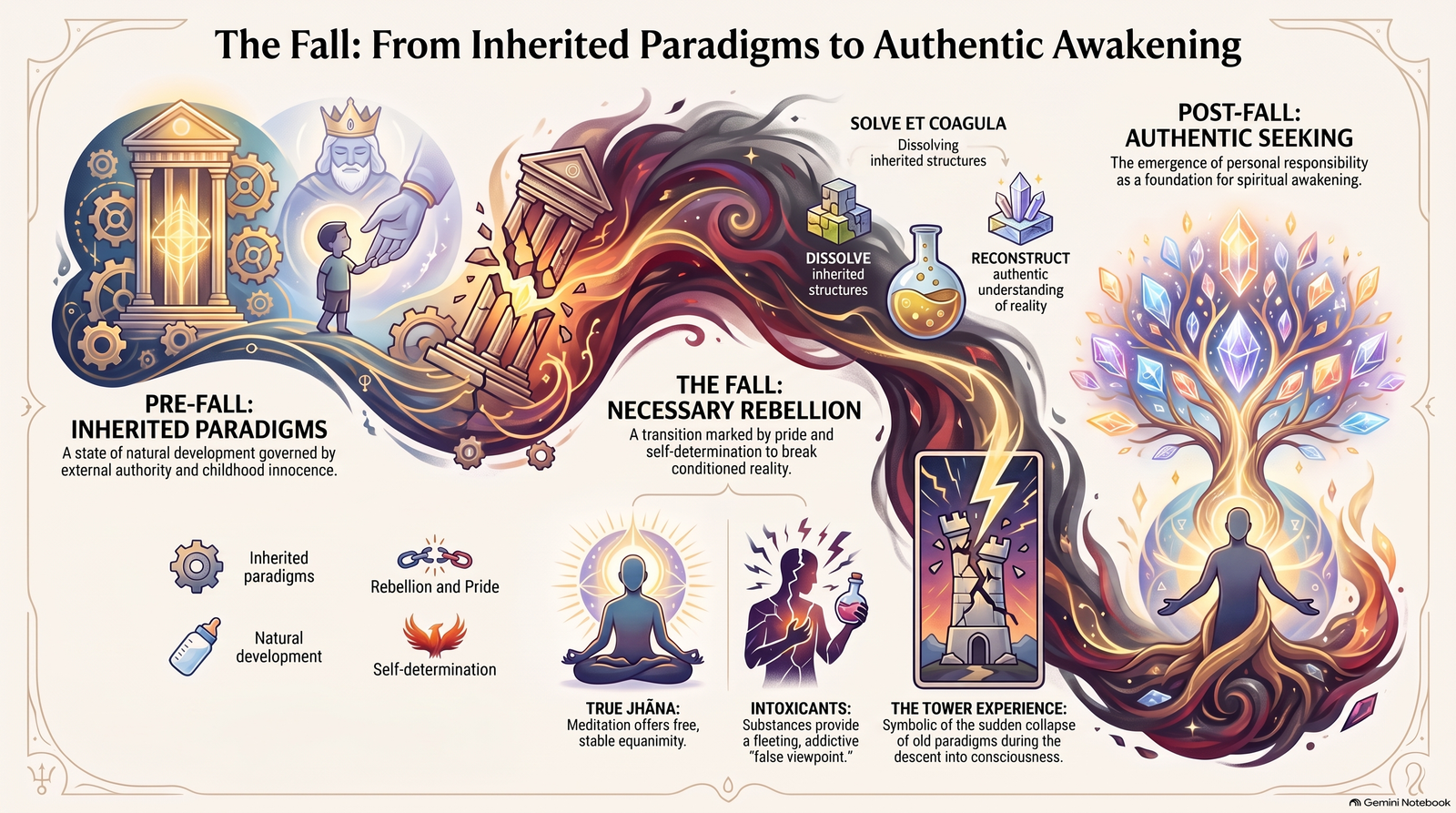
Book and recording
What each layer contributes
| Layer | What it contributes | Boundary to retain |
|---|---|---|
| The written chapter | A concise personal account of self-determination, intoxicants, the Tower dream and reconstruction through solve et coagula. | It is Dr Robinson’s autobiographical and alchemical interpretation, not a standard developmental model or clinical theory. |
| The AI-generated recording | A sustained psychological narrative moving from inherited authority through ego formation, collapse and integration. | It amplifies the source, sometimes turning possibility into certainty and introducing historical or clinical claims the chapter does not establish. |
| Biblical and Jungian imagery | Eden, naming, consciousness and individuation provide languages for separation from an inherited world. | The reading is symbolic and modern; Genesis has diverse Jewish and Christian interpretations, and Jungian psychology is not biblical exegesis. |
| Buddhist vocabulary | Jhāna, pīti, sukha, upekkhā and taṇhā help compare craving with disciplined contemplative development. | The comparison does not make intoxication equivalent to absorption or explain addiction and tolerance as Buddhist mechanisms. |
Working vocabulary
Terms used in the chapter and recording
The Fall
Individuation
Duality
Jhāna
Pīti, sukha and upekkhā
Taṇhā
Addiction and tolerance
The Tower
Nigredo
Solve et coagula
Shadow
Continue within the course
Related pathways
- 1.4.1. What Went BeforeThe preceding Subject chapter asks how a life becomes recognisable as a path when viewed retrospectively.
- Chapter 39 video: Why You Feel Exiled From YourselfThe next Subject chapter continues from separation and self-authority into the symbolism of exile and inner conflict.
- 1.3.2 The Trees of ConsciousnessProvides the course’s earlier symbolic framework for the Tree of Life, the Tree of Knowledge and divided awareness.
- 1.1.9 The Rebis & Rejection of IdentityDevelops the alchemical problem of division, opposites and the possibility of a less rigid identity.
- 1.1.11 The Dark Night of the SoulExamines how images of darkness and collapse can orient reflection without making suffering proof of progress.
Reference points
For careful further reading
- Genesis 2:15–3:24, NRSVUEThe primary biblical narrative of the garden, the prohibited tree, eating, new self-awareness and expulsion; it permits comparison with the chapter’s modern symbolic reading.
- International Association for Analytical Psychology: IndividuationAn introduction to the Jungian process of psychological integration, which is broader and more demanding than rebellion against inherited authority.
- International Association for Analytical Psychology: AlchemyExplains Jung’s psychological engagement with alchemical imagery and helps distinguish that approach from the history of laboratory alchemy.
- SuttaCentral: AN 3.90, The Three TrainingsAn early Buddhist source placing ethics, meditative absorption and wisdom within an ordered training rather than treating altered experience alone as liberation.
- NHS: Drug addiction—getting helpPractical, non-judgemental information about routes to assessment, treatment and support in the UK.
Question to carry forward
What have you chosen—and what are you merely opposing?
Bring to mind one belief or expectation you have moved away from. In two short columns, note what you no longer accept and what you positively choose in its place. Does the newer position increase responsibility, honesty and care, or does it still depend mainly on resisting the old authority? This is a question for ordinary reflection, not a test of spiritual progress.
Course navigation