
Albedo · Subject · Chapter 38 of 48
2.4.2. Metanoia
Metanoia here names a shift in standpoint: changing experience is noticed without turning the capacity to notice into another permanent self.
Chapter video
The mirror and what it reflects
Book orientation
The chapter in brief
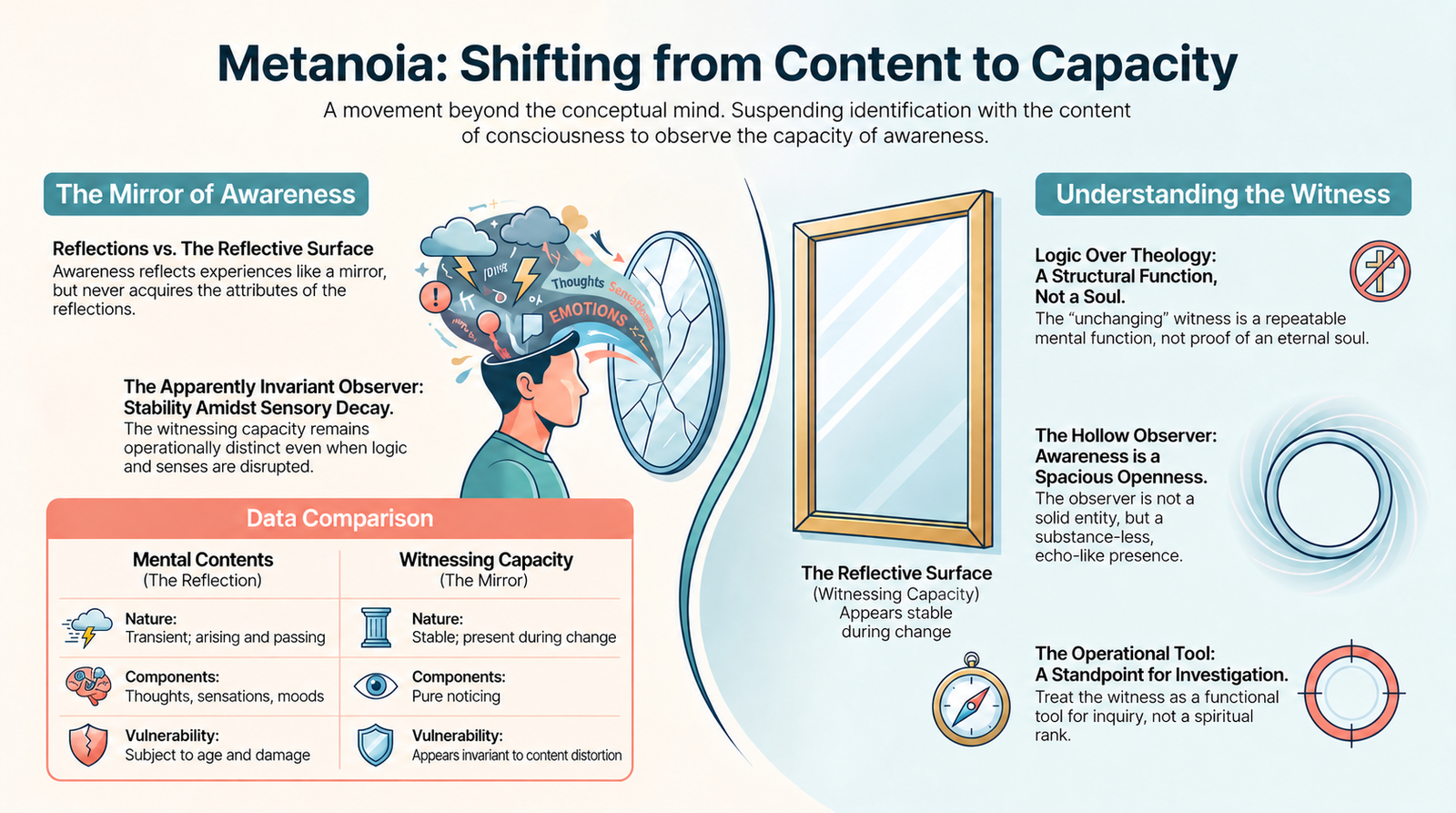
Following the warning of “Experiment”, this chapter asks what remained observable when perception, reasoning and the familiar personality were chemically disturbed. Dr Simon Robinson names a contrast between the changing contents of consciousness and the capacity through which change is noticed. The Śūraṅgama Sūtra’s mirror-like account of seeing supplies the chapter’s principal image: reflections change while the reflective function appears stable. Yet the witness is not offered as an eternal soul or final spiritual identity. It is an operational standpoint from which thoughts, sensations and moods can be investigated. The chapter ultimately distinguishes a brief, destabilising glimpse from cultivated contemplative attainment and returns the inquiry to ethical grounding, meditation and integration.
Transcript-led guide
From the contents of experience to the capacity that knows them
The recording begins by redefining metanoia. Its ordinary Greek history concerns a change of mind, purpose or orientation; the episode deliberately extends this into an alchemical reading of meta as “beyond” and noos as “mind”. That is a productive interpretive construction rather than the word’s uncontested literal meaning. Within the chapter, it names a movement beyond exclusive identification with thoughts, emotions and personality towards examination of the context in which they appear.
The argument emerges from Robinson’s earlier chemical experiments. As sensory coherence, logical thought and autobiographical identity became unstable, he reports that a capacity to register the instability still seemed present. The video presents this as the distinction between a damaged television and an unaffected broadcast signal. Phenomenologically, the analogy captures the difference between what is experienced and the fact of experiencing it. Logically and scientifically, however, the episode cannot establish that awareness exists independently of the brain, that a separate subject must stand behind every experience, or that an apparently clear witness was itself unaffected by intoxication. The safer conclusion is narrower: experience can contain a powerful sense of witnessing that feels less changeable than its objects.
The Śūraṅgama Sūtra deepens the inquiry through the dialogue with King Prasenajit. The king’s body and eyesight age, while the knowing of visual change does not seem to possess wrinkles or years in the same manner. The recording develops this into the Mirror of Awareness: childhood and old age, clarity and confusion, pleasure and fear appear as reflections without becoming properties of the reflective surface. This is best read as contemplative instruction and metaphor. It does not by itself demonstrate a timeless substance, and the chapter explicitly warns against converting the functional witness into a soul, a “true self” or a theological proof.
The final movement enters what the chapter calls the “hollow observer”: a chemically precipitated experience of spaciousness that resembled the Buddhist dimension of infinite space. The book carefully calls this a glimpse rather than an attainment. Traditional descriptions imply intentional entry, stability and repeatability; a forced episode supplies none of those criteria. The recording then identifies three subtler traps: worshipping the witness as soul, using it to bypass painful emotion, and confusing the thought “I am watching” with non-verbal observation. Its five-minute Mirror Drill turns the teaching into practice while retaining the decisive caution: the witness is a tool for inquiry, not a rank or a new identity.
Argument map
How the recording moves
A familiar word is made structural
Metanoia is moved beyond a change of opinion and used for a shift in identification from mental content towards the capacity in which content appears.
The machine is disturbed
Chemical destabilisation disrupts perception, reasoning and personality while an experience of witnessing seems to remain available.
Content and capacity are separated
Thoughts, sensations, moods and memories are transient; pure noticing is presented as the reference point through which their variation becomes knowable.
The mirror clarifies the distinction
The Śūraṅgama Sūtra and the ageing test illustrate how a reflective function need not acquire the attributes of what it reflects.
Logic limits theology
The recording rejects the leap from an apparently stable witness to proof of an eternal soul, even though some of its analogies momentarily press beyond that limit.
The observer becomes hollow
A spacious, centreless episode resembles the dimension of infinite space but is qualified as an unstable glimpse rather than controlled contemplative attainment.
The tool is put down
The witness supports investigation only while it is not reified, narrated or used to escape emotion; integration returns attention to ordinary conduct and practice.
Book–video relationship
Metaphor, expansion and qualification
The chapter establishes
A distinction between transient mental contents and an apparently stable witnessing capacity, then warns against turning that capacity into another self.
The video expands
The television, empty-room, movie-screen, mirror, mountain and wrench analogies make the structural shift vivid and carry it into anxiety and daily practice.
The guide qualifies
Etymology, phenomenology, neuroscience, textual attribution and contemplative attainment are separated so that a useful experience is not promoted into proof.
Video chapters
Navigate the discussion
- 00:00Opening: You Are Not Your Thoughts
- 02:10What Is Metanoia (Really)?
- 06:00The Collapse of Identification
- 10:40Contents vs Capacity
- 15:20The Mirror of Awareness Explained
- 20:30Does Awareness Change?
- 25:40The Void and Formless Experience
- 30:50Glimpse vs Attainment
- 34:40The Trap of the Witness
- 37:20Integration and Safe Practice
Glossary
Terms used in the chapter and recording
Metanoia
Mental contents
Witnessing capacity
Phenomenology
The Mirror of Awareness
Śūraṅgama Sūtra
Dimension of infinite space
The Hollow Observer
Reification
Witness as thought
Glimpse and attainment
Dissociation
Operational witness
Related pathways
Continue within the course
- 2.4.1. ExperimentThe preceding chapter supplies the autobiographical and chemical background from which the distinction between disruption and clarification emerges.
- 2.2.6. The Life ContinuumIntroduces bhavaṅga and the course’s earlier attempt to describe continuity beneath active cognitive events.
- 2.2.11. Transcendental ConsciousnessPlaces altered modes of knowing within a more technical account of path and fruit consciousness, with attainment requiring more than unusual phenomenology.
- 2.3.1. HollownessExamines the disorienting interval in which familiar identity has weakened but emptiness has not yet become an integrated and compassionate way of living.
- 2.3.8. The Death of the SelfExplores ego dissolution while distinguishing symbolic death, psychological experience and the doctrinal language of non-self.
- Albedo — Part TwoReturn to the main Albedo course directory and the four-part map of whitening, clarification and integration.
Reference points
Language, texts and evidence boundaries
- Online Etymology Dictionary: MetanoiaTraces the term through Greek metanoein, “to change one’s mind or purpose”. This helps distinguish the chapter’s creative “beyond mind” reading from ordinary lexical history.
- Majjhima Nikāya 2: Sabbāsava SuttaThe discourse named beneath the chapter’s mirage sentence. Standard versions concern methods for restraining and abandoning defilements; the sentence itself should not be presented as a verified quotation from this text.
- Saṃyutta Nikāya 40.5: A Question About the Dimension of Infinite SpaceAn early Buddhist description of entering and remaining in the dimension of infinite space, providing a textual benchmark for the stability and cultivation implied by an attainment.
- Stanford Encyclopedia of Philosophy: PhenomenologyAn introduction to the philosophical study of conscious experience, useful for understanding what first-person description can clarify without turning appearance into metaphysical proof.
- NHS: Dissociative disordersA clinical reference for depersonalisation, derealisation and persistent disconnection, helping distinguish a chosen contemplative exercise from distressing or impairing dissociation.
Question to carry forward
Can the witness be noticed without becoming “me”?
Allow one sound, sensation or thought to arise and pass. Notice the difference between the event and the capacity through which it is known. Then look for the observer itself. Does an entity appear, or only another image, feeling or sentence? The exercise is not to decide that you are an eternal mirror. It is to see how quickly the mind turns a useful standpoint into identity, and to release that construction as another reflection.