
Albedo · Subject · Chapter 41 of 48
2.4.5. Cultivating the Way
When an old way of living loses its authority before a new one becomes stable, ordinary routines can become the vessel that keeps transformation connected to life.
Chapter video
How to remain grounded when the path becomes real
Book orientation
The chapter in brief
Cultivating the Way examines the unsettled interval between intellectual interest and a practice capable of shaping daily life. In Dr Simon Robinson’s alchemical vocabulary, familiar rewards may lose their force before a stable ethical and attentional orientation has formed. The chapter calls this friction “heat”, describes the temporary inward turn as hermetic reflux, and treats “chop wood, fetch water” as functional grounding rather than decorative wisdom. It then distinguishes bitterness, nihilism and renunciation; considers addiction as an attempt to escape an intolerable life; and ends with multiplication, the testing of insight through renewed participation in ordinary life. This is an autobiographical and interpretive model, not a diagnostic sequence or evidence that distress indicates spiritual progress.
Transcript-led guide
Between dismantling and a workable life
The recording opens with the image of a phone caught between operating systems: the familiar structure has been removed, but the replacement is not ready. This analogy frames the central question: how can a person remain functional when conventional ambitions have lost their meaning and a more deliberate way of living has not yet stabilised? Withdrawal, irritability, fluctuating confidence and narrowed attention are presented as possible features of this interval. They are not reliable signs of awakening, and the same experiences may accompany depression, burnout, trauma, substance use, physical illness or other conditions requiring assessment.
The video names the conflict between old habits and emerging insight “alchemical heat”. Its account of the death of the self is deliberately unromantic: what falls away is not ordinary personhood but confidence in defensive identities, cultural rewards and fantasies of control. This can lead towards disillusionment, but the discussion insists on a consequential distinction. Disillusionment becomes nihilism when “nothing lasts” is converted into “nothing matters”; renunciation, by contrast, redirects effort towards what can be cultivated without promising permanent satisfaction.
“Chop wood, fetch water” therefore becomes a safety protocol. Sleep, hygiene, food, movement, simple work, bills and dependable contact with other people preserve functional continuity while meaning is being reconsidered. These actions do not prove or produce awakening. They provide observable anchors and expose whether spiritual language is helping a life become more responsible or permitting neglect to acquire a grand explanation.
The recording’s comparison between addiction and spiritual seeking is strongest when treated as a limited analogy. Both may begin in dissatisfaction with ordinary life, but addiction is not simply failed spirituality, and recovery cannot be reduced to renunciation. Dependence involves biological, psychological and social factors and may require clinical treatment, harm reduction, practical support and sustained relationships. The chapter’s useful challenge is narrower: recovery needs a life worth returning to, not merely the removal of an intoxicant.
A second tool concerns gods, demons, angels and other metaphysical language. Drawing on the Diamond Sūtra, the chapter proposes holding such claims provisionally: an image can shape experience without thereby becoming an independently verified entity. Ideas that increase fear, paranoia or helplessness should not be fed as spiritual certainties; symbols that support humility and kindness can be used without turning them into dogma. The final movement is multiplication—the gradual return from isolation, where walking, writing and renewed participation test whether insight can survive ordinary pressure. Integration is measured less by intensity than by steadier conduct, reduced harm and the capacity to re-engage.
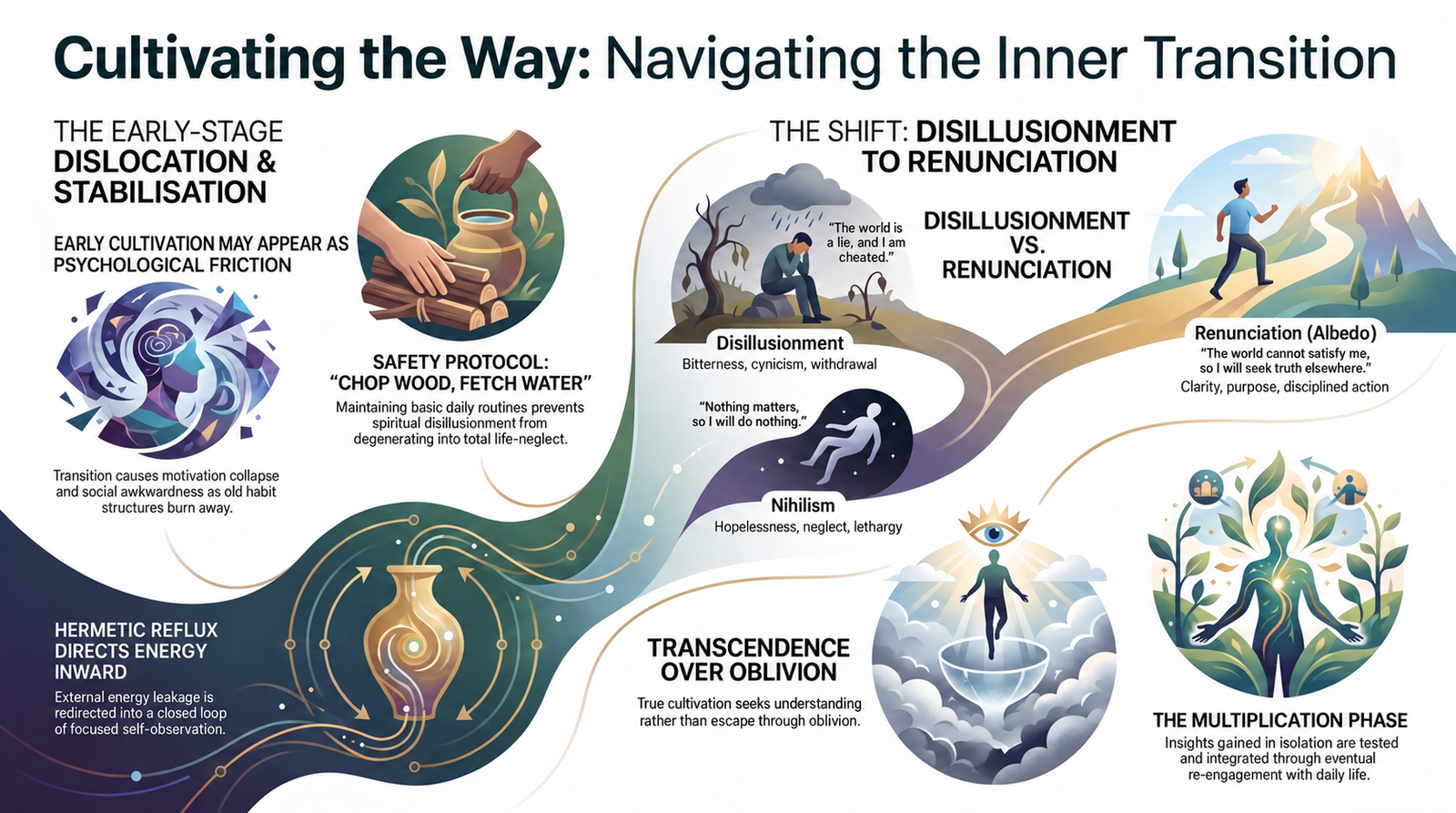
Argument map
How the recording moves
The transition is dislocating
Old motivations can lose their authority before a stable replacement exists, producing an awkward and vulnerable interval.
Friction becomes alchemical heat
The clash between established habits and emerging insight is interpreted as fuel for change rather than instant serenity.
Disillusionment can divide
Bitterness and nihilism withdraw from life; renunciation redirects effort without demanding that the world provide permanent satisfaction.
Ordinary duties stabilise
Sleep, hygiene, movement, food and simple work preserve continuity when larger narratives of meaning have become uncertain.
Escape is distinguished from understanding
The addiction analogy asks what kind of life recovery returns to, while avoiding the claim that dependence is merely a spiritual mistake.
Beliefs become provisional tools
Metaphysical images are judged by their effects on clarity, kindness and fear rather than promoted as verified geography.
Insight returns to the world
Multiplication tests whether what was learned in isolation can support steadier conduct, relationship and purposeful activity.
Book–video relationship
Framework, expansion and qualification
The chapter establishes
An autobiographical model of dislocation, alchemical heat, functional grounding, conditional claims and gradual return through multiplication.
The video expands
The operating-system, surgery, scaffolding and submersible analogies make the interval between dismantling and integration easier to recognise.
The guide qualifies
Distress is separated from attainment, addiction from failed spirituality, and useful symbolic language from verified metaphysical fact.
Video chapters
Navigate the discussion
- 00:00Opening: When the Path Becomes Real
- 02:10Early Awakening and Psychological Disruption
- 06:40The Collapse of Motivation and Meaning
- 11:20The Alchemical Heat Explained
- 16:30The Death of the Self: Reality vs Myth
- 21:40The Danger of Nihilism
- 26:10Chop Wood, Carry Water: Stabilisation
- 31:20Addiction and the Search for Escape
- 36:40Holding Spiritual Concepts Lightly
- 41:30The Gradual Return to Function
- 46:20Cultivating the Way: Integration
Glossary
Terms used in the chapter and recording
Cultivation
Dislocation
Alchemical heat
Hermetic reflux
Disillusionment
Nihilism
Renunciation
Conditional claims
Multiplication
Integration
Related pathways
Continue within the website
- 2.4.4. Inner WorldsThe preceding chapter distinguishes vivid altered experience from reliable interpretation and enduring integration.
- 2.3.9. Chop Wood, Carry WaterDevelops the relationship between insight and ordinary activity that Chapter 41 reframes as functional grounding.
- 2.3.12. TouristExamines the limits of detached observation and the need for insight to re-enter lived participation.
- 2.1.8. The White StoneExplores non-reactivity and the danger of converting spiritual discipline into a purified identity.
- 1.1.11. The Dark Night of the SoulPlaces lost meaning and spiritual darkness within Nigredo while distinguishing contemplative metaphor from mental illness.
- Don’t Mistake Dreams for RevelationThe next chapter video turns from provisional spiritual concepts to the interpretation of dreams and apparent messages.
External reference points
Textual context, mental health and practical support
- 84000: Perfection of Wisdom collectionCanonical context for the Vajracchedikā, commonly known as the Diamond Sūtra. The chapter uses its dream-and-illusion imagery as a method of non-clinging, not as proof that nothing matters.
- NHS: Symptoms of depression in adultsLoss of motivation, withdrawal, low energy and impaired functioning can be symptoms of depression; context, duration, severity and impact require proper assessment.
- NHS: MindfulnessPractical information on present-moment awareness together with the important qualification that mindfulness is not right for everyone and can make some people feel worse.
- NHS: Drug addiction—getting helpUK guidance on GPs, local drug services, treatment, harm reduction and support, keeping the chapter’s addiction analogy distinct from clinical care.
- NHS: Where to get urgent mental-health helpCurrent guidance for NHS 111, urgent GP support, listening services and emergencies in which someone cannot remain safe.
Grounded reflection
What keeps the vessel intact?
Without changing any treatment plan or abandoning an existing commitment, identify three ordinary actions that make daily life more stable—for example eating at a regular time, taking prescribed medication, walking, washing, paying one bill or speaking with a trusted person. Choose one action that is realistic today and complete it without turning it into a test of spiritual success.
Then ask: Does my present interpretation make responsible action easier, or does it justify withdrawal and neglect? If functioning is worsening, seek appropriate support rather than increasing the intensity of solitary practice.