
Albedo · Subject · Chapter 43 of 48
2.4.7. The Way In, The Way Out
Insight found in solitude becomes transformation only when it can meet criticism, boredom, obligation and relationship without rebuilding a superior spiritual self.
Chapter video
Where transformation is actually tested
Book orientation
The chapter in brief
The Way In, The Way Out turns from inward clarification towards reintegration. The chapter describes an alchemical rhythm: hermetic reflux concentrates attention and heat within a protected container; projection or multiplication returns the refined material to the world, where its durability can be tested. Ordinary life therefore becomes diagnostic. Small talk, loss of prestige, criticism and repetitive labour disclose whether reactivity has genuinely diminished or merely remained unprovoked. A second map, the Alchemical Week, places seven forms of psychological difficulty beside the traditional planets and metals of the days. These correspondences are part of Dr Simon Robinson’s symbolic and autobiographical synthesis. They are not a clinical taxonomy, a causal theory of mental illness or a substitute for appropriate care.
Transcript-led guide
From protected clarity to public reality
The recording opens with a blunt contrast: serenity may feel complete in a quiet room and disappear at the first collision with traffic, a passive-aggressive message or an unglamorous obligation. This does not make solitude useless. The chapter’s hermetic reflux is a necessary period of withdrawal in which attention can settle and habitual patterns become visible. The error is to confuse the absence of triggers with freedom from reactivity. Reintegration brings the refined substance back into contact with unpredictable conditions. Friction is no longer interpreted simply as failure; it becomes information about what remains defended.
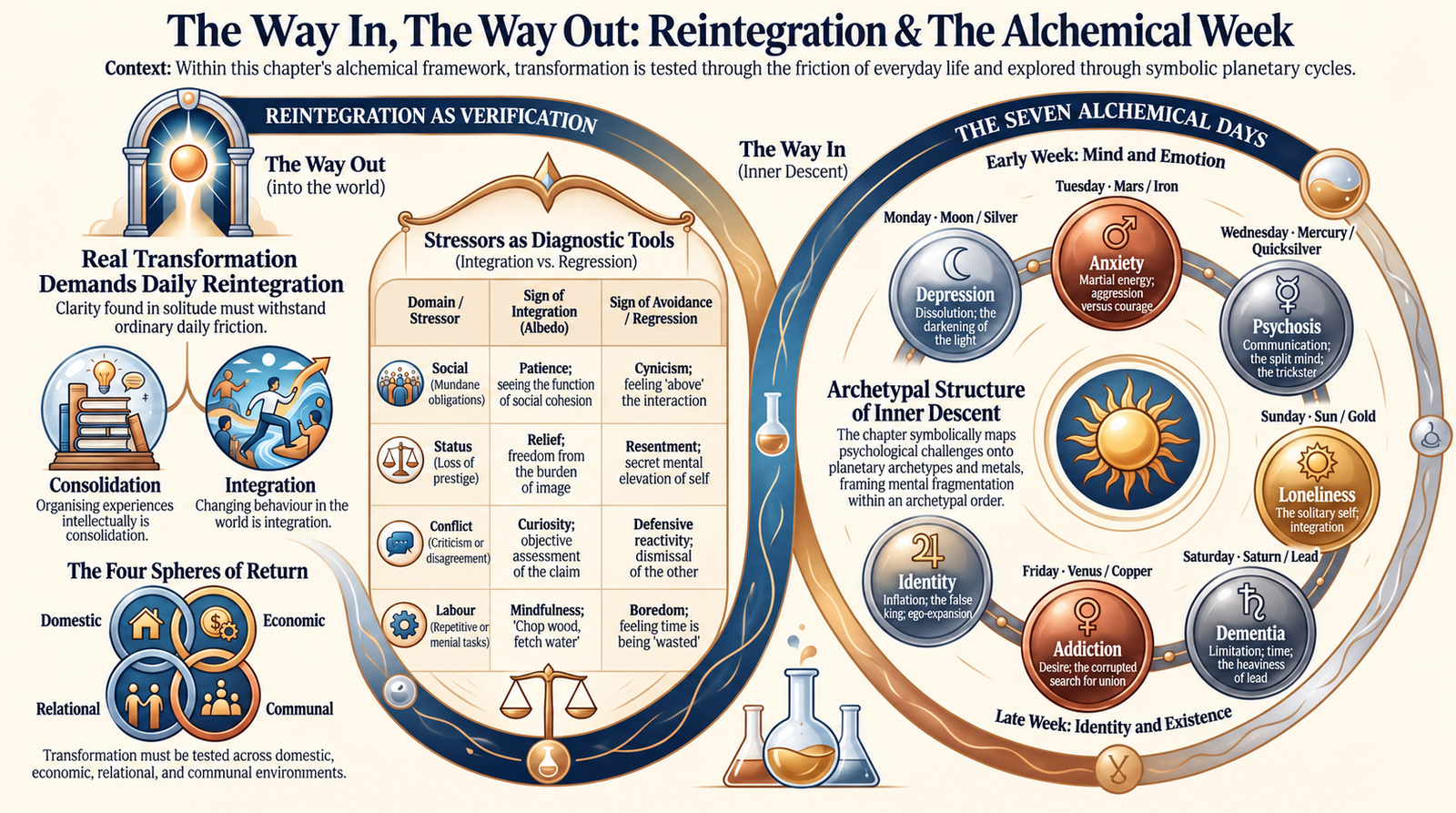
The chapter makes that test practical through four domains. Mundane social contact reveals patience or concealed superiority. Loss of status may bring relief from maintaining an image, or resentment at no longer being recognised. Criticism tests whether a claim can be examined with curiosity before the self mobilises in defence. Repetitive labour exposes whether attention can inhabit an ordinary task without treating time as wasted. These contrasts are diagnostic prompts, not a scorecard for judging other people. Reduced reactivity does not mean passivity, emotional numbness or tolerating harm; curiosity can coexist with boundaries, disagreement and decisive action.
A second movement distinguishes consolidation from integration. Writing, reading and conceptual organisation can give form to a difficult experience and reduce anxiety, but a coherent narrative is not yet behavioural change. Integration is tested through a sequence of returns: domestic life without demanding exceptional treatment; economic participation without regarding work or service as beneath one’s station; relational life without using intimacy primarily for validation or escape; and communal participation without retreating into cynicism. The recording sharpens this into a challenge to spiritual prestige: an identity built around being more advanced than others reproduces the architecture it claims to have transcended.
The Alchemical Week then maps depression to the Moon and silver, anxiety to Mars and iron, psychosis to Mercury and quicksilver, identity to Jupiter and tin, addiction to Venus and copper, dementia to Saturn and lead, and loneliness to the Sun and gold. The recording explores the imaginative logic of these pairings and the author’s illustrated The Way In. The Way Out. books. Their value here is archetypal and interpretive. Depression is not a required spiritual descent; psychosis is not simply an awakened magician; addiction is not only displaced longing; and dementia cannot be prevented or navigated by symbolism alone. The discussion returns at last to a quieter measure of success: less friction, less compulsion to defend a special identity, and greater functional availability to the situation and people at hand.
Argument map
How the recording moves
Solitude creates a protected container
Withdrawal can concentrate attention and reveal patterns, but favourable conditions cannot by themselves demonstrate stable transformation.
Return becomes verification
Reintegration is framed not as losing the work but as exposing it to the friction through which its durability becomes visible.
Prestige reveals a subtler ego
The wish to be recognised as unusually insightful can rebuild separation beneath the language of awakening and purification.
Four stressors make the test concrete
Social obligation, diminished status, criticism and repetitive labour disclose patience, defensiveness, resentment, boredom and availability.
The week supplies an archetypal map
Seven planetary metals organise seven psychological themes without becoming a scientific model or clinical classification.
Writing is not yet living
Consolidation organises experience in thought and language; integration appears as changed behaviour under ordinary pressure.
Return unfolds through four spheres
Domestic, economic, relational and communal life widen the field in which insight must become responsible participation.
Success becomes quieter
The chapter ends with reduced suffering and less friction rather than spectacle, status or a permanent performance of serenity.
Book–video relationship
Framework, expansion and qualification
The chapter establishes
Reintegration as verification, a four-domain stress test, the planetary Alchemical Week, the distinction between consolidation and integration, and four spheres of return.
The video expands
Retreat, battery, workplace, family, laundry and domestic-task examples translate the framework into recognisable moments of boredom, criticism and self-importance.
The guide qualifies
Symbolic correspondences are separated from diagnosis, reduced reactivity from emotional suppression, and autobiographical interpretation from universal or clinical claims.
Video chapters
Navigate the discussion
- 00:00Opening: The Illusion of Progress
- 02:10Solitude vs Real Transformation
- 06:20Reintegration as Verification
- 11:10The Prestige Trap
- 16:40The Stress-Test of Ordinary Life
- 22:30The Alchemical Week Explained
- 30:10Mapping Psychological States
- 36:20Writing vs Living the Work
- 40:50The Sequence of Returns
- 46:10Quiet Success: Reduction of Suffering
- 50:20Closing Reflections
Glossary
Terms used in the chapter and recording
Hermetic reflux
Projection or multiplication
Reintegration
True Albedo
Prestige stripping
Spiritual identity
Consolidation
Integration
Reintegration stress test
The Alchemical Week
Archetypal correspondence
The four spheres of return
Functional availability
Related pathways
Continue within the website
- 2.4.6. Dreams of DestinyThe preceding chapter practises restraint in interpretation and returns the value of a dream to its effects in waking conduct.
- 2.4.5. Cultivating the WayDevelops a grounded orientation in which spiritual models remain provisional and are judged partly through how they shape life.
- 2.4.2. MetanoiaExplores the movement beyond exclusive identification with thought while warning against converting the witness into a subtler self.
- Albedo Chapters 43–48 overviewA six-chapter orientation to the final movement of Albedo and the return of contemplative insight to lived experience.
- Surviving Spiritual Re-Entry Shock | Dialogues IA related discussion of the difficulty of returning from altered or clarified states to ordinary roles, relationships and expectations.
- Why You Feel Like an Outsider | The Witness AwakensThe following chapter video examines estrangement, observation and the risks of making distance from others into identity.
External reference points
Mental health, support and philosophical context
- NHS: Mental healthA starting point for information about symptoms, conditions, talking therapies and urgent support, helping keep symbolic interpretation distinct from assessment and treatment.
- NHS: PsychosisClinical guidance on hallucinations, delusions, disordered thinking and routes to help. Psychosis should not be romanticised as archetypal boundary-crossing or treated solely through contemplative interpretation.
- NHS: What is dementia?An overview of dementia as a group of syndromes involving cognitive decline, with information about symptoms, assessment and support beyond the chapter’s Saturn-and-lead symbolism.
- NHS: Addiction supportPractical routes to information and help for drug, alcohol and gambling problems. The chapter’s language of distorted longing does not replace evidence-based treatment or harm-reduction support.
- Marcus Aurelius, Meditations, Book VThe wider setting for the chapter’s closing passage on adapting to impediments and converting obstacles into material for action.
- NHS: Where to get urgent mental-health helpCurrent UK guidance on urgent support, NHS 111 and emergencies when someone cannot remain safe.
Question to carry forward
What appears when nobody is watching?
Choose one ordinary task today: washing dishes, answering routine messages, waiting in a queue or listening to a familiar story. Remove unnecessary distraction and notice the first signs of friction. Does the mind become bored, defensive, superior, hurried or resentful? Record the reaction without turning it into a verdict about your progress.
Then ask: What would functional availability look like here? It may be patient attention, a clear boundary, curiosity about criticism, or simply completing the task without demanding that it confirm a special identity. The test is not perfect serenity. It is whether awareness creates a little more room for an appropriate and responsible response.