
The Pleroma
Can the language of fullness loosen our fixation on separate things without becoming another fixed account of reality?
Revised Edition (2026) · Catalogue reference 3.4.1
Watch the chapter video
The Pleroma Explained | Fullness, Emptiness & Non-Dual Reality
The dialogue develops the chapter through analogy and comparison. Its language of light, creation and “mechanics” is philosophical and symbolic, rather than an established physical explanation.
The chapter in brief
Opening the Subject section, “The Pleroma” shifts the inquiry from the world as an object to the possibility of an undivided ground. Dr Simon Robinson uses fullness to challenge the idea that emptiness means mere absence. A builder who knows every Lego structure but has never noticed plastic supplies the central image: familiarity with forms can conceal the assumptions through which we understand them.
The chapter brings Jung’s Pleroma and Creatura into conversation with Kabbalistic tzimtzum, Chokmah and Binah, Yogācāra store consciousness, and the Heart Sūtra. It ends by distinguishing the desire to control appearances from a less possessive relationship with life. These correspondences belong to the author’s modern alchemical synthesis. They offer ways of asking about experience, without establishing that the traditions describe one substance, one attainment or one mechanism.
The central question: what does fullness change?
The recording begins with the reassurance of a clear diagnosis: a broken bone seems to present a problem with definite edges. It contrasts that model with questions about consciousness and ultimate reality, where the very framework of explanation is at issue. The hosts then reverse the ordinary meaning of emptiness. White light before a prism becomes an image of undivided potential, while Jung’s Seven Sermons to the Dead introduces the difficulty of describing what has no distinguishing qualities. Light here is an analogy; it does not establish a theory of consciousness or require looking at a bright source.
A challenge follows: if this fullness cannot be defined, why write or speak about it? The dialogue answers by treating words as pointers rather than containers. Its hammer and programmer images lead into the expert Lego builder who recognises every model but overlooks plastic. Creatura names differentiated existence in this Jungian vocabulary. The discussion uses that image to reframe ordinary life as participation rather than a mistake to escape. This is a metaphysical interpretation, not evidence that hardship is chosen, deserved or simply self-authored.
The middle of the recording imagines a descent from infinity into perspective. It draws on tzimtzum, introduces the demiurge as a creator unaware of its source, and compares the sefirot to layered lampshades. It then turns this cosmology inward: we can mistake stories about work, relationships and identity for the whole situation. The comparison table extends this pattern to Chokmah, Binah and ālayavijñāna. The hosts sometimes call these traditions identical “physics”; the comparison is better read as Robinson’s synthesis. In particular, Yogācāra store consciousness should not be treated as an eternal, unchanged divine mirror.
The final movement asks what insight is for. The hosts contrast self-serving “magic” with the chapter’s account of spontaneous, beneficial “thaumaturgy”, expanding the warning through manifestation culture and the pursuit of control. Claims about siddhis or reality-bending remain extraordinary claims, not demonstrated consequences of meditation. The Matrix and the Heart Sūtra carry the closing turn towards surrender: perhaps life need not be continually secured by self-narration. Buddhist emptiness does not establish that the world is unreal or made from divine plastic. The useful challenge is whether less insistence on controlling a story can support clearer, more responsible participation in it.
How the argument unfolds
From diagnosis to uncertainty
A problem with clear edges gives way to questions about the framework through which anything is known.
Fullness challenges absence
The prism and Jungian paradox unsettle the assumption that emptiness means nothing remains.
Language becomes a pointer
The hammer and Lego builder expose the difference between naming forms and examining assumptions.
Cosmology turns inward
Contraction, filters and the demiurge become images for a perspective that mistakes its own story for the whole.
The comparison widens
Kabbalistic and Yogācāra terms are arranged alongside the Pleroma within the author’s interpretive map.
Control gives way to participation
The warning about powers leads to surrender, the Heart Sūtra and the question of life beyond compulsive self-authorship.
Book and recording
The chapter’s emphasis
A compact symbolic journey through fullness, differentiation, contraction and return, concluding with surrender rather than manipulation.
The recording’s expansion
The hosts add the diagnostic opening, prism and lampshade explanations, workplace self-narratives and contemporary examples of control. These expansions are commentary rather than separate historical evidence.
Explore the video
These supplied chapter starts are timed estimates. Use them as approximate entry points, rather than exact boundaries.
- 00:00Opening: Entering the Pleroma
- 02:20Emptiness as Fullness
- 06:10Why the Pleroma Cannot Be Defined
- 10:40The Plastic and the Lego Bricks
- 15:30Creatura and the Illusion of Separation
- 20:20The Tzimtzum and the Birth of Perspective
- 25:40Chokmah, Ālaya, and the Ground of Mind
- 30:30Magic vs Thaumaturgy
- 35:10Surrender to the Fullness
- 39:20Form Is Emptiness
A visual map of the comparison
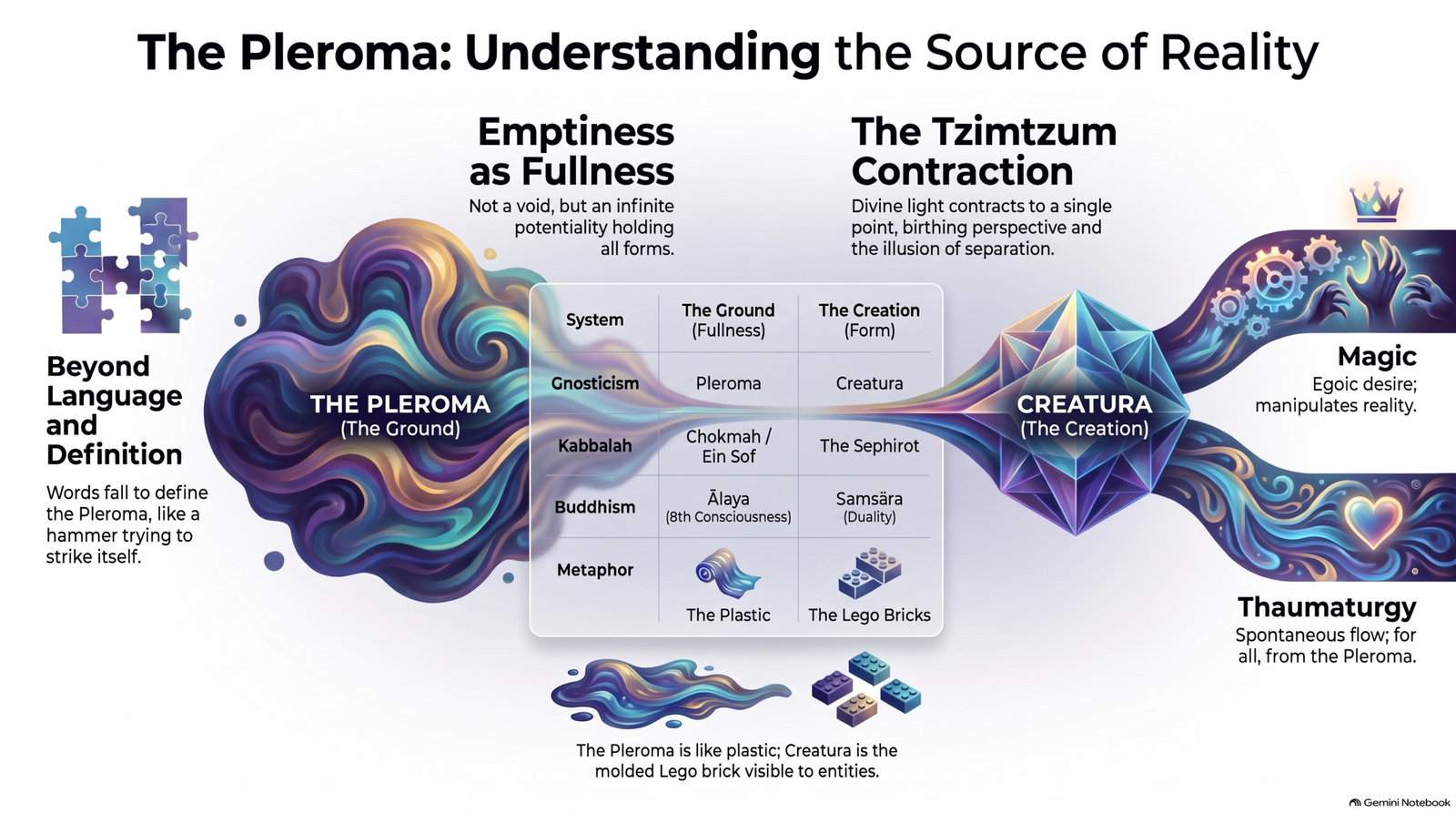
Terms for careful reading
Pleroma
Greek for “fullness”, used in several religious and philosophical settings. In Gnostic contexts its meaning depends on the particular system. Here the immediate point of departure is Jung’s Seven Sermons to the Dead, reworked by Robinson into an image of undivided potential. This usage is not a neutral definition shared by all Gnostic traditions.
Creatura
In Jung’s First Sermon, Creatura names the differentiated realm in which beings have qualities and make distinctions. The chapter pictures it through moulded Lego bricks. Jung’s text gives differentiation a necessary place in creaturely existence; it should not be reduced to a defect that must simply be erased.
Śūnyatā · emptiness
In Mahāyāna Buddhist discussions, emptiness concerns the lack of an independent, intrinsic nature. The Heart Sūtra relates it to the very forms of experience. Robinson’s language of fullness offers a comparison, but does not establish emptiness as a cosmic material, a divine self or a limitless store of possible objects.
Tzimtzum · divine contraction
A central image of Lurianic Kabbalah, associated with sixteenth-century Jewish mysticism: divine withdrawal or self-limitation makes room for creation. Interpretations differ. The recording’s account of a first observer and a psychological descent is a comparative elaboration, rather than empirical physics or a summary of every Kabbalistic account.
Ein Sof, Chokmah and Binah
Kabbalistic terms with distinct roles: Ein Sof refers to the limitless divine; Chokmah means wisdom and Binah understanding. Chokmah and Binah are sefirot within the Tree of Life. The seed-and-womb imagery expresses their relationship in the chapter; Chokmah is not simply another name for Ein Sof.
Sefirot · Sephirot
The plural of sefirah: the ten divine attributes or emanations represented in Kabbalistic traditions. The recording uses successive lampshades to picture limitation. This is an explanatory analogy; describing the sefirot merely as increasing ignorance compresses the richer theological meanings of their distinct functions and relationships.
Demiurge
A world-maker in Greek philosophical vocabulary, interpreted differently across Platonist and Gnostic systems. Some Gnostic narratives portray an ignorant creator. Robinson and the hosts use this figure psychologically for self-narration that forgets its limits. Linking it to tzimtzum is part of their synthesis, not an established Jewish doctrine.
Ālayavijñāna · store consciousness
In Yogācāra Buddhist models, this supports continuity and carries karmic dispositions, often represented as seeds. It is not straightforwardly an eternal pure consciousness. The recording’s unchanged-mirror image therefore needs qualification: store consciousness participates in conditioned processes and is subject to transformation, rather than functioning as a permanent cosmic self.
Saṃsāra
In Buddhist traditions, the cycle of conditioned existence and rebirth bound up with ignorance and craving. The chapter’s table compresses this into “duality”. That label captures one aspect of its comparison, but does not exhaust the term or imply that ordinary relationships and ethical responsibilities are merely errors of perception.
Magic, thaumaturgy and siddhis
Thaumaturgy means wonder-working; siddhis are accomplishments or powers reported in Indian religious traditions. Robinson distinguishes self-serving manipulation from spontaneous benefit. This is his ethical distinction, rather than a universal historical classification. Neither the distinction nor the dialogue demonstrates miraculous causation, mental control of matter or freedom from accountability.
Nonduality and surrender
Nonduality can question the fixed opposition between subject and object, but its meaning varies across traditions. Here surrender concerns loosening possessive self-authorship. It need not mean suppressing thoughts, losing personal boundaries, denying harm or allowing an alleged higher force to excuse decisions. Ordinary care and responsibility remain relevant.
Related pathways
- 3.3.12. The Ground of Being — The previous book topic, The Ground, retains this established public page title.
- 3.1.7. The Heart Sutra — Read the Buddhist source context behind the recording’s concluding comparison.
- 3.2.9. The Metaphor of the Film Projector — Follow another model of perception while keeping metaphor distinct from mechanism.
- 2.2.3. Different Types of Consciousness — Revisit the course’s earlier discussion of differing consciousness models.
- 2.3.10. Thaumaturgy — Trace the author’s earlier treatment of wonder-working and motivation.
- Citrinitas – Part Three — Return to the four-section organisation of Part Three.
External reference points
- C. G. Jung · Seven Sermons to the Dead — The primary literary source for the Pleroma–Creatura pairing; read the First Sermon’s treatment of differentiation alongside its opening paradox.
- Christoph Schulte · Zimzum: God and the Origin of the World — University of Pennsylvania Press, 2023; translated by Corey Twitchell. A scholarly history of contraction and its later interpretations, rather than a physical cosmology.
- Stanford Encyclopedia of Philosophy · Yogācāra — Scholarly context for store consciousness, karmic continuity and the tradition’s internal philosophical diversity.
- 84000 · The Heart of the Perfection of Wisdom, the Blessed Mother — Toh 21, Dharmachakra Translation Committee. A recognised translation and introduction to the longer Heart Sūtra, distinct from the book’s AI-assisted rendering tradition.
Question to carry forward
When a story about another person feels completely certain, what might you leave open long enough to listen more carefully—and what responsibility remains yours regardless of the story?