
Albedo · Subject · Chapter 44 of 48
2.4.8. Alien
A widened observing perspective can loosen conditioning, but clarity is tested by whether distance remains connected, humane and grounded in shared reality.
Chapter video
When observation begins to feel like exile
Book orientation
The chapter in brief
Alien examines the estrangement that may accompany sustained introspection and the loosening of familiar social reflexes. Dr Simon Robinson describes a “dual-layer” experience: participating in life while also observing behaviour from a quieter vantage. The chapter distinguishes connected witnessing from distressed withdrawal through changes in social interest, self-perception, affect and cognition, then warns that difference can harden into superiority, persecution narratives or isolation. Its two stabilising responses are the four Buddhist brahmavihāras—loving-kindness, compassion, appreciative joy and equanimity—and the recognition that a gap between inner experience and outward persona is widely human. This is an autobiographical and interpretive map, not a clinical diagnostic tool or a universal account of contemplative development.
Transcript-led guide
From structural estrangement to secret kinship
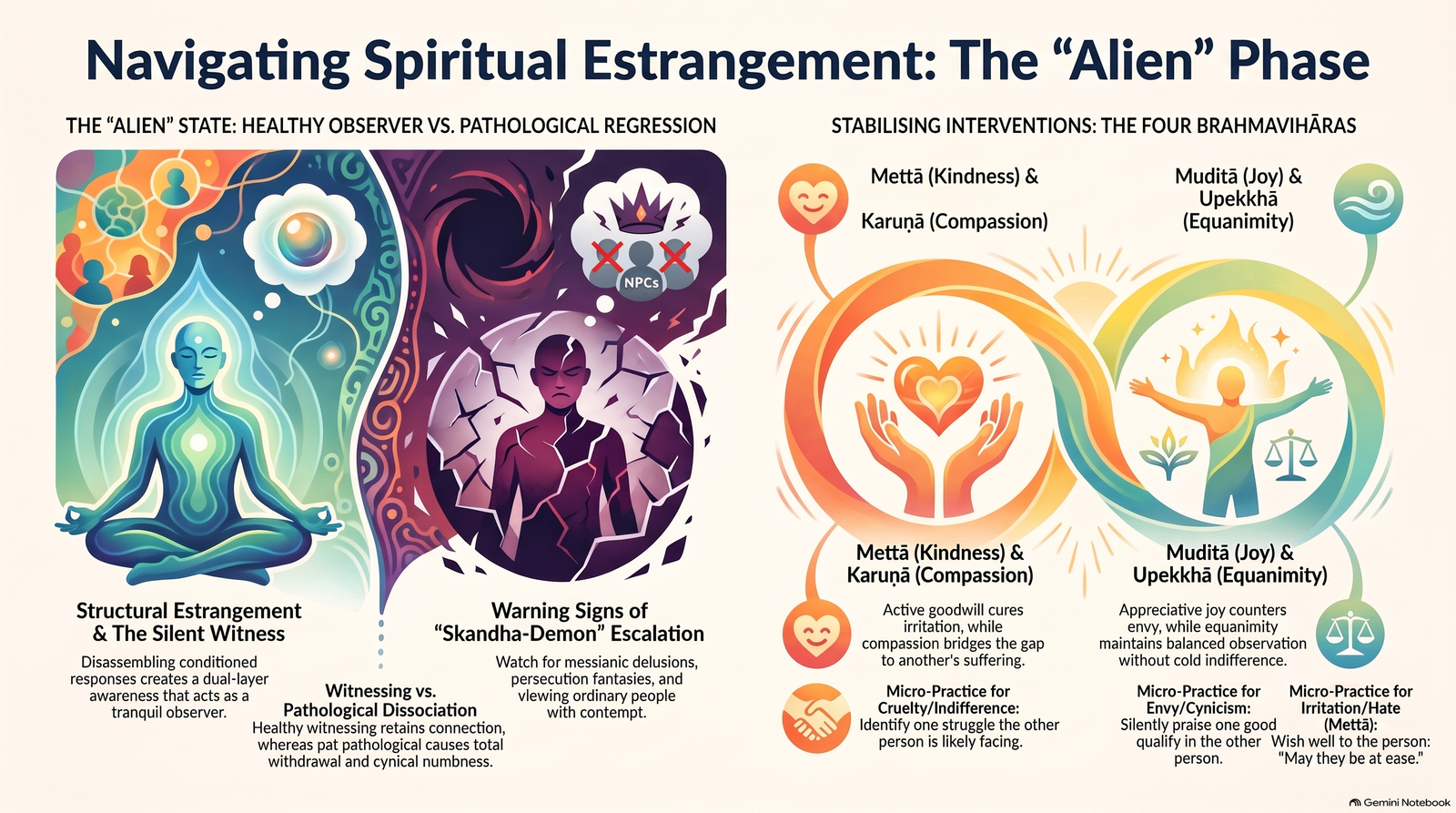
The recording begins with an intentionally paradoxical image: a classic cinematic alien seated in meditation inside an ouroboros. It gives form to the central question: why can deep inward work make familiar relationships, roles and routines feel strangely remote? The discussion calls this structural estrangement. As automatic bids for approval, group belonging and habitual performance become more visible, participation may no longer feel effortless. The video’s diving-suit and avatar metaphors portray both sides of the shift: greater freedom from social pressure and a troubling loss of immediacy.
The “silent witness” is then presented as a capacity to notice thoughts, emotions and impulses without being wholly absorbed by them. The video contrasts this with clinical dissociation, but the distinction requires more care than a single inward test can provide. Depersonalisation can itself involve observing one’s actions or thoughts from a distance, while derealisation may make people or surroundings feel unreal or lifeless. Curiosity, calm and continued connection may be reassuring; fear, involuntary detachment, memory gaps, persistent unreality, functional impairment or loss of safety deserve support. There is no simple brain-based divide in which witnessing is always “prefrontal” and dissociation merely switches the prefrontal cortex off.
The inquiry next turns towards the ego’s appropriation of difference. Robinson’s phrase skandha demons names narratives of exceptional status, cosmic mission, persecution or spiritual superiority. The contemporary “NPC” metaphor becomes the clearest warning: treating other people as programmed background figures denies the depth of their experience and converts observation into contempt. Reduced appetite for gossip or status competition is not, by itself, evidence of insight. The more revealing question is whether genuine interest, warmth, reality-testing and responsible participation remain available.
The four brahmavihāras supply the video’s practical counterweight. Mettā interrupts ill will with goodwill; karuṇā looks for suffering without condescension; muditā answers cynical envy by appreciating another’s joy; and upekkhā combines care with respect for agency and limits. These traditional Buddhist qualities have a broader religious and contemplative setting than the chapter’s social micro-practices, but here they help return the observer to relationship. The final movement, the “universality of the gap”, dissolves the exceptional alien identity: every person carries more inward complexity than their public role can display. The proposed cure for estrangement is therefore not renewed conformity, but a gentler recognition of secret kinship.
Argument map
How the recording moves
The alien image names the tension
A futuristic outsider seated in meditation gives imaginative form to the intimacy and strangeness of inward change.
Conditioning becomes visible
Automatic social roles and bids for belonging lose some of their force, creating both freedom and disorientation.
A dual-layer perspective appears
The recording describes acting in the world while simultaneously observing thoughts, emotions and behaviour from a wider vantage.
Distance requires careful interpretation
Connected metacognition is distinguished from distressed detachment, while the guide resists turning this contrast into self-diagnosis.
The ego claims exceptional status
Messianic, persecutory and “NPC” narratives convert difference into hierarchy, contempt and further isolation.
The brahmavihāras restore relationship
Goodwill, compassion, appreciative joy and equanimity interrupt irritation, indifference, envy and controlling attachment.
The gap becomes universal
Recognising hidden depth and distance in every person transforms solitary alienation into a modest form of kinship.
Book–video relationship
Framework, expansion and qualification
The chapter establishes
Structural estrangement, the silent witness, a reflective comparison with pathology, warning signs of superiority, the four brahmavihāras and the universality of the gap.
The video expands
Dinner-party, workplace, traffic, café and relationship examples turn the written map into recognisable tests of connection, contempt, envy and control.
The guide qualifies
Clinical dissociation cannot be excluded by calmness or curiosity alone; “skandha demon” is the author’s metaphor, and Buddhist divine abodes are broader than psychological techniques.
Video chapters
Navigate the discussion
- 00:00Opening: The Feeling of Being “Alien”
- 02:10Why Alienation Happens in Albedo
- 05:40The Dual-Layer Mind: Observer and Actor
- 10:20The Silent Witness Explained
- 15:10Insight and Dissociation: A Critical Distinction
- 20:00Social Markers of “Alien-ness”
- 25:30The Trap of Superiority and Specialness
- 30:40Skandha Demons and Delusion Patterns
- 35:20The Brahmavihāras as Stabilisers
- 39:10The Universal Gap: You Are Not Alone
- 42:00Closing Reflections
Glossary
Terms used in the chapter and recording
Structural estrangement
The silent witness
Metacognition
Dissociation
Depersonalisation
Derealisation
Skandha demon
The NPC trap
Brahmavihāras
Mettā
Karuṇā
Muditā
Upekkhā
The universal gap
Related pathways
Continue within the website
- 2.4.7. The Way In. The Way Out.The preceding chapter tests private insight through ordinary relationship, criticism, work and responsibility.
- 2.4.2. MetanoiaExamines the shift beyond exclusive identification with thought and the risk of turning observation into a subtler identity.
- 2.3.4. Brahma’s ChariotIntroduces loving-kindness, compassion, appreciative joy and equanimity in the wider architecture of Albedo.
- 2.1.10. A New Kind of DemonExplores how insight can be appropriated by identity, specialness and the wish to become spiritually exceptional.
- Albedo Chapters 43–48 overviewA six-chapter orientation to the final Subject movement of Albedo and its return to lived experience.
- Life as Practice | The Dojo ExplainedThe following chapter video turns everyday encounters and difficulty into the field in which practice is tested.
External reference points
Clinical context and Buddhist sources
- NHS: Dissociative disordersDefines dissociation, depersonalisation and derealisation, describes associated difficulties and explains routes to assessment and support.
- Systematic review of depersonalisation-derealisation researchA 2024 review of behavioural, autonomic and neural evidence that also identifies limitations and confounds in current neurobiological models.
- Systematic review of adverse events in meditationA peer-reviewed review supporting a balanced approach in which contemplative practice may have benefits but difficult or harmful effects are not dismissed as progress.
- SuttaCentral: AN 3.66, SāḷhasuttaA translated early Buddhist discourse that includes the directional cultivation of love, compassion, rejoicing and equanimity.
- NHS: Where to get urgent mental-health helpCurrent UK guidance for obtaining immediate expert advice or emergency help when distress or risk cannot safely wait.
Question to carry forward
Does distance preserve connection?
Recall one recent moment when you felt separate from a group, conversation or familiar role. Without deciding that the experience was either spiritual progress or pathology, ask what it did to your capacity for contact. Could you still listen, respond, recognise another person’s depth and attend to practical reality—or did the distance become frightening, involuntary, unreal, contemptuous or disabling?
Then choose one modest act of reconnection: listen without rehearsing a reply, acknowledge a hidden difficulty the other person may carry, appreciate one good quality, or set a calm boundary without dehumanising them. If detachment is persistent, distressing or disruptive, the grounded response may instead be to pause intensive practice and seek appropriate support.