
A Course in Modern Alchemy / Volume II
Albedo
The whitening. The work of clarification.
A study of reactive habits, the subtleties of identity, and the return from insight to ordinary life.
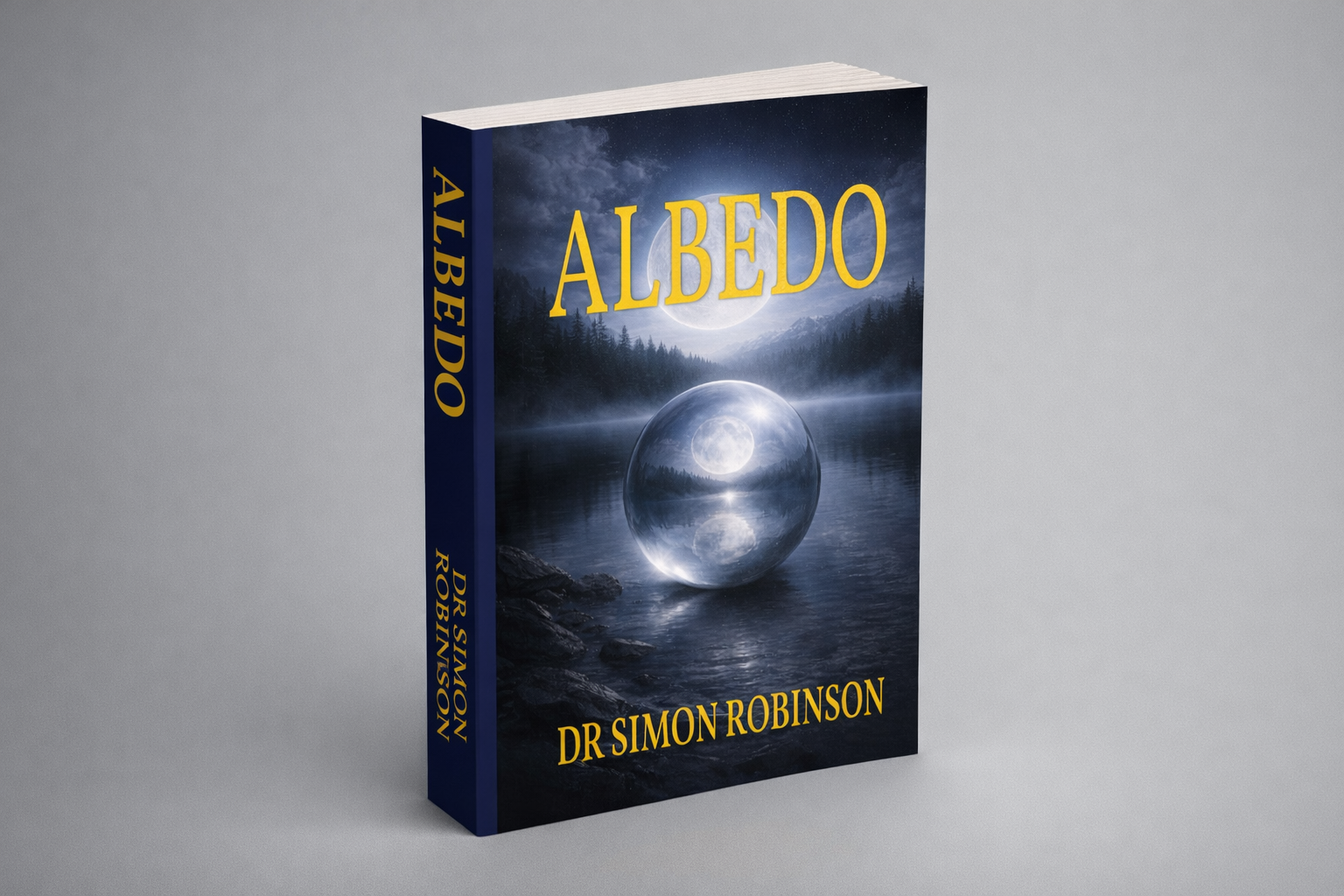
The second volume of A Course in Modern Alchemy explores what happens after familiar certainties have begun to loosen. Across forty-eight chapters, Albedo brings Buddhist models of consciousness into conversation with alchemical symbols, psychological reflection and the practical demands of living with other people.
48chapters across four sections
98numbered tables
8 pagesof glossary entries
2026revised edition
A reader’s overview
What follows the first breaking-open?
Nigredo introduces the blackening: the questioning of inherited identity and the encounter with what has been rejected or left unexamined. Albedo develops the next part of the author’s map. Its concern is clarification: recognising how reaction continues, how insight can become another identity, and how understanding might change conduct.
The introduction describes a cooler and more patient phase of the work. The Moon, silver, the white stone and the reflecting mirror provide its recurring imagery. These symbols accompany a detailed enquiry into volition, karma, perception and the mental habits through which a sense of self is continually renewed.
A central idea is purification through removing the conditions that sustain unwholesome habits. The book calls this “negative-first purification”: attending to greed, aversion, self-comparison and defensive reaction, rather than trying to construct an impressive spiritual personality. This becomes a recurring question about the difference between clearer conduct and the wish to be seen as a good or realised person.
Its scope is wider than meditation alone. Chapters address shame and responsibility, spiritual pride, dreams, the temptation to retreat from the world, and the friction of ordinary relationships. The movement towards Chop Wood, Carry Water, Dojo and The Prodigal Self gives daily life an increasingly central role.
A personal synthesis of traditions
The book combines Abhidhamma, other Buddhist frameworks, Western esoteric grades and Christian and alchemical imagery. Its proposed correspondences belong to the author’s interpretation. Keeping the traditions’ differences in view is part of reading the comparisons carefully.
The structure of the course
Four sections, forty-eight chapters
The sequence retains the four-part structure of Nigredo: Mythos, Dharma, Object and Subject. It moves from symbolic orientation through the analysis of mind to the challenges of transformation and integration. Open a section for its full chapter list.
01. Mythos — chapters 1–12
Symbols of purification and their complications
The first twelve chapters revisit religious and alchemical images as ways of examining experience. The seven deadly sins lead into cosmology, rebirth and the symbolism of hells and heavens. The Moon and white stone introduce reflection and clarification; later chapters examine shame, spiritual distortion, guidance and the Master of the Temple.
- The Seven Deadly Sins p. 55
- The Cosmos p. 67
- Rebirth and Saṃsāra p. 77
- Hell and Hell Beings p. 87
- Angels and Gods p. 97
- The Alchemist p. 107
- The Moon p. 117
- The White Stone p. 125
- Grace and the Healing of Shame p. 135
- A New Kind of Demon p. 145
- The Holy Guardian Angel p. 155
- The Master of the Temple p. 163
02. Dharma — chapters 13–24
Volition, consequence and the sequence of a thought
The technical centre of the volume distinguishes active, resultant and functional consciousness. It explores the life continuum, wholesome and unwholesome karma, the cognitive series and the conditions associated with awakening. The section brings the analysis back to the lower fetters and the Anagāmī, or non-returner, within the book’s developmental map.
- The Crystal Universe p. 173
- Fate and Determinism p. 183
- Different Types of Consciousness p. 193
- Volition p. 203
- Resultant Consciousness p. 211
- The Life Continuum p. 219
- Unwholesome Karma p. 227
- Wholesome Karma p. 237
- The Cognitive Series p. 247
- Types of Karma p. 257
- Transcendental Consciousness p. 267
- The Anagāmī p. 277
03. Object — chapters 25–36
Thresholds, relinquishment and the return to routine
This section approaches transformation through images of hollowness, the Beast, the Abyss, Māra and the Crucifixion. Brahma’s Chariot provides a discussion of the four illimitable qualities. The later chapters return to ordinary tasks, the interpretation of extraordinary experience and the temptation to mistake relief or a partial insight for completion.
- Hollowness p. 287
- The Beast p. 295
- The Watcher of the Abyss p. 303
- Brahma’s Chariot p. 311
- Māra p. 319
- The Dark Night of the Spirit p. 329
- The Crucifixion p. 337
- The Death of the Self p. 347
- Chop Wood, Carry Water p. 355
- Thaumaturgy p. 363
- The Appointed p. 371
- Tourist p. 379
04. Subject — chapters 37–48
Testing understanding in the life one actually has
The final twelve chapters combine personal accounts with reflection on altered experience, learning cycles, dreams and reintegration. They consider alienation, social responsibility and the wish to escape ordinary obligations. Dojo, Two Roads and A New Kind of Confidence lead towards the closing image of the Prodigal Self.
- Experiment p. 391
- Metanoia p. 401
- Cycles of Learning p. 409
- Inner Worlds p. 419
- Cultivating the Way p. 427
- Dreams of Destiny p. 437
- The Way In, the Way Out p. 447
- Alien p. 457
- Dojo p. 465
- Two Roads p. 473
- A New Kind of Confidence p. 481
- The Prodigal Self p. 489
Page references follow the supplied Revised Edition (2026). Its printed contents also list many internal chapter headings, making it possible to find a particular discussion within a chapter.
Orientation and active reading
Summaries, study guides and clarifying questions
The volume begins with a recap of the first book. What Went Before: A Summary of Nigredo, on pages 17–24, revisits its forty-eight chapters and ends with a comparison of the two stages. How to Use Albedo follows on pages 25–26, and a chapter overview on pages 27–50 maps the new volume before the main text begins.
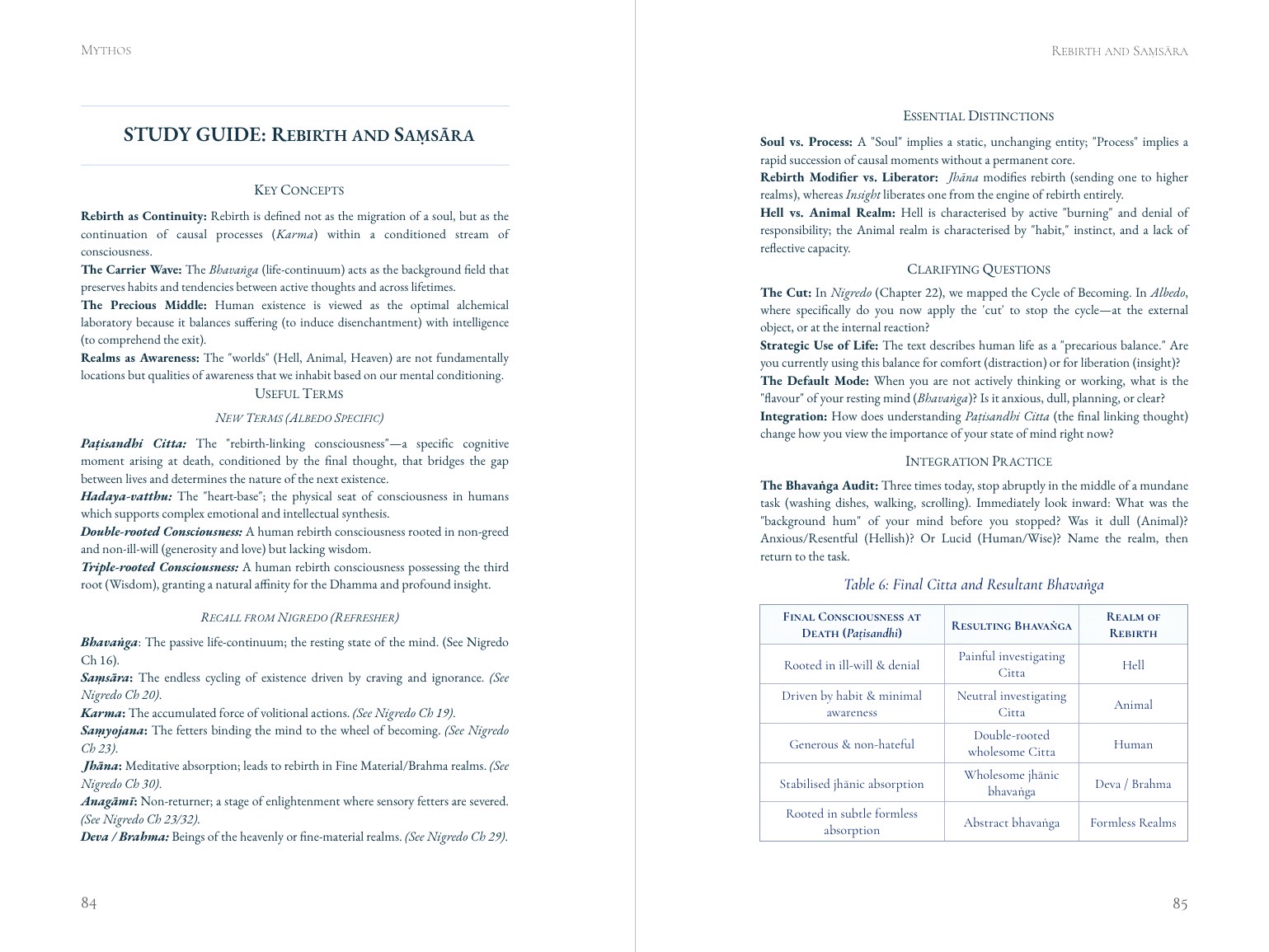
The author explicitly describes the book as something to consult and revisit over time. Its study guides support that approach through key concepts, useful terms, essential distinctions and clarifying questions. They also distinguish vocabulary introduced in Albedo from concepts recalled from Nigredo.
A bridge between volumes
Refresher entries help recover earlier ideas when they become relevant again. In the first chapter’s guide, the unwholesome roots, conceit, the hindrances, jhāna and the fetters are connected back to discussions in Nigredo.
Questions that test a distinction
The guides ask readers to examine how a concept operates in experience. Their purpose is to turn a persuasive explanation into something that can be questioned, differentiated and observed.
An example: The Seven Deadly Sins
The study guide on pages 64–65 gathers the chapter’s account of purification, self-comparison and reactive habits. Its questions explore how removing the conditions of a habit differs from suppressing unwanted experience, and whether an apparently humble identity can still depend on comparison.
The reader is repeatedly asked to notice the mechanism of a response, rather than simply adopt the chapter’s vocabulary.
A substantial reference apparatus
Ninety-eight numbered tables
Tables are one of the revised edition’s most distinctive features. Ninety appear before the appendix, followed by eight larger reference tables. A complete numbered list on pages 521–524 supplies their titles and locations.
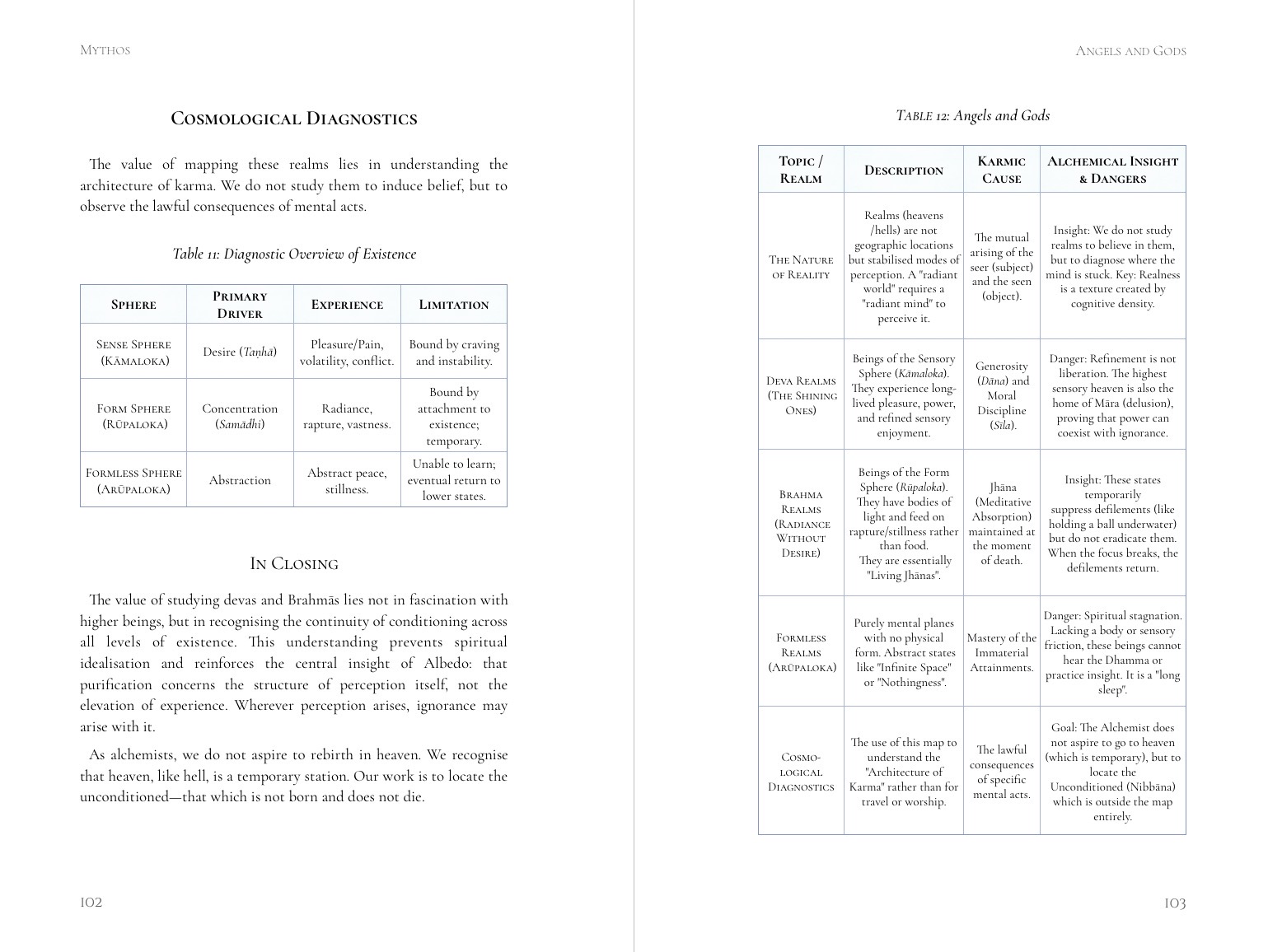
Some tables organise traditional classifications; others compare easily confused experiences or bring the argument into everyday situations. The following selection gives a sense of that range.
| Area | Examples of what is included | Pages |
|---|---|---|
| Orientation and symbolism | Nigredo compared with Albedo; the seven deadly sins and Buddhist roots; reflective cognition and direct awareness; purification and saintliness. | 24, 57, 119, 127 |
| Shame and spiritual identity | Guilt and shame; subtle fetters and skandha demons; ego and guardian; the Western magical grades. | 137, 148, 157, 165 |
| Consciousness and volition | The six sense doors; ethical categories of citta; karmic and functional consciousness; active and passive consciousness; types of bhavaṅga. | 195–222 |
| Karma and cognition | The spectrum of greed; eight wholesome javana cittas; the structure of a complete cognitive series; object strength; and the hierarchy of karmic precedence. | 232, 241, 251–252, 258 |
| Fetters and thresholds | The ten fetters; the supramundane sequence; the five lower fetters; body identification and body care; hollowness distinguished from nihilism. | 268, 270, 278, 280, 290 |
| Interpretation and integration | Repression and resolution; the four illimitables and their distortions; disruption and clarification; common misreadings of the witness; dream handling. | 304, 314, 393, 405, 442 |
| Conduct in everyday life | A reintegration checklist; social micro-practices; Dojo triggers and responses; an examination of motives for service; anger and ill-will. | 449, 461, 467, 469, 483 |
The eight appendix reference tables — pp. 509–520
- The Stages of Enlightenment p. 509
- Life Continuum of Beings p. 510
- Perceptions of Different Beings p. 511
- The Realms of Existence pp. 512–513
- Types of Citta (Consciousness) p. 514
- The 52 Mental Factors (Cetasikas) p. 515
- The 28 Types of Matter p. 516
- The 50 Skandha Demon States pp. 517–520
The appendix brings together Buddhist classifications and the author’s comparisons with alchemical and Western esoteric systems. It includes a table of the 31 planes of existence and an overview of 89/121 types of consciousness.
These tables describe traditional models and the book’s interpretations. Their numerical classifications should be read within that context, rather than as findings from contemporary physics or neuroscience.
Recurring questions
From the mechanics of mind to ordinary conduct
What keeps a reaction going?
The discussions of volition, resultant consciousness and the cognitive series distinguish receiving an experience from adding a fresh response to it. The book uses this framework to investigate how familiar patterns perpetuate themselves.
Can responsibility survive self-forgiveness?
Grace and the Healing of Shame explores the distinction between recognising harm and building an identity around being irredeemably flawed. Its account of grace returns to honesty, repair and the possibility of acting differently.
When does insight become another attachment?
A New Kind of Demon, Māra and Tourist examine the appeal of special knowledge, spiritual status and premature completion. Luminous or compelling experiences are repeatedly subjected to questions about interpretation.
What changes in a difficult interaction?
Dojo treats relationships and obligations as the setting in which habits become visible. Its examples include hostility, manipulation, under-appreciation and mistakes, bringing the discussion back to boundaries, restraint and repair.
The book as a visual object
Colour, symbolic images and readable structure
The supplied edition uses colour within a spacious, predominantly white interior. Illustrated chapter openings, blue ornamental titles and coloured study-guide text distinguish different kinds of material. The result gives a reader visual cues when moving between reflection, explanation and reference.
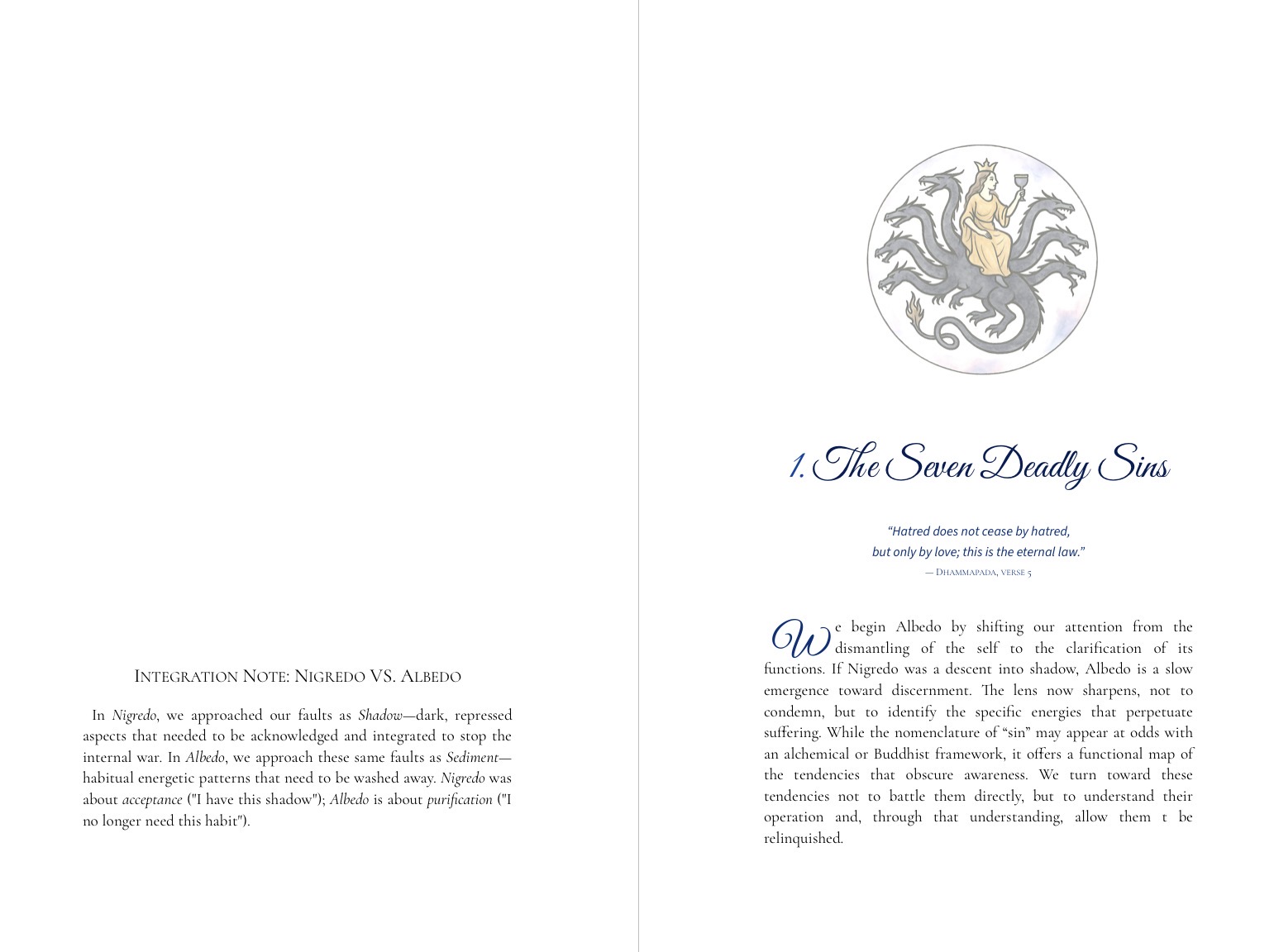
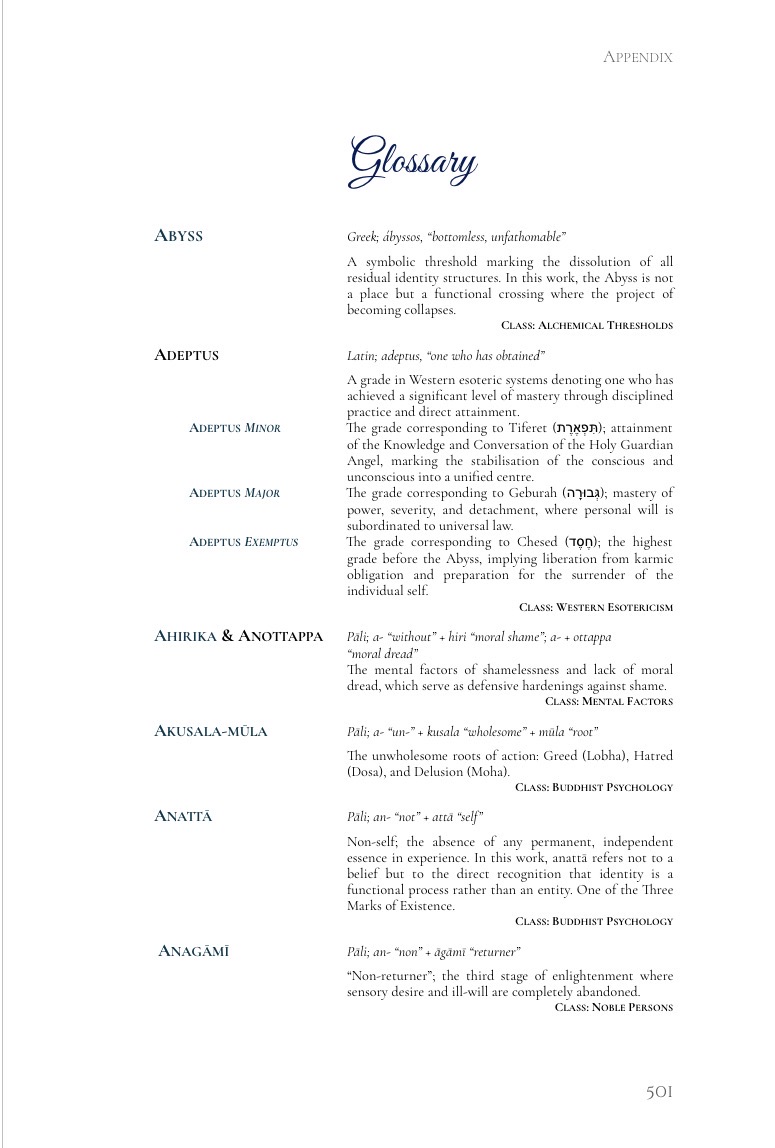
The opening of The Seven Deadly Sins, for example, pairs a circular symbolic illustration with an ornamental chapter heading. Later, the table of the cognitive series uses a clearly divided grid to show stages, moments, functions and karmic status. The glossary takes another approach, setting terms beside their definitions and origins.
The edition credits the author with design, layout and typography. It also acknowledges AI assistance with images, some editorial work and study-guide formatting, with the images refined manually for print.
Sample pages
Select a sample to open the existing full-size image in a new tab.
Vocabulary and cross-reference
A glossary, table list and index across two volumes
The glossary on pages 501–508 is arranged alphabetically. Entries combine definitions with language origins or etymologies and subject classifications. It brings the book’s Buddhist, alchemical and Western esoteric vocabulary into one reference section.
Mind, karma and practice
Examples include citta, bhavaṅga, javana, dependent origination, the unwholesome roots, karmic types, the fetters and stages of awakening.
Symbols and esoteric language
Entries include the Abyss, Adeptus grades, the daemon, the Demiurge, grace, the white stone, and Tree of Life terms such as Binah, Tiferet and Yesod.
The table list follows the appendix tables, on pages 521–524. The alphabetical index on pages 533–541 labels references by Nigredo or Albedo, allowing readers to trace subjects across the two volumes. It reflects the course’s cumulative approach: concepts introduced in the first book return in a new setting in the second.
A five-page introduction to Citrinitas, beginning on page 525, looks ahead to the next stage, followed by the author biography.
A deliberate change from Nigredo
Albedo does not add another recommended reading list. In How to Use Albedo, the author explains that further exploration should increasingly follow the reader’s own curiosity. The glossary and tables support that independence without prescribing a new external syllabus.
An alternative introduction
Watch and listen
Video explainer
Audio overview
The accompanying discussion introduces the book under the title Technical Manual for Dissolving the Self.
Continue through the online course
The Albedo course pages offer a companion route through the material. You can also explore practical resources, media and course material.
Approach and perspective
Reading Albedo
This is a dense, author-led study intended for repeated use. Readers interested in the relationship between contemplative practice, symbolic traditions and the analysis of experience will find several routes into it. The technical vocabulary is cumulative, so familiarity with Nigredo is helpful; the opening recap provides a way to recover the main ideas.
One approach is to read the chapter overview first, then follow the four sections in order. Another is to return to a question already alive in experience, read the relevant chapter and its study guide, and consult the glossary and tables as needed. The author explicitly encourages allowing difficult material time to settle.
The language is often precise and forceful, but the book remains a personal interpretation of spiritual development. Its diagnostic tables and descriptions of attainment are best treated as material for reflection, with room to question the categories and the proposed parallels.
A note on symbolism, altered experience and the language of the self
Some chapters discuss demons, inner guidance, synchronicity and altered states. In A New Kind of Demon, the text explicitly uses “demon” for a distortion of cognition rather than an external agent. Inner Worlds distinguishes the vividness of an experience from evidence that its interpretation is true.
The autobiographical material on experimentation is accompanied by discussion of its limitations and hazards. It should be read as reflective testimony, not a method to reproduce. Likewise, the language of the “death of the self” concerns the book’s account of identification; it is not an instruction to harm the body or abandon its care.
This is an educational and contemplative work, not a clinical treatment manual. Its accounts of spiritual difficulty should not be used to diagnose distress or to treat instability as proof of attainment.
The wider course
From blackening to clarification
Albedo develops the vocabulary introduced in Nigredo and prepares the ground for Citrinitas. Within the course’s colour sequence, whitening marks a phase of refinement whose implications still have to unfold.
Edition and availability
Book details
Albedo: Part Two of A Course in Modern Alchemy
Dr Simon Robinson · Revised Edition (2026)
ISBN: 978-1-918532-04-3
These links open bookseller searches for Albedo by Simon Robinson. Use the title, author and ISBN to identify the edition, and check the retailer for format, current price, delivery and availability. An independent bookshop can also use the ISBN to enquire about ordering.