
Albedo · Mythos · Chapter 11 of 48
2.1.11. The Holy Guardian Angel
When the mind’s loudest conflicts begin to settle, how can quiet discernment be distinguished from fear, habit, self-flattery—or an ego that has simply learned to whisper?
Watch the chapter discussion
Inner guide—or refined illusion?
Book orientation
The chapter in brief
This chapter deliberately removes the Holy Guardian Angel from a purely romantic reading. Within its Albedo framework, the “Angel” is a transitional regulatory function: as gross confusion weakens, ethical sensitivity and long-range coherence may be experienced as though they were a separate guide. Its value is tested neither by splendour nor certainty, but by whether it reduces clinging and reactivity. Its final purpose is self-cancellation. As conduct and truth become less divided, the guider and the guided cease to appear as two. This is the author’s contemplative and psychological interpretation; it does not settle theological questions, define all occult uses of the term, or convert internal voices into spiritual authority.
Transcript-led guide
From corrective signal to silent integration
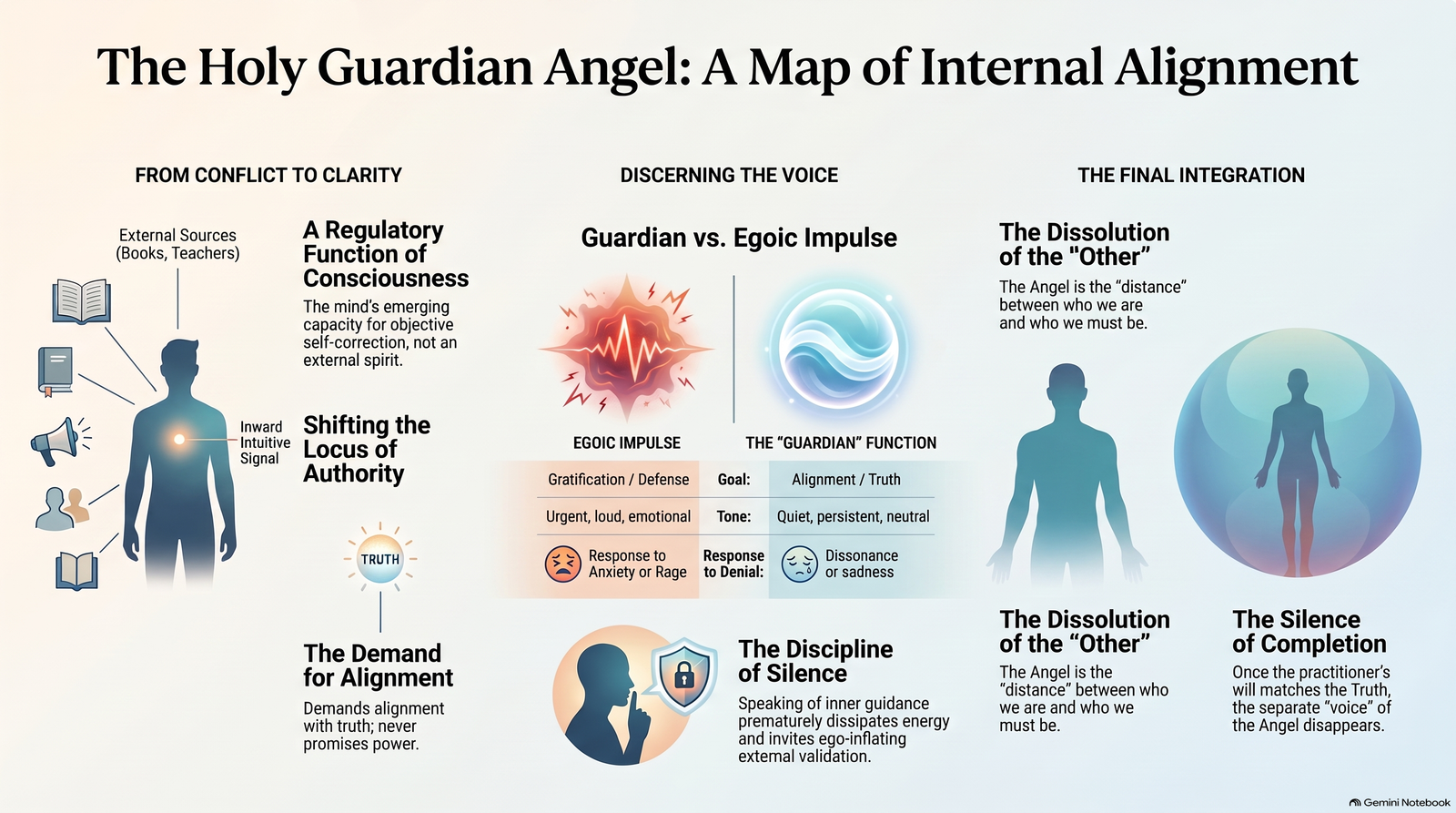
The recording begins with a familiar image: a kneeling practitioner beneath a winged presence that confers light from above. The image is evocative, but the chapter treats literal dependence upon an external rescuer as a possible trap. Its central question is functional rather than iconographic: what kind of inner event is occurring when an intuition seems quieter, more objective and less self-protective than ordinary thought?
Socrates supplies an early comparison. In Plato’s Apology, his divine sign is presented as something that opposes or restrains him rather than a voice that supplies a complete programme of action. The sentence used as the chapter epigraph—“I have a guardian who goes with me always—my daemon”—is best read as a modern condensation of the Socratic motif, not as a secure verbatim translation of Apology 31d. The comparison is useful precisely because the sign is inhibitory: it interrupts an unwise movement without flattering the person who hears it.
The course then defines the Guardian as a transitional regulatory function of consciousness. “Transitional” matters. Early learning relies upon books, teachers and rules. With experience, some of that guidance becomes tacit: like a cook who no longer measures every ingredient, the practitioner begins to recognise misalignment without consulting an external script. Because this clarity differs from habitual self-talk, it may initially be experienced as an “other.” The chapter’s language of an aligned superego is an analogy for this internalisation, not an established clinical construct.
The developmental setting is linked to sakadāgāmī, the once-returner. In early Buddhist texts, a once-returner has ended three fetters and weakened greed, hate and delusion. That is a specific religious attainment within a rebirth-and-liberation framework, not a synonym for being functional, emotionally mature or less impulsive. The chapter uses the stage structurally: when gross consequences no longer provide obvious feedback, subtler patterns require finer discernment.
Its “complex karmic knots” resemble bad posture more than acute injury. A dramatic act brings immediate consequences; a small defensive habit may produce little pain today while organising years of relationships around withdrawal, resentment or self-protection. The Guardian names the felt discrepancy between present conduct and a more coherent response. Yet the absence of immediate trouble is not evidence of alignment, and a feeling of rightness is not self-authenticating proof.
This introduces the chief danger: co-optation. The ego can borrow the language of intuition, boundaries, destiny or spiritual insight to defend an old preference. It can become quiet without becoming truthful. The chapter therefore refuses to judge guidance by dramatic form. A vision, dream, bodily sensation or sentence in the mind is evaluated by consequences over time: does it reduce identification and reactivity, remain open to evidence, and support responsible action—or does it increase specialness, urgency and exemption from scrutiny?
| Feature | Egoic impulse | “Guardian” function |
|---|---|---|
| Origin | Conditioned habit or craving | Emerging clarity or fresh insight |
| Tone | Urgent, loud or emotionally coercive | Quiet, persistent and comparatively neutral |
| Goal | Immediate gratification or defence of self-image | Alignment with what the situation actually requires |
| Response to denial | Anxiety, rage or a demand for immediate compliance | Dissonance or sadness without retaliation |
Table 23 is offered as a reflective instrument, not a diagnostic test. Urgency may be entirely appropriate in an emergency; anxiety can accompany a wise choice; sadness does not certify truth; and an apparently neutral impulse may still be avoidant, dissociated or mistaken. The table is strongest when combined with time, evidence, ethical consequences, trusted challenge and willingness to revise.
Silence is the next discipline. Speaking too quickly about an intuition may recruit admiration, opposition and identity before the experience has stabilised. The chapter therefore recommends containment: allow guidance to mature into conduct before converting it into a story about oneself. This is not a demand for secrecy around abuse, risk, illness or distress. Nor should silence prevent consultation with a clinician, trusted person, safeguarding lead or other appropriate source of help.
The final movement dissolves the entire figure. If the Angel is the distance between how one is acting and what one already recognises as true, increasing integration narrows that distance. The “voice” becomes unnecessary because perception and response are no longer divided by the same argument. The chapter recasts the Hermetic formula “Knowledge and Conversation of the Holy Guardian Angel” as the silence remaining when the conflict with reality ends. That reinterpretation belongs to this course; ceremonial and Thelemic traditions may understand the formula differently.
Reification is therefore the final warning. Any inner figure that demands permanence, unquestioned obedience, superiority or immunity from evidence contradicts the chapter’s own criterion. A useful guide remains provisional and corrigible. The completion of its work is not enthronement but disappearance: not a louder authority inside the self, but less division within action.
Argument map
The life cycle of the guide
External authority
Rules, teachers and texts provide an indispensable scaffold while judgment is still being formed.
Internalisation
Practice develops tacit discernment; because it differs from habitual thought, clarity may be felt as a separate presence.
Objective testing
The signal is judged by origin, tone, purpose, response to frustration and—above all—its consequences for clinging and conduct.
Containment
Silence limits premature identity and lets the insight become ordinary behaviour before it becomes a public story.
Integration
The gap between conscience and action narrows; right response requires less internal argument or imagined mediation.
Dissolution
The guide completes its task by ceasing to appear as an “other.” Any demand for permanent authority signals renewed identification.
Video chapters
Estimated timestamps
These chapter points are estimated from the final 43:40 transcript and may be nudged by a few seconds to the nearest speaker change in YouTube Studio.
- 00:00The Holy Guardian Angel—Without the Supernatural Baggage
- 03:30Socrates and the Inner Restraining Sign
- 06:35A Transitional Regulatory Function
- 09:20When Authority Shifts Inward
- 11:50The Once-Returner and Subtle Karmic Knots
- 16:30How the Ego Co-opts Inner Guidance
- 18:50Table 23: Ego versus Guardian
- 28:25What Guidance Feels Like—and How to Test It
- 30:55Why Silence Protects the Signal
- 34:25The Guide Must Eventually Disappear
- 41:05A Practical Discernment Test
Working vocabulary
Glossary
Holy Guardian Angel
Daemon / daimonion
Superego aligned with Dhamma
Dhamma / Dharma
Sakadāgāmī / once-returner
Karmic knot
Co-optation
Phenomenology of guidance
Knowledge and Conversation of the Holy Guardian Angel
Reification
Silence / containment
Integration
Source map
Book, video and wider traditions
The chapter’s proposal
The Angel is a transitional function generated by the felt distance between conditioned action and recognised truth; it guides only until integration removes that distance.
The video’s expansion
The recording translates the proposal into everyday decision-making: origin, tone, goal and response to denial become a practical discernment grid.
Historical traditions
Socratic, Buddhist, Quaker and ceremonial-magical sources provide comparisons, but their metaphysics, aims and vocabulary should not be flattened into a single timeless psychology.
Continue within the course
Related pathways
- Mythos | Albedo | Spiritual Alchemy Course | Dr Simon RobinsonThe section landing page for all twelve chapters in The Deconstruction of Narrative.
- 2.1.10. A New Kind of DemonThe preceding chapter examines how genuine insight may be appropriated by identity—the danger that makes objective testing of the “Guardian” necessary.
- 2.1.12. The Master of the TempleThe next chapter turns from provisional guidance toward the figure of mastery and the responsibilities that accompany apparent integration.
- 2.1.9. Grace and the Healing of ShameClarifies why discernment must be separated from a punitive inner critic and from shame masquerading as conscience.
- 2.3.5. MāraA later chapter explores personified temptation and the ways apparently spiritual motives can renew attachment.
Reference points
Texts and distinctions
- Plato, Apology 31d: the Socratic divine signThe primary classical comparison for a sign that restrains rather than supplies a full programme. It supports the motif, while also showing why the chapter’s epigraph should be treated as a paraphrase.
- Saṃyutta Nikāya 55.25: the once-returnerAn early Buddhist source describing once-return as the ending of three fetters together with the weakening of greed, hate and delusion.
- Aṅguttara Nikāya 10.13: the ten fettersProvides the wider canonical path structure within which once-return and the remaining fetters are understood.
- Aleister Crowley, Liber SamekhA Thelemic source for the “Knowledge and Conversation of the Holy Guardian Angel.” Its ritual and metaphysical setting differs substantially from this chapter’s psychological reinterpretation.
- George Fox: “Stand still in that which is pure”The fuller Quaker passage situates stillness within temptation, disclosure and submission to the Light; the chapter’s shortened closing quotation condenses that context.
- NHS: hallucinations and hearing voicesPractical information on causes, assessment and when to seek urgent help. It is included to prevent an esoteric framework from replacing appropriate care.
- NHS: where to get urgent mental-health helpCurrent UK routes for urgent advice and emergencies. Immediate danger requires emergency help rather than contemplative interpretation.
A grounded reflection
Test the signal—do not enthrone it
Choose one ordinary, reversible decision. Do not use this exercise for emergencies, medication changes, severe distress, legal or financial commitments, or experiences that feel commanding or frightening.
- Write the impulse in plain language, without “destiny,” “sign,” “angel” or other authority-conferring terms.
- Trace its origin: is it a familiar defensive groove, a craving for relief, or a genuinely new perception of the situation?
- Notice the tone. Is it coercively urgent, flattering or exceptional—or quiet enough to tolerate a pause?
- Ask what it serves: gratification, protection of self-image, truth, repair, responsibility or reduced clinging.
- Say “not yet.” Observe the response without assuming that anxiety proves ego or sadness proves guidance.
- Seek disconfirming evidence and one trusted perspective. A useful intuition can survive scrutiny and revision.
- Take the smallest reversible action, then review its effects on reactivity, honesty and other people over time.
The aim is not to locate an infallible voice. It is to make discernment slower, more objective and less available to self-flattery. If the experience includes commands, externalised voices, loss of sleep, fear, unusual certainty, impaired functioning or risk, pause intensive practice and seek appropriate support.