
Albedo · Mythos · Chapter 5 of 48
2.1.5. Angels and Gods
If heaven is extraordinarily refined experience, what prevents radiance, power and bliss from being mistaken for liberation?
Watch the chapter discussion
Higher States Are Not Liberation
Book orientation
The chapter in brief
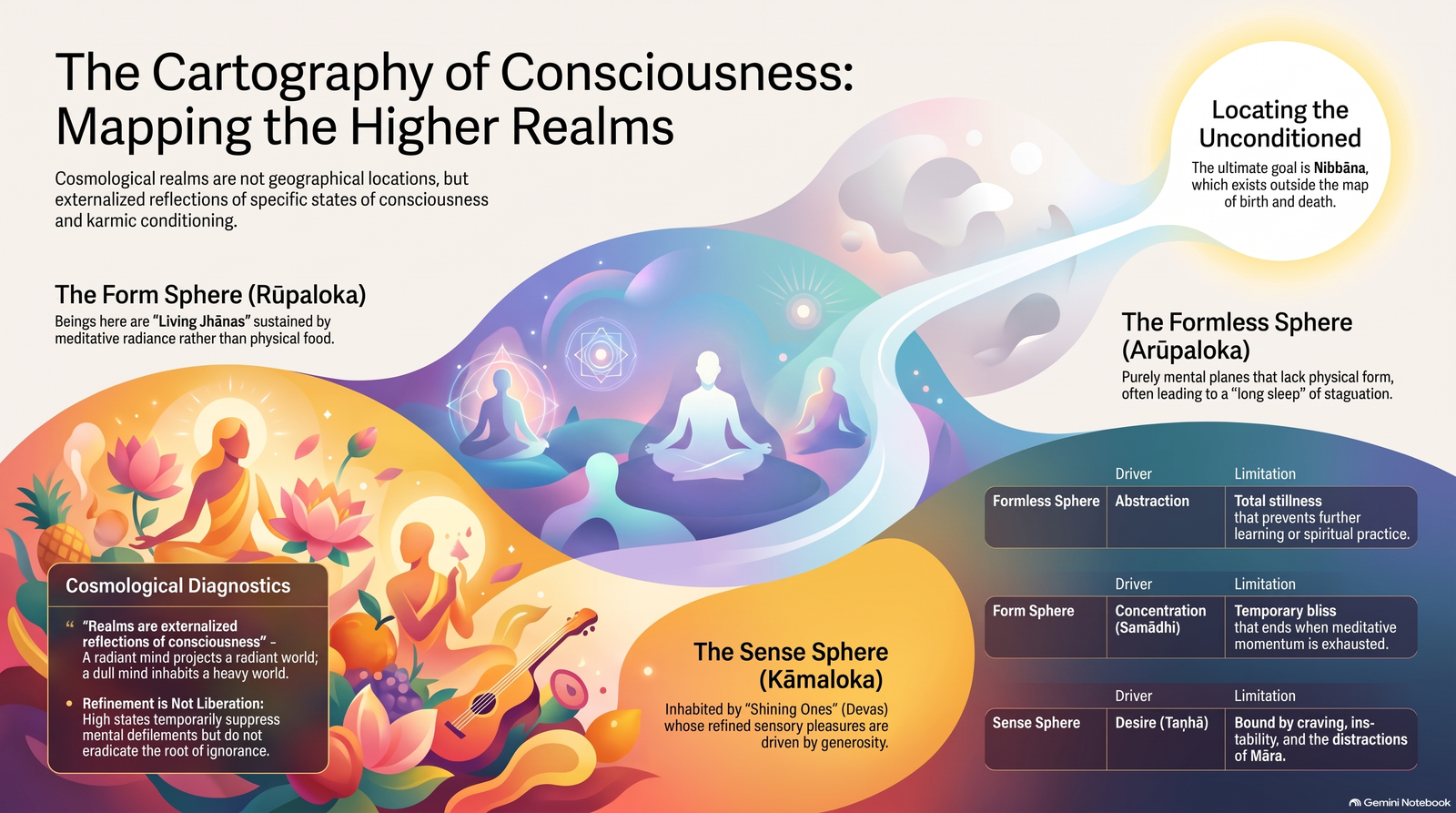
This chapter surveys the upper regions of Buddhist cosmology: devas within the sense sphere, Brahmās associated with refined form, and the immaterial realms reached through formless attainment. Its governing distinction is between refinement and freedom. Generosity, ethical conduct and concentration may condition extraordinarily pleasurable or luminous forms of existence, yet those states remain impermanent and do not by themselves uproot ignorance. The chapter also gives the cosmology an alchemical and phenomenological reading, treating a “realm” as a coherent world disclosed by a particular quality of mind. That synthesis is the author’s interpretive framework. It sits beside, rather than replacing, the traditional Buddhist claim that these are actual modes of rebirth.
Transcript-led guide
A cartography of splendour—and its limits
The recording begins with the “mechanism of realness”: every experienced object appears from a point of view, and the felt solidity of a world cannot be separated from the consciousness to which it appears. A traffic jam can be oppressive in one state and spacious in another, even when the physical scene has scarcely changed. The discussion expands that familiar phenomenology into a cosmological proposal: heavy, radiant and abstract worlds correspond to heavy, radiant and abstract modes of mind. This is a contemplative interpretation of cosmology, not evidence that private mental states literally manufacture a shared external universe.
The first ascent remains within kāmaloka, the sphere of sensory desire. Devas are described as long-lived “shining ones” whose pleasure arises from wholesome karma, yet whose worlds still depend upon sight, sound, status and enjoyment. The recording moves from terrestrial devas to Tāvatiṃsa and the higher sense heavens, drawing out a recurring paradox: goodness, order, contentment and creative power can be remarkable without being unconditioned. The symbolic alignment of Mount Meru with the spine and thirty-three vertebrae belongs to a modern esoteric or internal-alchemical reading; it is not a standard anatomical claim or an early Buddhist explanation of Tāvatiṃsa.
Beyond sense pleasure, the discussion turns to rūpaloka. Brahmās are presented as beings sustained by the karmic result of meditative absorption, with increasingly subtle realms corresponding broadly to increasingly refined jhāna. The map is useful, but the exact Theravāda classification is more intricate than a one-line equation between each jhāna and one destination. The Pure Abodes are especially important: they are traditionally reserved for non-returners, not simply produced by attaining fourth jhāna. Concentration suppresses hindrances and can condition elevated rebirth; liberating insight concerns impermanence, suffering and not-self.
The final movement reaches arūpaloka: infinite space, infinite consciousness, nothingness, and neither perception nor non-perception. These are not unconscious vacuums. In Buddhist analysis they are exceedingly subtle mental attainments and possible rebirths without material form. Their serenity is still conditioned, and their vast duration eventually ends. The chapter’s practical challenge is therefore diagnostic: notice the state being sought, the attachment concealed within that aspiration, and the temptation to call an exquisite experience final. The purpose of the map is not to despise beauty or concentration, but to keep the unconditioned from being confused with the summit of conditioned experience.
Argument map
How the ascent is organised
Question “realness”
Experience always includes a world and a standpoint from which that world appears; the quality of mind colours the texture of what is encountered.
Map the sense heavens
Deva realms display the fruits of generosity, ethics and refined pleasure, while remaining within desire and the instability of conditioned life.
Expose celestial power
Tāvatiṃsa, higher devas and Māra show that order, bliss, creativity and sovereignty can coexist with conflict, attachment and delusion.
Enter radiant form
Brahma realms are related to meditative absorption: sensuality has fallen away, but subtle form, duration and identification remain.
Pass beyond form
The immaterial attainments refine attention toward boundlessness, nothingness and extreme subtlety without becoming unconditioned.
Locate the real threshold
The map ends by distinguishing every produced state from liberation: refinement changes experience; insight releases clinging to it.
Book, tradition and video
Three layers of the material
The chapter establishes
A three-sphere map of sense, form and formless existence, together with the warning that heavenly rebirth and meditative refinement remain impermanent.
The video expands
Everyday examples of state-dependent reality, detailed deva hierarchies, political and creative metaphors, and a sustained diagnostic reading of cosmology.
The synthesis proposes
“Cognitive density,” internal Mount Meru and realms as externalised perception. These are modern interpretive bridges, not a single doctrine shared by Buddhism and historical alchemy.
Video chapters
Follow the discussion
These chapter markers are retained from the supplied YouTube catalogue. The final running time was not included in the supplied materials, so the last marker could not be checked independently against the endpoint.
- 00:00Introduction: The Mechanism of “Realness”
- 04:15Heavens and Hells as States of Consciousness
- 08:30The Deva Realms: Understanding the “Shining Ones”
- 13:45Tāvatiṃsa and the Internal Axis Mundi
- 19:10The Brahma Realms: Radiance Without Desire
- 25:20Correspondence: Jhāna States and Rebirth Destinations
- 30:45The Formless Realms: The Trap of Spiritual Stagnation
- 35:30Cosmological Diagnostics: Locating the Unconditioned
Working vocabulary
Glossary
Deva
Kāmaloka
Tāvatiṃsa
Māra
Brahmā and rūpaloka
Jhāna
Pure Abodes
Arūpaloka
The Unconditioned
Cognitive density
Continue within the course
Related pathways
- Mythos | Albedo | Spiritual Alchemy CourseThe section landing page for all twelve chapters in The Deconstruction of Narrative.
- 2.1.4. Hell and Hell BeingsThe preceding chapter examines the painful end of the cosmological map and the recursive structures of aversion and craving.
- 2.1.6. The AlchemistThe next chapter turns from the map of realms toward the practitioner’s stance, method and responsibility.
- 2.1.2. The CosmosIntroduces the larger architecture of mind and world within which the present chapter locates heavenly experience.
- 2.2.8. Wholesome KarmaDevelops the intentional and ethical conditions traditionally associated with fortunate human and celestial results.
- 2.2.12. The AnagāmīProvides the course’s fuller treatment of the non-returner and the doctrinal significance of the Pure Abodes.
- 2.3.4. Brahma’s ChariotReturns to Brahmā symbolism through the four immeasurables and their role in ethical and contemplative development.
Reference points
Texts and distinctions
- Majjhima Nikāya 49: The Invitation of BrahmāBaka Brahmā mistakes his refined world for permanence and ultimacy, offering an early textual parallel to the chapter’s warning against celestial idealisation.
- Dīgha Nikāya 11: With KevaddhaA discourse in which the Great Brahmā’s apparent omniscience is exposed as limited, useful for distinguishing exalted status from liberating knowledge.
- Saṃyutta Nikāya 14.11: Seven ElementsNames light, beauty and the dimensions of infinite space, infinite consciousness and nothingness as attainments with particular conditions.
- Majjhima Nikāya 121: Shorter Discourse on EmptinessTraces increasingly subtle meditative perceptions while continuing to examine the conditionality and disturbance remaining in each.
- Aṅguttara Nikāya 4.123: FirstConnects meditative development with Brahmā-world rebirth while preserving the decisive question of whether the liberating teaching has been understood.
A grounded reflection
Notice the wish hidden inside the ideal state
Recall one ordinary but genuinely pleasant state: ease after finishing work, absorption in music, quiet during meditation, creative flow or the warmth of being appreciated.
- Name what was wholesome or nourishing about the experience.
- Notice the moment enjoyment became a wish for permanence, repetition or identity.
- Ask what disappointment appeared when the state changed.
- For a few breaths, let appreciation and impermanence be present together.
The point is not to flatten pleasure or distrust meditation. It is to practise receiving a good state without asking it to become an unchanging refuge or proof of spiritual rank.