
Citrinitas · Object · Chapter 27 of 48
3.3.3. The Magus
Can the story of being someone loosen its grip while care, judgement and ordinary responsibility remain?
Revised Edition (2026): chapter 27, The Magus. The reference 3.3.3 is catalogue notation. This established webpage retains its earlier public numbering, 3.3.11.
Watch the discussion
The Magus and the Simulation of Reality | Modern Alchemy
Open on YouTube · Publication month and final duration supplied by the author.
The chapter in brief
The Magus examines the attachment that can remain after social identities have loosened: the feeling of an inner owner standing behind experience. Within Object, it follows Solipsism and shifts the inquiry from how a world is perceived to how a perceiver is assumed. Robinson describes this through the protagonist who becomes a prisoner of the story, the transition from Albedo to Citrinitas, and a dream without a separate dreamer.
The revised chapter extends these images through a comparison of Gnostic cosmology, alchemical symbolism and modern simulation language. Its “ground of being” gives expression to a reported spaciousness beyond habitual identification. These correspondences belong to the author’s interpretive framework; they neither establish a computer-generated universe nor make the Magus, arahant and bodhisattva interchangeable attainments.
The video’s central question
What changes when experience is no longer continually recruited to defend a central character? The recording opens with an imaginary medical consultation in which an X-ray seems to undermine the reality of the whole room. This is a dramatic thought experiment, not something radiology can demonstrate. From there, the hosts turn to a cinema: trying to repair the protagonist’s life by scratching at the screen becomes their image for repetitive, self-involving thought. The important turn comes when they ask whether abandoning that struggle would also abandon the ability to function.
The red-light example answers this within the discussion. Stopping the car and remembering practical obligations remain; the additional story of personal persecution is what the hosts question. Their image of a person collecting experiences into a defensive fort develops the same point. This is an analogy for identification, not an explanation of trauma or a diagnosis. The movement from Albedo’s social masks to Citrinitas’s subtle observer then locates the question within Robinson’s model. A quieter spiritual identity can still make itself the centre of everything.
The second movement widens the lens. A rock acquires an entirely different emotional significance when it is identified as the object used in a break-in. The hosts use this to explain the chapter’s “twofold simulation”, then compare the Matrix, the Gnostic Demiurge and alchemical sulphur. The comparison is imaginative, but the recording’s claim that the maps are identical goes beyond the evidence. Historical cosmologies and modern psychological readings must remain distinguishable. Nor does recognising interpretation make vandalism, danger or their consequences unreal.
Finally, the hosts move from the imagined projector to its light: the chapter’s ground of being, essence and manifestation, and Buddha-nature. They contrast the liberated wanderer with the bodhisattva’s commitment, then propose a day lived as an “unauthored life”. This page carries forward the question about possessiveness while retaining deliberate choice and accountability. It does not reproduce that exercise. The recording’s useful practical distinction is between functioning and self-defence; its larger metaphysical conclusions remain interpretations rather than established results.
Simulation is a metaphor, not a verdict on reality
Experiencing the world through perception does not establish that an individual mind creates the physical universe. Here, “simulation” names an interpretive overlay: the felt world organised around expectation, fear and identity. It is not evidence for computational simulation, a cosmic controller or the unreality of other people.
Likewise, Buddhist emptiness does not mean that events are meaningless or harmless. Nirvāṇa cannot be reduced to pleasant, unlabelled sensory “raw data”. The recording’s equation of thinking with saṃsāra needs its own qualification: Buddhist teachings distinguish harmful thinking from thought directed towards harmlessness and understanding. Clear judgement, consent, care and practical action still matter.
How the argument develops
01
The search for a structural fix
An impossible X-ray consultation introduces the unsettling possibility that the assumed framework itself is being questioned.
02
The protagonist becomes the prisoner
The cinema image shifts attention from repairing every scene to the identity that claims the entire story.
03
Functioning survives the question
The red light distinguishes necessary practical cognition from the added narrative of a persecuted self.
04
Even the observer can become a role
Albedo and Citrinitas mark the author’s contrast between relinquishing social masks and relinquishing an inner owner.
05
Meaning changes the experienced world
The rock and the comparative simulation chart connect emotional interpretation with the author’s modern reading of Gnostic and alchemical imagery.
06
Freedom returns to ordinary conduct
Ground-of-being language leads to the wanderer, the bodhisattva and the closing challenge about authorship and responsibility.
Book, recording and interpretation
The chapter’s emphasis
The Magus, the twofold simulation and the ground of being organise a first-person account of loosening identification.
The recording’s expansion
The cinema, red light, defensive fort and rock turn the chapter’s compact propositions into everyday examples.
The interpretive boundary
The comparison table is Robinson’s synthesis. Neither ancient Gnostic myths nor Buddhist liberation maps establish the proposed one-to-one correspondences.
A visual companion
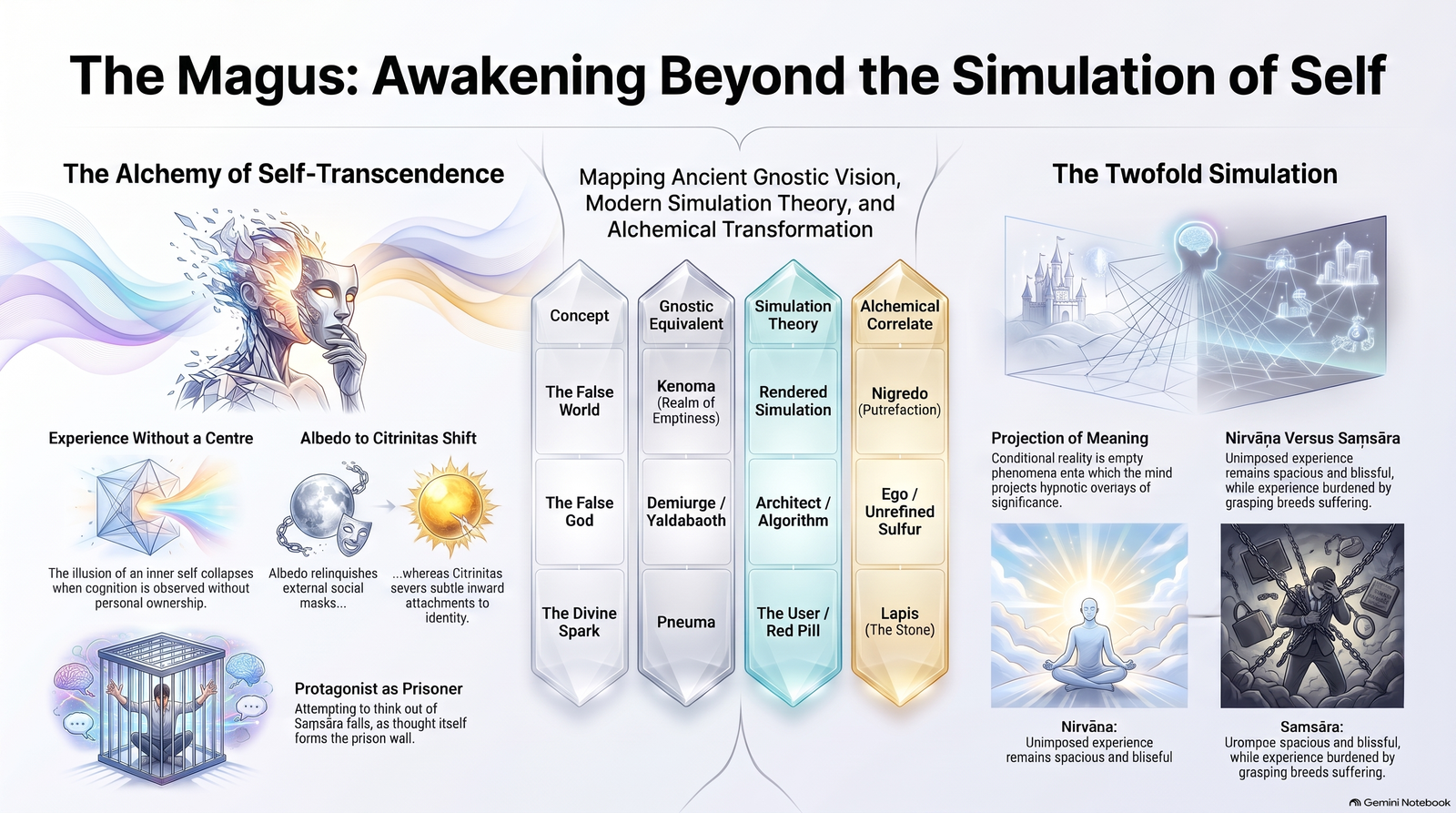
Terms for careful reading
Magus
In this course, the Magus is a symbolic designation for the loosening of an assumed inner controller. The word has wider religious and Western esoteric histories, but the chapter’s particular placement within Citrinitas is Robinson’s framework. It does not supply a recognised cross-traditional test of liberation or a credential for the reader.
Albedo and Citrinitas
These alchemical colour terms mean whitening and yellowing. Robinson uses them to distinguish relinquishing defended social identities from questioning a more subtle inward owner of experience. His psychological and contemplative sequence should not be treated as a single historical doctrine shared by all alchemical writers, or as a timetable everyone must follow.
Saṃsāra and nirvāṇa
In Buddhist traditions, saṃsāra concerns conditioned wandering and rebirth sustained by ignorance and craving; nirvāṇa concerns release. The chapter translates this contrast into the burden of grasping and a spacious relationship with experience. That is an interpretive simplification: ordinary thought, meaningful relationships and useful distinctions are not themselves equivalent to bondage.
No-self and emptiness
Buddhist no-self teachings question taking impermanent processes as an enduring self. In Mahāyāna, emptiness concerns the absence of independent, intrinsic existence. Neither establishes that other people are inventions of one private mind. The chapter’s dream language is best read as a challenge to ownership, with ordinary persons and ethical consequences still acknowledged.
Simulation and narrative overlay
“Simulation” here describes the experienced world as shaped by interpretation, expectation and self-reference. The recording’s rock example shows how information changes an object’s emotional meaning. It does not demonstrate that material objects are computer code, that all suffering is self-created, or that recognising a narrative removes an actual threat.
Demiurge and gnosis
A demiurge is a world-maker; some ancient Gnostic narratives portray this figure as ignorant of a higher divine reality. Gnosis concerns saving knowledge within those religious settings. The recording turns the world-maker inward as an image of self-organising perception. That modern psychological reading must be distinguished from the narratives’ own cosmological claims.
Kenoma, pleroma and pneuma
These Greek terms are used in Gnostic contexts for deficiency or emptiness, fullness, and spirit, with meanings that vary by text and system. The chapter aligns them with simulated reality, source and divine spark. This is a comparative scheme, not evidence that ancient writers anticipated computer simulation or taught Buddhist emptiness.
Ground of being and Buddha-nature
“Ground of being” names the chapter’s proposed spacious basis of experience. Buddha-nature belongs to diverse Mahāyāna teachings about buddhahood and its possibility or presence. Similar imagery does not make them identical, establish an eternal personal soul, or prove a metaphysical substance underlying the universe. Essence and manifestation are explanatory terms within this discussion.
Arahant and bodhisattva
Arahant names a liberated person in early Buddhist and Theravāda traditions. In Mahāyāna, the bodhisattva pursues buddhahood for the benefit of beings. The recording’s wanderer/rescuer contrast is its comparative framing; it should not imply that arahants lack compassion or that Mahāyāna is a universally accepted stage beyond Theravāda liberation.
Bhūmi
Literally “ground”, a bhūmi is a level of the bodhisattva path in Mahāyāna literature. Ten grounds are prominent in the Daśabhūmika Sūtra. They concern the cultivation of wisdom and beneficial qualities, rather than ten physical layers of awareness. The chapter’s “grounds of being” language is an interpretive bridge, not an exact doctrinal equivalence.
Related pathways
- 3.3.2. SolipsismThe preceding revised-book chapter asks how perception and significance shape the world we experience.
- 3.2.9. The Metaphor of the Film ProjectorDevelops the projector metaphor used throughout this recording.
- 3.3.12. The Ground of BeingAn established related page for the language of awareness and its proposed ground.
- Object — Part Three of Citrinitas | Spiritual Alchemy Course | Dr Simon RobinsonExplore the Object section; its public numbering may retain the older sequence.
- Citrinitas – Part ThreeReturn to the wider Citrinitas course and its place in A Course in Modern Alchemy.
External reference points
These sources clarify terminology and provenance. Their inclusion does not imply that the hosts used these particular editions.
- Dhammapada 1–20 · translated by Acharya BuddharakkhitaA recognised Pāli translation places the opening verses in the context of mind, action and consequences; it does not establish that thought manufactures the physical world.
- Two Sorts of Thinking (MN 19) · translated by Ṭhānissaro BhikkhuA primary-text counterpoint to “thinking is saṃsāra”: the discourse distinguishes harmful thought from thought associated with harmlessness and understanding.
- The Secret Book of John · translated by Stevan DaviesRead the myth of Yaldabaoth in a translated ancient text, distinguishing its cosmology from the recording’s inward reinterpretation.
- The Ten Bhūmis · 84000 translationThe Mahāyāna scripture provides a textual setting for ten bodhisattva grounds, rather than a universal ladder beyond an alchemical grade.
- Tractatus Logico-Philosophicus · C. K. Ogden translation, 1922Propositions 1.1 and 2 place facts and states of affairs within Wittgenstein’s philosophical project; the recording’s comparison with emptiness is a further interpretation.
A question to carry forward
Think of a small disagreement: what practical responsibility remains when the need to defend your identity becomes less urgent?
Consider an ordinary response such as listening, checking a fact, apologising or maintaining a boundary. There is no need to suspend judgement, surrender authorship of your day or test whether the self has disappeared.