
Nigredo · Dharma · Chapter 15 of 48
1.2.3 The 72 Types of Entities
Can a finite map of experience reveal how a seemingly solid self and world are assembled—and where the map itself must finally be left behind?
Watch the chapter discussion
What Reality Is Made Of
The book
The chapter in brief
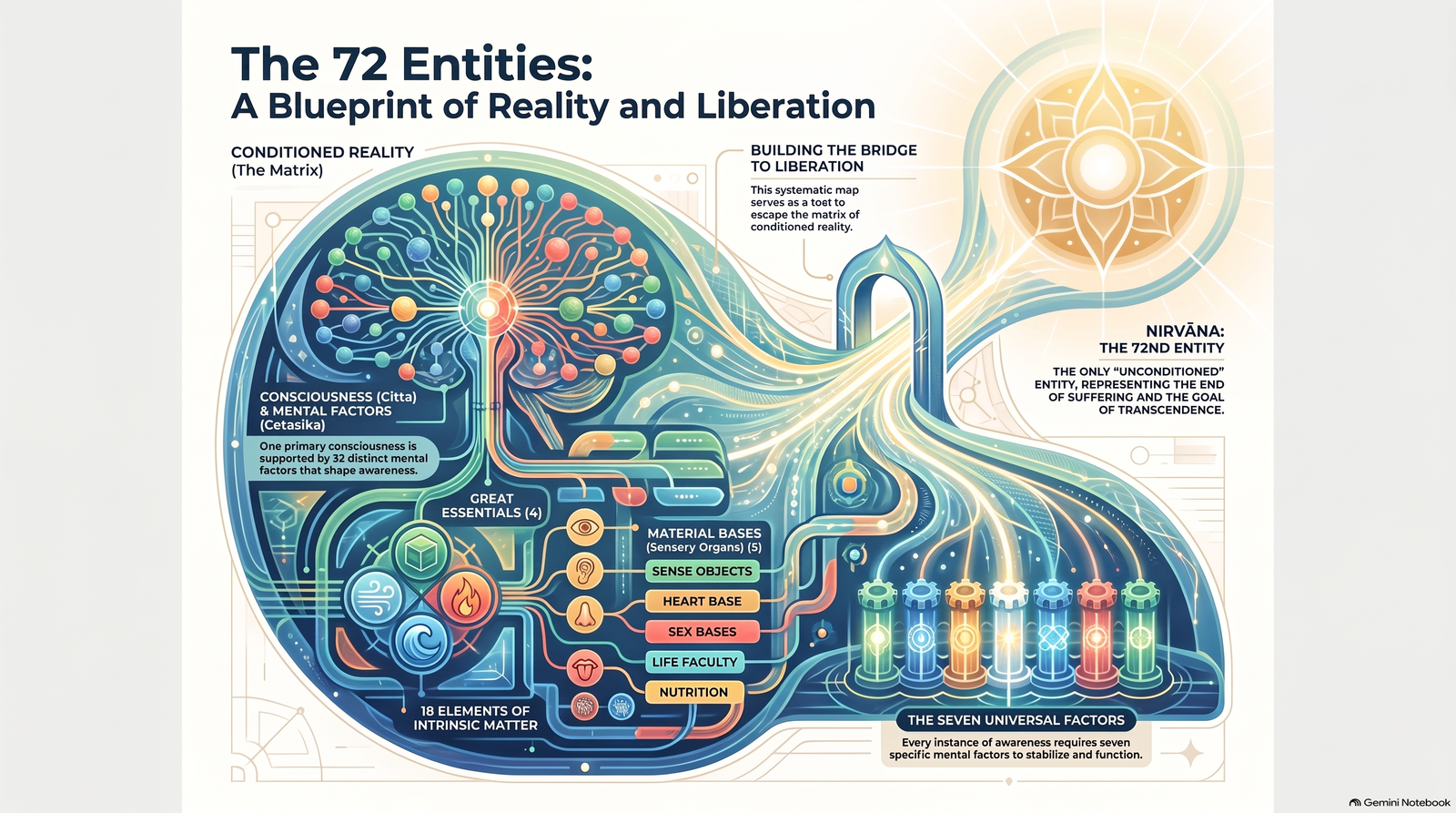
The 72 Types of Entities turns the previous chapter’s broad account of conditioned reality into a mnemonic inventory. The course counts one category of consciousness, fifty-two mental factors and eighteen kinds of material phenomenon as the seventy-one components of conditioned experience; Nibbāna, treated as unconditioned, becomes the seventy-second. The purpose is practical rather than encyclopaedic: apparent persons and things are re-read as changing configurations so that identification with them may loosen.
The number seventy-two is the chapter’s selected teaching model, not the standard total of the later Theravāda Abhidhamma taxonomy. That scheme ordinarily lists eighty-two ultimate dhamma categories: one citta category, fifty-two cetasikas, twenty-eight rūpas and Nibbāna. The chapter reaches seventy-two by counting only eighteen kinds of materiality as possessing intrinsic nature. That choice—and the alchemical framing built around it—belongs to Dr Robinson’s synthesis.
Video guide
A useful palette, not a periodic table
The recording opens with the apparent solidity of a hand, cup or chair, then asks what remains when the seamless surface of experience is analysed into processes. Its painter’s-palette and Lego metaphors make the chapter’s intent clear: the list is not meant to compete with physics or chemistry. It is a contemplative classification of experience—an intermediate bridge between everyday talk of selves and things and the Buddhist investigation of conditioned phenomena.
The video next contrasts apparent reality with phenomena said to possess an individual characteristic. Space becomes the test case: it is presented as a concept dependent on boundaries rather than a separately existing component. “Intrinsic nature” needs care here. Within Abhidhamma discussion it refers to a dhamma’s characteristic and function, not to an independently self-existing substance. Conditioned dhammas arise in dependence on causes and relations; the analysis is designed to weaken reification, not install seventy-one miniature eternal objects behind appearances.
The mental side is divided into citta and cetasikas. Citta is the event of cognising an object; mental factors such as contact, feeling, perception, volition and attention arise with it and shape the character of that moment. The video’s celebrity-and-entourage metaphor makes the distinction memorable. Its practical payoff is equally important: “anger is present” need not harden into “I am an angry person”. However, the claim that these sequences occur “billions of times per second” is rhetorical rather than an established Abhidhamma measurement or scientific finding.
The account of materiality moves through the four great elements, five sensitive bases, four sense objects, heart-base, two sex phenomena, life faculty and nutritive essence. These are categories from a premodern phenomenological and commentarial system; earth, water, fire and air name qualities such as resistance, cohesion, temperature and motion rather than chemical elements. The traditional heart-base is a proposed physical support for mental activity in later Theravāda commentary. The video’s description of an electromagnetic vortex and its suggestion that this may anchor consciousness are modern speculative additions, not established neuroscience. Likewise, traditional sex phenomena should not be treated as a complete modern account of sex, gender or identity.
Nibbāna supplies the final contrast. In this Theravāda framework it is the one unconditioned dhamma, not another conditioned component or a material escape hatch. The recording sometimes gives the seventy-one conditioned categories the dramatic language of prison, simulation and machinery. Read more soberly, the map’s work is diagnostic: it asks whether anything within changing body and mind can sustain the burden of “I”, “me” and “mine”. Its liberating value lies less in believing a number than in observing conditionality directly.
Argument map
How the inquiry develops
Question the seamless object
A hand, cup or emotion feels singular until attention distinguishes the physical and mental conditions composing the encounter.
Use a provisional bridge
The taxonomy is openly presented as a mental construction whose value lies in carrying inquiry beyond ordinary reification.
Separate awareness from its colouring
Citta cognises an object while accompanying cetasikas supply feeling, recognition, intention, attention and ethical tone.
Analyse embodied conditions
The selected eighteen rūpas organise elemental qualities, sensory bases and objects, vitality, nutrition and other bodily conditions.
Distinguish process from identity
Anger, pleasure and perception can be observed as conditioned events rather than converted immediately into a fixed personal story.
Do not confuse map and territory
The count is a soteriological aid: it is meant to expose dependency and impermanence, not provide a modern scientific inventory.
Set the unconditioned apart
Nibbāna is placed outside the seventy-one conditioned types as the cessation of the processes sustaining suffering.
Book, video and tradition
What belongs to which layer?
The written chapter
Introduces the 72-part mnemonic: consciousness, fifty-two mental factors, eighteen kinds of materiality and Nibbāna, presented as a bridge beyond apparent reality.
The video’s expansion
Adds the hand, painter’s palette, Lego, celebrity entourage, operating-system and prison metaphors, then draws practical implications for identity and emotional reactivity.
Theravāda Abhidhamma
Supplies the four broad categories and the analysis of momentary citta with associated cetasikas, but its conventional later enumeration totals eighty-two rather than seventy-two.
The course’s synthesis
Selects eighteen rūpas, gives the count alchemical meaning and adds modern language about algorithms, energy, gender polarity and electromagnetic fields.
Clickable chapters
Navigate the video
Seven supplied markers fit within the verified final runtime of 28:55. The supplied 31:30 and 36:00 markers were omitted because they fall after the recording ends.
Terms for orientation
Expandable glossary
Dhamma
Paramattha dhamma
Sabhāva / intrinsic nature
Citta
Cetasika
The seven universals
Rūpa
Nipphanna-rūpa
The four great elements
Heart-base
Sex phenomena
Nibbāna
Continue through the course
Related pathways
- 1.2.2. The Matrix of Conditioned RealityThe preceding chapter introduces matter, consciousness and mental factors before the present chapter assigns them a memorable count.
- 1.2.4 ConsciousnessThe next chapter examines the types and functions gathered under the present page’s single citta category.
- 1.2.5 The Mental FactorsDevelops the fifty-two cetasikas that accompany and colour consciousness.
- 1.2.6 MaterialityReturns in greater detail to the rūpa categories compressed into the present chapter’s eighteenfold selection.
- Nigredo: DharmaThe section index for the twelve chapters that develop the course’s map of conditioned experience and liberation.
Context beyond the course
External reference points
- Stanford Encyclopedia of Philosophy — AbhidharmaA scholarly overview of Abhidharma’s history, competing school taxonomies, eighty-two Theravāda categories and practical purpose.
- Buddhist Publication Society — A Comprehensive Manual of AbhidhammaBhikkhu Bodhi’s edited guide to the later Theravāda manual tradition, including citta, the fifty-two cetasikas and twenty-eight rūpas.
- SuttaCentral — The Unconditioned (SN 43.12)A brief early Buddhist discourse identifying the ending of greed, hate and delusion with the unconditioned.
A two-minute observation
From “my experience” to present conditions
Rest a hand on a table or on your knee. Notice resistance, temperature or movement. Then notice the knowing of that contact, its pleasant, unpleasant or neutral tone, the recognition of what is being touched and any impulse to adjust.
There is no need to decide whether the chapter’s full taxonomy is correct. Simply test its practical proposal: does separating one apparently simple moment into physical quality, awareness and mental colouring alter how solid or personal it feels?