
Dialogues II · Episode 13 of 18
The Matrix as a Spiritual Trojan Horse
Can a cyberpunk blockbuster carry serious questions about illusion, conditioning and liberation without becoming a secret scripture? This episode follows the teaching hidden inside the entertainment—and the point at which every cinematic metaphor reaches its limit.
Orientation
A teaching concealed inside a familiar story
The Matrix works as a Trojan horse not because it secretly proves one religious system, but because a popular story can carry difficult questions past our usual defences. Beneath the leather coats, code and action choreography lies a more disturbing possibility: escaping an obvious illusion may reveal only another conditioned world.
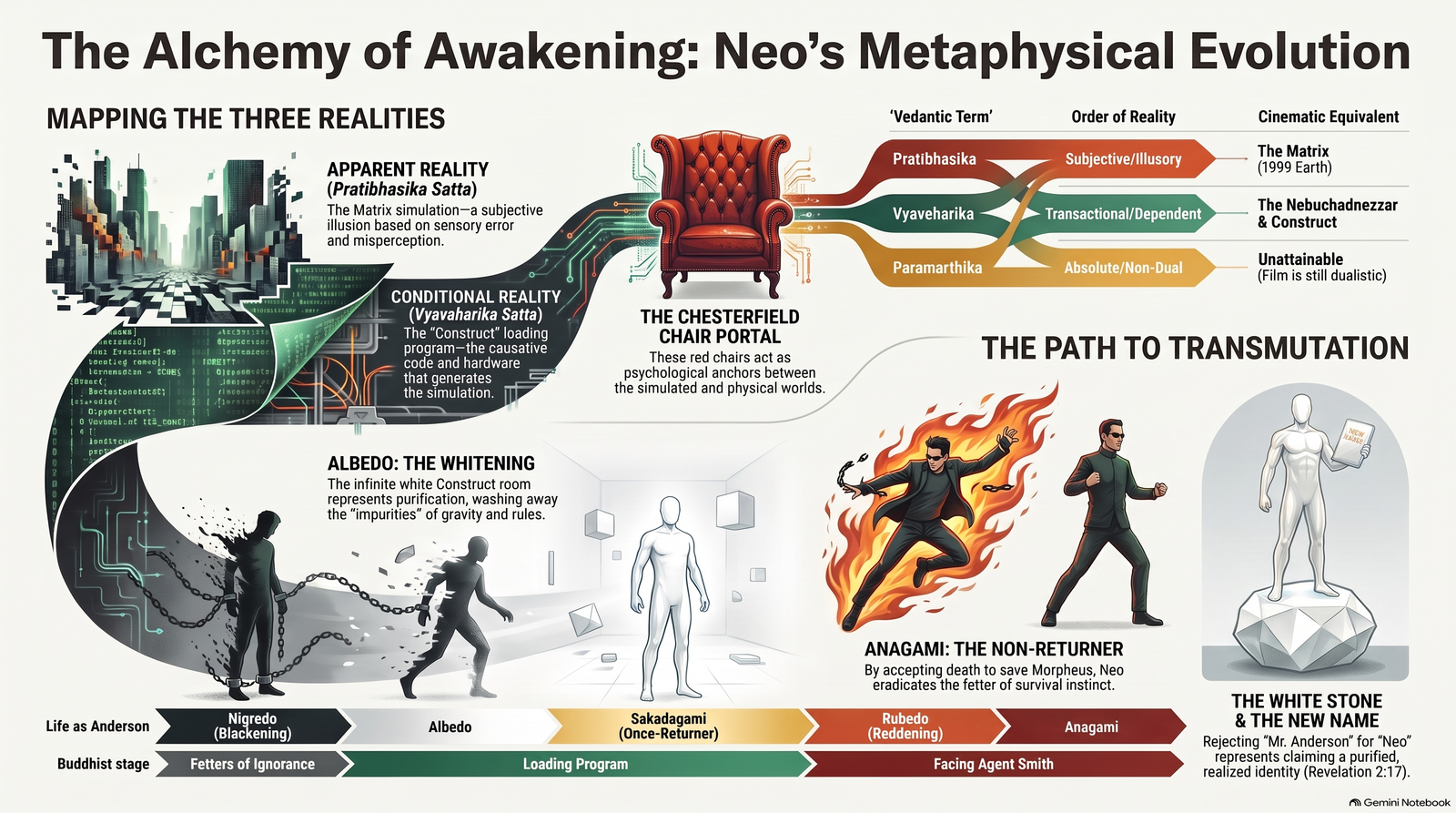
The episode begins with a three-level map drawn from later Advaita Vedānta. The Matrix resembles apparent reality: coherent from within, yet founded upon misrecognition. The machinery, programs and devastated world outside it resemble transactional or conventional reality: causally effective, but still dependent. Ultimate non-dual reality cannot be given an adequate cinematic equivalent, because any film must continue to divide viewer from viewed, figure from ground and hero from obstacle.
The white Construct then becomes a hinge. Its red Chesterfield chairs visually connect familiar domestic space with a placeless field where objects, clothes and rules can be loaded. Read alchemically, Neo’s traumatic extraction from the pod suggests Nigredo, while the stripped white field suggests Albedo: not final liberation, but clarification of the conditions by which a world is assembled.
The central map
Three realities, three different questions
Apparent reality
The rope mistaken for a snake is the classical illustration: an appearance taken to be something it is not. The Matrix simulation is the episode’s cinematic analogue. This does not make ordinary perception worthless; it asks how expectation, naming and error shape what appears.
Transactional reality
The Nebuchadnezzar, its hardware and the Construct possess practical causal force within the story. They explain how the simulated world is generated. Yet an explanatory layer is not therefore absolute: it too depends upon conditions, distinctions and a perceiving standpoint.
Ultimate reality
In Advaita, ultimate reality is non-dual Brahman rather than a second, more solid location behind appearances. The film’s scorched Earth cannot simply represent this, because it remains a world of separation, conflict, bodies, machines and survival.
Chapters
Follow the complete discussion
- 00:00The Matrix as a Hidden Spiritual Teaching
- 03:20Late 90s Cinema, Y2K Anxiety, and Cyberpunk Disguise
- 06:40Advaita Vedānta and the Three Orders of Reality
- 11:10Apparent Reality: The Rope Mistaken for a Snake
- 15:00Conditional Reality and the Machinery Beneath the Illusion
- 18:20Why the “Real World” Is Not Ultimate Reality
- 22:10The Loading Program as Psychological Threshold
- 25:40The Finger, the Moon, and the Limits of Film
- 29:40Morpheus, Prophecy, and Spiritual Dogma
- 33:10Neo’s Nigredo: Breakdown, Death, and Awakening
- 36:40The White Construct and Alchemical Albedo
- 39:50The Ten Fetters and the Buddhist Path of Purification
- 43:00The Oracle, Sacrifice, and the End of Fear
- 45:30The White Stone, the New Name, and Final Liberation
- 47:00Closing Reflection: What Is Your Loading Program?
Argument map
From hidden machinery to freedom from the rules
- A story lowers the guard. Philosophy arrives disguised as entertainment. The viewer can encounter doubt, illusion and liberation before deciding whether the film is a spiritual text at all.
- Escaping one appearance reveals another level. Neo discovers that the Matrix is generated, yet the world of ships, cables and machines remains conditional rather than ultimate.
- The Construct makes dependence visible. Objects and physical laws can be loaded because their apparent solidity depends upon a deeper architecture. The white room clarifies construction without disclosing an unconditioned absolute.
- The map begins to transform the traveller. Neo no longer relates to gravity, identity or danger as unquestionable facts. The episode reads this change through Albedo and the weakening of attachment, while stopping short of a literal attainment claim.
- The Oracle removes the heroic identity. Her words can be read as a narrative intervention that prevents Neo from acting merely as a guaranteed saviour. Sacrifice becomes chosen action rather than the performance of a flattering destiny.
- The new name marks a changed allegiance. “Neo” opposes the system’s “Mr Anderson.” Revelation’s white stone supplies a resonant image of overcoming and a new name, not proof that the scene has a single Christian or esoteric meaning.
Fact-sensitive notes
Where the metaphor illuminates—and where it breaks
A correction to the generated discussion. The exchange “You’re empty” / “So are you” does not occur in the subway fight in The Matrix. The scene’s relevant naming exchange is Agent Smith’s insistence on “Mr Anderson” and Neo’s reply, “My name is Neo.” The absent exchange should not be used as evidence for the episode’s emptiness interpretation.
Advaita is not simulation theory
The distinction among apparent, transactional and ultimate reality is epistemic and metaphysical; it does not predict computer hardware behind the universe. Brahman is not a superior physical layer analogous to the Nebuchadnezzar.
Buddhist attainments are not character beats
In the traditional four-stage scheme, stream-entry abandons the first three fetters; once-return weakens sensual desire and ill will; non-return abandons those two. Neo’s choices may illustrate loosening fear or identity, but the film cannot certify these attainments.
Fearlessness is not non-return
Anāgāmī does not simply mean someone willing to risk death. The term belongs to a specific Buddhist account of liberation from the five lower fetters. Heroic sacrifice and doctrinal attainment should remain distinct.
The white stone remains multivalent
Revelation 2:17 joins the white stone with hidden manna, overcoming and a new name. Historical explanations of the stone vary. The page therefore uses it as a textual and symbolic resonance rather than asserting one settled Roman legal origin.
Nigredo is not trauma as initiation
Neo’s disorientation can be read through alchemical blackening, but psychological collapse, depersonalisation and trauma are not reliable marks of awakening. Distress deserves care rather than spiritual romanticisation.
The finger is not the moon
The failure of the film to depict a non-dual absolute is not a defect that must be repaired. A story works through distinctions. At its best it directs attention beyond itself without pretending to contain what it indicates.
Traditions in conversation
Keep the source languages distinct
Advaita Vedānta
The three orders distinguish erroneous appearance, the shared world of practical dealings and ultimate non-dual reality. They provide the episode’s ontology, but should not be treated as synonymous with Buddhist emptiness.
Theravāda Buddhism
The fetter model describes progressive abandonment of what binds beings to continued existence. The episode borrows it as a disciplined reading of Neo’s arc, while the page retains the difference between doctrine and film criticism.
Alchemy
Nigredo and Albedo supply images of dissolution and clarification. Their alignment with the pod and Construct is an interpretive correspondence, not a claim about the filmmakers’ intention or a universal sequence of psychology.
Christian apocalyptic imagery
The white stone and new name come from Revelation 2:17. Set beside Neo’s rejection of “Mr Anderson,” they open a fruitful comparison about identity and overcoming without turning the film into Christian allegory.
Glossary
Terms used in the episode
Prātibhāsika-sattā
Apparent or illusory reality: an experience that seems coherent until its error is disclosed, classically illustrated by mistaking a rope for a snake. It is not merely imagination without consequences; a mistaken appearance can still produce fear and action.
Vyāvahārika-sattā
Transactional or empirical reality: the shared, causally ordered world in which ordinary knowledge and practical action operate. Advaita regards it as valid within its domain while denying that it is ultimately independent.
Pāramārthika-sattā
Ultimate reality in Advaita: non-dual Brahman, not another object or location within the world. Translating this into a cinematic image inevitably reintroduces divisions the term is meant to exceed.
Nigredo and Albedo
Blackening and whitening within alchemical processes and later symbolic interpretations. The episode associates Neo’s rupture with Nigredo and the Construct’s stripped clarity with Albedo. These are interpretive correspondences rather than clinical stages.
The ten fetters (saṃyojana)
A Buddhist scheme of ten bonds that sustain saṃsāric existence. The first five are identity view, doubt, attachment to rules and observances as sufficient, sensual desire and ill will; five subtler fetters remain in the higher stages.
Sotāpanna
A stream-enterer, the first of four noble stages in early Buddhist traditions. The first three fetters are said to be abandoned. The episode’s association with Neo’s awakening from the pod is metaphorical.
Sakadāgāmī
A once-returner, traditionally one who has abandoned the first three fetters and attenuated sensual desire and ill will. Manipulating the Construct is a cinematic analogy for a changed relation to conditions, not the doctrinal criterion for this stage.
Anāgāmī
A non-returner, one who has abandoned the five lower fetters and is not reborn in the sense-desire realm. The term should not be reduced to bravery, self-sacrifice or loss of a survival instinct.
Skillful means (upāya)
A Mahāyāna term for teaching adapted to a person’s needs and capacities. Reading the Oracle’s words in this way is an interpretive comparison, not a claim that she possesses Buddhist authority.
The white stone and new name
Revelation 2:17 promises a white stone bearing a new name to the one who overcomes. The episode places this beside Neo’s chosen name. The image has accumulated multiple historical and esoteric interpretations, none of which need be treated as certain here.
Study paths
Continue into the ideas
Related reading on this site
- Why Your Mind Bends the SpoonEpisode 12 approaches constructed reality through emptiness, designation, perception and the famous spoon scene.
- What is the Matrix?The site’s wider account of the Matrix as a model for conditioned experience rather than a literal computer hypothesis.
- 1.2.2. The Matrix of Conditioned RealityA course chapter on the processes and relations through which an apparently stable world is assembled.
- The Ten FettersAn introduction to the Buddhist framework used in the episode’s reading of Neo’s development.
- 2.1.8. The White StoneThe wider alchemical and scriptural setting for purification, overcoming and the new name.
- Albedo — Part TwoThe broader course movement associated with whitening, clarification and reflective awareness.
External reference points
- Advaita Vedānta — Internet Encyclopedia of PhilosophyAn accessible scholarly overview of non-dual Vedānta, knowledge, appearance and liberation.
- Śaṅkara — Stanford Encyclopedia of PhilosophyContext for Advaita’s account of self, Brahman, ignorance and the status of the empirical world.
- Fetters Sutta — SuttaCentralA translation of an early Buddhist discourse enumerating the five lower and five higher fetters.
- The stream — SuttaCentralAn early Buddhist account of the factors associated with stream-entry.
- Revelation 2:17 — NRSVueThe scriptural source for the hidden manna, white stone and new name used in the episode’s closing comparison.
- The Matrix and its influences — BFIFilm-historical context for the Wachowskis’ fusion of cyberpunk, philosophy, religion and action cinema.
A grounded reflection
Notice the loading program
Choose one ordinary situation that reliably changes when your interpretation changes: entering a meeting, seeing an unread message or hearing a familiar criticism. Separate three layers without denying any of them. What immediately appears? What memories, expectations, bodily reactions and social conditions help generate that appearance? What remains unknown when those explanations have been named? The purpose is not to decide that the situation is unreal. It is to see how much of its apparent inevitability is being loaded before conscious reflection begins.
Continue the sequence