
Dialogues II · Episode 15 of 18
The Matrix as a Buddhist Meditation Manual
Neo sees the code, returns for others and finally stops fighting. Can the trilogy be read as a Buddhist path of seeing, practice and surrender without mistaking a powerful analogy for doctrine?
Central question
What if Neo’s resurrection begins the path rather than completing it?
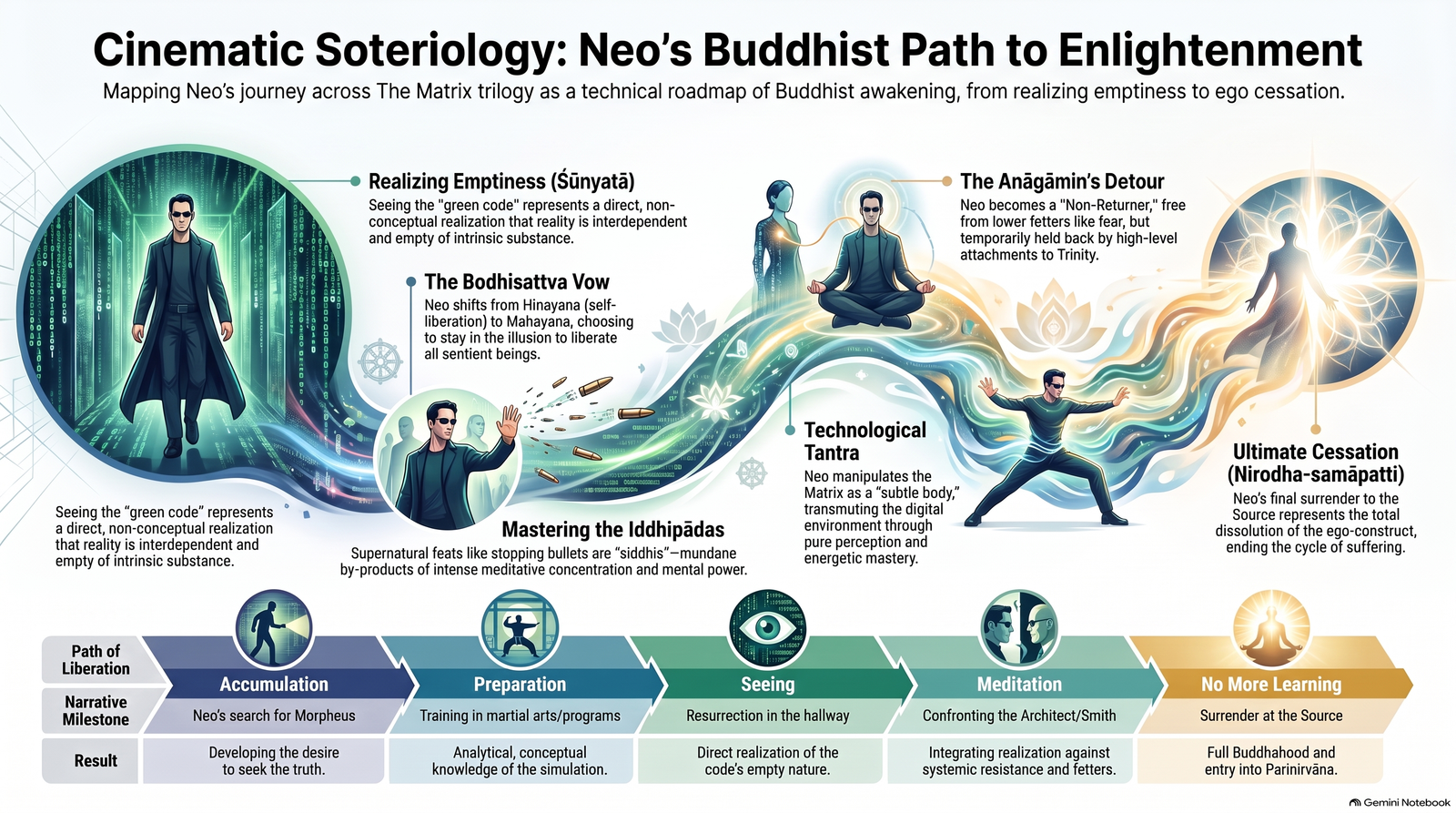
At the end of the first Matrix film, Neo returns from apparent death, stops bullets and sees the hallway as green code. The usual messianic reading treats this as his final arrival. This episode instead makes the scene the centre of a three-film Buddhist thought experiment: not omniscience, but a first direct seeing that must still be integrated through attachment, responsibility, power and surrender.
The discussion begins with Yogācāra and the possibility that experienced reality is never encountered without perception, interpretation and conceptual construction. The Matrix becomes an epistemological prison: not merely a false location from which bodies must escape, but a compelling world whose appearances are continually mistaken for self-existing reality. Neo’s vision of code is then placed beside emptiness and dependent origination. Walls, bullets and avatars appear less like independent things and more like temporary events held together by conditions.
From there, the whole trilogy is arranged across the five-path scheme. Neo’s search becomes accumulation; his training becomes preparation; the hallway becomes the path of seeing; the sequels become the long work of cultivation; and his final encounter with Smith becomes an image of completion. His extraordinary abilities are read through traditional accounts of iddhi, abhiññā, the four bases of power and kasiṇa meditation. The phone call at the end of the first film becomes a bodhisattva-like refusal of private escape, while the Architect’s two doors dramatise the unresolved force of Neo’s love for Trinity.
The final movement turns towards Vajrayāna, pure perception and what the episode calls “technological tantra.” Digital code functions as a cinematic analogue for subtle energetic structure; Neo’s blindness gives way to golden perception; and his last surrender to Smith is compared with the attainment of cessation. The metaphor is deliberately ambitious. Its value lies in the questions it makes visible, not in proving that the films encode a single Buddhist system or that dramatic scenes document recognisable stages of awakening.
Argument map
A trilogy recast as a path of liberation
- The prison is epistemological. The Matrix works because sensory information, memory and interpretation are experienced as a stable world. Yogācāra supplies a lens for questioning how subject, object and appearance are constructed.
- Seeing the code is not omniscience. Neo’s hallway vision is read as the path of seeing: an immediate recognition that appearances lack the solidity previously attributed to them, while much of the wider system remains unknown.
- Power follows concentration, not liberation. Traditional Buddhist literature contains accounts of supernormal abilities cultivated through meditative mastery. These allow the film’s powers to be read symbolically without making them the measure or purpose of awakening.
- Insight returns to relationship. Neo does not leave the Matrix behind. His promise to reveal its controlling structure is interpreted as a bodhisattva-like turn from private release towards responsibility for others.
- Attachment complicates the map. The Architect offers a controlled return to the system, but Neo chooses Trinity. The episode calls this an anāgāmī’s detour: love becomes both remaining attachment and refusal of a liberation purchased through sacrifice.
- The medium of bondage becomes the vehicle. In the episode’s “technological tantra,” Neo no longer merely escapes code. He works through its underlying patterns, and even the distinction between simulated and physical reality begins to lose its former rigidity.
- The final victory is surrender. Neo cannot defeat the multiplying Smith through greater force. By ceasing the fight and allowing Smith to absorb him, he opens a route through the opposition itself—an image of relinquishment that the episode places beside cessation and final release.
Interpretive lenses
How the episode builds its cinematic map
The Matrix trilogy
The films provide the narrative sequence: Thomas Anderson’s search, training, resurrection, return, confrontation with the Architect, blindness, journey to Machine City and surrender to Smith. The Buddhist structure is an interpretation placed over that sequence.
Yogācāra and emptiness
Representation-only, conceptual construction, dependent origination and emptiness help interrogate what it means to experience a world as solid. They should not be compressed into the simple assertion that nothing exists outside an individual mind.
Paths, fetters and powers
The five paths organise the trilogy, while early Buddhist fetter teaching, iddhipāda and later Theravāda meditation literature provide a technical vocabulary for attachment, cultivation and extraordinary ability. These frameworks do not automatically coincide.
Bodhisattva and tantric imagery
The refusal of private escape, the transformation of the medium and the final surrender are read through Mahāyāna and Vajrayāna motifs. “Technological tantra” is the episode’s modern metaphor, not a traditional Buddhist category.
Chapters
Follow the complete discussion
- 00:00Neo Beyond the Messiah Reading
- 03:45Why the Western Saviour Model Fails
- 07:30Yogācāra and the Constructed Nature of Reality
- 12:20The Matrix as an Epistemological Trap
- 16:50The Hallway Scene and the Path of Seeing
- 21:30Śūnyatā, Code, and “There Is No Spoon”
- 25:40Siddhis, Abhiññā, and the Limits of Power
- 31:10The Bodhisattva Vow and Returning to the Matrix
- 35:40The Ten Fetters and Neo as Anāgāmī
- 39:50Trinity, Attachment, and the Architect’s Choice
- 43:50Vajrayāna, Technological Tantra, and Pure Perception
- 47:10Smith, Surrender, and Nirodha-samāpatti
- 49:20Final Reflection: Could the Machines Awaken?
Fact-sensitive notes
Where the roadmap joins systems that should remain distinct
The most important distinction. Nirodha-samāpatti is the temporary meditative attainment called the cessation of perception and feeling. Traditional accounts describe emergence from it; it is therefore not identical with death, parinirvāṇa, ego extinction or a permanent blank state. Neo’s death and the system reboot can be read as a cinematic image of surrender, but the film does not mechanically depict this attainment.
Yogācāra is subtler than “only my mind exists”
Yogācāra analyses how experience is structured by cognition and challenges naive realism. Scholars disagree over how strongly its representation-only language commits the tradition to metaphysical idealism. The episode’s claim that the table exists only in one’s mind is a vivid simplification.
The text attribution needs correction
Vasubandhu’s Abhidharmakośa is an Abhidharma compendium and critique, not his principal Yogācāra defence of representation-only. The Twenty Verses and Thirty Verses are more direct reference points. Sarvāstivāda-Vaibhāṣika and Vibhajyavāda should also not be fused into one school name.
The five paths are not a universal Buddhist ladder
Accumulation, preparation, seeing, cultivation and no-more-learning are especially prominent in northern Indian and later Mahāyāna scholastic systems. They can illuminate the trilogy, but should not be presented as one unchanged map used identically across Theravāda and Mahāyāna.
Traditional powers remain traditional claims
Buddhist texts and commentaries describe iddhi, abhiññā and powers associated with concentrated practice. This is evidence that such ideas occur in Buddhist literature, not scientific confirmation that concentration transmutates matter, permits flight or explains fictional bullet-stopping.
Non-return has exact doctrinal conditions
An anāgāmī has abandoned the five lower fetters, including sensual desire and ill will. Neo’s love, composure or exceptional abilities cannot establish that attainment, and “the anāgāmī’s detour” is the episode’s own narrative device rather than a recognised doctrinal stage.
Bodhisattva commitment is not retained clinging
Mahāyāna bodhisattva practice is grounded in compassion, wisdom and the aspiration to awakening for all beings. It should not be reduced to an awakened person deliberately preserving fetters. Neo’s return is a resonant comparison, not a formal bodhisattva vow.
Tantra is not simply accelerated rule-breaking
Vajrayāna includes disciplined ritual, initiation, ethical commitments, deity yoga and subtle-body practices within specific lineages. Calling digital code a subtle body can be imaginatively productive, but it does not make hacking or energetic imagery equivalent to Buddhist tantra.
Parinirvāṇa is not annihilation
Early Buddhist sources resist describing the liberated person after death through the ordinary alternatives of existence and non-existence. “Selfless extinction” risks suggesting nihilism. The film concludes with a truce and a promise of choice, not an explicit statement that every mind has been liberated.
Resonance does not establish intention
The trilogy draws on a conspicuously wide field of religious, philosophical, cyberpunk and cinematic sources. Buddhist film scholarship can support this mode of interpretation, but it does not by itself prove that every sequence was deliberately engineered from a fifth-century meditation manual.
AI awakening remains a closing question
The suggestion that Neo plants a bodhisattva seed in machine consciousness is an imaginative extension beyond the films’ explicit conclusion. It raises questions about ethics and inherited patterns; it is not evidence that contemporary AI is conscious, spiritually receptive or capable of attainment.
Glossary
Terms used in the episode
Soteriology
The study of doctrines and paths concerned with salvation or liberation. The episode uses the term for its proposed Buddhist reading of Neo’s development across the trilogy.
Yogācāra
A Mahāyāna Buddhist philosophical tradition concerned with cognition, experience and the processes through which subject-object duality appears. Its vijñapti-mātra, or representation-only, teaching has received several competing scholarly interpretations.
Parikalpita-svabhāva
The imagined or conceptually constructed nature in Yogācāra accounts of the three natures. It concerns the falsely projected division of perceiver and perceived, not merely the everyday fact that people can imagine nonexistent objects.
Śūnyatā
Emptiness: the absence of independent, intrinsic nature. It does not mean sheer nothingness. The episode maps Neo’s sight of conditional code onto this idea, while code remains a cinematic analogy.
Dependent origination
The principle that phenomena arise through causes and conditions. Emptiness and dependent origination are closely related in Mahāyāna thought, but neither is equivalent to the technical operation of computer software.
The five paths
Accumulation, preparation, seeing, cultivation or meditation, and no-more-learning. This influential scholastic map takes distinct forms in different Buddhist systems. The episode uses it as the trilogy’s narrative spine.
Darśana-mārga
The path of seeing, associated in several Buddhist path systems with direct insight into reality and entry into noble attainment. Neo’s hallway resurrection is placed here as interpretation, not diagnosis.
Iddhipāda
The four bases of spiritual or psychic power: desire or enthusiasm, energy, mind or concentration, and investigation, each joined with concentrated striving. Their primary place is within Buddhist cultivation, not superhero taxonomy.
Kasiṇa
A meditation object and the concentrated practice developed with it, classically using such themes as earth, water, fire, air, colours, light and limited space. Later Theravāda manuals connect mastery of these practices with accounts of supernormal powers.
Abhiññā and iddhi
Abhiññā refers to higher or direct knowledges; iddhi can refer to forms of spiritual potency or supernormal ability. Buddhist traditions repeatedly warn that unusual abilities are not identical with release from greed, hatred and delusion.
Bodhisattva
One committed to awakening. In Mahāyāna traditions, the bodhisattva path joins wisdom and compassion with the aspiration to Buddhahood for the benefit of beings. The episode reads Neo’s return for others through this lens.
Anāgāmī
A non-returner, the third of four noble stages in early Buddhist accounts. The five lower fetters have been abandoned. The episode’s application of this title to Neo is symbolic and conflicts with his continuing attachments if read literally.
Vajrayāna and subtle body
Vajrayāna is a family of esoteric Buddhist traditions using initiation, ritual, mantra, visualisation and other structured practices. Some completion-stage systems work with channels, winds and drops; details and interpretations vary by lineage.
Pure perception
A Vajrayāna orientation in which appearances are trained and understood within the mandala of awakened body, speech and mind. Neo’s golden sight is a cinematic parallel, not a demonstration of the practice or the divine eye.
Nirodha-samāpatti
The attainment of the cessation of perception and feeling. In traditional accounts it is a temporary, highly advanced meditative attainment from which the practitioner emerges. It is not ordinary unconsciousness, death or a permanent erasure of self.
Parinirvāṇa
A term commonly used for the final nirvāṇa associated with the death of a fully awakened being. Buddhist texts do not support treating it as the simple annihilation of an independently existing person.
Study paths
Continue into the ideas
Related reading on this site
- When Neo Stops RunningEpisode 14 examines the first film’s climax through the fetters, dependent origination and path and fruit consciousness.
- 1.2.2. The Matrix of Conditioned RealityA course chapter on conditioned experience and the interpretive matrix through which a world is known.
- EmptinessAn introduction to emptiness within the website’s wider Buddhist and alchemical framework.
- An introduction to the law of dependent originationBackground to the conditionality that the episode renders through code and simulation.
- 3.1.10. The BodhisattvaThe course treatment of the Mahāyāna commitment that informs Neo’s symbolic return for others.
- 3.1.3. Mantras, Tantras and DeitiesContext for the esoteric practices evoked by the episode’s metaphor of technological tantra.
- The ten fettersThe early Buddhist scheme behind the episode’s claims about non-return and remaining attachment.
External reference points
- Yogācāra — Stanford Encyclopedia of PhilosophyA scholarly introduction to Yogācāra, its texts, its analyses of cognition and the debates surrounding mind-only interpretations.
- The Ten Bhūmis — 84000A translated Mahāyāna scripture with editorial context for the bodhisattva levels and their relationship to path models.
- The Analysis of the Bases of Psychic Power — SuttaCentralAn early Buddhist discourse defining the four bases and associating their cultivation with traditional accounts of psychic power.
- Visuddhimagga — Pali Text SocietyBibliographic context for Buddhaghosa’s influential fifth-century compendium of Theravāda doctrine and meditation.
- The Shorter Elaboration — SuttaCentralAn early Buddhist discussion of bodily, verbal and mental processes and emergence from the cessation of perception and feeling.
- The Great Passing Away — SuttaCentralThe discourse of the Buddha’s final days, relevant to distinguishing meditative cessation from final extinguishment.
- The Matrix — BFIFilm-historical context for the original film’s reality-bending premise, philosophical unease and effects-driven action.
A grounded reflection
Look for conditions before looking for code
Choose one ordinary experience that feels unusually solid today: a worry, a role, a resentment or a decision that appears to have only one possible meaning. Without denying its reality or trying to dissolve it, name three conditions that help it appear in this form—perhaps memory, bodily tension, language, expectation or another person’s response. Then ask what changes when the experience is approached as a conditioned event rather than a fixed object. The exercise is not an attempt to acquire powers or declare the world unreal. It is a small experiment in seeing how a world is assembled.
Continue the sequence