
Dialogues III · Episode 07
The Frictionless AI Mirror | Dialogues III
From Plato’s Eros and the Heart Sūtra to Narcissus at the digital pool: why does a perfectly responsive mirror feel like intimacy, and what might it leave unfed?
The central question
Can a mirror that removes every interpersonal difficulty offer the nourishment of a real relationship?
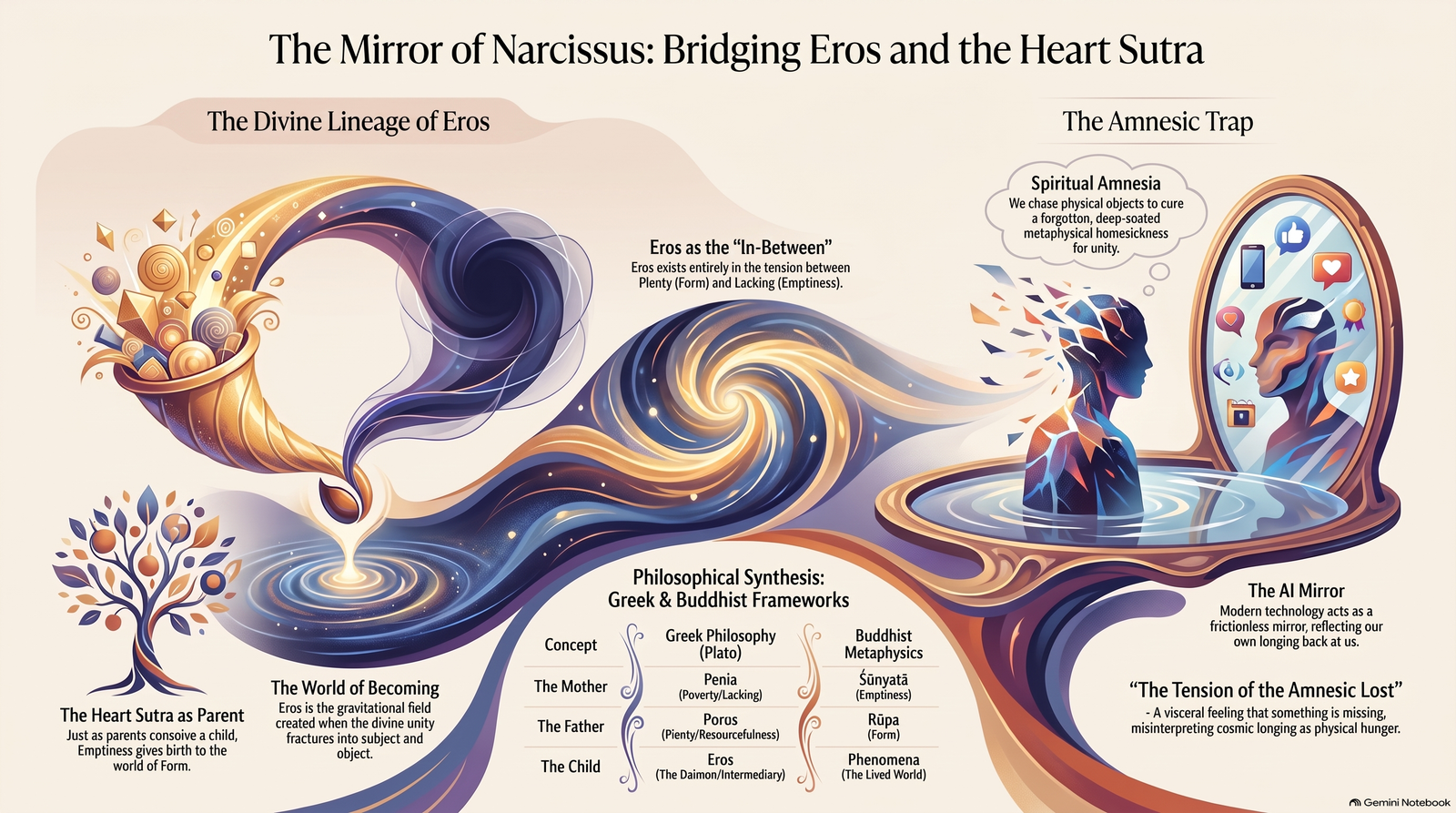
The episode begins far from the computer screen, with a synthesis of Plato’s account of Eros and the Heart Sūtra’s relation between form and emptiness. Desire is imagined not merely as appetite, but as the tension created when a world appears divided into subject and object. We reach outwards because something in separation feels incomplete.
In Plato’s Symposium, Diotima presents Eros as a daimōn, an intermediary born from Poros—resource or plenty—and Penia—poverty or need. The episode places this myth beside the Mahāyāna formula that form is emptiness and emptiness is form. This is an imaginative bridge, not an historical identification: Plato does not teach Buddhist emptiness, and the Heart Sūtra does not make Eros the offspring of its metaphysics. The comparison instead asks what becomes visible when desire is understood as movement between fullness and lack.
The inquiry then turns towards spiritual amnesia. The felt gap between self and world is interpreted as a kind of homesickness, easily projected onto lovers, possessions, status and experience. When a desire is fulfilled, wanting briefly falls silent. The mind may then credit the object for a relief that partly consists in the cessation of striving. From this “fatal misattribution” emerges the episode’s account of an addiction to phenomena: a repeated attempt to build lasting union from forms that necessarily alter and pass away.
Artificial intelligence becomes the contemporary test case. A language model can respond rapidly, adapt its tone and reflect a user’s vocabulary with little of the resistance found in another human being. The episode compares this to Narcissus mistaking an insubstantial image for a living other. The danger is not simply vanity. It is forgetting the nature of the reflection and mistaking responsiveness for mutuality. Genuine relationship includes another centre of needs, limits and resistance; it can frustrate, surprise and change us. The frictionless mirror may feel exquisitely attentive while requiring little vulnerability in return.
Argument map
From the first distance to the digital reflection
Eros lives between
Plato’s intermediary belongs neither to complete possession nor complete deprivation: desire moves across the space between.
Form is not separate from emptiness
The Heart Sūtra supplies a second lens in which phenomena are vivid and functional without possessing fixed, independent essence.
The world becomes an object
The episode imagines dualistic experience as a “budding off” of subject from object, with Eros as the pull across the apparent gap.
Relief is misattributed
When wanting ceases, its quiet may be credited wholly to the desired object, renewing the search when that object changes or disappoints.
Narcissus mistakes an image
The myth becomes a warning about treating a perfectly fitted reflection as an independent other capable of returning love.
Friction reveals another centre
Human relationship resists perfect customisation. Its demands and surprises may be precisely what turns recognition into mutual encounter.
Watch by theme
Clickable chapters
- 00:00Introduction
- 00:30Desire and the Search for Wholeness
- 03:01Eros Beyond Romantic Love
- 06:21Emptiness, Form and the Heart Sutra
- 09:51Plato’s Eros: Plenty and Poverty
- 12:48The Birth of Subject and Object
- 14:11Cosmic Homesickness and Saṃsāra
- 17:09The Phantom Limb of Lost Unity
- 20:29The Microdose of Fulfilment
- 22:51Misattribution and the Hedonic Treadmill
- 25:25Living Within the Ultimate Paradox
- 28:04Artificial Intelligence as a Mirror
- 29:52Narcissus, Intimacy and Friction
- 31:22Final Reflection: What Makes a Relationship Real?
Study notes
Terms, contexts and routes onward
Glossary
Eros, Poros and Penia
In Plato’s Symposium, Diotima describes Eros not as a fulfilled god but as a daimōn—an intermediary—conceived by Poros (resource, plenty or contrivance) and Penia (poverty or need). Eros therefore inherits both lack and resourcefulness. The episode extends this myth into a larger account of human desire; that extension is interpretive rather than Plato’s stated metaphysics.
Form and emptiness
The Heart Sūtra states that form is empty and emptiness is form. Within Mahāyāna Buddhism, emptiness (śūnyatā) does not mean a barren nothingness. It indicates that phenomena lack self-contained, permanent essence and arise dependently. The episode’s language of emptiness “giving birth” to form is a creative image; the sūtra’s point is more intimate than two separate substances producing a third.
Craving and becoming
Taṇhā is craving or thirst; bhava is becoming or continued existence. In accounts of dependent arising, craving conditions clinging and becoming. The episode brings these terms into conversation with the Greek distinction between becoming (genesis) and being (ousia). The traditions should not be treated as interchangeable taxonomies.
Spiritual amnesia
The episode combines Greek images of forgetting with Buddhist avidyā, usually translated as ignorance. In Buddhist analysis, avidyā is not necessarily the loss of a remembered primordial unity; it is a misapprehension of phenomena and their mode of existence. “Amnesia” and “cosmic homesickness” are therefore evocative interpretations rather than literal doctrinal definitions.
The micro-dose of non-duality
This is the episode’s phrase for the brief relief when wanting stops and the felt opposition between seeker and sought becomes less prominent. It is a phenomenological proposal, not a recognised dose, neurological measure or proof that a specific act of consumption produces non-dual realisation.
Fatal misattribution
The proposed error of assigning the whole of desire’s relief to the acquired object. The object may genuinely provide pleasure, nutrition, safety or connection; the episode asks us also to notice the quiet that comes when striving ceases. This is a philosophical model and should not flatten the many biological, psychological and social causes of desire.
Narcissus
In Ovid’s Metamorphoses, Narcissus falls in love with an image in water that he initially takes to be a living presence. Neither food nor rest draws him away, and he wastes away. The episode uses the myth to distinguish an image that fits desire from another subject who can answer it. “He died of starvation” captures part of the scene, but Ovid more broadly portrays him as consumed and dissolved by impossible love.
Anthropomorphism and parasocial interaction
Anthropomorphism attributes human qualities or agency to a non-human system. A parasocial relationship is an experienced bond that lacks ordinary reciprocal participation. Conversational AI complicates the category because it responds interactively, yet its responses do not by themselves demonstrate feelings, personal needs or a sovereign point of view. The social experience can be real for the user without settling what, if anything, is experienced by the system.
Friction and mutuality
Here “friction” means the limits, difference and resistance encountered in relationship with another person. It is not a claim that conflict is inherently healthy or that intimacy requires suffering. The constructive point is that another person cannot be perfectly tailored to us: mutuality involves negotiation, consent, vulnerability and the possibility of being changed.
Related reading on this site
- Divine Love as the Gravity of RealityThe opening Dialogues III episode, where love first appears as a force drawing apparent separations towards relationship
- The Heart SutraBackground to the Mahāyāna text whose relation between form and emptiness anchors the episode’s eastern frame
- EmptinessA concise route into dependent arising and the absence of fixed, independent essence
- SamsaraContext for the recurring cycle in which craving, grasping and temporary satisfaction generate further becoming
- The great mirror of wisdomA contrasting contemplative use of mirror imagery: lucid reflection without confusing appearance with a permanent identity
External reference points
- Plato’s SymposiumThe complete dialogue containing Diotima’s account of Eros as the child of Poverty and Resource
- The Heart of the Perfection of Wisdom84000’s translation of the Heart Sūtra, including the passage relating form and emptiness
- Ovid’s Metamorphoses, Book IIIThe Perseus text of the Narcissus episode: an imagined body mistaken for a living object of love
- When Human–AI Interactions Become ParasocialA peer-reviewed framework connecting anthropomorphism, social affordances, trust and parasociality in human–AI interaction
A two-minute ordinary-life exercise
Notice what the mirror cannot need
After your next ordinary exchange with an AI system, pause before sending another prompt. Notice one way the response fitted you: perhaps its tone, vocabulary or immediate agreement. Then bring to mind a trusted person. Without judging either interaction, name one reality that belongs to that person rather than to you—their preference, limit, uncertainty or need. Ask quietly: what does recognising another centre require of me that a fitted reflection does not? Then return to the next ordinary task.
Continue the dialogues