
Dialogues IV · Episode 03
The Neuroscience of the Narrative Ego
The voice in the mind may help compose the story of “me” without being the whole of thought—or the owner of awareness.
Watch here, or continue on YouTube with chapters and comments. Open on YouTube ↗
The central question
Can interrupting the inner voice disclose awareness—or only produce a temporary altered state?
The voice inside the head feels intimate enough to be the self. Yet inner speech is a cognitive process: one way human beings rehearse, regulate, interpret and narrate experience. This episode asks what becomes visible when that linguistic process loses its ordinary fluency.
The discussion begins with Watson and Vygotsky, then develops a provocative image of the narrative ego as “linguistic extraction software”: a process that turns a richer field of memory, sensation, emotion and meaning into a linear account of “me”. The default mode network provides a neuroscientific reference point for internally directed and self-related cognition, while cannabis becomes the episode’s difficult test case. If THC alters attention, working memory and functional connectivity, can the resulting interruption act as a wedge between awareness and its habitual story?
The answer remains deliberately unsettled. An altered state may loosen certainty about a controlling self, but it can also impair judgement, intensify vulnerability or become an object of craving. The episode therefore turns from the external catalyst to alchemical and Buddhist images: lead and gold, the Philosopher’s Stone, the heavenly worlds reached through soma, and the water-clearing jewel of faith. In Dr Robinson’s synthesis, the Stone becomes a symbol of subjective awareness—not an object acquired by the ego, but the ordinary capacity in which thoughts are noticed.
The final challenge is practical and sober: can awareness meet the movement of thought without suppressing it, worshipping its interruption, or converting insight into another possession?
How to read this episode: inner speech contributes to many forms of self-regulation and self-reflection, but not all thought is verbal and no single brain network is “the ego”. Research shows that THC can alter cognition and brain-network activity; it does not establish cannabis as a neurological equivalent of vipassanā or as a reliable path to awakening. The “wedge”, lead-to-gold transmutation and Philosopher’s Stone are interpretive metaphors. The infographic below condenses those metaphors and should not be read as a clinical or pharmacological model.
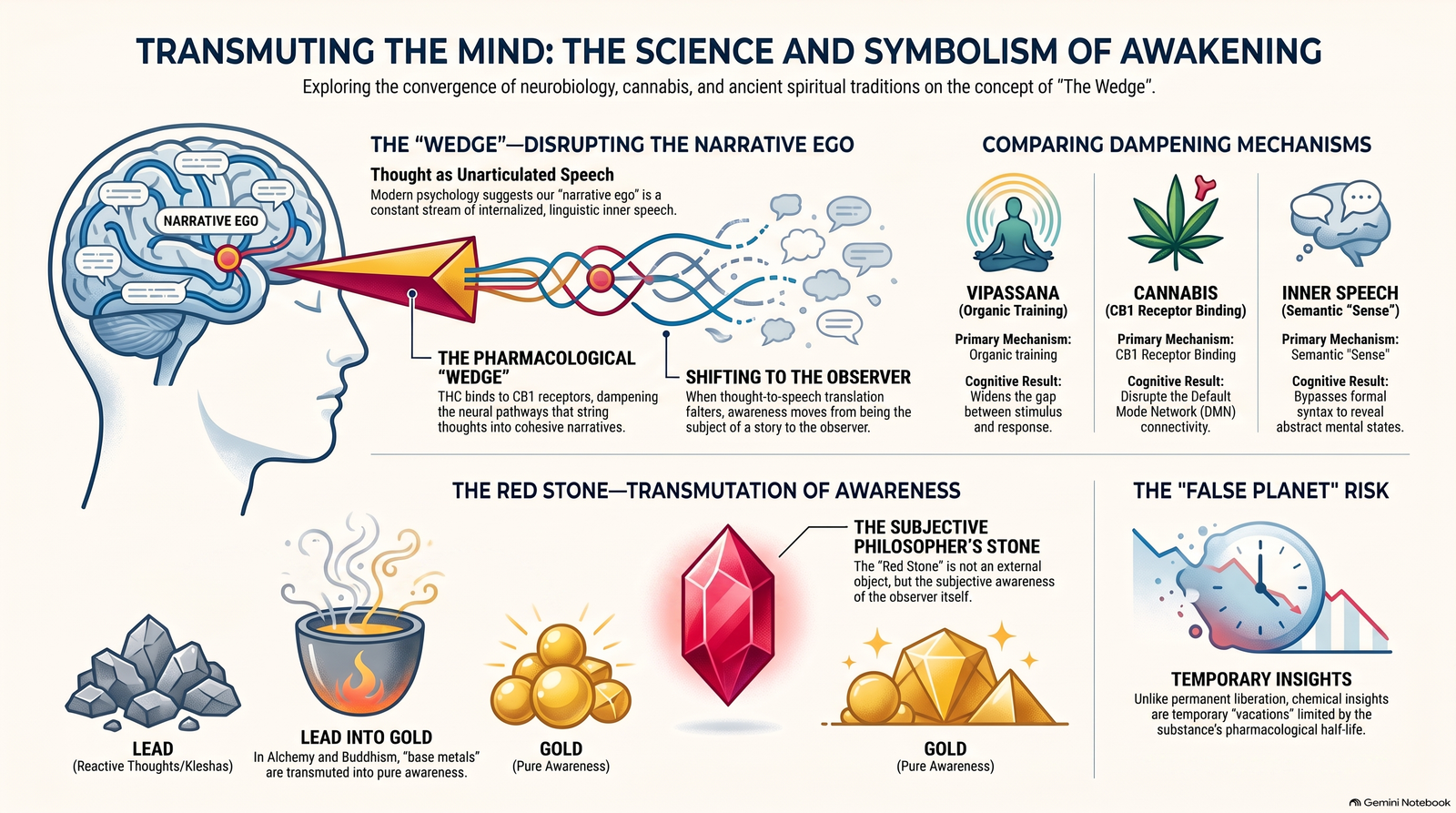
Argument map
Six movements from inner voice to unpossessed awareness
Thought exceeds speech
Inner speech helps organise memory, intention and self-reflection, but visual, sensory, emotional and abstract thought need not arrive as words.
The self becomes a story
Language can arrange a changing field of experience into an apparently continuous narrator: the familiar voice that says “I”, “me” and “mine”.
A chemical wedge appears
The episode proposes that THC may disrupt the usual assembly of narrative thought. This is a hypothesis and metaphor, not a demonstrated mechanism of ego dissolution.
The shortcut has a horizon
A temporary state ends. The Gītā’s soma passage becomes a warning: exalted experience within conditioned existence is not the same as liberation.
The laboratory turns inward
Nigredo, Albedo and Rubedo are read psychologically. The material to be transformed is not discarded; reactive experience becomes material for awareness.
The Stone cannot be owned
In Dr Robinson’s synthesis, the Philosopher’s Stone is subjective awareness. The Buddhist “nothing to acquire” prevents this insight becoming a spiritual trophy.
Navigate the discussion
Chapters
Selecting a chapter opens the published video at that point on YouTube.
- 00:30Are You the Thinker of Your Thoughts?
- 03:25Watson, Vygotsky and the Origins of Inner Speech
- 07:45How Meaning Becomes the Narrative Ego
- 10:46The Self as Linguistic Extraction Software
- 12:56THC, CB1 Receptors and the Default Mode Network
- 16:07The Pharmacological Wedge in Thought
- 19:08The Sea Fret and the Loss of Cognitive Traction
- 21:18Chemical Shortcuts, Addiction and False Liberation
- 24:35Jung, Nigredo and the Inner Meaning of Alchemy
- 27:54The Philosopher’s Stone as Observing Awareness
- 30:28The Muddy Stream and the Water-Clearing Jewel
- 32:13Nothing to Acquire: Non-Self and the End of Lack
- 33:40Are You the Voice or the Space Around It?
Key language
Glossary
Inner speech
The experience of speaking silently to oneself. Vygotskian accounts describe it as developing through the internalisation and transformation of social speech. It can support planning, self-regulation and reflection, but it is neither uniform nor the whole of human thought.
Narrative ego
The episode’s name for the autobiographical story that organises memories, expectations and interpretations around “me”. It is a philosophical and psychological construct, not a discrete organ or single neural circuit.
Default mode network (DMN)
A distributed set of interacting brain regions associated with internally directed cognition, including autobiographical memory, self-related processing and imagining possibilities. Calling it “the ego network” would be an oversimplification.
THC and CB1 receptors
Delta-9-tetrahydrocannabinol (THC) is the principal intoxicating constituent of cannabis. Many of its effects are mediated through cannabinoid CB1 receptors in the brain. Effects vary with dose, route, individual vulnerability, context and other constituents.
The “pharmacological wedge”
A metaphor proposed in the episode for a drug-induced interruption between an impulse and its usual linguistic or autobiographical elaboration. It is not an established neuroscientific term and should not be treated as a recommendation.
Vipassanā
A broad Buddhist term for insight or clear seeing, interpreted differently across traditions and modern meditation systems. Training attention and discernment is not pharmacologically or phenomenologically identical to intoxication.
Soma, svarga and the “false planet”
Bhagavad Gītā 9.20–21 describes ritualists who drink soma, reach a heavenly world and later return when their merit is exhausted. The episode’s phrase “false planet” is an interpretive shorthand: the text presents a temporary conditioned attainment, not a modern claim about a drug’s half-life.
Nigredo, Albedo and Rubedo
The blackening, whitening and reddening associated with stages of the alchemical work. Jung’s psychology helped popularise their modern interpretation as images of psychic transformation. Dr Robinson’s four-stage course uses them as an original contemplative map rather than a claim that all historical alchemists held one psychological doctrine.
The Philosopher’s Stone
In alchemical literature, the Stone is the agent of transmutation and is described through varied material, religious and symbolic meanings. Identifying it specifically with the alchemist’s subjective awareness is Dr Robinson’s philosophical synthesis, not a settled historical definition.
Śraddhā and the water-clearing jewel
Śraddhā (Pali: saddhā) can mean trust, confidence or faith. The muddy-stream simile appears in the Questions of King Milinda, where faith clears the mind as a jewel clears disturbed water. The recording associates the image with the Awakening of Faith; this page corrects that attribution.
Non-self and “nothing to acquire”
Buddhist teachings on non-self deny an independent, permanent owner within conditioned experience. Mahāyāna wisdom literature also undermines attachment to attainment. These teachings do not simply assert that an eternal observer replaces the ego.
A sober observation
Listen for the moment before the sentence completes
For one minute, let attention rest naturally. When a phrase appears in the mind, notice its sound, pace and emotional tone without trying to stop it. Then notice what else is present: sensation, imagery, mood, silence or simple uncertainty. The question is not “How do I eliminate the voice?” but “What part of experience does this sentence organise—and what does it leave out?”
A reflection, not an altered-state instruction
This exercise does not involve cannabis or any other substance. The episode’s discussion of THC is descriptive, exploratory and not a recommendation. Cannabis can impair attention, memory, coordination and judgement, and can carry dependency and mental-health risks. If observing thoughts increases anxiety, dissociation or other distress, stop and return to ordinary grounding or appropriate professional support.
Continue the series