
Dialogues IV · Episode 09
The Spiritual Trap of Trying to Be Special | Dialogues IV
What if spiritual maturity is not the acquisition of extraordinary powers, but the relinquishing of the need to appear extraordinary?
Watch here, or continue on YouTube with comments. Open on YouTube ↗
The central question
Does the wish to become spiritually exceptional conceal the freedom that practice is meant to reveal?
The episode begins with a deliberate reversal. After decades of discipline, the imagined prize is not levitation, clairvoyance or a radiant identity, but being entirely at ease with doing the laundry. This apparent “cosmic bait-and-switch” becomes an inquiry into why religious stories often surround founders and accomplished practitioners with spectacle—and why the lived value of practice may be quieter, more subtractive and more ordinary.
Oral history and reconstructive memory provide the first tools. Jan Vansina’s work shows that orally transmitted accounts must be studied as historically situated forms with their own conventions, while Elizabeth Loftus and John Palmer’s well-known experiment demonstrates how later wording can influence an individual’s recollection. The episode brings these ideas together as a model of communal and literary escalation. That conjunction is plausible, but it is not a universal law: oral traditions can preserve information as well as reshape it, and a laboratory study of eyewitness memory does not by itself explain the formation of scripture.
Buddhist and Christian developments are then presented as examples of founders becoming progressively more cosmic in later literature. The broad contrast is useful, but the textual histories are more complicated than a single upward curve. Early Buddhist discourses do depict the Buddha as ageing, ill and subject to pain, yet the precise cause of his final illness is uncertain; later Lokottaravāda literature offers a markedly transcendent Buddhology, but it should not be dismissed simply as competitive exaggeration. Likewise, differences between Mark and John reflect genre, theology and community as well as chronology.
The argument returns from scripture to practice through Sādhumatī, the ninth bodhisattva ground. Its four analytical knowledges concern meanings, teachings or phenomena, linguistic expression and inspired eloquence. The episode interprets these not as supernatural credentials but as a capacity to communicate insight for the benefit of others. That is a contemporary psychological reading of a Mahāyāna doctrinal map—not a method for identifying anyone’s attainment.
Layman Pang, the raft simile, spiritual bypassing and spiritual materialism bring the question into daily life. The popular sentence “before enlightenment, chop wood, carry water; after enlightenment, chop wood, carry water” is not a verbatim saying preserved from Pang; it is a later formulation related to his verse celebrating drawing water and carrying firewood as “marvellous activity”. The point survives the correction: ordinary conduct, relationships and responsibilities remain the testing ground of any claimed insight.
The episode closes with the Alister Hardy archive of first-person reports of religious and spiritual experience. The collection establishes that thousands of people have described such experiences; because submissions were self-selected, it does not establish how common they are, validate their interpretation or prove a metaphysical reality. What it does preserve is a serious record of experiences that many respondents regarded as transformative without requiring a scriptural carnival around them.
How to read this episode: “Realisation is subtractive” is the episode’s philosophical thesis, not a settled clinical finding. Hagiography is not simply false history, and oral transmission is not invariably degradation. The ninth bhūmi is a traditional Mahāyāna category, not a psychological diagnosis or a status that output, calmness or eloquence can verify. “Spiritual bypassing” describes a proposed pattern of avoidance; it should not be used casually to diagnose others. The default mode network participates in several forms of internally directed cognition and is not a single neural “ego centre”. Reports of mystical experience are evidence that experiences were reported—not proof of their cause or ultimate meaning.
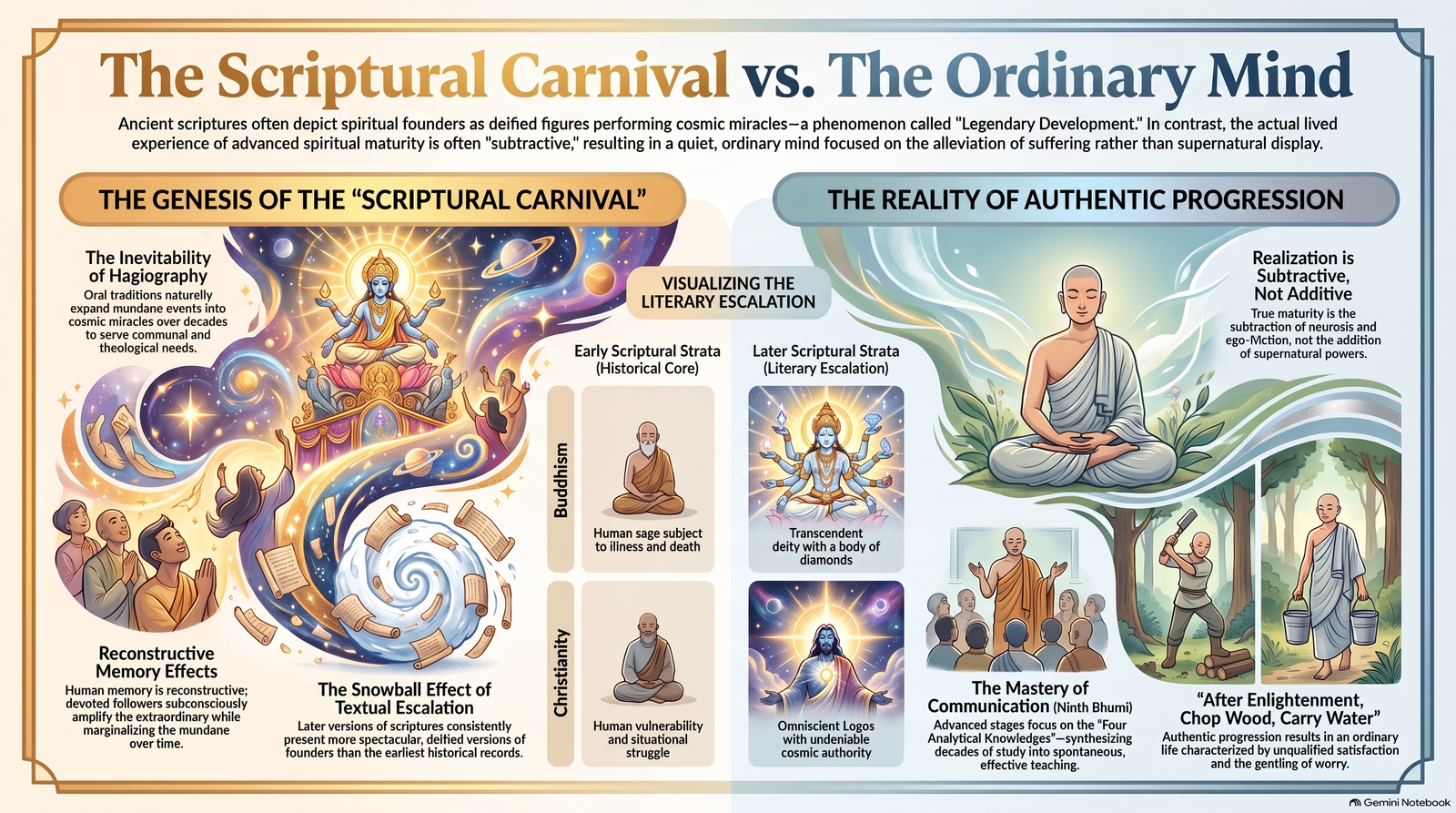
Argument map
Six movements through the episode
Spectacle sets the wrong test
The expectation that profound effort must produce visible supernatural reward turns spiritual practice into another contest for distinction.
Memory is reconstructed
Oral transmission, communal needs and suggestive language can reshape accounts, although none supplies a simple formula for how every sacred text developed.
Hagiography changes scale
Human vulnerability and cosmic imagery may coexist across textual layers. Reading by genre preserves symbolic value without treating every marvel as modern reportage.
Good Intelligence communicates
The ninth bhūmi redirects attention from powers to the traditional analytical knowledges: understanding distinctions and expressing Dharma skilfully.
The ordinary tests the insight
Layman Pang’s verse, the raft and household tasks ask whether understanding can survive work, limits, relationships and the absence of applause.
The path can become possession
Bypassing and spiritual materialism show how teachings can protect an identity rather than loosen it; scepticism and accountability keep the question open.
Navigate the discussion
Chapter points
- 00:00The Cosmic Bait-and-Switch of Enlightenment
- 02:00Why Spiritual Realization May Be Subtractive
- 03:00Oral Tradition, Memory and Religious Hyperbole
- 06:00How Memory Reconstructs the Past
- 09:05From Human Teachers to Supernatural Figures
- 13:20Reading Spiritual Hyperbole Without Throwing It Away
- 15:40The Ninth Bhūmi and the Four Analytical Knowledges
- 19:40Layman Pang: Chop Wood, Carry Water
- 24:45Leave the Raft Behind
- 27:15Spiritual Bypassing and Avoiding the Difficult
- 30:10Spiritual Materialism and the Desire to Be Special
- 32:30Can Mystical Experience Be Ordinary?
- 35:30The Greatest Superpower May Be Enoughness
Key language
Glossary
Hagiography and legendary development
Hagiography is writing about saints or revered figures, normally shaped by devotional, ethical and theological purposes rather than the conventions of modern critical biography. “Legendary development” describes change and elaboration in a tradition; neither term means that every element is fabricated or that one uniform process explains all scriptures.
Oral tradition and communal shaping
Oral tradition transmits knowledge, memory and identity through speech and performance. Communities may select, stabilise, adapt or reinterpret material as circumstances change. The episode’s “telephone game” image captures possible alteration but understates the disciplined techniques through which oral cultures can preserve accounts.
Reconstructive memory
The view that remembering is an active reconstruction rather than the replay of a complete stored recording. Loftus and Palmer showed that wording introduced after an event could affect speed estimates and later reports of broken glass. Their study concerns individual eyewitness memory; extending it to centuries of textual formation requires additional historical evidence.
Lokottaravāda and the Mahāvastu
The Lokottaravāda was an early Buddhist school associated with the Mahāsāṃghika tradition. Its composite Mahāvastu presents a strongly transcendent understanding of the Buddha alongside biography, doctrine and narrative. “Docetic” can suggest an analogy with Christian debates about apparent embodiment, but it is not a neutral native label for the school’s complete Buddhology.
Sādhumatī, the ninth bhūmi
The ninth of the ten bodhisattva grounds in Mahāyāna Buddhism, translated by 84000 as “Good Intelligence”. The Ten Bhūmis associates it with precise knowledge of phenomena and accomplished Dharma teaching. It belongs to a traditional soteriological map and cannot be established through self-report, productivity or communication skill alone.
The four analytical knowledges
A traditional group commonly described as analytical knowledge of meanings (artha), of dharmas or formulations (dharma), of linguistic explanation or etymology (nirukti), and of inspired eloquence (pratibhāna). Translations and explanations vary. The episode’s comparison with diagnosis, teaching and audience-sensitive communication is a modern interpretation.
Layman Pang and “chop wood, carry water”
Pang Yun was an eighth-century Chinese lay Chan figure whose recorded verse calls drawing water and carrying firewood his “supernatural power and marvellous activity”. The familiar before-and-after-enlightenment sentence is a later popular formulation, not a direct quotation from Pang, but it develops the same celebration of ordinary activity.
The raft simile
In the Alagaddūpama Sutta (Majjhima Nikāya 22), a traveller constructs a raft to cross dangerous water and does not carry it after reaching safety. The teaching concerns using the Dhamma skilfully without turning it into an object of clinging; it does not recommend discarding practice, ethics or discernment before they have served their purpose.
Spiritual bypassing
A term associated with psychotherapist John Welwood for using spiritual beliefs or practices to avoid unresolved emotional, relational or developmental difficulties. It names a possible pattern, not a formal diagnosis. Boundaries, emotional regulation and contemplative practice cannot be reduced to a simple contrast between “healthy” and “bypassing”.
Spiritual materialism
Chögyam Trungpa’s term for the appropriation of teachings, experiences and identities by the very self-protective patterns that practice is intended to expose. It can appear as collecting attainments, authority or exceptional experiences. The concept is best used for self-examination rather than as a weapon against other practitioners.
Alister Hardy archive
A collection begun by the Religious Experience Research Unit in Oxford in 1969, containing thousands of first-person accounts of religious or spiritual experience. It is an important qualitative archive. Voluntary submissions document what respondents reported, but do not by themselves provide a representative prevalence estimate or decide how the experiences should be explained.
Default mode network (DMN)
A set of interacting brain regions associated with several forms of internally directed cognition, including autobiographical memory, future thinking and aspects of self-referential processing. It is not identical with the ego, anxiety or narrative self, and reduced activity in parts of the network does not establish enlightenment or the truth of a mystical interpretation.
A three-minute experiment
Let one ordinary action remain ordinary
Choose a small task you are already about to do: washing a cup, folding a towel or answering a routine message. For the duration of the task, notice any wish to make the moment meaningful, impressive or evidence of progress. There is no need to suppress that wish. Let it be present while giving the task the attention it actually requires. When the task is complete, ask only: was anything added by needing this moment to say something special about me?
Continue the series