
Dialogues IV · Bonus Episode · Dialogues V Preview
Why the Wound Becomes the Way
A threshold conversation about carrying insight back into ordinary life: from the four alchemical movements and Thomas Covenant’s unhealed wound to skilful language, the Magus and the disappearance of the separate operator.
Watch here, or continue on YouTube with comments. Open on YouTube ↗
The threshold question
What becomes of spiritual insight when it must return to the marketplace?
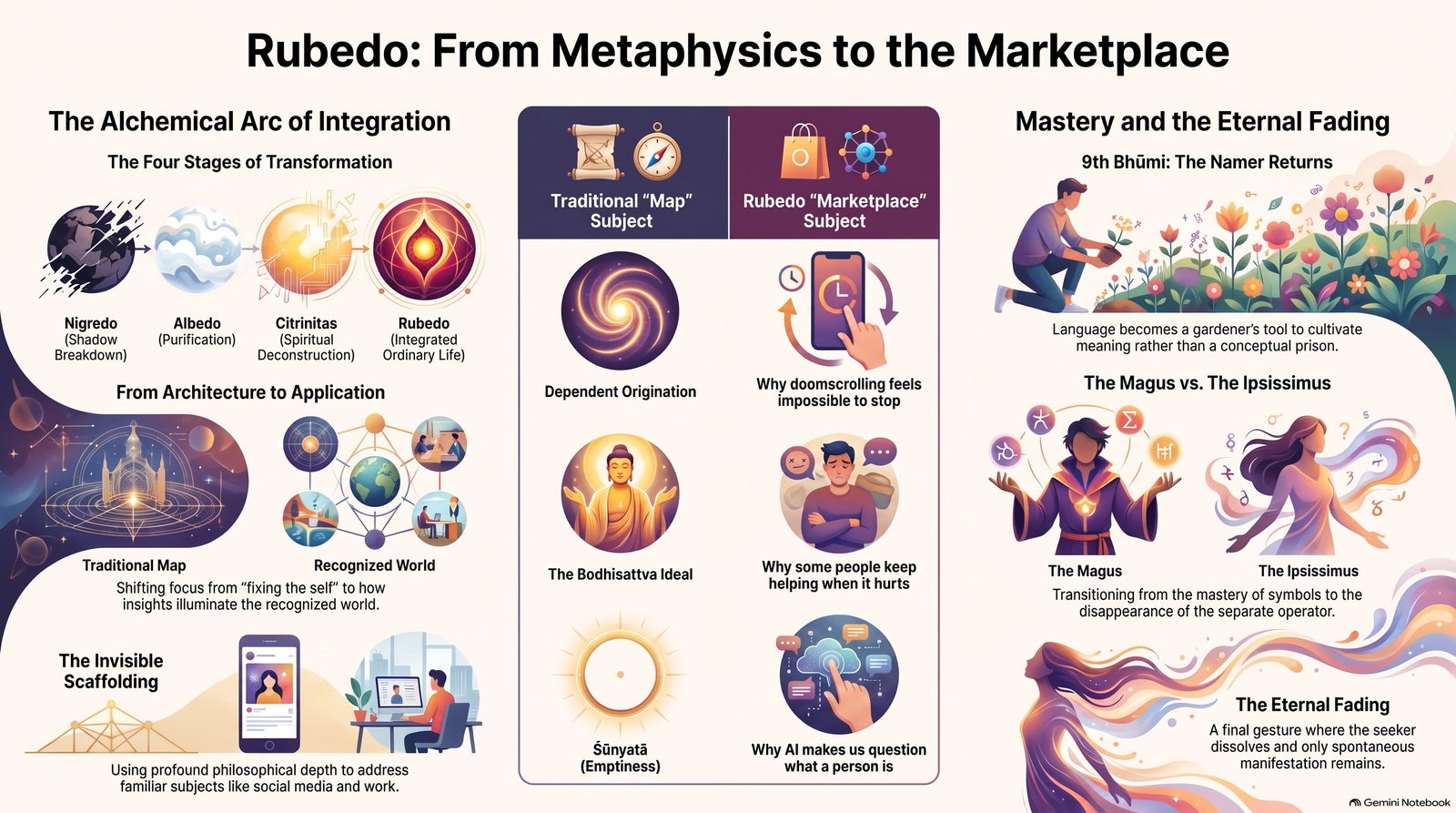
Dialogues IV ends by looking beyond the completion of a metaphysical map. The episode begins with the changing character of Dialogues V: familiar subjects—fiction, addiction, AI, work, language and ordinary distress—begin to carry the contemplative architecture that earlier episodes placed in the foreground. Rubedo is presented not as escape into a perfected elsewhere, but as integration: illumination brought back into embodied, social and practical life.
Thomas Covenant’s leprosy and refusal of miraculous healing become the central literary image. His wound is not praised because suffering is inherently ennobling. Rather, it is treated as load-bearing knowledge: the limitation that prevents fantasy from erasing consequence and that makes responsible action possible. The wider proposal is delicate. A wound can become part of the way without being denied, romanticised or preserved when genuine care and healing are available.
From there, the discussion turns to language. Words first appear as prisons when their provisional distinctions are mistaken for reality itself; later they return as tools. The image of Adam as gardener reframes naming as cultivation: language selects, arranges and directs attention without creating the whole field from nothing. The episode then places the Mahāyāna ninth bhūmi beside the Western esoteric figure of the Magus, before imagining a further release in which even the separate wielder of language fades.
How to read this episode: this is a deliberately synthetic bridge, not a claim that Mahāyāna Buddhism, Lurianic Kabbalah, Thelemic grades, modern psychology and literary fiction teach one hidden system. The four-colour alchemical sequence is used here as Dr Simon Robinson’s interpretive framework rather than a uniform historical account of alchemy. The ninth bhūmi is traditionally associated with highly developed teaching and four kinds of discerning knowledge, but the episode’s parallels with the Magus and its movement towards the Ipsissimus are original comparisons. “The eternal fading” and “frolicking in ousia” are poetic formulations, not standard Buddhist or Greek philosophical doctrines.
Argument map
Seven movements from metaphysics to the marketplace
The map begins to recede
Dialogues V moves from explicit religious and metaphysical subjects towards recognisable problems, while keeping its contemplative depth as invisible scaffolding.
The wound carries knowledge
Thomas Covenant’s damaged body prevents a consoling fantasy from becoming consequence-free. The wound becomes a discipline of attention rather than proof that suffering should remain untreated.
Alchemy returns to life
Nigredo, Albedo and Citrinitas name breakdown, clarification and illumination; Rubedo asks whether their insight can become relationship, responsibility, embodiment and effective action.
Conventional reality remains useful
“Occasional squinting” allows chairs, selves and boundaries to function without turning these practical distinctions into fixed and independent substances.
Language returns as a tool
After words have been exposed as provisional, naming becomes cultivation. Like pruning shears, a word directs attention and reorganises meaning without manufacturing reality from nothing.
The namer learns to serve
The ninth bhūmi’s discerning knowledge and eloquence are placed beside the Magus as images of skilled expression: not omnipotence, but responsibility for how symbols shape a shared world.
The operator finally fades
The closing gesture imagines mastery becoming spontaneous participation. Like improvisation in music, expression remains while the hard division between performer, instrument and event relaxes.
Listen by theme
Chapters
Selecting a chapter opens the published video at that point on YouTube.
- 00:00When the Body’s Alarm System Fails
- 03:39Why Imaginary Worlds Reveal Real Problems
- 06:32Thomas Covenant, Leprosy and Unbelief
- 15:21The Unhealed Wound as Architecture
- 16:50The Ravers and Dangerous Detachment
- 22:05The Sunbane and the Politics of Despair
- 25:38Nigredo to Rubedo: The Alchemical Journey
- 29:38Returning to Ordinary Life
- 30:52AI and Occasional Squinting
- 32:47When Language Returns
- 33:52The Ninth Bhūmi and the Power of the Word
- 36:41Naming, Adam Kadmon and the Magus
- 39:39Beyond Mastery: The Operator Disappears
- 43:43The Question of the Unhealed Wound
Terms in context
Glossary
Rubedo
Literally “reddening”, Rubedo is commonly treated in later alchemical and depth-psychological interpretations as a culminating image of integration. Within A Course in Modern Alchemy, it names the return of insight to ordinary embodied life. Historical alchemical texts do not present one universal four-stage psychological system, so the episode’s sequence should be read as a contemporary interpretive map.
Return to the marketplace
A recurring contemplative image for returning from retreat, insight or transcendence to ordinary relations and responsibilities. Here “marketplace” includes work, culture, technology, family, politics in the broad human sense and the practical world in which understanding must become conduct.
The unhealed wound
The episode’s literary and alchemical image for a limitation or injury that becomes part of the architecture of ethical attention. It does not imply that trauma, illness or disability should be retained for spiritual benefit, or that seeking medical or psychological care betrays the path.
Occasional squinting
A phrase developed in the Dialogues V material for using conventional distinctions without forgetting their provisional character. A chair can remain a chair for practical purposes even when analysis shows that neither its boundary nor its identity is completely self-grounding.
Dependent origination
A family of Buddhist teachings in which phenomena arise in dependence upon causes and conditions. The episode uses it as part of the invisible scaffolding beneath contemporary questions. It is not established by noticing structural similarities in social media, AI or literary narratives.
Śūnyatā — emptiness
In Mahāyāna Buddhist philosophy, emptiness generally indicates the absence of independent, intrinsic existence. It does not mean non-existence or insignificance. The episode’s return to practical boundaries depends on this distinction: what is empty can still function and have consequences.
Ninth bhūmi — Perfect Understanding
The ninth of the ten bodhisattva levels is called Sādhumatī. “Good Intelligence” is one possible literal rendering; the 84000 translation of The Ten Bhūmis uses “Perfect Understanding”. Its account emphasises teaching and four discerning knowledges: of phenomena, meaning, definitions and eloquence. The episode’s image of “the namer returning” is an interpretive development of this material.
Adam Kadmon
The “primordial human” of Kabbalistic cosmology, especially elaborated in Lurianic Kabbalah: an archetypal configuration associated with the first ordering of divine emanation, not the ordinary biblical Adam as a historical individual. The episode’s gardener and naming imagery draws on Genesis as well as this later mystical figure without claiming that they are identical doctrines.
Magus
In the episode, the Magus represents mastery of language, symbols and meaning. Within the A∴A∴ system associated with Aleister Crowley, Magus is a specific initiatory grade and “uttering a Word” belongs to that tradition’s own symbolism. The podcast translates this into participatory power over attention and shared meaning, not supernatural control of physical events.
Ipsissimus
The highest grade in the A∴A∴ hierarchy, above Magus. The episode uses it as a cross-traditional image for the disappearance of the separate operator after mastery has become complete. That comparison with the tenth bhūmi is Simon’s synthesis; the two systems have different histories, doctrines and aims.
Ousia
An ancient Greek philosophical term commonly translated as being, substance or essence, with meanings that vary among authors and periods. “Frolicking in ousia” is the source dialogue’s playful phrase for the sheer appearing of reality. It should not be treated as a standard definition of the Greek term.
The eternal fading
The dialogue’s poetic name for a condition in which phenomena continue to arise but no separate observer or master is re-established by reflection. It is not a recognised technical term in Buddhism, Kabbalah or Greek philosophy, nor an empirical claim about a measurable state.
Read further
Connections and reference points
Within this website and course
- Why Being a Good Person Is ExhaustingThe Dialogues IV finale questions moral identity and uncontrived response; this bonus episode carries that movement towards integration
- Why the Mind Turns Everything Into SomethingThe first principal Dialogues V episode continues the transition by asking how maps, diagnoses and words become mistaken for reality
- Rubedo: A Course in Modern AlchemyThe course landing page for the fourth movement: integration, embodiment and the return of insight to ordinary life
- 3.3.11. The MagusCourse context for language, symbols and the esoteric figure used near the summit of the episode’s argument
- 1.1.8. The Fisher-King WoundAn earlier alchemical treatment of the wound as a demand for questioning, feeling and transformation
External reference points
- 84000: The Ten BhūmisA complete translation of the Mahāyāna source used to check the ninth bhūmi, its teaching function and the four kinds of discerning knowledge
- Stanford Encyclopedia of Philosophy: Speech ActsPhilosophical context for the idea that language does more than describe: utterances can perform actions within social and conventional worlds
- Liber B vel MagiA primary Thelemic text for the Magus and the Word; useful for distinguishing the episode’s interpretation from the source tradition’s own language
A gentle reflective question
Can the wound be renamed without being denied?
Bring to mind one difficulty that has become part of how you understand yourself. Notice the names already attached to it: failure, damage, injustice, illness, initiation, burden or gift. Without forcing a positive interpretation—and without denying harm or abandoning appropriate help—ask what each name makes visible, what it hides and what kind of response it invites. Is there a more accurate word that lets the history remain true while opening a less imprisoned future?
Cross the threshold