
Dialogues V · Episode 13
Why Touch Feels Like the Boundary of the Self | Dialogues V
The sleeve you cease to feel is still touching you, yet a light tap can bring the edge of the body suddenly into view.
The central question
How does touch help us feel where the body meets the world?
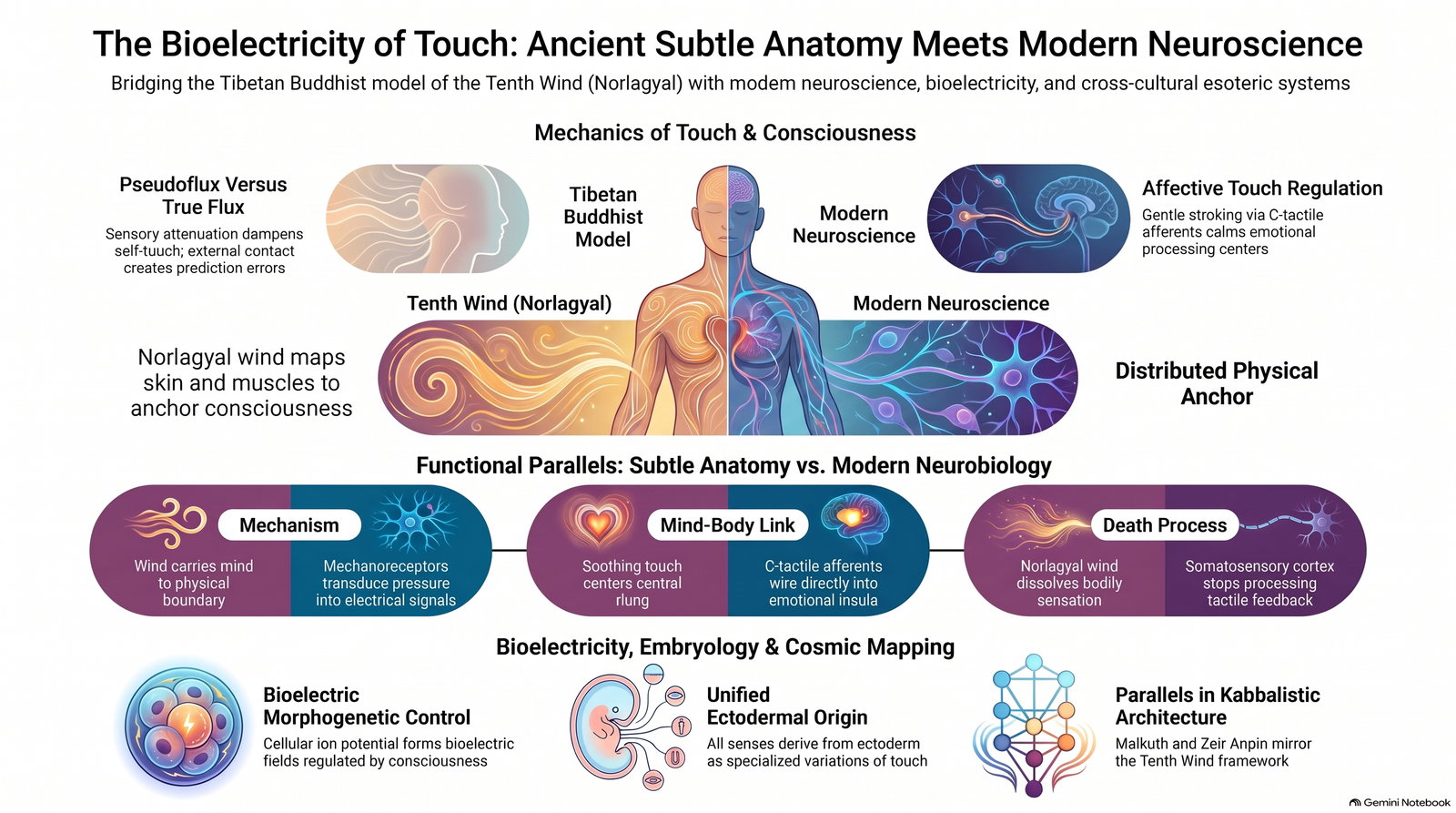
The hosts begin by asking you to feel your clothing without moving. For a moment a contact that has been present all along becomes perceptible again. The ease of that shift gives the episode its question. The skin marks an anatomical edge, but the feeling of having an edge comes and goes with what the body is doing and what draws attention. In the Tibetan Buddhist imagery introduced next, wind carries mind as a horse carries a rider. The dialogue uses the wind associated with touch to imagine a felt surface spread across the body.
The conversation then turns to experiments that address different aspects of this experience. Gentle stroking can have a pleasant quality as well as a discernible speed and location. Some touch receptors respond chiefly to changes, while others continue signalling under steady pressure. That distinction helps make sense of the sleeve. Self-tickling raises a different question about prediction. The nervous system can anticipate some of the contact our own actions produce. Together these examples let us ask how a relatively stable sense of the body can coexist with large swings in how vividly we feel it.
Halfway through, the hosts ask how the living surface that makes sensing possible comes to have its shape. They move from the collective behaviour of a social amoeba to research on membrane voltage in frog embryos, using the farmer and livestock as an analogy for the relationship between individual cells and a developing whole. Paracelsus’s mummia then prompts a broader use of the word contact, extending it to sound, light and chemical stimuli. Each reaches an organism in a physically different way.
Dreams complicate that account. A surface can feel solid in a dream even when no corresponding surface is pressing against the skin. The hosts close by borrowing the image of Malkuth as a receptive vessel from their reading of Kabbalah. Their strongest claim, that feeling proves existence, is philosophical. The practical challenge is quieter. When something comes into felt contact, can you distinguish the sensation itself from the judgement about where it came from and what it says about you?
Argument map
From the sleeve to the felt self
The boundary recedes into the background
A sleeve can stay in contact all day while its texture slips in and out of notice.
Give the boundary a traditional image
The horse-and-rider analogy leads to the branch wind associated in the discussion with touch across the body.
Contact carries more than location
Research on gentle stroking gives the hosts a way to ask how contact can acquire a pleasant or unpleasant character.
Separate steadiness from expectation
Receptor adaptation helps explain why constant pressure recedes, while prediction helps explain why some self-produced touch feels weaker.
Ask how the surface takes shape
The farmer-and-livestock metaphor moves the question from a body sensing its surroundings to cells coordinating as a developing organism.
Test what counts as contact
Paracelsus, the different senses and vivid dreams stretch the idea of contact beyond ordinary pressure on the skin.
Return to the felt encounter
Malkuth gives the hosts a final image of receptivity before they ask what it means to experience the world from within a body.
Chapters
Each chapter opens at its listed time on YouTube in a new tab.
- 00:00The Touch You Stop Noticing
- 03:13Mind as Rider, Wind as Horse
- 06:43The Tenth Wind and the Boundary of the Body
- 12:05Gentle Touch and Emotional Regulation
- 16:51Why Constant Sensation Disappears
- 22:37The Homunculus, Self-Touch and Prediction
- 28:55The Farmer, the Livestock and Cellular Electricity
- 31:20Slime Mould and Collective Organisation
- 34:55Bioelectricity and the Growth of Form
- 38:42Paracelsus and the Origins of Feeling
- 43:14Are the Senses Specialised Forms of Touch?
- 45:30Dreams and the Internal Sensory Canvas
- 49:26Malkuth and the Kabbalistic Tree
- 54:32Feeling as the Interface of Existence
Glossary
Rlung and the tenth wind
Rlung is Tibetan for “wind” or “breath”. In Tibetan tantric and medical frameworks, winds help describe relationships between mental and bodily processes. The recording uses the image of wind as the horse and mind as its rider, and calls the branch wind associated with touch the “tenth wind”. Numbering and functions should be read in the context of a particular tradition.
Mechanoreceptors and sensory adaptation
Mechanoreceptors respond to mechanical changes such as skin deformation. Rapidly adapting receptors respond especially strongly to changes such as the onset or release of pressure. Slowly adapting receptors continue signalling during sustained contact. A sleeve can fade from awareness while the nervous system still has access to information about its pressure.
Affective touch and C-tactile afferents
Affective touch refers to how contact feels in an emotional or social sense. C-tactile afferents are slowly conducting sensory nerve fibres found mainly in hairy skin. In controlled brushing experiments they respond strongly to slow, gentle strokes, which participants often rate as pleasant. The person’s expectations and the context of the touch also matter.
Somatosensory homunculus
The “little person” diagram represents the relative amount of primary somatosensory cortex devoted to parts of the body. Hands and lips appear enlarged because they have extensive cortical representation. It is a simplified illustration of how the nervous system represents the body, useful when the episode’s image of an even canvas begins to break down.
Sensory attenuation and efference copy
Attenuation is a reduction in the perceived intensity of a sensation or in the neural response to it. One explanation for weaker responses to some self-produced touch is that the nervous system uses a copy of an outgoing movement command to predict its sensory consequences. The degree of attenuation varies with the task and the match between predicted and actual feedback.
Pseudoflux and true flux
These are terms from the episode’s source dialogue. “Pseudoflux” describes the relative quietness of expected self-touch and “true flux” the salience of unexpected contact. They name a contrast in experience. External touch can be expected, and a movement we make ourselves can have a surprising sensory consequence.
Membrane potential and developmental bioelectricity
Membrane potential is the voltage difference across a cell membrane. It depends on how ions are distributed and move across that membrane. In development, voltage differences can influence what cells do and how tissues form, alongside gene activity and chemical and mechanical signals. The frog eye-patterning study shows how voltage can influence development within that network. The episode’s “farmer” is a metaphor for coordination at this larger scale.
Dictyostelium and cyclic AMP
Dictyostelium discoideum is a social amoeba. When food is scarce, cells emit and relay pulses of cyclic AMP, a signalling molecule often abbreviated cAMP. Cells move towards higher concentrations and aggregate, eventually forming a spore-bearing structure. It is an example of coordinated behaviour arising through local signals.
Mummia
An early modern medical term with several uses. In Paracelsian writing it can refer to a bodily virtue or efficacy understood within a historical account of life and healing. The episode borrows it as an image of continuity between living matter and sensation. That is a modern use of the historical term.
Sensory transduction and the ectoderm
Transduction is the conversion of a stimulus into a biological signal. In hearing the stimulus is mechanical, while vision begins when a light-sensitive molecule absorbs a photon. The ectoderm is an embryonic layer that gives rise to the epidermis and many nervous and sensory structures. Shared embryonic ancestry is distinct from a shared sensory mechanism.
Malkuth and Yesod
Malkuth means “kingdom” and Yesod “foundation”. They are conventionally the tenth and ninth sefirot, aspects of divine manifestation in Jewish Kabbalah. The episode compares Malkuth to a receptive surface and uses Yesod in its discussion of dreams. These are interpretive links and should be read within the wider symbolic tradition.
Zeir Anpin and tikkun
Zeir Anpin, usually rendered “Small Countenance”, is a configuration associated with six sefirot from Ḥesed through Yesod in Lurianic Kabbalah. Tikkun means repair or rectification and has a wider cosmological role in that tradition. The episode’s farmer analogy brings out one theme of organisation while leaving much of the original symbolism outside its scope.
A one-minute reflection
When does contact enter awareness?
While sitting comfortably, choose a contact that is already there, such as a sleeve against your wrist or your hand resting on a table. For a few seconds, notice what you can feel without moving. Then make one small, comfortable shift and let the contact settle again.
Notice which details became clearer and which receded. If attention alone brought a detail back, see whether it felt different from the change you made by moving. Return to what you were doing.
MAP. NOT MASTER.