
Dialogues VI · Episode 16
What Do Dragons Tell Us About Billionaires?
What happens when guarding what we have begins to govern how we live?
When does keeping something begin to shape the keeper?
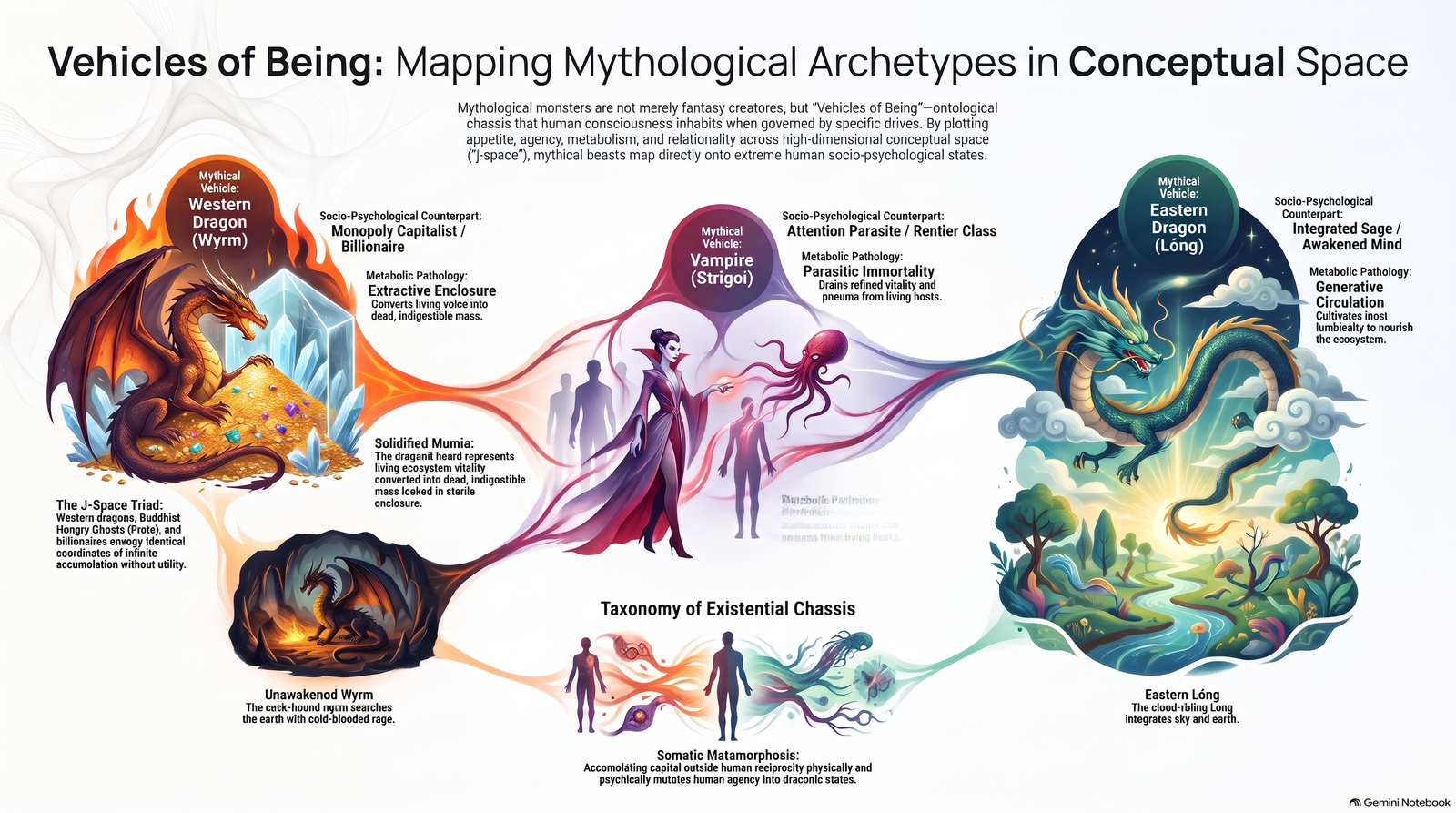
The episode opens by placing a dragon, a Buddhist hungry ghost and a monopoly billionaire at the same point on an imaginary map. The likeness the hosts propose is a relation to appetite. Each figure is used to picture how acquiring or guarding something can become the organising activity of a life. The Great Chain of Being supplies the historical starting point. From there the hosts ask what a creature can show about how someone inhabits a world. Ursula K. Le Guin’s Earthsea makes that shift imaginable through dragons whose relation to the Old Speech differs from the mages’.
Fáfnir gives the comparison a cost. The ransom that enters his family as compensation soon breaks the bonds it might have repaired. Guarding the gold leaves him alone with it. In Beowulf, centuries of possession do the dragon no good. The hosts follow that observation into Tolkien’s fiction and then into Marx’s accounts of hoarding and living labour. They bring in mummia, a historical medicinal substance associated with human remains, as a disturbing image of what happens when living value is treated as something that can simply be stored.
The middle of the episode looks for an image of appetite within the person. Plato’s diaphragm divides regions of the mortal soul in the Timaeus. Paired dragons in alchemical imagery give the hosts a further way of picturing the relation between fixed and volatile qualities. The hungry ghost brings the cost of insatiability into view. The hosts then pass from the waters held back by Vṛtra to selected images of Chinese rain-bringing dragons and the flying dragon of the Yijing. By that route, circulation becomes a way to think about integration in Rubedo, the fourth part of A Course in Modern Alchemy.
The final figures bring the question into ordinary life. Ammit devours, the vampire draws its sustenance from a host, Talos carries out his charge, and Roman shades give the hosts an image for a late-night scroll through other people’s alarm. The recording comes back to the dam and the rain. How can we tell whether what we preserve is available for life tomorrow, or whether preserving it has already become the main thing we do?
Argument map
Build a map of habits
The Great Chain of Being gives way to a map of how a dominant drive can shape what a person notices and how they act.
Follow the gaze to the hoard
Earthsea makes a different way of perceiving imaginable, while Fáfnir shows how guarding the treasure can take the place of kinship.
Ask whom the treasure enriches
Beowulf’s dragon, Tolkien’s dragon-sickness and Marx’s account of hoarding separate the act of keeping wealth from the question of what it does.
Give the appetite a form
Plato’s partitioned soul, the alchemical pair of dragons and the hungry ghost give the hosts different ways to picture appetite cut off from other capacities.
Picture what returns
The waters released from Vṛtra and the rain associated with Chinese dragons shift the emphasis from keeping hold to making something available again.
Try the map on everyday life
Ammit, the vampire, Talos and the Roman dead recast consumption, extraction, compliance and doomscrolling before the hosts return to the image of the dam and the rain.
Chapters
Chapter links open on YouTube in a new tab.
- 00:00 Dragons, hungry ghosts and billionaires
- 02:40 From the Great Chain to vehicles of being
- 06:40 Earthsea: dragons, language and the gaze
- 11:05 Fáfnir: greed, isolation and the guarded hoard
- 16:35 Beowulf, Tolkien and dragon sickness
- 18:20 Marx, mummia and the metaphor of dead wealth
- 24:00 Plato and the diaphragm as a symbolic boundary
- 27:20 Winged and wingless dragons: alchemical integration
- 29:50 Hungry ghosts: appetite without satisfaction
- 31:00 From blocked rivers to rain-bringing dragons
- 36:55 Ammit and the image of endless consumption
- 40:00 Vampires and the attention economy
- 42:00 Talos and obedience without reflection
- 44:20 Roman ghosts, doomscrolling and returning to circulation
Glossary
Great Chain of Being
A historical image of ordered existence, often pictured as a ladder with divinity above and material things below. Arthur O. Lovejoy traced versions of this idea across several centuries. The hosts use it as a point of departure for asking what a creature can express about a way of living.
Vehicle of being and J-space
Yāna means vehicle and can designate a Buddhist path, as in Mahāyāna. Heidegger’s Dasein concerns the being for whom its own being is at issue. The episode brings the terms together to imagine ways of inhabiting the world. Its “J-space” is a metaphorical map, with axes such as appetite and reciprocity.
Fáfnir
In the Norse tradition, Fáfnir seizes a cursed treasure after killing his father and guards it in serpent form. In the Poetic Edda, prose accompanying the lays and Fáfnir’s speeches supply parts of the story. The hosts read the transformation as an image of isolation organised around possession.
Hoarding and dead labour
In Capital, Volume I, Chapter 3, Marx describes hoarding as money held back from circulation and also discusses the role of monetary reserves. In Chapter 10, his vampire image concerns capital drawing on living labour. The hosts connect the passages through the dragon. Net worth can include actively invested assets, and a monetary reserve can serve future obligations.
Mummia and mumia
Names used in the history of materia medica for substances associated with bitumen, and later for remedies made from preserved human remains. The hosts turn this history into an image of stored vitality. Linking it to Marx’s alchemical imagery is their interpretive step.
Pneuma and the diaphragm
Pneuma can mean breath, wind or spirit depending on the author and context. In Plato’s Timaeus, the diaphragm divides regions assigned to spirited and appetitive parts of the mortal soul. The hosts extend this ancient philosophical anatomy to the dragon as a picture of what happens when appetite dominates.
Fixed and volatile dragons
A work traditionally attributed to Nicolas Flamel pairs a wingless fixed dragon with a winged volatile one. Michael Maier’s Atalanta Fugiens uses different emblems, including a dragon with a woman in a grave. The episode reads their imagery as a way of thinking about integration.
Rubedo and circulation
Rubedo, or reddening, is a term for a late stage of the alchemical work and the fourth part of A Course in Modern Alchemy. Circulatio names an alchemical operation involving repeated circulation within a vessel. The hosts borrow the language of circulation for resources that move through relationships and remain available to others.
Preta (hungry ghost)
A kind of being in Buddhist cosmologies, often portrayed as tormented by hunger or thirst and unable to obtain nourishment. The needle-thin mouth is one traditional depiction. The hosts also read the image psychologically, as a way to recognise a recurring appetite that acquiring more continually fails to satisfy.
Vṛtra and lóng
Vṛtra is the serpent overcome by Indra in Rigveda 1.32, after which the waters flow. Lóng is the Chinese word for dragon. Some Chinese dragon traditions associate the creature with clouds and rain. The episode draws a contrast from selected stories, and its reading of the Yijing dragon alongside Plato is a further interpretive layer.
Ammit and Talos
Ammit waits by the scales in Egyptian funerary imagery, ready to devour the condemned heart. Talos, the bronze guardian of Crete, drives away intruders. The hosts use the two figures to distinguish indiscriminate consumption from obedience to a rule, two different ways the consequences of an action can drop from view.
Lemures and Lemuria
The lemures are spirits of the dead in Roman tradition. In Book V of Ovid’s Fasti, a householder casts black beans behind him in a rite for ancestral shades at the Lemuria. The episode borrows the nocturnal repetition for its image of scrolling through fragments of other people’s alarm.
Related reading
- Greed
Continues the inquiry into greed at the scale of ordinary emotional life.
- Why do we use symbols in alchemy?
Explores why symbols can carry ideas across several levels of meaning.
- The Garden in Your Body: Eden and Appetite
An earlier episode reads appetite and embodiment through another mythic setting.
- Why Wisdom Needs Both Solitude and the World | Dialogues V
Asks how fruitful withdrawal can return to relationship, a useful companion to Fáfnir’s withdrawal around the hoard.
- Rubedo – Part Four
Places the episode’s interest in integration within the fourth part of A Course in Modern Alchemy.
External reference points
External references open in a new tab.
-
Karl Marx, Capital, Volume I, Chapter 3
Section 3A discusses hoarding, the alchemical retort and the function of reserves. The image of capital drawing on living labour like a vampire appears in Chapter 10, “The Working Day”.
-
Plato, Timaeus 70, translated by R. G. Bury
The passage supplies the dividing wall of the diaphragm and the image of appetite tethered at a manger.
-
84000, glossary entry for preta in Toh 437
The translators’ glossary describes hungry ghosts in Buddhist cosmology and points to a fuller classification in Toh 287.
-
Helmut Nickel, “The Dragon and the Pearl”
The Metropolitan Museum Journal article documents rain and pearl associations and examines possible origins of the motif.
-
Apollonius of Rhodes, Argonautica, Book IV
In this version, Medea bewitches Talos and he grazes his ankle on a rock. The recording blends this account with variants about his origin, a bronze pin and a burning embrace.
Reflection
Take a minute to think of something you’ve kept, such as a tool, a collection of notes or an hour set aside. What purpose did keeping it serve? What would tell you that its purpose had changed? If someone could make use of it, what would have to happen for it to reach them?