
Nigredo · Subject · Chapter 39
Exile
When innocence gives way to self-conscious choice, the resulting freedom can feel like banishment. This chapter reads Cain, Abel and Seth as figures for material agency, moral conscience and their difficult integration.
Watch the chapter discussion
Why You Feel Exiled From Yourself
Chapter guide
Follow the edited discussion
- 00:00Opening and the Cain–Abel Story
- 02:55Genesis as an Alchemical Map
- 05:50Adam and Eve: Awareness Becomes Reflective
- 09:35Knowledge, Dukkha and the Loss of Innocence
- 13:35Cain and Abel: The Self Divides
- 17:35The Cain Moment and Self-Authority
- 19:25The Wilderness of Self
- 24:40The Dark Night and Collapse
- 27:30The Symbolic Tree of Inner Conflict
- 30:00Seth, Integration and the Middle Way
- 33:40Recap: Seeing Other People Differently
Brief book orientation
From the Garden to the wilderness of self
The written chapter interprets Genesis as an alchemical account of developing consciousness. Adam and Eve represent an original openness and its reflective mind; exile follows the knowledge of suffering, judgement and mortality. Cain, Abel and Seth then become figures for self-authorising material life, moral conscience and the possibility of reconciliation.
This is Dr Simon Robinson’s modern symbolic synthesis. It is neither a claim about literal human origins nor a standard Jewish, Christian, Buddhist or Jungian interpretation of the biblical narrative.
What the recording explores
Exile as an inner division
Myth as an inward map
The discussion opens by treating Genesis as a symbolic account of psychological development rather than biological history.
Awareness becomes reflective
Adam names immediate, embodied awareness; Eve names the mind capable of reflecting upon experience and dividing it into concepts.
Knowledge ends innocence
Learning about death, disease, scarcity and suffering is presented as a universal loss of the child’s undivided world.
Cain silences Abel
Material agency and self-authority suppress moral or spiritual restraint, leaving conscience to return as a haunting inner voice.
Neither pole is sufficient
Unchecked self-interest becomes destructive, while a punitive conscience can produce guilt, paralysis and estrangement from ordinary life.
Seth holds a possible synthesis
The final movement imagines material competence and ethical awareness no longer as enemies, but as capacities that can be integrated.
Symbolic interpretation, not developmental law
The recording often speaks as though everyone must pass through the same sequence of innocence, selfish rebellion, collapse and integration. That sequence is better understood as the chapter’s interpretive map. Harmful behaviour is not made necessary or harmless by calling it a developmental stage, and compassion does not require withholding boundaries or accountability.
Argument map
How the recording develops
Change the reading frame
The biblical story is recast as an alchemical psychology of consciousness rather than a literal account of early humanity.
Begin with undivided awareness
Adam and Eve are used to distinguish immediate experience from the reflective mind that names and evaluates it.
Enter knowledge and exile
Recognition of vulnerability and suffering fractures innocence and locates experience within an anxious world of judgement.
Divide agency from conscience
Cain’s material self-authority appears to defeat Abel, yet the silenced ethical voice persists as guilt and inner conflict.
Reach exhaustion
The discussion connects prolonged conflict with disenchantment and depression, then interprets crisis as a possible invitation to reflection.
Seek integration
Seth and the Middle Way become images of responsible worldly participation informed by conscience rather than ruled by either extreme.
Visual synthesis
The chapter’s archetypal sequence
The infographic gathers the chapter’s principal figures into one modern interpretive arc: open awareness, reflective knowledge, exile, material self-assertion, divided conscience and possible integration. It is a visual guide to this chapter, not a historical genealogy or a universal model of psychological development.
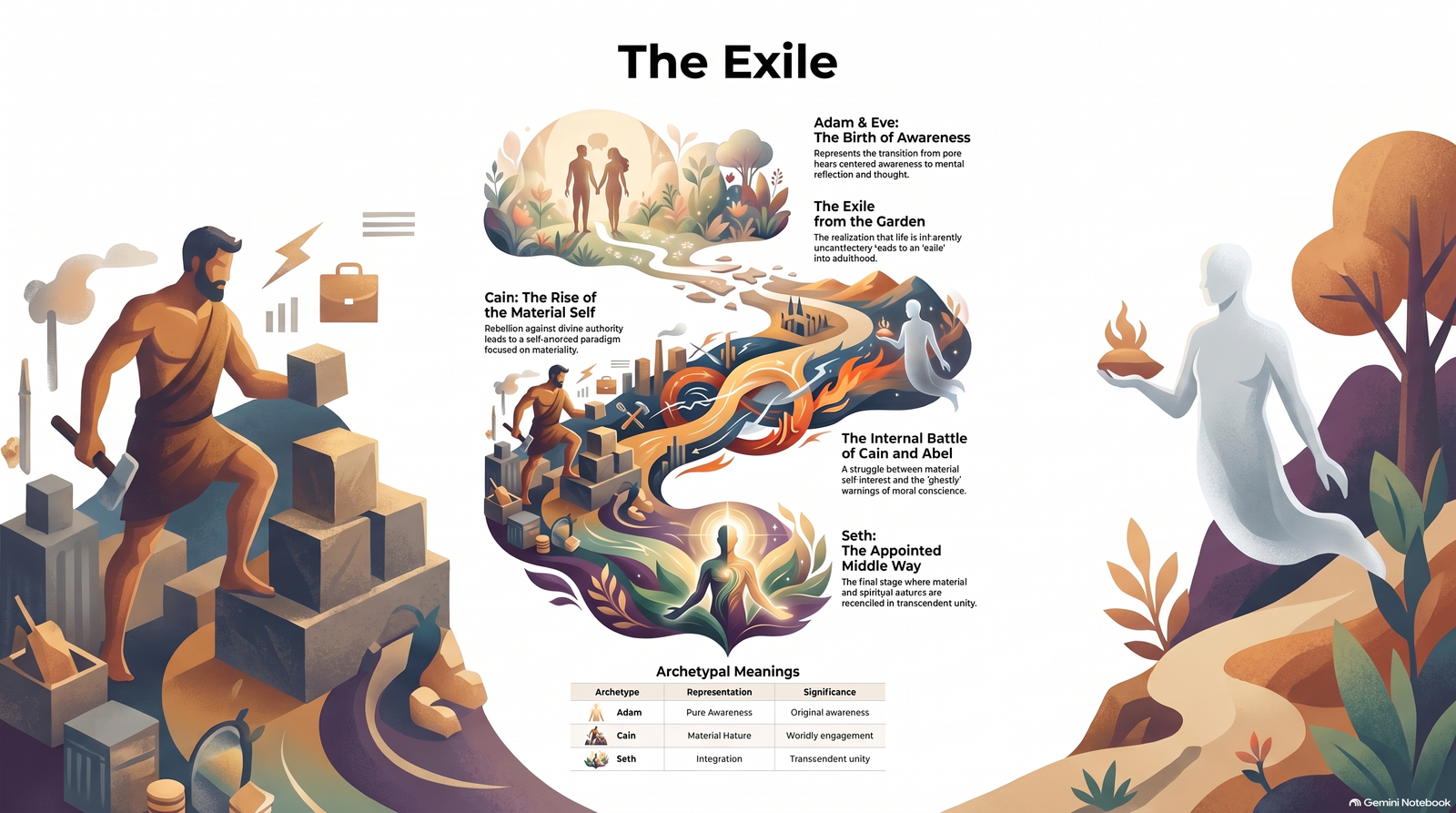
Book and recording
What each layer contributes
| Layer | What it contributes | Boundary to retain |
|---|---|---|
| The written chapter | A concise symbolic reading of exile, rebellion, self-interest, conscience, despair and reconciliation through Adam, Eve, Cain, Abel and Seth. | It presents the author’s alchemical synthesis, not an agreed meaning of Genesis or an empirically established sequence of adult development. |
| The AI-generated recording | A fuller narrative of innocence, conceptual division, material agency, haunting conscience and integration in ordinary life. | It expands the source rhetorically and sometimes turns metaphor into certainty. Its first-person corporate anecdote is generated host narration, not biographical evidence about Dr Robinson. |
| Genesis 3–4 | The garden, expulsion, farming, herding, fratricide, judgement, wandering and the birth of Seth provide the narrative material. | The text does not identify these figures with fixed psychological faculties. Jewish and Christian interpretation is far more diverse than this one modern reading. |
| Jungian and Buddhist comparisons | Individuation, integration of opposites and the Middle Way help the chapter describe a life no longer governed by one-sidedness. | These terms arise from different traditions. Their juxtaposition can be illuminating without proving that they describe one mechanism. |
Working vocabulary
Terms used in the chapter and recording
Exile
Adam and Eve
Cain and Abel
Seth
Dukkha
Conscience
Individuation
Middle Way
Dark night
Modern alchemy
Continue within the course
Related pathways
- 1.4.2. The FallThe preceding Subject chapter follows the departure from inherited authority and the formation of a more self-conscious centre.
- Chapter 40 video: Why Success Still Feels EmptyThe next Subject chapter turns from exile to wandering, restlessness and the persistence of dissatisfaction.
- 1.1.3. Evolution of AdulthoodProvides an earlier course framework for maturation, identity and the changing relationship between dependence and autonomy.
- 1.3.2 The Trees of ConsciousnessDevelops the symbolic background of the Tree of Life, the Tree of Knowledge and divided awareness.
- 1.1.10 The Shadow & The Lost InfantExamines rejected aspects of experience and the danger of allowing symbolic language to turn inner division into blame.
- 1.1.11 The Dark Night of the SoulPlaces the chapter’s language of breakdown within the wider Nigredo treatment of darkness, crisis and transformation.
Reference points
For careful further reading
- Genesis 3:22–4:26, NRSVUEThe primary biblical sequence of expulsion, Cain and Abel, Cain’s wandering, his descendants and the birth of Seth.
- Bible Odyssey: CainA scholarly introduction to the narrative, its unanswered questions and the history of interpretation.
- International Association for Analytical Psychology: IndividuationClarifies individuation as a process of psychological integration rather than simple individualism or rebellion.
- SuttaCentral: SN 56.11, Setting the Dhamma Wheel in MotionAn early Buddhist source for the Middle Way and its identification with the Noble Eightfold Path.
- NHS: Depression in adultsClinical context for a real health condition that should not be reduced to spiritual exhaustion, moral conflict or a necessary dark night.
Question to carry forward
Which voice has become absolute?
Choose one current decision in which self-interest and conscience appear to conflict. Write one sentence for what the “Cain” voice is protecting and one for what the “Abel” voice is protecting. Then ask: what responsible action would honour the valid information in both without excusing harm or turning guilt into punishment? The names are prompts for reflection, not diagnoses or fixed parts of the self.
Course navigation