
A Course in Modern Alchemy / Volume I
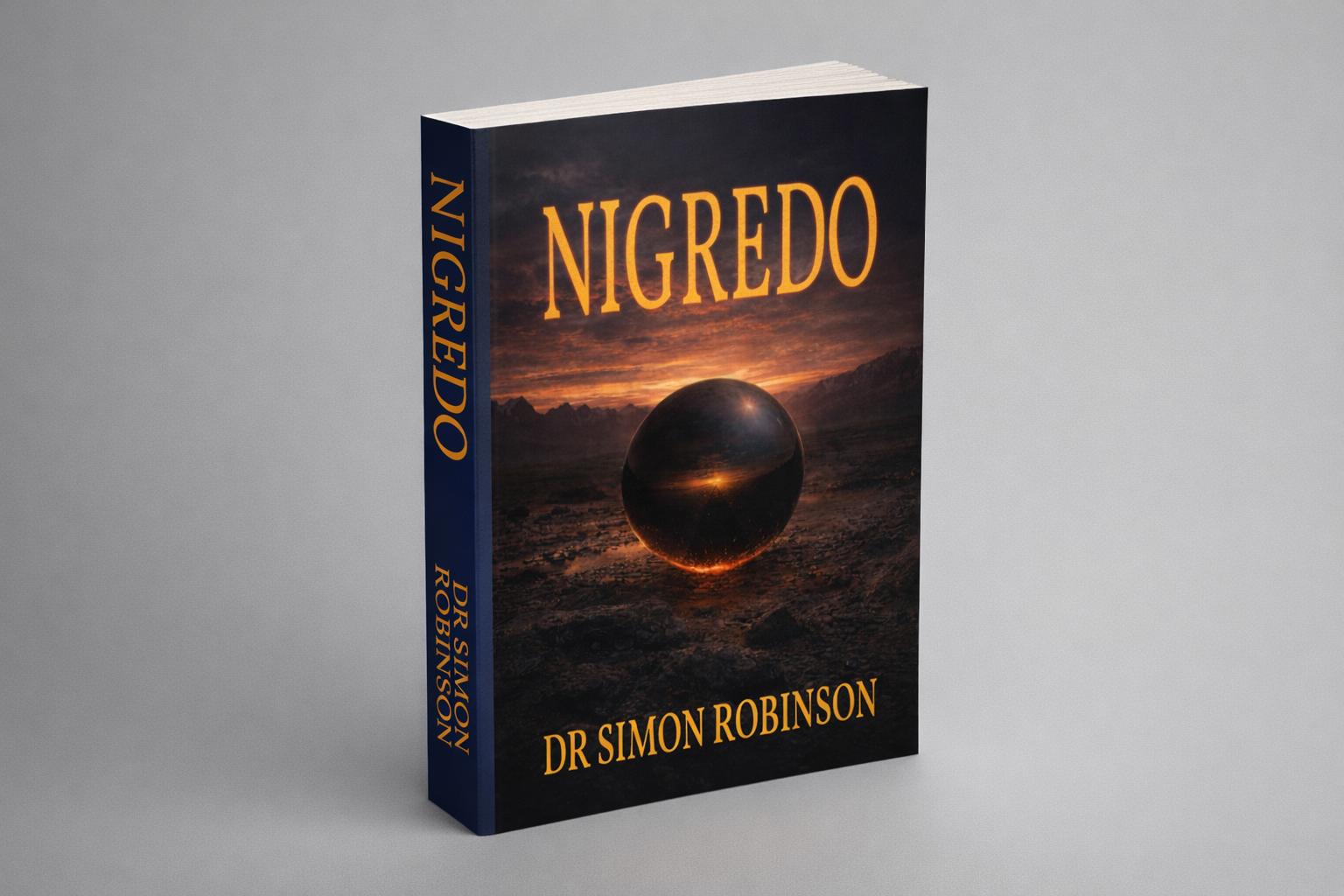
Nigredo
The blackening. The beginning of the work.
A study of consciousness, conditioning and the unsettling business of questioning what we take ourselves to be.
Across forty-eight chapters, Nigredo brings alchemical symbolism into conversation with Buddhist philosophy, depth psychology and lived experience. Its subject is inner transformation: how familiar ways of seeing are formed, why they become constraining, and what it might mean to look more closely.
48chapters with study guides
4sections, each with twelve chapters
8thematic glossary categories
2025revised edition
A reader’s overview
What kind of book is this?
Nigredo began as notes made during the author’s own exploration of spiritual practice. That origin remains visible in its voice: personal, questioning, sometimes playful and sometimes uncompromising. The revised edition places those reflections within a substantial apparatus of chapter summaries, study guides, diagrams, tables and definitions.
The organising image is alchemical blackening: the period in which an established account of life begins to lose its authority. The book explores this through the wounded king, the Shadow, the lost infant, the departure from Eden and the Dark Night of the Soul. Alongside these images sits a more analytical enquiry into the components of experience, drawn particularly from the Buddhist Abhidhamma.
This combination gives the book its distinctive movement. A myth introduces a difficulty; a philosophical model examines it; a study guide brings it back to the reader’s own habits of perception. The recurring concern is the relationship between the stories we tell about ourselves and the changing processes those stories attempt to describe.
The approach is a personal synthesis. Its connections between alchemy, Buddhism, Kabbalah and Christian imagery express the author’s interpretation; they are best explored with attention to the differences between those traditions. Readers can engage with the comparisons without having to accept every proposed correspondence.
The structure of the course
Four approaches to the same enquiry
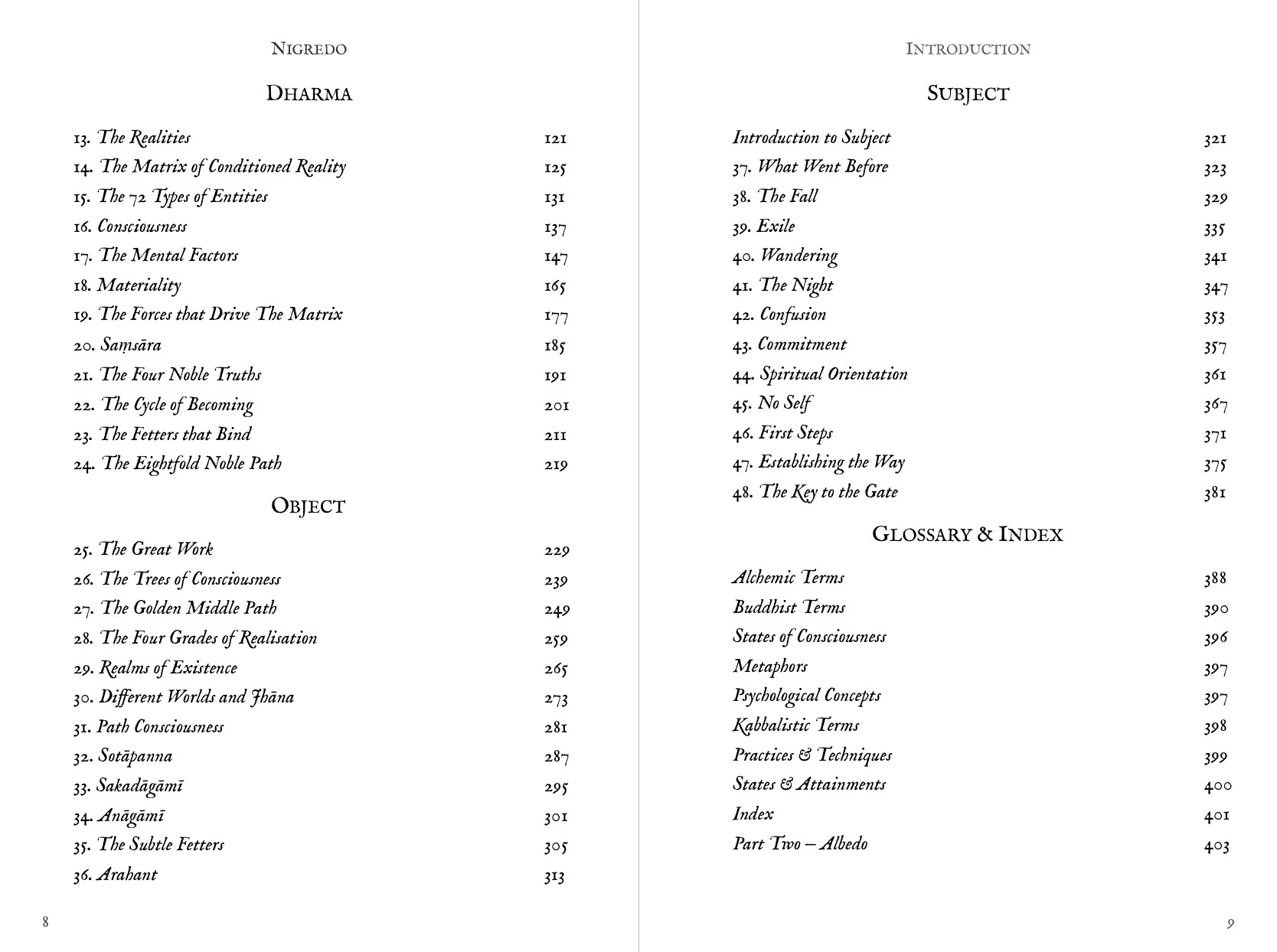
The four sections move from symbol and story, through a detailed model of mind, into maps of the path and the experience of living through change. Each contains twelve chapters. Open a section below for its complete chapter list.
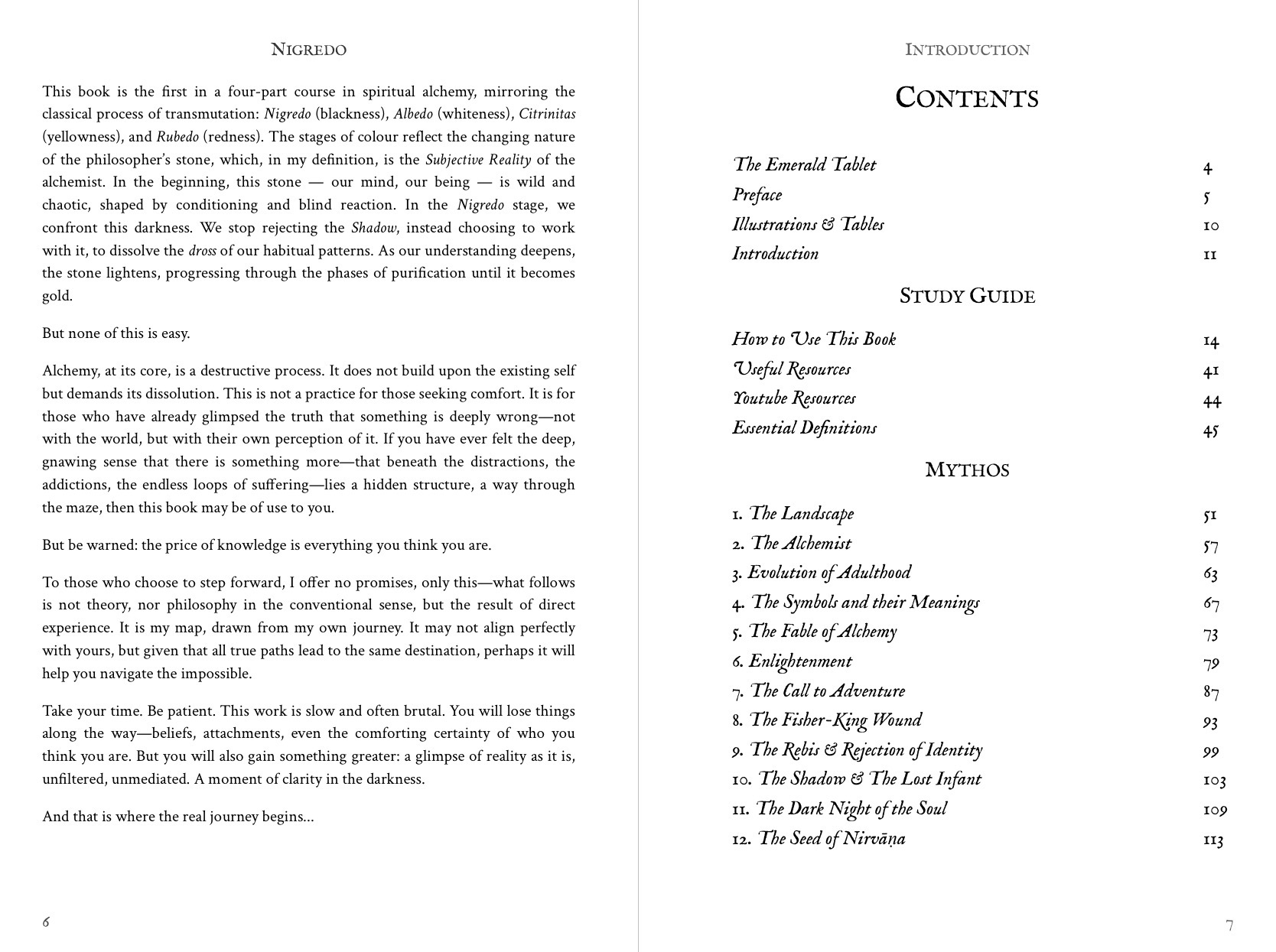
01. Mythos — chapters 1–12
Symbols, wounds and beginnings
The opening section establishes the language of spiritual alchemy. It considers the formation of adult identity, the interpretation of symbols, the call to adventure and the wounds that make familiar explanations inadequate. The Fisher-King, the Rebis and the lost infant become ways of approaching division, rejection and the possibility of integration.
- The Landscape p. 51
- The Alchemist p. 57
- Evolution of Adulthood p. 63
- The Symbols and their Meanings p. 67
- The Fable of Alchemy p. 73
- Enlightenment p. 79
- The Call to Adventure p. 87
- The Fisher-King Wound p. 93
- The Rebis & Rejection of Identity p. 99
- The Shadow & The Lost Infant p. 103
- The Dark Night of the Soul p. 109
- The Seed of Nirvāṇa p. 113
02. Dharma — chapters 13–24
The components of conditioned experience
The most technical section introduces an Abhidhamma-based account of consciousness, mental factors and materiality. It moves from the distinction between apparent and conditioned reality to the Four Noble Truths, dependent origination, the ten fetters and the Noble Eightfold Path. Tables give the unfamiliar vocabulary a structure that readers can revisit.
- The Realities p. 121
- The Matrix of Conditioned Reality p. 125
- The 72 Types of Entities p. 131
- Consciousness p. 137
- The Mental Factors p. 147
- Materiality p. 165
- The Forces that Drive The Matrix p. 177
- Saṃsāra p. 185
- The Four Noble Truths p. 191
- The Cycle of Becoming p. 201
- The Fetters that Bind p. 211
- The Eightfold Noble Path p. 219
03. Object — chapters 25–36
Maps of practice and realisation
Here the focus turns to the Great Work as a path: the Trees of Consciousness, the Middle Way, realms of existence, meditative absorption and path consciousness. Chapters examine stream-entry, once-returning, non-returning and arahantship, alongside the author’s alchemical and Kabbalistic comparisons. These are the book’s maps of development, to be read reflectively rather than used as personal certification.
- The Great Work p. 229
- The Trees of Consciousness p. 239
- The Golden Middle Path p. 249
- The Four Grades of Realisation p. 259
- Realms of Existence p. 265
- Different Worlds and Jhāna p. 273
- Path Consciousness p. 281
- Sotāpanna p. 287
- Sakadāgāmī p. 295
- Anāgāmī p. 301
- The Subtle Fetters p. 305
- Arahant p. 313
04. Subject — chapters 37–48
How the journey is experienced
The final section follows the lived sequence of departure, exile, searching, confusion and renewed orientation. Its chapter titles become simpler and more immediate: The Fall, Wandering, Commitment, No Self and First Steps. The emphasis returns to how understanding becomes part of ordinary experience, ending at the threshold of Albedo.
- What Went Before p. 323
- The Fall p. 329
- Exile p. 335
- Wandering p. 341
- The Night p. 347
- Confusion p. 353
- Commitment p. 357
- Spiritual Orientation p. 361
- No Self p. 367
- First Steps p. 371
- Establishing the Way p. 375
- The Key to the Gate p. 381
Page numbers refer to the revised edition. Before the main chapters, the book includes the Emerald Tablet, a preface, an introduction, guidance on using the course and an illustrated overview of all forty-eight chapters.
Learning and returning
The study material around the chapters
The supporting material is a substantial part of the book. How to Use This Book begins on page 14, followed by a technical outline and a chapter-by-chapter overview on pages 17–40. These opening summaries provide a first pass through the whole course before the detailed reading begins.
Chapter-end study guides then provide another way into the material. Their headings vary, but recurring elements include core concepts, new terminology, main themes, practical applications, reflection questions, integration points, common misconceptions and progress indicators.
Concepts and vocabulary
Definitions sit close to the chapter in which they are needed. A reader encountering prima materia, citta or anatta can pause, clarify the term and return to the argument.
Reflection and connection
Questions turn an abstract discussion towards experience, while integration points direct attention to related chapters. The structure encourages rereading across the book as well as moving through it in order.
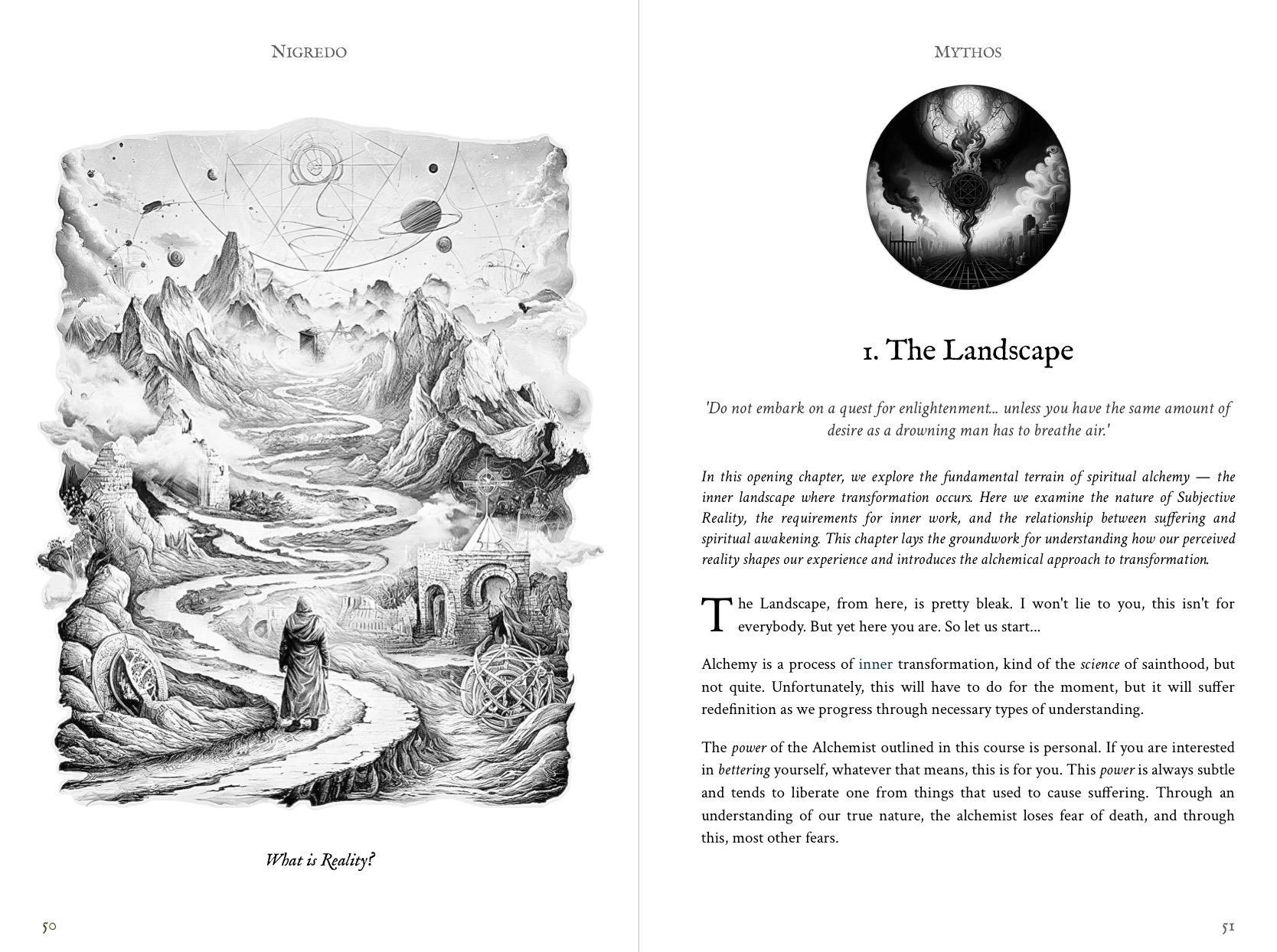
An example: The Landscape
The first chapter’s study guide, on pages 55–56, asks the reader to consider differences between personal and shared reality, what makes an experience feel real, and how perception changes in company or solitude. It connects these questions to adulthood, the Fisher-King wound, the Shadow and the Rebis.
This illustrates the book’s working method: read an idea, examine its vocabulary, notice it in experience, then follow its connections.
The reference layer
Lists, classifications and comparative tables
A dedicated Illustrations & Tables list appears on page 10. The material it indexes ranges from compact psychological comparisons to detailed Buddhist classifications. The following selection shows the breadth of what is included.
| Area | What the book includes | Where to look |
|---|---|---|
| Components of experience | The five aggregates; the book’s account of the 72 types of entities; categories and roots of consciousness; sense-sphere, form-sphere, formless, path and fruit consciousness. | pp. 130–146 |
| Mental factors | The 52 cetasikas, organised into universal, occasional, unwholesome and beautiful factors. Tables set out groups and examples, alongside more detailed descriptions. | pp. 148–161 |
| Materiality | The four great elements, the 28 categories of matter, and tables of material categories and characteristics within the book’s Abhidhamma framework. | pp. 165–175 |
| Suffering and conditioning | Aspects of saṃsāra; the twelve links of dependent origination; causes of suffering; and components of the Noble Eightfold Path. | pp. 184–209 |
| Fetters and the path | The ten fetters, gross and subtle fetters, stages of realisation, and comparisons linking changes in the fetters with the four Buddhist attainments. | pp. 210–218, 263, 291–292, 311 |
| Tree of Life and cosmology | Sephirot and their attributes; layers of consciousness; classes of beings; and form, formless, sensual and jhānic realms. | pp. 237–241, 264–279 |
| The personal journey | Tables on the lost infant, the Dark Night, Genesis symbolism, types of suffering, commitment, spiritual orientation and integration. | pp. 107–111, 338–365 |
These are traditional classifications and the author’s interpretive comparisons. Their use here is contemplative and philosophical; the numerical schemes are not presented as measurements from contemporary neuroscience or physics.
The visual language
Illustrations that carry part of the argument
The monochrome interior alternates extended prose with symbolic images, explanatory diagrams and tabular material. Small illustrations accompany the opening chapter summaries, while larger images give particular concepts room to stand on their own.
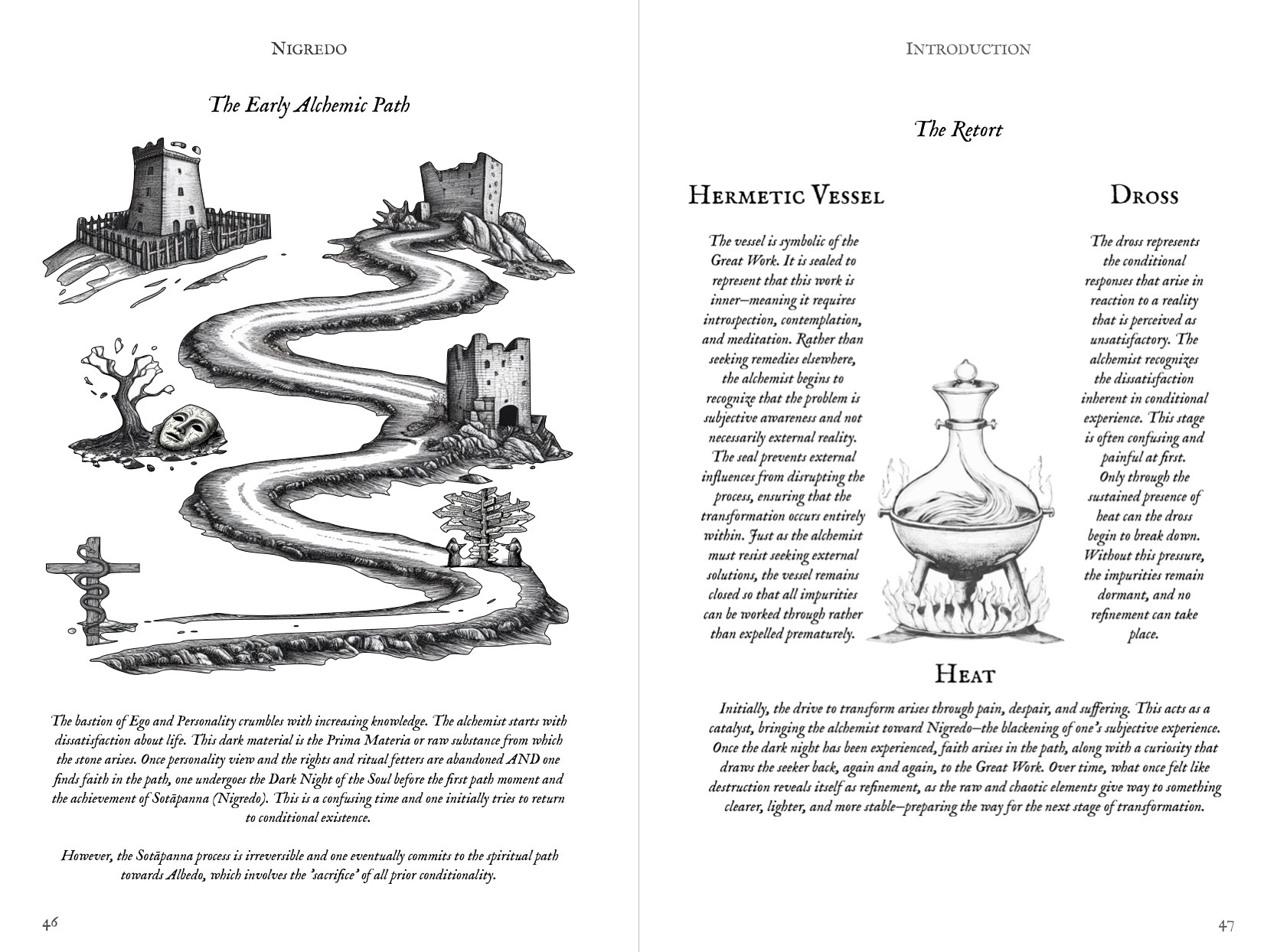
Examples include the early alchemical path and the retort, the Three Realities, the Fisher-King wound, the Dark Night, the ten fetters and the Rebis. A candle-and-flame analogy on page 164 illustrates the relationship between consciousness and its supporting mental factors. On page 238, a three-dimensional representation of the Kabbalistic Tree of Life arranges its figures spatially, with explanatory labels.
The images support a different mode of reading from the tables: symbolic associations can be contemplated slowly, while the classifications can be consulted for orientation. The edition credits the author with the book design and typography, and acknowledges AI assistance with the cover and interior images, some editorial work and study-guide formatting.
Sample pages
Select an image to open the existing full-size sample.
Finding your way through the terminology
Eight glossary categories, plus an index
A short Essential Definitions section on page 45 provides initial orientation. The fuller glossary occupies pages 388–400 and groups its vocabulary by subject. Many entries include pronunciation guides, associated ideas, a classification, related terms and etymology, making the glossary useful for following connections as well as checking a meaning.
Alchemic terms
Stages, operations, vessels and symbols: the alembic, crucible, black crow, black sun, calcination, conjunction, metals and planetary correspondences.
Buddhist terms
The vocabulary of mind, conditioning and practice, including aggregates, mental factors, craving, karma, emptiness, insight and liberation.
States of consciousness
Meditative and experiential categories, including path and fruit consciousness, sense-sphere experience, and apparent, subjective and unconditioned reality.
Metaphors
The Garden of Eden, Fisher-King wound, Tree of Duality and White Rabbit, with pointers to the ideas they carry within the book.
Psychological concepts
The lost child, the Matrix, perception, projection, the Shadow and other terms used in the discussion of identity and psychological experience.
Kabbalistic terms
Sephirot, Daʿat and Qlippoth, with Hebrew forms, pronunciation guides, symbolic associations and related concepts.
Practices & techniques
Gentling, jhāna practice, kasina, kenosis, samatha, solve et coagula and vipassanā.
States & attainments
Buddhist attainments alongside mystical vocabulary such as gnosis, satori, Christ consciousness and the Dark Night.
The alphabetical index on pages 401–402 supplies page references for returning to a subject in the main text. The glossary explains a term; the index helps locate its discussion.
Beyond the main text
Resources, further reading and closing material
The resource section on pages 41–44 records books, lectures and channels that informed the author’s studies. Its central Buddhist reference is A Comprehensive Manual of Abhidhamma, associated with Bhikkhu Bodhi. Other listed works include The Path of Purification, The Buddhist Cosmos, Ledi Sayadaw’s Manuals of Buddhism and Henepola Gunaratana’s study of jhāna.
The Western and psychological reading includes works by Manly P. Hall, Jung’s Psychology and Alchemy, Robert A. Johnson’s He, and Robert Bly’s Iron John and A Little Book on the Human Shadow. The recommendations also extend to the Secret History of Western Esotericism Podcast and a page of YouTube resources.
After the glossary and index, an outline of Albedo introduces the next volume. The closing material includes the poem Black Cloak and an author biography. The book therefore ends with both a view forward into the course and a return to a more personal register.
Another way into the material
Watch and listen
Video introduction
Audio overview
A discussion of alchemy and path consciousness, offering an alternative introduction to the book’s central concerns.
Explore the online course
The Nigredo course pages provide a companion route into the material. You can also browse practical resources, media and course material.
Pace, approach and perspective
Reading Nigredo
The book is likely to interest readers who want to explore the relationship between symbolic traditions and the analysis of experience. Its first volume introduces the course, but its technical middle chapters ask for patience: Pāli terminology, classifications of mind and comparisons between traditions accumulate quickly.
A useful first reading is to follow the opening chapter overview, then work through Mythos before entering the more detailed Dharma section. Keep the glossary available and return to the tables when a particular distinction becomes relevant. The study guides offer pauses for reflection; there is no need to memorise every classification before continuing.
The personal voice is part of the book’s character. Readers seeking a detached historical survey or a single tradition’s standard textbook should expect a different kind of work here: an author-led exploration that uses inherited maps to make sense of experience. Its value can lie as much in the questions it opens as in the conclusions with which a reader agrees.
How should the language of darkness and transformation be read?
The book uses strong language about dissolution, suffering, identity and the Dark Night. These belong to its spiritual and autobiographical framework. A description of spiritual crisis should not be used to diagnose distress, to treat suffering as proof of attainment, or to suggest that care and support are obstacles to understanding.
This is a work for education and contemplation, not a clinical treatment manual. Its maps and progress indicators are prompts for enquiry rather than a requirement to force experience into a prescribed sequence.
The wider course
A place on the bookshelf
Nigredo establishes the language and framework of A Course in Modern Alchemy. The four-volume sequence is organised around blackening, whitening, yellowing and reddening. Each colour gives the course another perspective on transformation.
Edition and availability
Book details
Nigredo: Part One of A Course in Modern Alchemy
Dr Simon Robinson · Revised Edition (2025)
ISBN: 978-1-0684310-0-5
The following links lead to the book’s retailer listings. Consult the retailer for current format, price, delivery and availability. The ISBN can also be used when enquiring at an independent bookshop.