
Nigredo · Dharma · Chapter 18 of 48
1.2.6 Materiality
If matter feels solid and continuous, what changes when it is examined as a conditioned field of qualities rather than a collection of permanent things?
Watch the chapter discussion
Why Matter Isn’t Solid
The book
The chapter in brief
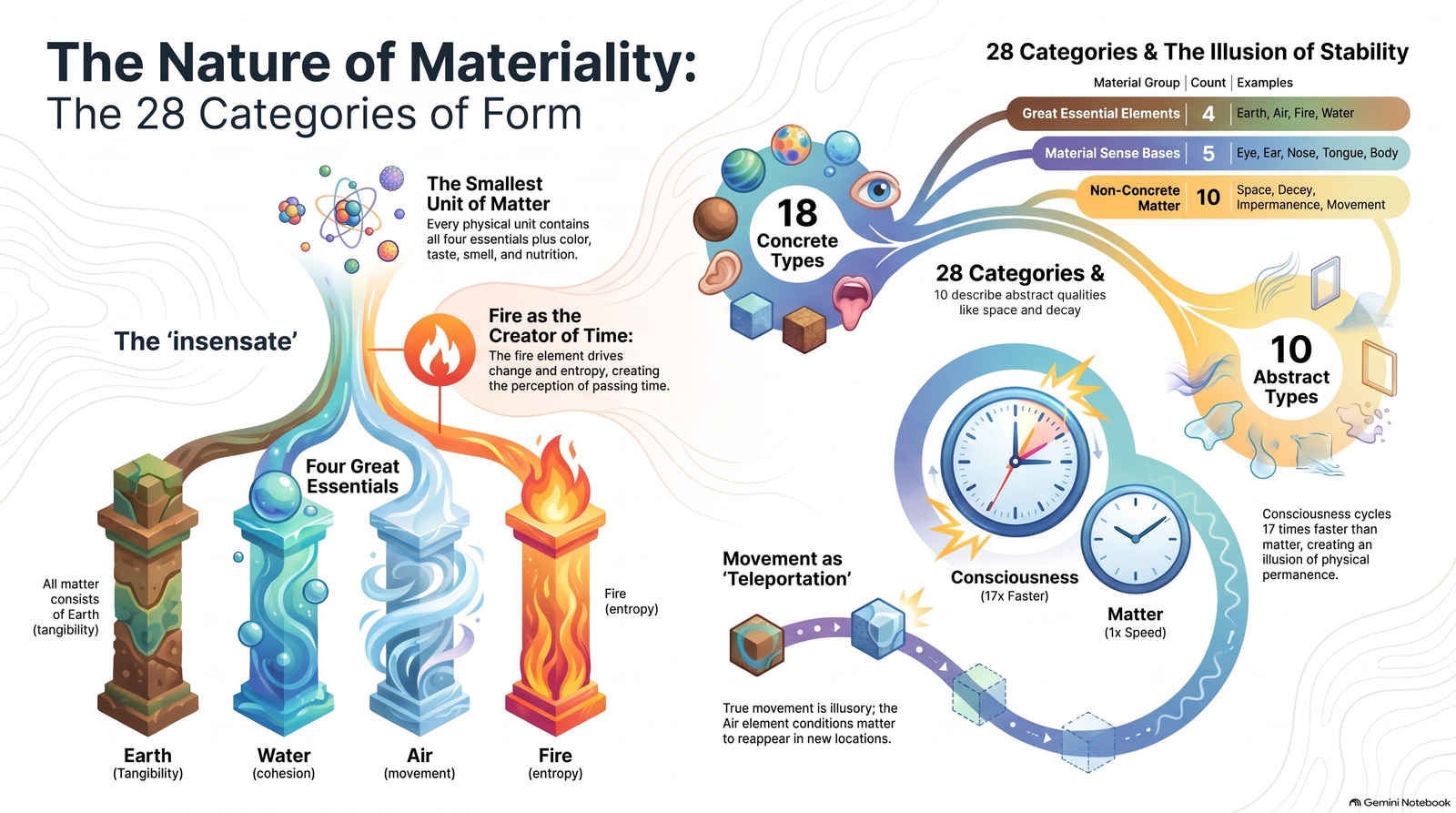
This sixth Dharma chapter introduces rūpa, or material form, within the Theravāda Abhidhamma framework used by the course. It distinguishes matter from mind by the absence of awareness, then presents the four great elements as qualities: earth as hardness or resistance, water as cohesion, fire as temperature and maturation, and air as pressure or motion.
The chapter then surveys twenty-eight kinds of material phenomenon: eighteen treated as concrete and ten as dependent or abstract characteristics. Sense bases and objects, life, nutriment, space, bodily and verbal intimation, adaptability and the phases of arising and decay all become parts of a functional map. The purpose is not to replace physics, physiology or biology, but to examine how the appearance of a stable material world participates in attachment and suffering.
Visual orientation
The nature of materiality
Video guide
What makes a changing world appear solid?
The recording begins with the Heart Sūtra’s relation between form and emptiness, but then turns to the markedly different analytical language of Theravāda Abhidhamma. Its central question is practical: if material things do not know or experience anything, how does the body come to feel like “me” and the world like a stable field of objects? Back pain supplies the first example. Bodily change, sensory contact, unpleasant feeling and interpretation are separated so that pain is not simplistically attributed to an insensate body alone.
The four great elements provide the next layer of analysis. Earth, water, air and fire are de-literalised as resistance, cohesion, movement or pressure, and temperature or maturation. The shower, balloon, melting ice and slowly changing diamond help the speakers ask how separate qualities are gathered into recognisable things. The video then presents momentariness through a strobe-light or film-frame image: matter arises and ceases while consciousness constructs an impression of persistence. The claim that material phenomena last for seventeen mind-moments belongs to later Theravāda analysis; it is not an experimentally measured ratio.
The inquiry proceeds through the twenty-eight material phenomena, including the sense bases and objects, heart-base, life faculty, nutriment, space, bodily and verbal intimation, lightness, malleability, wieldiness, production, continuity, decay and impermanence. Pixel and teleportation metaphors dramatise a traditional account of apparent motion. Further comparisons—electromagnetic anchoring of consciousness, a physical account of near-death experiences, and mental production of elemental forces—extend the chapter into modern speculation and should not be read as accepted neuroscience or physics.
The closing movement returns classification to its soteriological purpose. The twenty-eightfold list is not offered as an inventory of everything that exists. It is a disciplined way of loosening the assumption that body, voice and possessions are unitary, permanent or independently owned. The practical challenge is therefore neither to deny conventional matter nor to despise the body, but to notice how quickly useful appearances become claims of solidity, identity and control.
Argument map
How the inquiry develops
Separate knowing from the known
Matter is defined as insensate, allowing bodily change, sensory signalling and the mind’s experience of pain to be examined without collapsing them into one thing.
Replace substances with qualities
Earth, water, air and fire cease to mean literal soil, liquid, wind and flame and become resistance, cohesion, pressure or movement, and temperature.
Question apparent continuity
The strobe-light and long-exposure images present solidity as an impression produced from rapidly changing conditioned events.
Reframe movement
The pixel analogy interprets motion as causally connected appearances in adjacent locations, a traditional-philosophical claim dramatised as “teleportation” rather than a result of physics.
Map the twenty-eight phenomena
Sense bases and objects, life, nutriment, space, intimation, adaptability and material change broaden rūpa beyond simply solid objects.
Test the mind–body boundary
Heart-base and intimation ask how consciousness depends upon and acts through embodied conditions, while the video’s electromagnetic account moves into speculation.
Follow matter through its phases
Production, continuity, decay and impermanence make dissolution intrinsic to material process rather than an accident that begins only in old age.
Turn analysis towards release
The final question is whether seeing body and world as conditioned processes can weaken grasping without denying their conventional reality.
Book, video and evidence
What belongs to which layer?
The written chapter
Establishes the mind–matter distinction, the four great elements, the twenty-eight material phenomena, material momentariness and their place beside consciousness and mental factors in the course’s model.
The video’s expansion
Adds back pain, swimming, showers, balloons, ice cream, diamonds, pixels, Wi-Fi and a sack of scrap metal to make a dense classification vivid and memorable.
Traditional source layer
The rūpa taxonomy is specifically Theravāda Abhidhamma; the four elements also appear in earlier discourses, while the Heart Sūtra’s form–emptiness teaching belongs to Mahāyāna Prajñāpāramitā literature.
Modern synthesis and speculation
Alchemy, simulation code, quantum fields, entropy as time, literal teleportation, electromagnetic consciousness and an explanation of near-death experience are interpretive comparisons or conjectures, not one verified ancient-scientific theory.
Clickable chapters
Navigate the video
These eight chapter markers are the supplied final YouTube markers. A separate final runtime was not supplied, so no duration is stated on this page.
Terms for orientation
Expandable glossary
Rūpa / material form
Abhidhamma and Abhidharma
The four great elements
Earth element (paṭhavī-dhātu)
Water element (āpo-dhātu)
Fire element (tejo-dhātu)
Air element (vāyo-dhātu)
Concrete and non-concrete rūpa
Material sense bases
Heart-base (hadaya-vatthu)
Bodily and verbal intimation
Lightness, malleability and wieldiness
Production, continuity, decay and impermanence
Seventeen mind-moments
Form and emptiness
Continue through the course
Related pathways
- 1.2.5 The Mental FactorsThe preceding chapter examines the factors accompanying citta, completing the mental side of the model before this analysis of materiality.
- 1.2.4 ConsciousnessIntroduces citta and the classifications of awareness against which insensate rūpa is distinguished.
- 1.2.7 The Forces that Drive The MatrixThe next chapter asks how consciousness, mental factors and materiality are conditioned and set in motion.
- 1.2.8 SaṃsāraExtends the analysis of changing conditioned phenomena into the course’s account of repetition, attachment and suffering.
- Dharma — Part Two of NigredoThe section index for the twelve chapters that develop the course’s analysis of conditioned experience and the path beyond suffering.
Context beyond the course
External reference points
- Stanford Encyclopedia of Philosophy — AbhidharmaA scholarly account of the development, competing schools, taxonomies, momentariness and soteriological purpose of Abhidharma analysis.
- Buddhist Publication Society — A Comprehensive Manual of AbhidhammaBhikkhu Bodhi’s edited guide to the Theravāda manual tradition, including its treatment of consciousness, mental factors and material phenomena.
- Access to Insight — The Great Elephant Footprint Simile (MN 28)An early discourse that analyses the four elements in relation to the body and impermanence, useful beside the later twenty-eightfold system.
- Access to Insight — Dhammapada, The PathIncludes verse 277 on seeing the impermanence of conditioned things with discernment, the traditional closing reference used by the chapter.
A two-minute observation
From object to changing qualities
Choose an ordinary, neutral object such as a mug or tabletop. Without trying to make it disappear or feel unreal, notice the qualities through which it is known: colour, hardness or softness, temperature, pressure, sound when touched, and the space that marks its boundary. Then notice which part of the apparently single “thing” is supplied by recognition and naming. Does seeing several changing qualities alter the strength of the assumption that the object is one fixed, self-contained substance?