
Nigredo · Dharma · Chapter 20 of 48
1.2.8 Saṃsāra
If Buddhism denies a permanent soul, what—if anything—continues from one moment or life to the next, and what keeps the wheel of becoming in motion?
Watch the chapter discussion
Why You Keep Reincarnating
The book
The chapter in brief
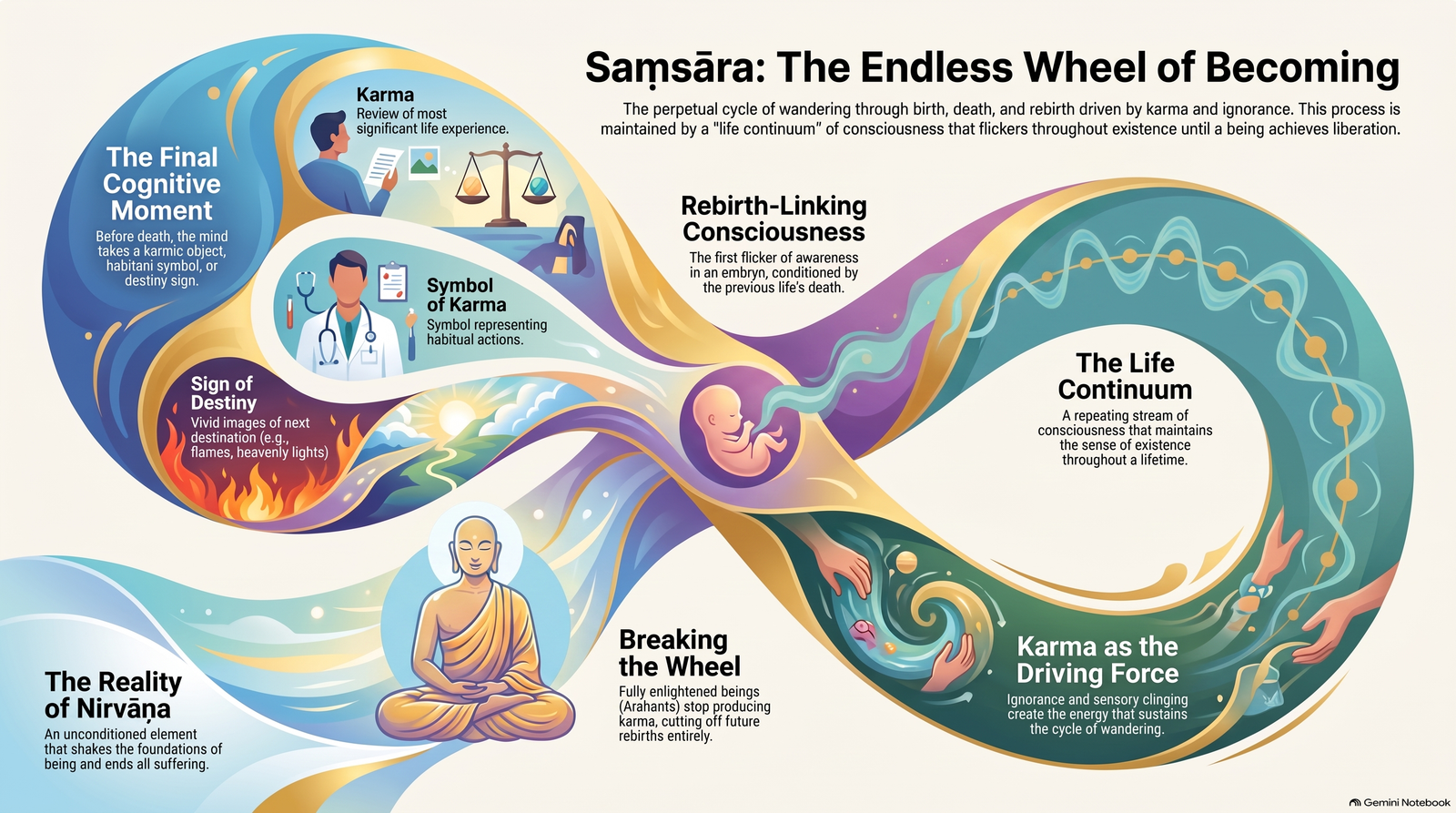
This eighth Dharma chapter extends the preceding discussion of karma into the traditional Buddhist account of repeated birth and death. It introduces the Theravāda concepts of death consciousness, rebirth-linking consciousness and the life-continuum to describe causal continuity without positing an immortal soul that travels between lives.
The chapter then sets that account within saṃsāra’s beginningless wandering and presents arahantship and nibbāna as the ending of the conditions for further rebirth. Its detailed sequence belongs chiefly to developed Theravāda Abhidhamma and commentarial explanation; several of the chapter’s Bardo, alchemical and evolutionary images come from other traditions or from the course’s own synthesis.
Visual orientation
The endless wheel of becoming
Video guide
What keeps reconstructing the self?
The recording begins by recasting the Four Noble Truths as a diagnostic structure: a problem, its cause, the possibility of cessation and a course of treatment. This is a useful traditional comparison, though the video’s language of medical charts, operating systems and “hacking the program” is contemporary metaphor. Dukkha is presented less as uninterrupted misery than as the instability and inadequacy of conditioned experience—even pleasure cannot be held permanently.
From there, the discussion moves into dependent origination. The river and vortex image distinguishes changing processes from the apparently solid being they seem to form. Ignorance conditions volitional formations; these condition consciousness, which participates in the emergence of name-and-form, the senses, contact, feeling, craving, clinging and becoming. The standard twelve-link formula is a Buddhist explanatory framework with several traditional interpretations. It should not be presented as a neurological circuit, a laboratory model of embryonic development or proof of post-mortem rebirth.
The recording gives special attention to contact, feeling, craving and clinging. A smell, sensation or encounter is rapidly marked pleasant, unpleasant or neutral; habitual pursuit or resistance can follow before reflective choice becomes obvious. The bakery example makes that momentum easy to recognise. Yet the speakers’ claim of “zero free will” in the initial response is philosophical shorthand, not an established scientific result. Automaticity, learned pattern and constrained agency do not make people biochemical puppets, nor do they erase ethical, social or clinical complexity.
The video then translates the chain into a practical question: can awareness recognise feeling before it hardens into craving and identity? Its language of intercepting a signal and cutting puppet strings dramatises the role of mindfulness. Buddhist practice is broader than a single pause, however. The Eightfold Path integrates view, intention, speech, action, livelihood, effort, mindfulness and concentration; its ethical dimensions are not merely techniques for reducing mental “CPU usage”.
The book chapter itself concentrates more narrowly on continuity across death. In developed Theravāda analysis, the final consciousness of one life (cuti-citta) is followed—without a migrating self—by rebirth-linking consciousness (paṭisandhi-citta), after which bhavaṅga cittas provide a life-continuum when active cognitive processes are absent. The account of a karmic deed, a sign of karma or a sign of destination appearing near death belongs to this later analytical tradition. It is not established by contemporary neuroscience, and bhavaṅga is not a permanent witness or a stream running simultaneously beneath every conscious act.
The chapter briefly mentions a Bardo after sudden death, while orthodox Theravāda generally describes rebirth-linking as immediate; intermediate-state teachings are more characteristic of Tibetan and some other Buddhist traditions. Likewise, claims that the new consciousness first arises in an embryo, depends on the heart or blood flow, or preserves a death-object across a temporal gap are doctrinal propositions within the model rather than biomedical findings. The recording is most reliable when it presents rebirth as a traditional question of conditioned continuity and distinguishes that question from the observable renewal of identity in this life.
Finally, the discussion maps the Buddhist path onto Nigredo, Albedo, Citrinitas and Rubedo. Nigredo is described as the collapse of familiar satisfactions; Albedo as analysis and purification; Citrinitas as integration; and Rubedo as release from the compulsion to manufacture a self. This is Dr Robinson’s modern alchemical synthesis, not a historical equivalence accepted across Buddhist or European alchemical traditions. The culmination—“just the water” rather than a perfected vortex—expresses no-self vividly, but should not be taken to deny conventional persons, responsibility or care.
Argument map
How the inquiry develops
Diagnose instability
The Four Noble Truths frame dukkha as a structural problem of conditioned experience rather than a command to believe that every moment feels miserable.
Replace the solid self with process
The vortex image shows how a recognisable pattern can persist while its constituents change, allowing continuity without an independent essence.
Trace the dependent chain
Ignorance, formations, consciousness and the remaining links describe how contact and feeling can develop into craving, clinging, becoming and renewed suffering.
Locate the practical hinge
Attention to feeling and reaction offers a place to recognise conditioned momentum before it becomes another unquestioned act or identity claim.
Extend continuity across death
The chapter’s Theravāda model connects death consciousness, rebirth-linking consciousness and bhavaṅga without introducing a soul that passes unchanged between lives.
Turn diagnosis into a path
Ethics, effort, mindfulness and concentration support insight; the course then reads that transformation through the four colours of the alchemical work.
Book, video and evidence
What belongs to which layer?
The written chapter
Introduces saṃsāra, the life-continuum, the last cognitive process, three kinds of death-object, rebirth-linking consciousness, the continuation of ignorance and karma, arahantship and nibbāna.
The video’s expansion
Adds the Four Noble Truths, the twelve links of dependent origination, the river-vortex model, bread and pizza examples, the Eightfold Path and an extended Nigredo-to-Rubedo interpretation.
Traditional source layer
Beginningless wandering, karma, dependent origination, no-self and cessation appear across early Buddhist discourse. Cuti, paṭisandhi, bhavaṅga and the three death signs are articulated most fully in Theravāda Abhidhamma, commentaries and manuals.
Modern synthesis and speculation
The mind as software, zero free will, cognition as engineering, the “spark of the divine”, evolutionary ascent through animal lives, depression as spiritual progress and a direct four-stage Buddhist–alchemical correspondence are interpretive claims or metaphors.
Clickable chapters
Navigate the video
These eight chapter markers are the supplied final YouTube markers. A separate final runtime was not supplied, so no duration is stated on this page.
Terms for orientation
Expandable glossary
Saṃsāra
Dukkha
Dependent origination
Taṇhā and upādāna
Bhava
Cuti-citta
Paṭisandhi-citta
Bhavaṅga
Kamma, kamma-nimitta and gati-nimitta
Bardo
Anattā / no-self
Arahant
Nibbāna / nirvāṇa
Noble Eightfold Path
Nigredo, Albedo, Citrinitas and Rubedo
Continue through the course
Related pathways
- 1.2.7 The Forces that Drive The MatrixThe preceding chapter introduces karma and conditional relations, providing the immediate basis for this account of continuity and rebirth.
- 1.2.4 ConsciousnessProvides the earlier course vocabulary for citta, resultant consciousness and momentariness that the present chapter assumes.
- 1.2.9 The Four Noble TruthsThe next chapter develops the diagnostic framework that occupies a substantial part of this recording.
- 1.2.10. The Cycle of BecomingExtends the video’s account of dependent origination and the links through which suffering and renewed becoming arise.
- Dharma — Part Two of NigredoThe section index for the twelve chapters that analyse conditioned experience, suffering and the path beyond automatic repetition.
Context beyond the course
External reference points
- SuttaCentral — Grass and Sticks (SN 15.1)An early discourse presenting saṃsāra as wandering with no discoverable beginning, sustained by ignorance and craving.
- SuttaCentral — Dependent Origination (SN 12.1)A concise early-discourse statement of the twelve-link sequence and its cessation.
- Buddhist Publication Society — A Comprehensive Manual of AbhidhammaA guide to the Theravāda manual tradition, including cognitive processes, death and rebirth, paṭisandhi, bhavaṅga and the classification of karma.
- Stanford Encyclopedia of Philosophy — BuddhaA scholarly orientation to no-self, dependent origination, karma, rebirth, suffering and liberation, with attention to philosophical interpretation.
A two-minute observation
Watch one small becoming
Choose an ordinary impulse with little emotional charge: checking a message, reaching for another cup of tea or rehearsing what you will say later. Notice the first feeling tone, the leaning towards or away, and the brief picture of the person you are about to become. Nothing needs to be suppressed. Can the sequence be known as a changing set of conditions rather than as a command or a fixed identity? Keep the exercise modest; it does not prove or disprove rebirth.