
Nigredo · Object · Chapter 26 of 48
1.3.2 The Trees of Consciousness
Is consciousness one continuous thing, or a layered pattern through which perception, selfhood and conflict are progressively constructed?
Watch the chapter discussion
Why Consciousness Isn’t One Thing
The book
The chapter in brief
This chapter introduces the Tree of Life as the course’s large-scale map of consciousness. Beginning with the candle flame, it questions whether an apparently continuous awareness is a single entity or a pattern assembled from momentary events. It then reinterprets the ten sefirot as layers running from primal awareness to embodied perception, before distinguishing innocent, fallen and perfected forms of the Tree.
This is Dr Robinson’s modern alchemical synthesis. It draws upon Kabbalistic, Hermetic, Gnostic, Buddhist and psychological vocabularies, but it is not a standard account within any one of those traditions and should not be read as a scientific anatomy of the mind.
“The Tree Of Life is more than a symbol. It is an actual map of the Universe and the psyche.”Israel Regardie, The Middle Pillar, as quoted in the chapter. The course adopts this claim as an esoteric premise rather than an empirically established description.
Visual orientation
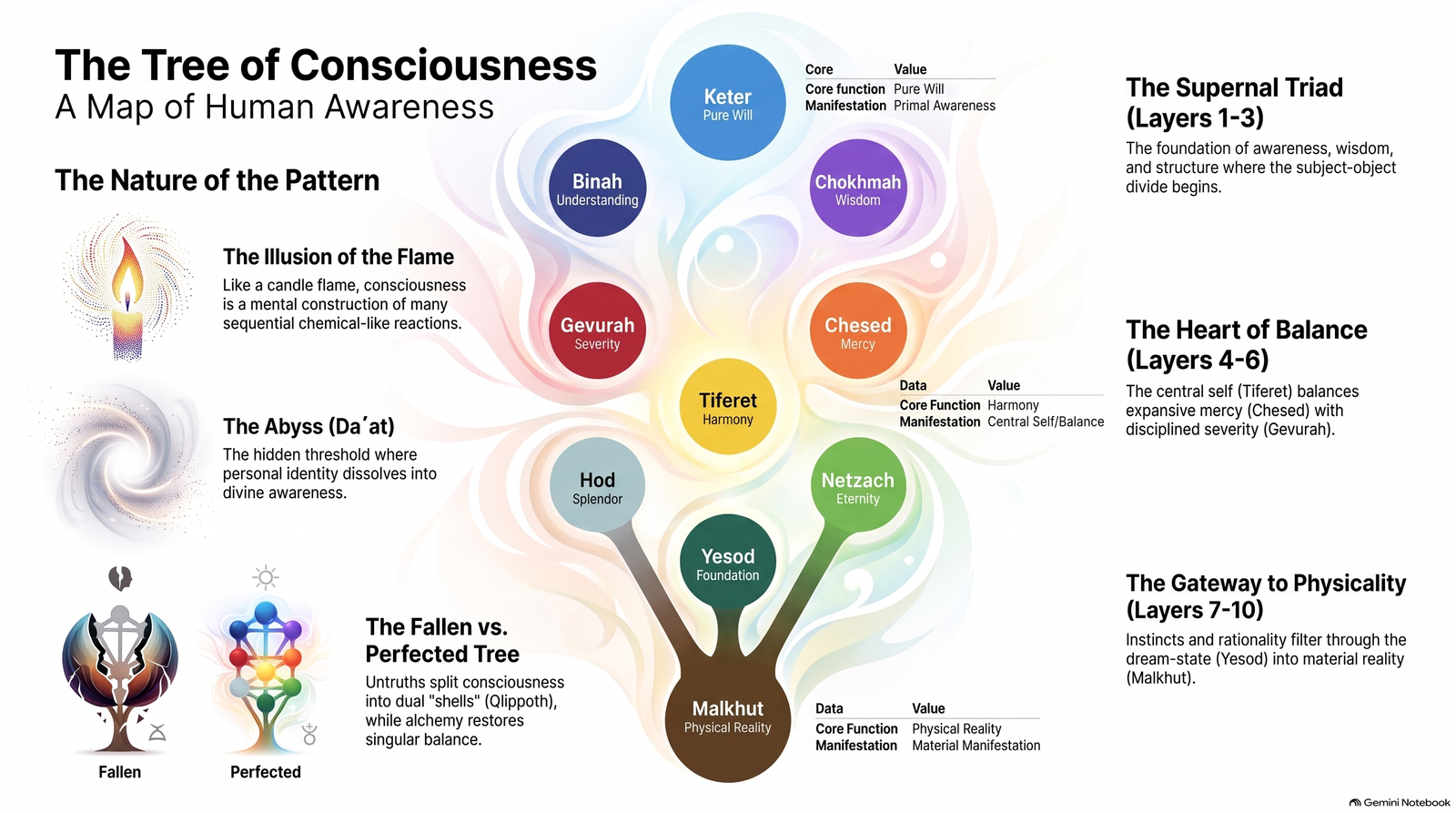
A modern map of the chapter’s Tree
Video guide
How does a seamless “I” arise from a changing pattern?
The recording begins by challenging the intuition that consciousness is a single, unbroken stream. A candle flame appears stable, yet is continually renewed by combustion; in the same way, the chapter treats “consciousness” and “self” as names for patterns rather than independent substances. The blue-cup example then separates raw colour, recognition and practical meaning. This helps the speakers ask how immediate sensing becomes a world of named things, preferences and threats. The analogy is philosophical and contemplative: it does not demonstrate that experience consists of measurable psychic atoms, and the transcript’s citta language belongs to Buddhist analysis rather than contemporary neuroscience.
The Tree of Life provides the recording’s organising image. Keter, Chokhmah and Binah are used for primal awareness, attraction to pattern and the formation of subject and object. Chesed and Gevurah become expansive care and discriminating restraint; Tiferet becomes the balancing centre identified as self. Netzach, Hod and Yesod are then read as drive, retrospective rationalisation and the dream-like foundation of personal identity, while Malkhut marks embodied, material experience. The lampshade metaphor makes these levels concentric rather than a literal ladder. Yet these psychological assignments are selective modern correspondences, not straightforward translations of the sefirot’s meanings in Jewish Kabbalah.
The final movement contrasts three configurations. The “innocent” Tree imagines experience before a hardened division between self and world. The “fallen” Tree appears when deception and self-interest split the central identity, multiplying defensive “shells” and producing the anxious world of survival, status and future threat. The “perfected” Tree does not destroy ordinary functions but restores balance by loosening compulsive self-reference. The transcript intensifies this into a claim that suffering is self-generated and liberation lies within our hands. A more careful reading is that our habits and interpretations contribute to suffering; this does not make every hardship self-caused or place blame upon people facing illness, trauma, poverty or danger.
The recording therefore offers a symbolic diagnostic question rather than a literal cosmology to prove: when feeling, judgement and explanation arrive almost together, can their different functions be noticed? The practical challenge is to use the map provisionally — recognising the pull of affection, defence, impulse and rationalisation — without turning ten evocative symbols into ten hidden organs or a test of spiritual rank.
The course map
Three configurations of one symbolic structure
Innocent Tree Undivided but undeveloped
Nine layers describe a mind not yet fully identified with material vulnerability. The recording associates this with play, fantasy and an early fluidity between awareness and its objects.
Fallen Tree Division, defence and self-interest
The central self splits between inner truth and performed identity. The resulting “shells” symbolise defensive habits, conflict and the multiplying choices of an adult life organised around preservation.
Perfected Tree Integration rather than erasure
Ten functions remain, but the course imagines them in a more harmonious relation. This is its alchemical ideal of reduced duality, not a standard psychological outcome measure or proof of enlightenment.
The Abyss A threshold in the esoteric map
Da’at is presented as a hidden threshold between personal identity and transpersonal awareness. “The Abyss” reflects later Western esoteric usage and should not be assumed to carry one fixed meaning across Kabbalistic traditions.
Keep the languages distinct
What is inherited, adapted and proposed
| Source language | How the recording uses it | Editorial boundary |
|---|---|---|
| Jewish Kabbalah | Ten sefirot, divine emanation, Keter through Malkhut, balance and the Tree | The course’s cognitive “layers” are a modern adaptation, not a comprehensive account of Kabbalistic theology or practice. |
| Hermetic Qabalah | The Tree as a map of universe and psyche; Da’at as Abyss; ascent, fall and integration | These emphases developed within Western esotericism and should not be projected backwards onto all Jewish sources. |
| Buddhist analysis | Citta, momentary awareness, pleasant and unpleasant feeling, conditioned identity and release from clinging | The synthesis combines Theravāda analytical terms with other traditions; it is not itself a recognised Buddhist doctrinal system. |
| Modern psychology | Self/other differentiation, drive, rationalisation, personal identity, childhood play and defensive conflict | These comparisons are explanatory metaphors. The Tree is not a diagnostic model, and the transcript’s developmental claims are not established clinical findings. |
| The course synthesis | Innocent, fallen and perfected Trees; lies splitting the central self; alchemy restoring non-dual balance | This is Dr Robinson’s proposed contemplative architecture and should be assessed as interpretation rather than universal mechanism. |
Argument map
How the recording develops
Question the continuous self
The flame and film-like sequence of experience challenge the assumption that awareness is one enduring inner object.
Separate sensation from recognition
The blue cup illustrates how colour, category, value and action can be distinguished within an apparently immediate perception.
Introduce the layered Tree
Ten sefirot and nine lampshades become a symbolic account of awareness moving from subtle pattern to material experience.
Construct subject and object
The first triad describes awareness taking itself as an object, becoming absorbed in its patterns and forming an inner observer.
Build the personal centre
Care and discrimination generate a balancing self, while drives, explanations and imagination organise its lived world.
Explain the fall into conflict
Deception and self-preservation split identity, turning flexible distinctions into defensive shells and recurrent suffering.
Reframe transformation as integration
The perfected Tree restores balance by reducing compulsive self-reference rather than abolishing perception, reason or embodiment.
Book, video and context
Four layers of the discussion
The written chapter
Defines consciousness as patterned rather than singular, presents ten layers and traces the course’s innocent, fallen and perfected Trees.
The video’s expansion
Adds the high-frame-rate image, the blue cup, the lampshades, a funhouse mirror, everyday arguments and the “internal lawyer” as accessible explanations.
The traditional inheritances
Sefirotic names come from Kabbalah; the Tree-as-psyche and Abyss language reflects Hermetic Qabalah; citta and conditioned experience come from Buddhist analysis.
The original synthesis
The exact ten-layer psychology, the three Trees and the claim that untruth divides Tiferet are the course’s interpretive construction rather than shared doctrine.
Recording outline
The route through the video
The nine valid supplied chapter markers are retained for the 39:49 final recording. A supplied 42:10 marker was excluded because it falls beyond the final runtime.
- 00:00Opening: You Are Not One Mind
- 02:20Consciousness as Pattern (Not a Thing)
- 06:10The Flame Analogy Explained
- 10:30From Single Awareness to Many Layers
- 15:40The Ten Sephirot (Structure of Mind)
- 21:30Subject vs Object (Birth of Self)
- 27:10The Fallen Tree and Duality
- 32:40Conflict, Identity, and Suffering
- 38:20The Perfected Tree (Resolution)
Key language
Glossary
Tree of Life
Sefirah · Sefirot
Keter, Chokhmah and Binah
Chesed, Gevurah and Tiferet
Netzach, Hod and Yesod
Malkhut
Da’at · the Abyss
Qlippoth · Qliphoth · Qlippot
Citta
Pleroma
Demiurge
Innocent, fallen and perfected Trees
Continue into the ideas
Related reading and reference points
Within this course
- 1.3.1. The Great WorkThe preceding chapter introduces the transformative undertaking for which the Trees become a working map.
- 1.3.3 The Golden Middle PathThe next chapter turns from the large-scale Tree towards balance, duality and the practical path through extremes.
- 1.2.4 ConsciousnessProvides the course’s earlier account of citta and the apparently continuous flow of awareness.
- 1.2.5 The Mental FactorsExamines the qualities accompanying consciousness before this chapter enlarges the view to the Tree.
- Object — Part Three of NigredoThe section index for the twelve chapters on paths, realisation and the apparent goal.
External reference points
- My Jewish Learning — What Are the Sefirot?A concise Jewish introduction to the ten sefirot as divine emanations, useful for distinguishing traditional theology from the course’s psychology.
- Reform Judaism — What Is Kabbalah?Places Kabbalah within Jewish tradition and provides a broader context for its concern with God, creation and hidden processes.
- Stanford Encyclopedia of Philosophy — ConsciousnessSurveys the many philosophical meanings and theories of consciousness, clarifying why one symbolic map cannot be treated as settled science.
- SN 22.59 — The Characteristic of Not-SelfAn early Buddhist discourse treating consciousness as impermanent and not-self; it offers canonical context without endorsing the chapter’s cross-traditional Tree.
Grounded reflection
What arrived first: the feeling, the judgement or the story?
Recall one minor moment of friction from an ordinary day — a delayed message, an interruption or a changed plan. Without trying to fit it rigidly to the Tree, distinguish what you first felt, the judgement that followed and the explanation you later gave yourself. Did those elements form one seamless reaction, or can several functions be noticed within it? The exercise is about careful description, not diagnosis or spiritual attainment.