
Nigredo · Object · Chapters 25–36 of 48
Object — Part Three of Nigredo
A map of the apparent object of the Great Work: how conditioned consciousness is assembled, how a path is described, and what Buddhist and alchemical traditions mean by awakening.
Section overview
The Alchemical Path to Enlightenment
A transcript-led journey through all twelve Object chapters, from momentary consciousness and the Trees of Consciousness to the four traditional grades of awakening.
The book
The section in brief
Object turns from Dharma’s analysis of conditioned experience towards maps of practice and realisation. The Great Work, the Trees of Consciousness and the Golden Middle Path establish the comparative framework. The section then examines realms, meditative absorption, path consciousness and the four Theravāda grades from stream-entry to arahantship.
The word object is deliberately unstable here. Awakening appears to be the goal pursued by a seeker, yet the course increasingly asks whether the seeker and goal can remain separate. Alchemical colours, Buddhist attainments and Western esoteric images are placed in conversation as Dr Simon Robinson’s synthesis. They are not historically identical systems or a universal instrument for certifying attainment.
Video guide
Seeing the code behind the apparent world
The recording begins with the Abhidhamma image of consciousness as a rapid sequence of cittas. A candle flame and a blue cup illustrate how separate events of sensing, recognition, memory and feeling can appear to form one continuous world and one continuous self. The analogy is contemplative rather than neuroscientific: it invites attention to construction without proving that experience is literally a film reel.
The discussion widens into the course’s Trees of Consciousness. A Qabalistic descent from undivided awareness to embodied identity becomes a story about duality, deception and defensive “shells”. The bhavaṅga, karma and cosmological realms then supply a Theravāda vocabulary for continuity and disposition. Claims connecting consciousness with iron in the blood, electromagnetic fields or trauma-induced “metaphysical death” belong to the recording’s speculative synthesis, not established physiology.
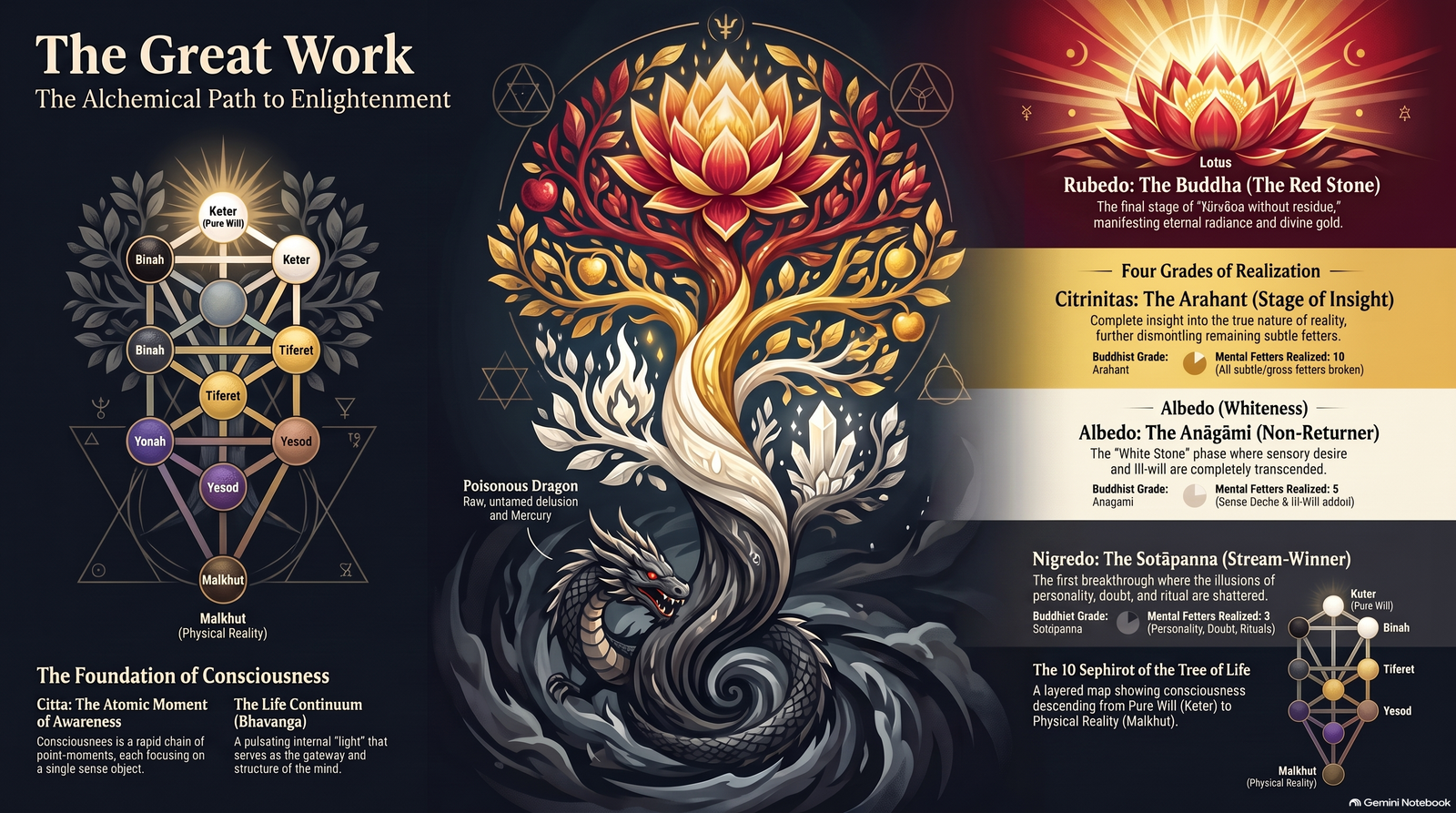
Jhāna and the Golden Middle Path mark a change from description to practice. The video warns that refined states can become objects of attachment, then presents awakening as observation no longer organised around possession or achievement. Its second half follows the four grades: Sotāpanna as a first irreversible reorientation; Sakadāgāmī as weakening of greed, hatred and delusion; Anāgāmī as release from the five lower fetters; and the arahant as freedom from all ten.
The conclusion brings the immense map back to an ordinary pause between stimulus and reaction. That modest exercise is the recording’s most accessible proposal: recognise a conditioned sequence without turning the recognition into a claim about spiritual status.
Argument map
The movement of the overview
Six transitions carry the recording from the construction of ordinary experience to its account of liberation.
Continuity is questioned
Citta, perception and memory are used to show how discrete events can appear as a seamless self and world.
The architecture expands
The Trees of Consciousness describe descent into duality, identity and defensive psychological shells.
Conditioning gains momentum
Bhavaṅga, karma and the realms offer a traditional and speculative account of differing dispositions.
Concentration meets its limit
Jhāna demonstrates the mind’s plasticity, but absorption and extraordinary experience remain possible attachments.
The path becomes irreversible
The first three grades are presented through the progressive ending of the lower fetters.
The reference point falls away
The higher fetters and arahantship carry the map beyond refined identity towards functional, unbound awareness.
Visual synthesis
One course map, several distinct traditions
The overview graphic gathers the section’s main correspondences. Use it as orientation, then return to the chapter guides for definitions and qualifications.
Twelve chapter guides
Follow the Object sequence
Read in order for the full argument, or open the chapter most relevant to your enquiry.
1.3.1. The Great Work
Introduces the philosopher’s stone as an image of transformed consciousness and compares the four alchemical stages with maps of awakening.
Open chapter guide → Chapter 26 of 481.3.2. The Trees of Consciousness
Uses Qabalistic and course-specific trees to explore the emergence of differentiation, identity, duality and defensive structure.
Open chapter guide → Chapter 27 of 481.3.3 The Golden Middle Path
Places the Buddhist Middle Way beside an alchemical movement beyond the divided extremes of virtue and desire.
Open chapter guide → Chapter 28 of 481.3.4. The Four Grades of Realisation
Introduces stream-enterer, once-returner, non-returner and arahant through the progressive abandonment of the fetters.
Open chapter guide → Chapter 29 of 481.3.5. Realms of Existence
Examines traditional Buddhist cosmology, karma and resultant consciousness while distinguishing doctrine from modern psychological analogy.
Open chapter guide → Chapter 30 of 481.3.6. Different Worlds and Jhāna
Explores meditative absorption, refined states and cosmological realms while asking why bliss and unusual experience are not liberation.
Open chapter guide → Chapter 31 of 481.3.7. Path Consciousness
Describes the Theravāda path-and-fruition model, change of lineage and the limits of trying to manufacture an awakening event.
Open chapter guide → Chapter 32 of 481.3.8. Sotāpanna
Studies stream-entry, the first three fetters and the traditional claim that entry into the path has become irreversible.
Open chapter guide → Chapter 33 of 481.3.9. Sakadāgāmī
Considers once-returning through the weakening of greed, hatred and delusion and the course’s imagery of deepened commitment.
Open chapter guide → Chapter 34 of 481.3.10. Anāgāmī
Turns to non-returning, the abandonment of the five lower fetters and the course’s transition from Nigredo towards Albedo.
Open chapter guide → Chapter 35 of 481.3.11. The Subtle Fetters
Examines attachment to form and formlessness, conceit, restlessness and ignorance as the final bonds in the Theravāda map.
Open chapter guide → Chapter 36 of 481.3.12. The Arahant
Closes Object with the ending of all ten fetters, functional consciousness and the distinction the course draws between arahant and Buddha.
Open chapter guide →Clickable video chapters
Navigate the overview
These markers follow the final transcript and fall within the stated duration of 1:01:22.
- 00:00The Apparent Continuity of Experience
- 02:51Citta: The Momentary Mind
- 07:41The Trees of Consciousness
- 12:50Duality, Deception and the Shells
- 16:22Bhavaṅga, Karma and the Realms
- 23:37Jhāna and the Limits of Absorption
- 27:33The Golden Middle Path
- 30:20Sotāpanna: Seeing the Code
- 37:19Sakadāgāmī: The Great Commitment
- 42:08Anāgāmī: The Five Lower Fetters End
- 47:57The Five Subtle Fetters
- 52:37Arahant, Buddha and the Red Stone
- 57:32From the Cosmic Map to Daily Life
Terms for orientation
A compact Object glossary
Open any term for a concise definition and its place in the section’s comparative map.
Citta
A moment or event of consciousness that knows an object in Abhidhamma analysis. Citta arises with mental factors rather than as an isolated substance. The video’s frames, flashes and computer-code comparisons are explanatory analogies, not literal measurements of the brain.
Bhavaṅga
The “life-continuum” of Theravāda Abhidhamma: a series of passive mind moments said to maintain continuity when an active cognitive process is absent. It should not be equated without evidence with an electromagnetic field, a neurological baseline or an eternal soul.
Tree of Life and Qabalah
The ten-sefirah Tree belongs historically to Jewish Kabbalah and was reinterpreted in Christian and Hermetic Qabalah. The course uses a modern esoteric form as a comparative model of consciousness. That use should not be mistaken for a standard Jewish interpretation or a historical source of Buddhist doctrine.
Jhāna
States of meditative absorption or unification taught in Buddhist traditions. Their exact interpretation and relation to insight vary. Bliss, altered perception or unusual capacities do not by themselves establish liberation, and difficult after-effects deserve grounded care rather than automatic spiritualisation.
Path and fruition consciousness
In Theravāda Abhidhamma, supramundane path consciousness directly realises nibbāna and abandons the fetters appropriate to that path; fruition consciousness experiences the corresponding result. This later analytical model is more detailed than the language normally found in early discourses.
The ten fetters
A traditional list of ten bonds divided into five lower and five higher fetters. They organise the four grades of awakening in Theravāda teaching. The list supports study and practice, but it is not a casual checklist for declaring one’s own or another person’s attainment.
Sotāpanna
The stream-enterer, traditionally said to have abandoned identity view, doubt and attachment to rites and observances, and to be assured of eventual full awakening. The assurances concerning rebirth belong to Buddhist doctrine rather than empirical verification.
Sakadāgāmī
The once-returner. Early-text formulations emphasise the ending of the first three fetters and attenuation of greed, hatred and delusion. Later summaries often describe the fourth and fifth fetters as greatly weakened.
Anāgāmī
The non-returner, traditionally said to have abandoned the five lower fetters, including sensual desire and ill will, and not to return to the sensual realm. The course’s lunar, Albedo and “karmic shock absorber” language is interpretive rather than standard Buddhist definition.
Arahant
One who has completed the path and abandoned all ten fetters in Theravāda Buddhism. Functional consciousness describes action that no longer generates new karma; it does not mean biological automatism. Buddhist traditions differ in how they understand arahants, Buddhas and the scope of awakened knowledge.
Nigredo, Albedo, Citrinitas and Rubedo
Colour stages drawn from alchemical traditions and used by this course to organise a modern path of dissolution, purification, illumination and embodiment. Their alignment with Buddhist grades is a contemporary comparative framework, not a correspondence established by all alchemical or Buddhist sources.
Within the course
Related pathways
- Nigredo Part OneThe main landing page for all four sections of the first volume.
- Dharma — Part Two of NigredoThe preceding section supplies the analytical vocabulary for conditioned experience.
- 1.3.1. The Great WorkBegin Object with the philosopher’s stone and the four-stage alchemical map.
- 1.3.12. The ArahantThe final Object chapter considers the course’s apparent goal.
- Subject overview videoThe following section returns from the map to the personal movement through fall, exile and entry into the way.
Beyond the course
External reference points
- Stanford Encyclopedia of Philosophy — AbhidharmaA scholarly introduction to Buddhist analytical systems, their histories and their accounts of momentary experience.
- AN 10.13 — FettersA concise early Buddhist list of the five lower and five higher fetters.
- AN 3.86 — TrainingAn early-text account distinguishing the stream-enterer, once-returner, non-returner and arahant.
- MN 64 — The Longer Discourse with MāluṅkyaA primary source on the five lower fetters and the path for giving them up.
A question to carry forward
Can you notice construction without constructing an attainment?
Choose one ordinary reaction: defensiveness, craving, comparison or the urge to escape discomfort. Before explaining it, see whether you can distinguish raw sensation, feeling tone, recognition, memory, impulse and the story of “me” that gathers around them.
The exercise is not a test of spiritual status. Let the map remain provisional. Its value lies in whether it makes one conditioned sequence a little easier to see and one response a little less automatic.