
Albedo · Mythos · Chapter 3 of 48
2.1.3. Rebirth and Saṃsāra
If no permanent self passes from life to life, what—within Buddhist accounts of rebirth—continues?
Watch the chapter discussion
What Continues After the Self?
Book orientation
The chapter in brief
This chapter asks how Buddhist traditions can speak of karmic continuity and rebirth while denying a permanent soul. Its principal vocabulary comes from later Theravāda Abhidhamma and commentarial analysis: active cognitive processes alternate with bhavaṅga, the life-continuum, while paṭisandhi-citta names the rebirth-linking moment at the beginning of a new life. The course interprets this model alchemically, treating the human condition as a rare opportunity to observe and loosen craving, aversion and ignorance. Traditional claims about past and future lives remain religious and philosophical teachings rather than scientifically verified descriptions of what happens at death.
Transcript-led guide
From the silent operating system to the wheel of becoming
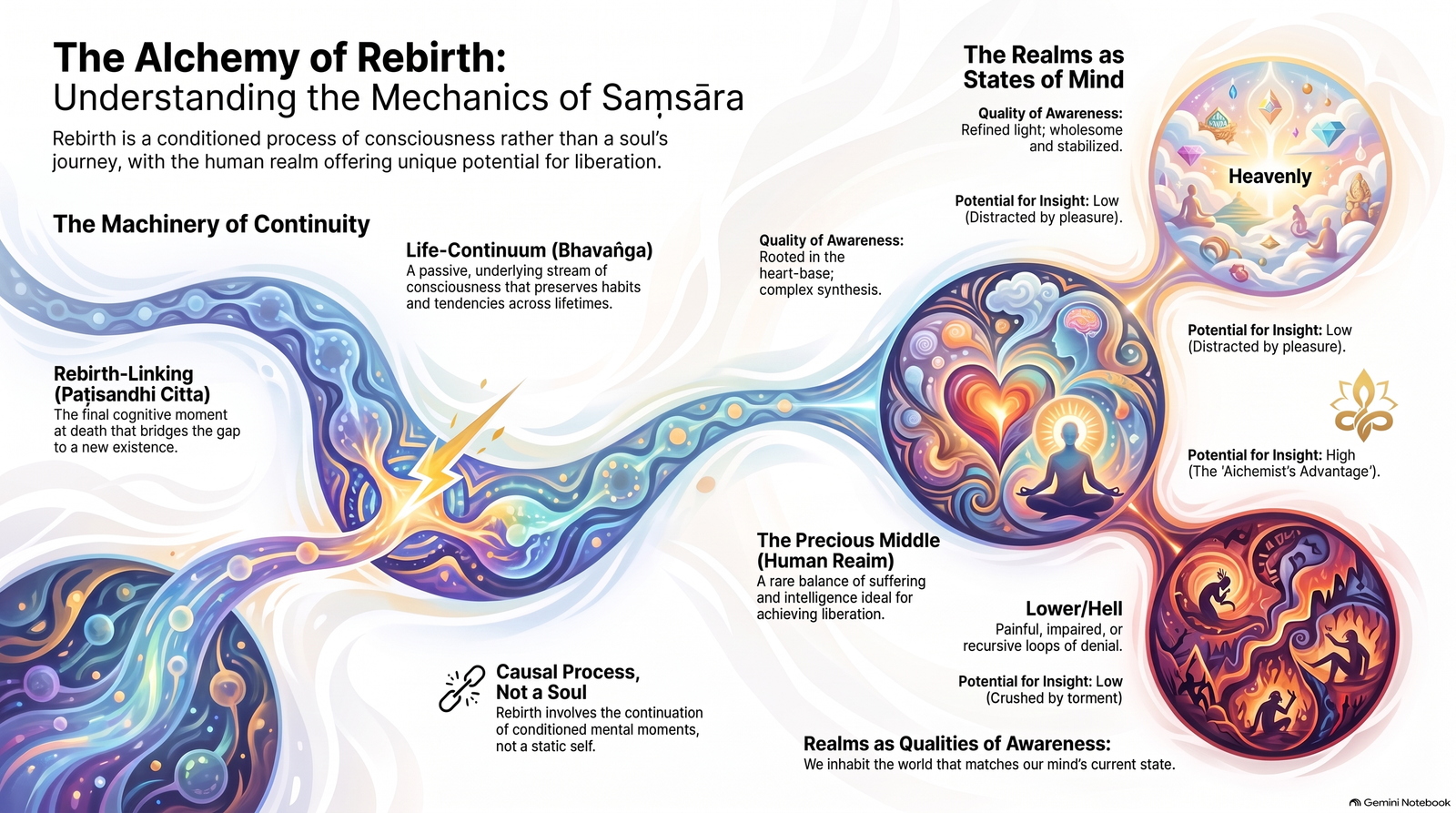
The recording opens with a smartphone whose dark screen conceals processes still running beneath it. This becomes an analogy for bhavaṅga: in a specifically Theravāda scholastic model, active sense and mind processes are punctuated by passive life-continuum moments that help explain continuity within a lifetime. The comparison makes a difficult system approachable, but bhavaṅga is not an eternal witness, a pristine field behind experience or an experimentally identified neural state. It remains a conditioned series of mental events.
The central puzzle follows directly. If Buddhism rejects an enduring self, who or what is reborn? The video answers with causal continuity rather than personal substance. Its relay-race image describes one conditioned process giving rise to another without a soul travelling between bodies. Within the traditional model, the final cognitive process of one life conditions a rebirth-linking consciousness in another. The language of transferred energy in the recording is metaphorical: the doctrine does not require a measurable physical energy to leap from one organism to another.
The discussion then places craving, aversion and ignorance at the centre of saṃsāra. Actions and repeated dispositions shape future experience; the video therefore treats the final object of a dying mind not as an isolated cosmic lottery but as the culmination of habits rehearsed through life. Later Theravāda accounts are more nuanced than a single last thought determining everything: weighty, death-proximate, habitual and residual karma are assigned different priorities. The broader ethical point survives the qualification—what is practised repeatedly matters.
The final movement surveys hell, animal, human, heavenly and formless rebirths before returning to the “precious middle” of human life. Traditional Buddhist cosmology generally presents these as modes or destinations of rebirth, while the course also reads them phenomenologically as qualities of awareness visible now. Those readings may illuminate one another, but they are not identical. The video’s account of hell as recursive denial, the heart-base as emotional-intellectual synthesis and the realms as matched inner frequencies belongs to its modern alchemical interpretation rather than to a single uncontested Buddhist doctrine.
Argument map
How the video develops its case
Question the solid self
The inquiry begins by contrasting an apparently continuous identity with a rapidly changing stream of conditioned experience.
Introduce the life-continuum
Bhavaṅga supplies the later Theravāda model with continuity between active cognitive processes without becoming a hidden soul.
Replace substance with conditions
Rebirth is presented as causal succession: neither the same person nor an entirely unrelated one continues.
Trace the karmic momentum
Craving, aversion and ignorance repeatedly shape intention, habit and the worlds through which experience is interpreted.
Survey modes of rebirth
The realms show different traditional results of conditioning, while the course also uses them as mirrors for present qualities of mind.
Return to practice now
Human life becomes the laboratory in which repeated reactions can be noticed and the manufacture of further bondage weakened.
Book, tradition and video
Three layers of the material
The chapter establishes
A concise model of continuity, karmic conditioning, rebirth-linking consciousness and the human opportunity for liberation.
The video expands
Smartphone, carrier-wave, relay-race and endless-staircase analogies that translate a dense scholastic account into lived questions.
The synthesis proposes
Realms as both cosmological teachings and present qualities of awareness. This psychological-alchemical reading is interpretive, not a universal Buddhist consensus.
Video chapters
Follow the discussion
- 00:00The Roots of Being: Beyond the Static Self
- 04:15The Mechanics of Continuity: Understanding the Bhavaṅga
- 09:30Rebirth vs. Soul: The Causal Process
- 14:45The Wheel of Saṃsāra & Karmic Momentum
- 19:20The Alchemist’s Advantage: The Precious Human Birth
- 24:05Paṭisandhi Citta: How Rebirth-Linking Consciousness Works
- 28:50Realms of Awareness: From Hell States to Heavenly Light
- 35:10The Formless Dead-Ends vs. True Awakening
- 39:45Closing: Ending the Movements that Forge the Chain
Working vocabulary
Glossary
Saṃsāra
Anattā / not-self
Bhavaṅga
Paṭisandhi-citta
Kamma / karma
Hadaya-vatthu
Three wholesome roots
Jhāna
Saṃyojana
Anāgāmī
Continue within the course
Related pathways
- Mythos | Albedo | Spiritual Alchemy CourseThe section landing page for all twelve chapters in The Deconstruction of Narrative.
- 2.1.2. The CosmosThe preceding chapter introduces the fourfold map of sensory, form, formless and supramundane consciousness.
- 2.1.4. Hell and Hell BeingsThe next chapter examines hell imagery, painful modes of existence and the course’s interpretation of recursive suffering.
- 2.2.6. The Life ContinuumA dedicated treatment of bhavaṅga, active cognitive processes and continuity without a permanent observer.
- 2.2.10. Types of KarmaDevelops the later Theravāda hierarchy of weighty, death-proximate, habitual and residual karma.
- 1.2.8 SaṃsāraThe earlier Nigredo chapter introduces conditioned wandering, repeated identification and the cycle this Albedo chapter analyses more technically.
Reference points
Texts and distinctions
- Dhammapada 116–128: Bad ConductIncludes verse 127, the chapter’s warning that the consequences of harmful deeds cannot be escaped by changing location.
- Dhammapada 157–166: The SelfIncludes verse 165 on personal responsibility for harmful action, purification and the limits of another person’s power to purify us.
- Dīgha Nikāya 15: The Great Discourse on CausationAn early Buddhist account of dependent origination, consciousness, name-and-form and the conditions sustaining continued becoming.
- Majjhima Nikāya 136: The Great Analysis of DeedsA canonical warning against simplistic conclusions about action, character, the timing of results and destinations after death.
- Stanford Encyclopedia of Philosophy: AbhidharmaScholarly context for Buddhist analytical traditions and the difference between early discourses and later systematic accounts of mind and causation.
A grounded reflection
What are you rehearsing?
Choose one recurring reaction from ordinary life—perhaps defensiveness, grasping, generosity or patience. There is no need to speculate about a past or future life.
- Recall one recent situation in which the reaction appeared.
- Notice the trigger, the feeling tone and the story that made the response seem necessary.
- Ask what became easier to repeat because this response was enacted.
- Imagine one modest alternative you could rehearse the next time similar conditions arise.
The exercise tests the chapter’s practical claim about habit and consequence in experience available now; it neither proves nor disproves traditional rebirth.