
Albedo · Object · Chapters 25–36 of 48
2.3. Object
The Nature of Reality
Seeing through a familiar self-image can bring clarity—and offer the materials for a subtler identity built around insight itself.
Section overview video
How Your Ego Turns Insight Into Identity
This two-host, AI-generated discussion interprets the Object section of the book. The guide below follows the supplied final transcript and distinguishes the author’s symbolic framework from historical, doctrinal and clinical claims.
Book orientation
The section in brief
Object is the third of Albedo’s four sections, comprising chapters 25–36. Its inquiry moves from the loss of familiar motivations towards a less possessive relationship with experience. Hollowness opens the sequence; the Beast, the Watcher and Māra give symbolic form to conditioning, resistance and spiritual pride. Brahma’s Chariot brings kindness, compassion, appreciative joy and equanimity into the discussion. The dark night, crucifixion and death of the self explore relinquishment through the author’s comparative framework. The final four chapters turn towards ordinary duties, the social effects of reduced reactivity, the temptation of feeling appointed, and the provisional relief of being a tourist. These correspondences belong to Dr Simon Robinson’s interpretive synthesis: they do not establish a shared initiation system across Buddhism, Christianity, Kabbalah and Western esotericism.
Transcript-led guide
What happens when clarity becomes “my” achievement?
The recording opens with an X-ray analogy: a broken bone can be located, but the problem of spiritual self-importance resists such a simple picture. Its central question is how an experience that loosens identification can be appropriated as a new identity. Rather than covering all twelve chapters equally, the discussion develops this question chiefly through the first eight, from Hollowness to The Death of the Self. Its language of machinery and diagnosis is an organising metaphor, not a clinical assessment tool.
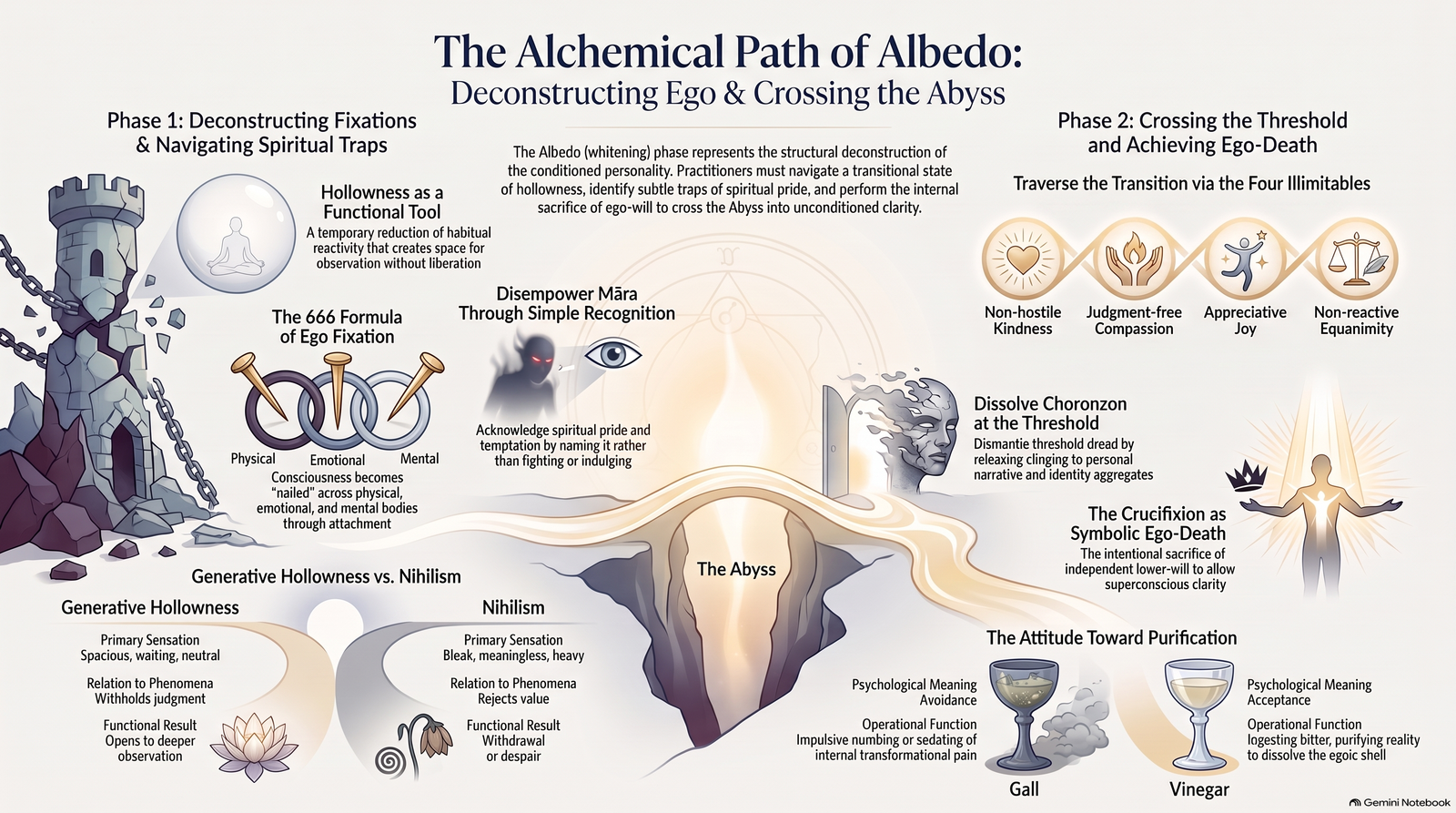
Hollowness first describes the interval in which familiar wants and aversions lose some of their authority. The recording warns against turning that quietness into either nihilistic withdrawal or the claim to be a serene observer. It then reads Revelation’s Beast and 666 as images of identification with bodily sensation, emotion and thought. The Watcher introduces restraint, while the Abyss and Choronzon dramatise fear and resistance. These are the course’s symbolic translations. Difficult psychological material is not thereby explained, and distress does not demonstrate that a necessary spiritual threshold is being crossed.
Brahma’s Chariot changes the emphasis from confrontation to the four immeasurables. Compassion and appreciative joy broaden concern beyond personal advantage; equanimity is distinguished from indifference. An apple illustrates the difference between a useful name and the assumption that its referent possesses an independent, permanent essence. The recording then returns to its central danger through Māra: an experience of clarity becomes ownership, ownership becomes a story of specialness, and that story hardens into a role. This “capture loop” is an interpretive account of self-importance, rather than a complete explanation of abusive teaching or a biological immune mechanism.
The closing movements ask whether even cherished spiritual ideals can be held provisionally. Dark-night language and an alchemical reading of the crucifixion explore that challenge; meaningful coincidences are considered alongside the temptation of destiny. Neither coincidences nor suffering establish attainment. The final warning concerns naming emptiness as a new essence—becoming “the witness” or “the void”. The ramp metaphor gathers the argument: a map has value insofar as it helps clarify experience, and can become another burden when used to certify who we are. The practical question is whether understanding makes everyday conduct more considerate and accountable, or simply makes a self-image more elaborate.
Symbolic maps are not diagnostic tests
Seven conceptual movements
The movement of the recording
Lose the familiar fuel
Hollowness raises the question of how to act when familiar motivations no longer settle every choice.
Avoid an identity made of absence
Quietness can be claimed as superiority, turning an interval of relief into apparent completion.
Make conditioning visible
The Beast, the Watcher and the Abyss translate fixation and resistance into the author’s symbolic vocabulary.
Broaden the response
The four immeasurables offer a language of care and balance alongside the inquiry into constructed objects.
Recognise the capture loop
Māra names the appropriation of insight into ownership, exceptionalism and a spiritual role.
Question the highest attachments
Dark-night and crucifixion imagery extend the inquiry to ideals, meaning and the temptation of destiny.
Let the map remain provisional
The conclusion asks whether even the concept of emptiness has become another definition of oneself.
Book, recording and inherited symbols
The book’s wider arc
Chapters 25–36 continue beyond identity’s dismantling into routine, service and the warning that relief is not completion. Those final chapters are available in the directory below; the overview does not give them separate, sustained treatments.
The recording’s emphasis
The discussion expands the earlier chapters with operating-system, immune-response and ramp analogies. These clarify its argument rhetorically; they are not scientific evidence for a measured mechanism of awakening.
Traditions retain their meanings
The four immeasurables and not-self have Buddhist contexts. John of the Cross writes about purification towards union with God. Revelation’s beasts have an apocalyptic context; the author’s psychological and numerical correspondences are additional readings.
A visual map of the author’s model
Video chapters
Use the supplied final chapter markers to revisit a movement in the discussion. Each link opens the individual recording at that point.
- 00:00The machinery of identity
- 03:07Hollowness and the loss of familiar motivations
- 08:23When emptiness becomes a new identity
- 10:09The beast as a map of personality
- 12:32An alchemical interpretation of 666
- 15:09The watcher: observing habitual reactions
- 16:49The abyss and difficult psychological material
- 20:29Brahma’s chariot: the four immeasurables
- 24:35Equanimity and the construction of objects
- 26:51Māra and the spiritual ego
- 28:51How insight becomes identity: the capture loop
- 32:23Refusing to build a self-image from experience
- 33:20The Dark Night of the Spirit
- 35:20Synchronicity and the temptation of destiny
- 36:10The crucifixion as an alchemical allegory
- 40:25Non-self and the trap of naming emptiness
- 42:33Discarding the map
- 43:34Final reflection: another spiritual identity?
Read in sequence or follow a question
The twelve Object chapters
Book chapters 25–36 correspond to course pages 2.3.1–2.3.12. Follow the sequence, or choose the chapter most relevant to your question. Each established page has its own chapter recording.
2.3.1. Hollowness
A working absence of familiar reinforcement, with a warning against mistaking quietness for completion.
2.3.2. The Beast
Revelation’s imagery reread as a symbolic map of fixation and conditioned personality.
2.3.3. The Watcher of the Abyss
The Abyss and Choronzon within the author’s account of resistance and relinquishment.
2.3.4. Brahma’s Chariot
Kindness, compassion, appreciative joy and equanimity as the section’s balancing qualities.
2.3.5. Mara
The appropriation of insight into pride, fascination and spiritual self-image.
2.3.6. The Dark Night of the Spirit
The relinquishment of cherished ideals through the author’s comparative dark-night framework.
2.3.7. The Crucifixion
Gospel imagery interpreted as an alchemical allegory of surrender rather than a universal historical explanation.
2.3.8. The Death of the Self
Non-self, the erosion of identification and the temptation to give emptiness a new identity.
2.3.9. Chop Wood, Carry Water
Ordinary responsibilities and routine as the setting for integration.
2.3.10. Thaumaturgy
“Wonder-working” reframed through reduced provocation and the interruption of escalating conflict.
2.3.11. The Appointed
The danger of turning a place on a spiritual map into a claim of exceptional status.
2.3.12. Tourist
Relief, provisional detachment and the warning that a reprieve is not the completion of the work.
Terms for careful listening
Albedo and Object
Hollowness and the once-returner
Ego and spiritual identity
Skandhas / khandhas · the five aggregates
Skandha demons and nyam
The Beast, 666 and gematria
The Abyss, Daʿat and Choronzon
The four immeasurables / brahmavihāras
Equanimity and emptiness
Māra and the capture loop
Dark night and ego death
Synchronicity and the ramp
Anattā and the trap of positive ontology
Related pathways
- Albedo – Part TwoThe four sections and Object’s place in the volume.
- Dharma — Part Two of Albedo | Spiritual Alchemy Course | Dr Simon RobinsonThe preceding section’s account of intention, conditioning and perception.
- 2.3.1. HollownessBegin with the interval between familiar motivation and emerging discernment.
- 2.3.5. MaraStudy the capture of insight into specialness in more detail.
- 2.3.9. Chop Wood, Carry WaterFollow the book beyond the overview into ordinary responsibilities.
- 2.3.12. TouristRead the section’s closing warning about relief and completion.
External reference points
These are reading companions for checking context and evidence boundaries; inclusion does not mean that every source is quoted in the recording.
- SN 22.59 · The Not-self Characteristic · Thanissaro BhikkhuA primary Buddhist discourse examining the aggregates and their appropriation as self; a point of comparison for the recording’s broader ego language.
- MN 7 · The Simile of the Cloth · Nyanaponika TheraA primary discourse describing the boundless cultivation of loving-kindness, compassion, joy and equanimity without presenting them as an esoteric crossing procedure.
- Revelation 13 and Matthew 27 · USCCBRevelation and its notes retain the apocalyptic and Roman-imperial context of the Beast and 666. Matthew 27 lets readers distinguish the Gospel narrative from the course’s added numerical and psychological correspondences.
- John of the Cross · Dark Night of the Soul · CCELThe primary Christian work places the nights of sense and spirit within its theological setting. The course’s soul-versus-spirit contrast is a reinterpretation, not the original taxonomy.
- NHS · Depression in adultsClinical guidance relevant to the opening discussion: persistent loss of enjoyment and motivation deserves assessment rather than exclusion on the basis of a spiritual interpretation.
A question to carry forward
When a useful insight makes you feel more certain about yourself, does it also make you more willing to listen, revise a judgement or take responsibility for a mistake?
Let one ordinary interaction provide the example. There is no need to decide on an attainment, dismantle a self-image or pursue an uncomfortable state. A small, considerate action is enough to give the question practical meaning.