
Albedo · Dharma · Chapters 13–24 of 48
2.2. Dharma
The Mechanics of Reality: how conditioned perception becomes a convincing world, and how intention shapes our response to it.
The section overview
How Your Mind Makes Reality Feel Solid
The AI-generated, two-host discussion interprets the course’s material. Read it alongside the distinctions below, then follow the individual chapter guides for greater depth.
Book orientation
The section in brief
Dharma is the second of Albedo’s four sections, spanning book chapters 13–24 and course pages 2.2.1–2.2.12. It moves from the felt solidity of perception to the distinctions between intention, karmic result and functional consciousness. The inquiry asks how experience becomes habitual, and what changes when an impulse is recognised before it governs action.
Dr Simon Robinson brings Theravāda Abhidhamma, Yogācāra accounts of consciousness and alchemical imagery into his own interpretive framework. The later chapters extend the inquiry through wholesome action, cognitive processes, classifications of karma and traditional awakening maps, concluding with the Anagāmī. These traditions are placed in conversation rather than treated as interchangeable systems. The overview video offers a selective entrance to the section; the chapter directory below preserves its complete twelve-part structure.
A guide to the recording
Where does perception become a command?
The recording begins with a desk: its resistance seems to confirm a world of separate, stable things. The hosts then ask how much of that apparent stability belongs to the encounter itself, and how much comes from recognition, memory and expected use. Their JPEG analogy suggests that practical labels compress a richer field of experience. It is an explanatory image, not an established description of a brain algorithm. The question concerns how reality is experienced; the discussion does not demonstrate that thought creates physical objects or that ordinary objects cease to exist.
From there, the elemental cascade pictures experience moving from openness through movement, transformation and cohesion into solidity. The book explicitly treats these elements as experiential metaphors rather than physics. This becomes a question about agency: if perception and reaction are conditioned, is change possible? The contrast between fate and conditionality makes forethought the practical hinge. A pause, a different interpretation or a better supporting condition can matter without settling the philosophical debate over determinism and free will. The recording also introduces Buddhist stages of freedom, but noticing an impulse is not a test for stream-entry or non-returning.
The middle of the discussion offers two different Buddhist maps. Its office-building analogy represents Yogācāra’s sensory consciousnesses, conceptual thought, self-appropriation and storehouse consciousness. Its fourfold classification of wholesome, unwholesome, resultant and functional consciousness comes from Theravāda Abhidhamma. The hosts connect these maps through intention: what is received and what is enacted need not be treated as the same event. This is a useful organising distinction, provided it is not turned into a rigid sequence in which all feeling is neutral and volition appears only afterwards.
The final movement examines habitual echoes, bhavaṅga and traditional rebirth accounts before distinguishing greed, aversion and delusion. The sandwich example illustrates conditioning; it cannot establish that anxiety is technically vipāka. Likewise, the child-and-adult theft comparison cannot justify a general ranking of karmic blame. The ending asks for observation without guilt: recognise a pattern without making it an identity, then consider a less harmful response. The ethical challenge remains ordinary and concrete—what will this next action reinforce? Kindness, restraint and repair remain valuable; the language of liberation does not make responsibility optional.
The argument in seven movements
Question the solidity
A familiar desk opens the distinction between practical recognition and the changing conditions of an encounter.
See the work of labels
The compression analogy asks what familiarity makes easy to navigate and easy to overlook.
Make fixation visible
The symbolic elemental cascade pictures experience hardening into something apparently fixed.
Locate practical agency
Forethought reframes freedom as a capacity to influence a response within conditions.
Separate the maps of mind
The office analogy and fourfold classification offer different ways to examine reception, interpretation and appropriation.
Distinguish intention from its effects
Volition, habitual echoes and life-continuum imagery explore action and continuity without establishing a single empirical mechanism.
Recognise without condemnation
The taxonomy of unwholesome consciousness leads to a less personal account of impulses while retaining ethical responsibility.
Book, recording and interpretation
The book’s full scope
Chapters 13–24 develop perception, agency, types of consciousness, volition, results, continuity, ethical roots, cognitive processes, karma and awakening maps.
The recording’s emphasis
The overview concentrates on chapters 13–19, using everyday analogies to connect perception and reaction. Chapters 20–24 receive less coverage and are best followed through their own guides.
The author’s synthesis
Alchemical purification links the different accounts. Their correspondences are interpretive proposals, rather than an official doctrinal synthesis or scientific validation.
A visual companion: result and response
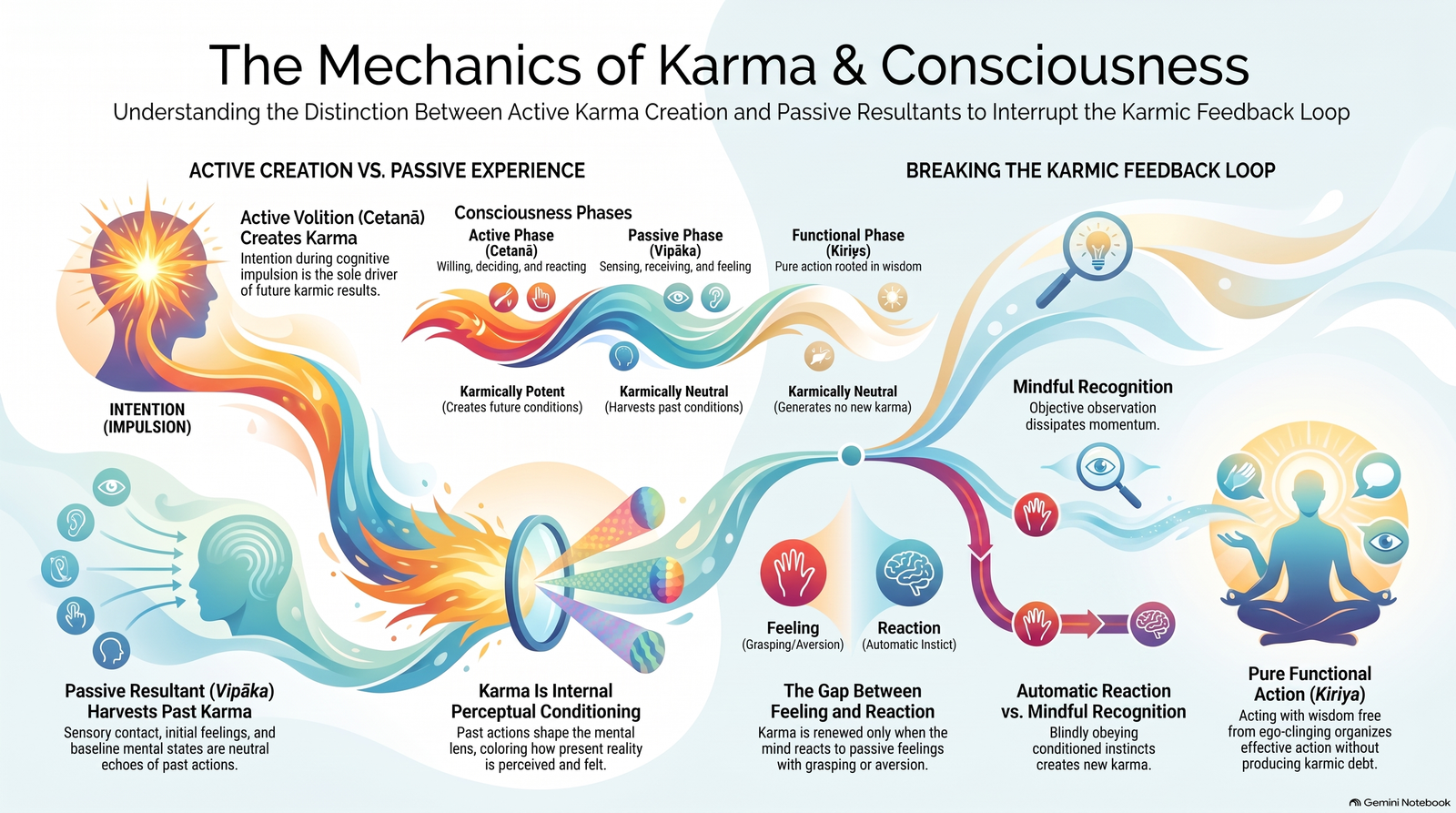
Video chapters
Chapter markers supplied for the finished 41:11 recording. Each link opens the overview at that point.
- 00:00Why reality feels solid
- 02:27Perception, labels and the compression analogy
- 04:59Emptiness and conditioned perception
- 07:49The symbolic elemental cascade
- 10:49Conditionality, fate and human agency
- 13:30Forethought: creating space before reaction
- 16:30Buddhist stages of freedom
- 18:38Sense doors and the eight consciousnesses
- 22:54Four categories of consciousness
- 24:48Intention and the creation of karma
- 26:56Ignorance, restraint and karmic weight
- 29:51Resultant consciousness and habitual echoes
- 31:41Bhavaṅga, continuity and rebirth
- 34:36Mapping greed, aversion and delusion
- 38:28Observation without guilt
- 39:44Closing: interrupting the feedback loop
Read in sequence or follow a question
The twelve Dharma chapters
Book chapters 13–24 correspond to course pages 2.2.1–2.2.12. These are the established chapter guides, each with its own recording.
2.2.1. The Crystal Universe
Perceptual clarity, conceptual overlays and the symbolic elemental cascade.
2.2.2. Fate and Determinism
Conditionality, the idea of fate and the possibility of forethought.
2.2.3. Different Types of Consciousness
Sense doors, Yogācāra’s eight consciousnesses and Abhidhamma categories.
2.2.4. Volition
Intention as the focus of karmic action and ethical discernment.
2.2.5. Resultant Consciousness
The author’s distinction between receiving an effect and renewing a response.
2.2.6. The Life Continuum
Bhavaṅga and continuity within traditional Theravāda analysis.
2.2.7. Unwholesome Karma
Greed, aversion and delusion in the twelvefold unwholesome classification.
2.2.8. Wholesome Karma
Generosity, goodwill and wisdom, alongside the distinction between virtue and liberation.
2.2.9. The Cognitive Series
The traditional cognitive process and its impulsion phase.
2.2.10. Types of Karma
Traditional classifications of karmic priority, especially in accounts of rebirth.
2.2.11. Transcendental Consciousness
Path and fruit consciousness in the Theravāda awakening map.
2.2.12. The Anagāmī
Non-returning, the five lower fetters and the limits of attainment claims.
Terms for careful listening
Dharma / Dhamma
Abhidhamma / Abhidharma
Emptiness · śūnyatā / suññatā
Yogācāra and ālaya-vijñāna
Manas · self-appropriation
Citta and cetanā · consciousness and volition
Kusala and akusala · wholesome and unwholesome
Vipāka · resultant consciousness
Kiriya · functional consciousness
Bhavaṅga and paṭisandhi · continuity and rebirth-linking
Javana and citta-vīthi · impulsion and cognitive process
Sotāpanna, Anagāmī and arahant
Vedanā · feeling tone
Wrong view and karmic weight
Related pathways
- Albedo – Part TwoThe volume’s four sections and the place of Dharma within the wider course.
- Mythos | Albedo | Spiritual Alchemy Course | Dr Simon RobinsonReturn to the symbolic narratives that precede this section.
- 2.2.4. VolitionFollow the overview’s central hinge into the dedicated chapter on intention.
- 2.2.5. Resultant ConsciousnessRead the author’s result-and-response distinction alongside its technical limits.
- 2.2.9. The Cognitive SeriesExplore the traditional process map beyond the overview’s introductory treatment.
- Object — Part Three of Albedo | Spiritual Alchemy Course | Dr Simon RobinsonContinue to the question of how insight itself can become another identity.
External reference points
These sources clarify the traditions and the boundaries of the course’s interpretation. They are reading companions, not a claim that every linked text appears in the recording.
- AN 6.63 · Nibbedhika Sutta · translated by Thanissaro BhikkhuA primary discourse locating karma in intention and distinguishing action from its results.
- SN 36.21 · Sivaka Sutta · translated by Thanissaro BhikkhuA direct counterweight to attributing everything felt entirely to past action; it recognises several causes of painful experience.
- A Comprehensive Manual of Abhidhamma · introductionU Rewata Dhamma and Bhikkhu Bodhi explain the Theravāda system’s philosophical, psychological and ethical scope, rather than presenting it as modern laboratory science.
- Nārada Mahā Thera · A Manual of Abhidhamma · PDFA traditional translation and explanation of the Abhidhammattha Saṅgaha for checking the detailed consciousness categories, mental factors and cognitive processes.
- Asaṅga · The Summary of the Great Vehicle · BDK editionThe publisher’s page for John P. Keenan’s translation of a major Yogācāra text, including a free PDF route; useful for separating this tradition from Theravāda Abhidhamma.
A question to carry forward
Think of one ordinary, manageable moment when an expectation shaped your response: a delayed reply, a misplaced object or a difference of opinion. What did you actually know, what did you assume, and what small act of checking or kindness would have helped?
There is no need to uncover a hidden cause or decide on a spiritual stage. Let the distinction serve one practical choice. If the example feels distressing, leave it and return to something ordinary.