
Dialogues IV · Episode 13
Cain, Abel and the Psychology of Shame | Dialogues IV
What if shame is neither proof of badness nor a guaranteed path to growth, but the dangerous moment when the self becomes visible to itself?
The central question
Can a divided self become wiser without treating its wounds as proof of progress?
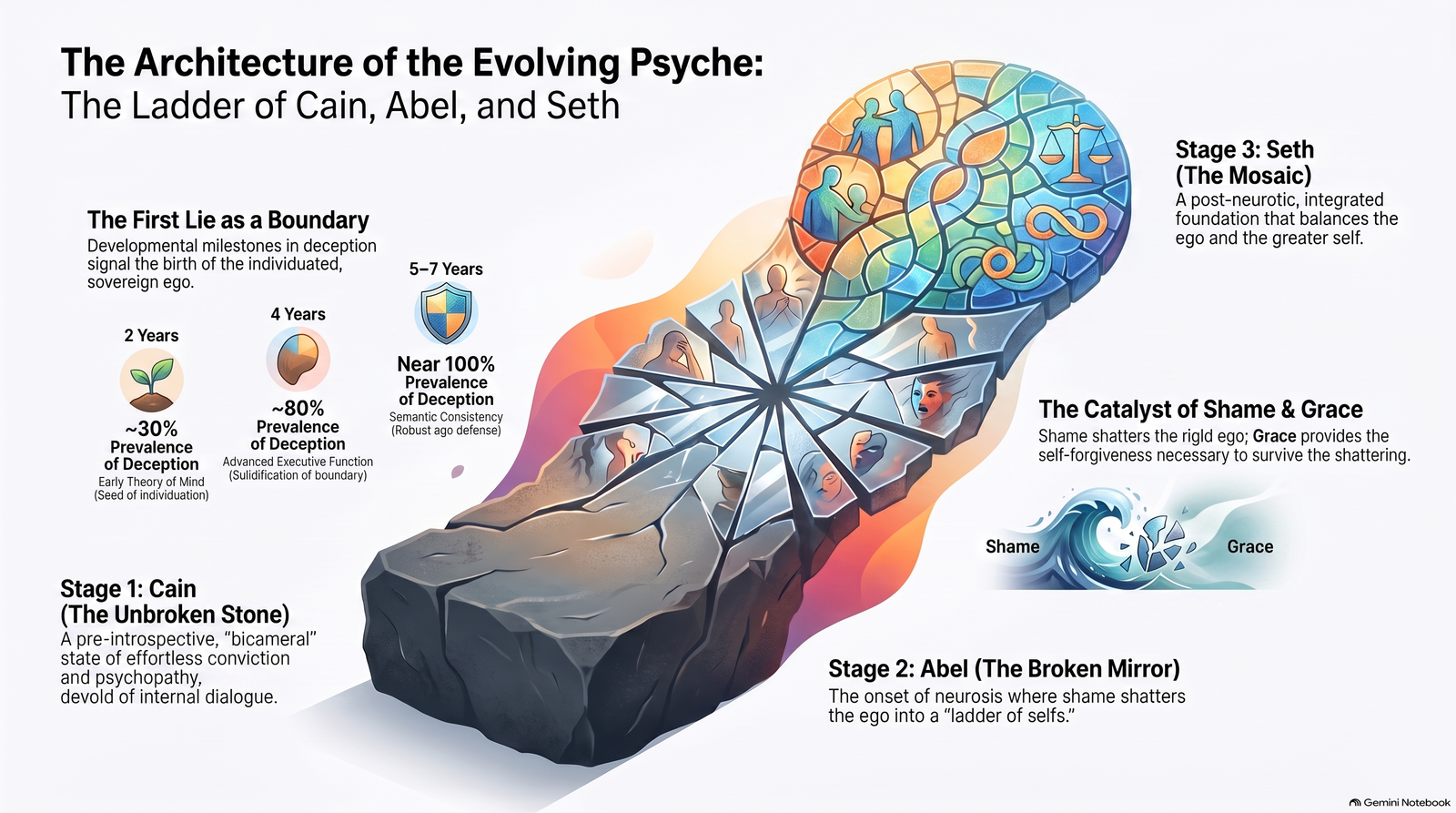
This episode reads Cain, Abel and Seth as three images of psychological organisation rather than as a simple moral division between villain, victim and replacement heir. Abel first appears as hevel—breath or vapour—an image for the permeable early self. Cain becomes the bounded, self-authorising ego: the unbroken stone. Shame fractures that solidity into a self capable of seeing and judging itself. Seth is then imagined as the mosaic, a more deliberate integration made from what has been broken.
The first lie supplies the discussion’s developmental hinge. Research does associate children’s developing capacity to deceive with theory of mind and executive function: a child must represent what another person knows, inhibit a truthful response and maintain competing accounts. Yet lying does not mark one exact scientific instant at which an ego is born, nor does the ability itself diagnose character. The episode uses it symbolically as evidence that an inner space can now be withheld from another mind.
From there, the inquiry brings several very different frameworks into conversation. Julian Jaynes’ controversial bicameral-mind hypothesis provides an image of action without introspective dialogue. Kazimierz Dąbrowski’s Theory of Positive Disintegration asks whether the loss of a stable but relatively automatic organisation can sometimes permit a more self-authored hierarchy of values. Sartre’s analysis of the Look describes the shock of encountering oneself as an object in another person’s world. Jungian language then frames integration as a changed relationship with disowned traits rather than their erasure.
The dramatic sequence—vapour, stone, shattered mirror, mosaic—is the episode’s own synthesis. Its strongest insight is not that shame is inherently beneficial. Shame may promote reflection, but it can also immobilise, isolate and intensify distress. The decisive possibility named here as grace is the capacity to acknowledge a harmful act or limitation without turning it into a total verdict on the person. Integration begins when responsibility and self-forgiveness can coexist.
How to read this episode: the Cain–Abel–Seth ladder is a contemporary symbolic interpretation, not the established meaning of Genesis or a validated developmental sequence. Children’s deception develops gradually and is related to—but not reducible to—theory of mind and executive function. Jaynes’ historical account remains contested; Dąbrowski’s levels are a theoretical and heuristic model, not a diagnostic scale. “Psychopathy” is a clinical and forensic construct and should not be used as a synonym for confidence, selfishness, low shame or the absence of inner dialogue. Anxiety, shame, depression, dissociation and inner conflict are not reliable signs of growth or spiritual development, and significant distress may require appropriate professional support.
Argument map
Seven movements from permeability to integration
Abel begins as vapour
The younger brother’s name becomes an image of the early, permeable self: responsive to its carers and environment, but not yet securely experienced as a private inner domain.
A secret draws a boundary
To deceive, a child must begin to distinguish their knowledge from another person’s knowledge. The episode treats this psychological privacy as a symbolic threshold, not a moral fall.
Cain becomes the stone
The bounded self can act, acquire and authorise itself. Its strength provides agency, but when certainty becomes impermeable it can exclude reflection, dependence and correction.
The Other interrupts sovereignty
Sartre’s Look captures the sudden discovery that one is not only a subject who sees, but also an object seen and judged within another person’s world.
Shame breaks the mirror
Self-consciousness divides actor from observer. That division can make remorse, revision and empathy possible, but shame without safety can also produce concealment or collapse.
Grace makes revision survivable
Here grace means permission to remain human while accepting responsibility. It separates “I did harm” from the fixed identity “I am nothing but harmful”.
Seth becomes the mosaic
Integration does not restore innocence or erase conflict. It arranges previously rejected capacities within a more conscious, relational and chosen pattern of life.
Listen by theme
Chapters
Selecting a chapter opens the published video at that point on YouTube.
- 00:00Cain and Abel as a Psychological Map
- 02:22Abel: The Vaporous Pre-Ego
- 05:57The First Lie and the Boundary of Self
- 09:18From Deception to the Fortified Ego
- 11:21Julian Jaynes and the Bicameral Mind
- 14:06Dąbrowski and the Unbroken Stone
- 15:35Shame, Sartre and the Look
- 20:54Grace and the Shattered Mirror
- 22:33Positive Disintegration and the Ladder of Selves
- 24:57Ego, Self and Psychological Alienation
- 27:27Seth: From Shattered Mirror to Mosaic
- 29:27Shadow Integration and Psychological Wholeness
Terms in context
Glossary
Abel / hevel
The Hebrew name Abel is associated with breath, vapour or transience. Ecclesiastes famously repeats the same word. The episode develops this into an image of permeability and the pre-egoic child; that developmental meaning is a modern interpretation, not a lexical definition of the biblical name.
Cain
The first son of Adam and Eve in Genesis and a worker of the ground. Genesis plays on his name in relation to acquiring or producing. This episode’s “unbroken stone” and fortified ego are symbolic extensions rather than standard biblical exegesis.
Seth
The later son named in Genesis 4:25, where Eve connects his name with God having appointed another offspring in place of Abel. The episode treats appointment or foundation as an image of renewed integration; “the mosaic” is its own contemporary metaphor.
Theory of mind
The capacity to represent mental states—such as beliefs, intentions and knowledge—in oneself and others. It develops gradually. A child’s ability to deceive can draw on theory of mind, but no single lie proves that the capacity is complete or marks the birth of a fixed ego.
Executive function
An umbrella term for capacities including working memory, inhibitory control and flexible attention. Maintaining a lie can recruit these capacities because a person must inhibit one response while tracking what different people know.
Semantic leakage
Information that unintentionally reveals a concealed truth because a deceptive account is not maintained consistently. The phrase is useful descriptively, but it is not a simple lie detector and inconsistency alone does not establish deception.
Bicameral-mind hypothesis
Julian Jaynes’ proposal that introspective consciousness emerged historically from an earlier mentality in which verbal commands were experienced as external voices. It is an influential speculative theory, not an accepted account of literal hemispheric organisation or the established history of consciousness.
Positive disintegration
Kazimierz Dąbrowski’s theory that the disruption of an existing personality organisation can, under some conditions, contribute to development towards more autonomous values. Disintegration is not automatically positive, and psychological suffering should never be assumed to be necessary, beneficial or self-correcting.
Sartre’s Look
Jean-Paul Sartre’s analysis of encountering oneself as seen by another subject. His keyhole example shows how shame can reveal both another person’s freedom and one’s own object-like appearance within their world.
Ego and Self
In the Jungian distinction used here, the ego is the centre of conscious identity, while the Self names the psyche’s wider totality, conscious and unconscious. The capitalised term belongs to a theoretical tradition and should not be mistaken for an anatomical structure.
Shadow integration
A Jungian approach to recognising traits, impulses and capacities excluded from the conscious self-image. Integration means relating to them with greater awareness and responsibility; it does not mean acting them out, excusing harm or eliminating all conflict.
Shame, guilt and grace
Guilt often concerns an action—“I did something wrong”—while shame can globalise the judgement—“I am wrong”. Real experiences do not always divide neatly. In this episode, grace means self-forgiveness spacious enough to permit honest responsibility; it is a philosophical and psychological metaphor, not a named clinical intervention.
Psychopathy
A specialised clinical and forensic construct involving a pattern of interpersonal, affective and behavioural features assessed with considerable caution. It cannot be inferred from a person’s confidence, childhood lying, low visible shame, difficult behaviour or apparent lack of inner conflict.
Read further
Connections and reference points
Within this website and course
- Albedo 2.1.9: Grace and the Healing of ShameThe clearest course companion to the episode’s account of responsibility, impermanence and self-forgiveness
- GraceA concise exploration of grace within the wider psychological and alchemical framework
- The ShadowBackground for the Jungian language of rejected qualities and their integration
- The Two Sides of EgoA companion reflection on ego as both necessary organiser and possible source of rigidity
- The Neuroscience of the Narrative EgoAn earlier Dialogues IV page on self-construction, narrative and the limits of neuroscientific explanation
External reference points
- Talwar and Lee: Children’s Lying BehaviourA peer-reviewed study connecting lie-telling with theory of mind, executive function and children’s partial leakage of concealed information
- Theory of Mind, Executive Function and Lying in ChildrenA meta-analysis clarifying the modest developmental associations without reducing deception to a single cognitive milestone
- Stanford Encyclopedia of Philosophy: The Look, Shame and IntersubjectivityAn academic guide to the Sartrean argument used at the centre of the episode
- Understanding Mental Health Through Positive DisintegrationA scholarly overview of Dąbrowski’s five-level developmental theory, its promise and its theoretical status
- Overview of Julian Jaynes’ TheoryA concise account from the organisation devoted to Jaynes’ work; useful as a statement of the hypothesis rather than independent confirmation of it
A gentle reflective question
Can responsibility remain specific?
Recall a small, ordinary mistake rather than a traumatic or overwhelming event. First name the action as plainly as possible: “I forgot”, “I interrupted” or “I avoided”. Then notice whether the mind turns that event into a total identity: “I am careless”, “I am selfish” or “I am a coward”. What becomes possible when the action remains real, but the verdict on the whole person is released? If the exercise becomes distressing, leave it and return attention to your immediate surroundings.
Continue the series