
Dialogues II · Episode 06
Why Miracles Are Meant to Shatter You | Dialogues II
The extraordinary may fail precisely when belief or explanation makes it ordinary again.
The central question
What if the purpose of a miracle is not to confirm a worldview, but to make the worldview fail?
This episode begins with an earthquake and a ruined house. The instinctive response is to salvage the rubble and rebuild as quickly as possible. But suppose the house was also a prison, and the shock had opened it. Reconstructing the same walls would then preserve the very enclosure the event exposed. This becomes the episode’s governing image for a miracle: not proof offered to belief, nor an unexplained datum awaiting a theory, but an imagined rupture in conceptual safety.
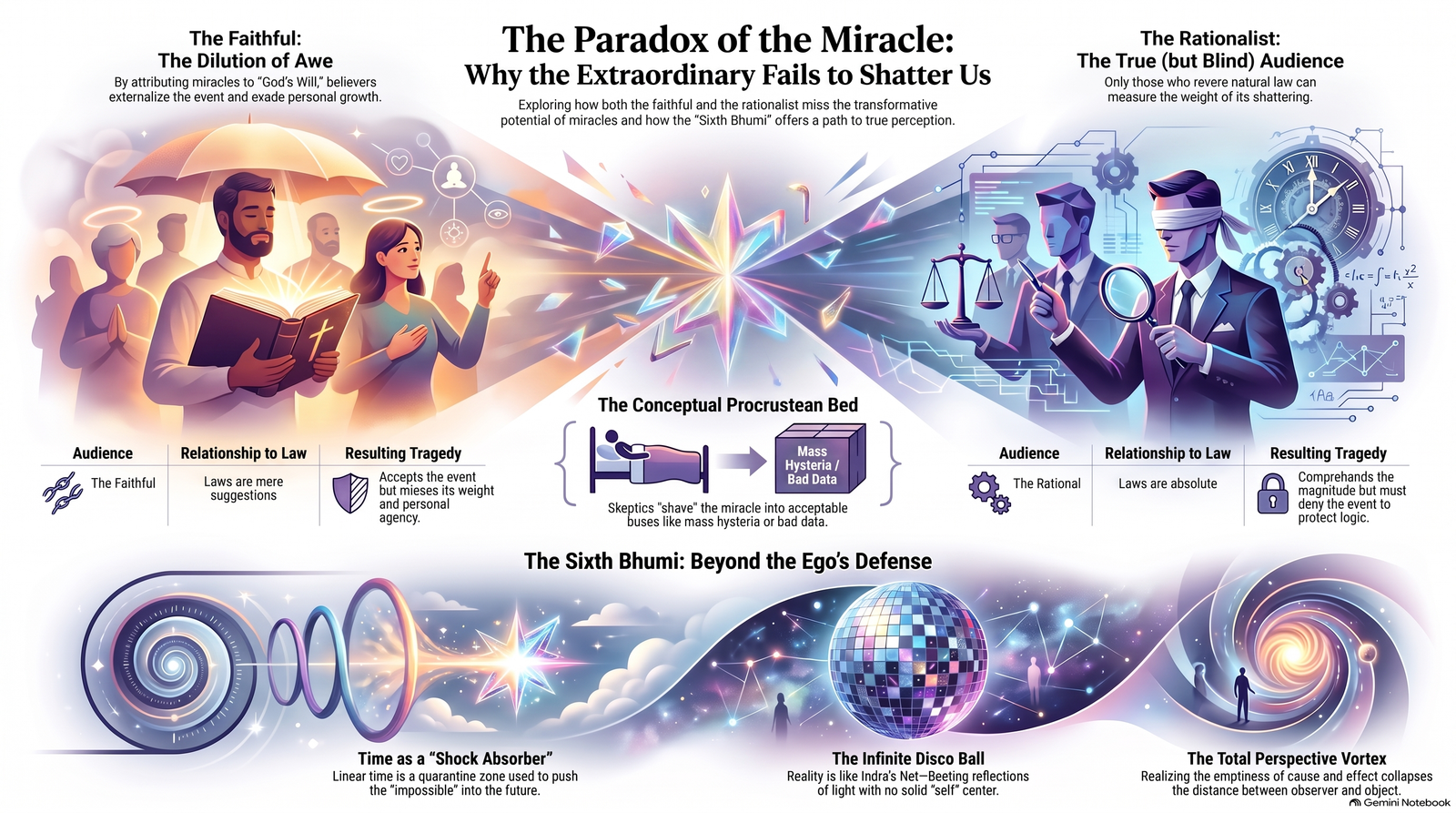
The first half develops a deliberately provocative symmetry. The faithful observer may domesticate the extraordinary by assigning it immediately to divine will; the rational observer may domesticate it by translating it into anomaly, error or the not-yet-understood. One risks making the miracle too easy to accept, the other too difficult. C. S. Lewis, Thomas Kuhn, psychoanalytic defence and Freud’s Reizschutz are brought into the argument as ways of asking how a mind protects an established order. Linear time then becomes a “shock absorber”: an imaginative model in which the overwhelming is divided into past, present and future so that it need not arrive all at once.
The discussion then crosses into Mahāyāna Buddhism. Dependent origination and emptiness are presented as a deeper challenge to the clockwork picture shared by interventionist religion and strict mechanism. The sixth bodhisattva ground, Abhimukhī, provides the episode’s threshold. Yet the recording sometimes moves too quickly from the absence of inherent existence to the claim that causality simply vanishes. Madhyamaka is subtler: emptiness denies independent essence while preserving conventional dependence, ethical consequence and ordinary explanation.
Douglas Adams’s Total Perspective Vortex, the Bāhiya Sutta, Advaita Vedānta, Dzogchen and Indra’s Net carry the final movement towards “seeing without a seer” and the image of an infinite disco ball. These are not interchangeable doctrines. Here they form an exploratory constellation around one challenge: when an event unsettles the person we take ourselves to be, can we pause before turning the opening into another fortified identity?
The movement of the episode
From the broken house to the play of reflected light
The rupture opens a door
The ruined house reframes catastrophe as a possible exposure of the conceptual structure that had quietly become a prison.
Both audiences rebuild
Belief assigns the event to a familiar divine category, while rational explanation returns it to an intelligible natural order.
Time absorbs the shock
Freud’s protective-shield image is extended into the episode’s hypothesis that sequence keeps the overwhelming safely divided.
Causality loses its solidity
Dependent origination shifts the question from broken laws to the absence of any self-grounding object, cause or observer.
The viewpoint begins to spin
The Total Perspective Vortex dramatises the panic of a self that can no longer locate one fixed place from which to stand apart.
Reflection replaces possession
Bāhiya, Indra’s Net and the infinite disco ball leave experience as an unfolding relation rather than the property of a solid centre.
The interpretive lenses
Four kinds of material, four different claims
Philosophy of miracles
The episode treats the miracle as a cognitive rupture. This is its own philosophical proposal, not a settled theological definition or proof of supernatural agency.
Science and psychoanalysis
Kuhn and Freud supply models of paradigm strain and psychic protection. They do not establish that scientific caution is merely ego defence or that linear time is a neurological shield.
Buddhist traditions
Madhyamaka, the bodhisattva grounds, early Buddhist sensory instruction and Dzogchen enter from different textual and doctrinal settings. Their resonances should not erase their differences.
Comparative metaphor
Advaita, Douglas Adams, Indra’s Net and the disco ball give imaginative form to the loss of a fixed centre. The synthesis belongs to this episode’s exploratory map.
Listen by chapter
The complete 44-minute journey
- 00:00The Earthquake That Breaks the House
- 03:20What a Miracle Is Actually For
- 06:40Why Belief Can Domesticate the Impossible
- 10:30The Rational Mind and the Weight of the Miracle
- 14:40Paradigms, Ego Defences, and Intellectualisation
- 18:50Linear Time as the Mind’s Shock Absorber
- 23:10The Miracle as a Temporal Ambush
- 26:40Dependent Origination and the Empty Machine
- 31:10The Total Perspective Vortex and Ego Collapse
- 35:20Pure Seeing Without a Seer
- 38:40Indra’s Net and the Infinite Disco Ball
- 41:20What Are You Rebuilding from the Rubble?
Study notes and routes onward
Terms, distinctions and reference points
Glossary
Miracle
A miracle may be understood as an event attributed to supernatural agency, an event beyond nature’s productive power, or an extraordinary occurrence carrying religious significance. Philosophers disagree about definitions involving violations of natural law. The episode adds a different emphasis: the miracle as an imagined cognitive interruption whose value lies in unsettling an established frame.
Mythological and methodological domestication
These are the episode’s labels for two ways of making the extraordinary safe. Mythological domestication assigns it to a known sacred story; methodological domestication places it within error, anomaly or future explanation. Both descriptions are polemical. Religious interpretation can demand transformation, and scientific investigation is not reducible to emotional avoidance.
Paradigm and anomaly
In Thomas Kuhn’s philosophy of science, a paradigm supplies exemplary problems, concepts and practices for normal research. An anomaly is a recalcitrant puzzle within that framework. Anomalies do not automatically overthrow paradigms; a crisis becomes revolutionary only under particular historical conditions and when a viable rival framework emerges.
Intellectualisation
In psychoanalytic language, intellectualisation describes retreat into abstract analysis to reduce contact with difficult feeling. Careful reasoning is not automatically a defence, however. In the episode the term names a possible emotional use of explanation, not a diagnosis of scientists, sceptics or anyone who asks for evidence.
Reizschutz
A German term meaning protection against stimuli. In Beyond the Pleasure Principle, Freud imagines a protective barrier that moderates external excitation and can be breached by trauma. It belongs to his speculative metapsychology. The episode’s claim that linear time functions as this shield is a creative extension, not an established neuroscientific mechanism.
Temporal ambush
The episode’s metaphor for an event that cannot be postponed into a manageable future or absorbed into an orderly sequence. It arrives as an immediate challenge to expectation. The phrase can illuminate sudden change, but it should not blur the difference between philosophical surprise, reported religious experience and clinically significant trauma.
Dependent origination
A central Buddhist principle stating, in broad terms, that phenomena arise and cease in dependence upon conditions. It has several doctrinal applications, including the twelvefold account of suffering and rebirth. Madhyamaka uses dependence to challenge inherent existence; this does not mean that ordinary causal relations become useless or that actions cease to have consequences.
Emptiness and svabhāva
Śūnyatā, emptiness, is the absence of svabhāva: an intrinsic, independent nature by which something would exist from its own side. In Madhyamaka, emptiness and dependent arising belong together. Emptiness is not a hidden substance behind appearances, a claim that nothing exists, or permission to ignore conventional truth and ethical consequence.
The sixth bhūmi, Abhimukhī
The ten bhūmis are bodhisattva grounds described in Mahāyāna Buddhism. The sixth is commonly called Abhimukhī, often translated as Face-to-Face or Manifest. It is associated with the perfection of wisdom and profound understanding of dependent origination. The episode’s “total perspective vortex” is a modern interpretive image, not a standard doctrinal definition.
Total Perspective Vortex
Douglas Adams’s fictional device from The Restaurant at the End of the Universe confronts a person with their proportion to the unimaginable whole. The episode uses the comic invention to picture the loss of an egoic vantage point. It is literary analogy rather than a model of meditation, mental health or Buddhist attainment.
The Bāhiya Sutta
An early Buddhist discourse in the Udāna in which Bāhiya receives the terse instruction that in the seen there should be only the seen, and likewise for hearing, sensing and cognising. The episode reads this through non-dual language. Interpretations vary, and the passage need not imply the metaphysical witness taught in Advaita.
Advaita Vedānta and the witness
Advaita Vedānta is a non-dual Hindu philosophical tradition in which consciousness or ātman is ultimately identified with Brahman. Its language of an unobjectifiable witness differs from Buddhist not-self and emptiness teachings. Placing them side by side can illuminate a shared question about subject and object without proving doctrinal identity.
Dzogchen and rigpa
Dzogchen, the Great Perfection, is a Tibetan Buddhist contemplative system found especially in Nyingma and Bön contexts. Rigpa can refer to pristine awareness recognised as empty and cognisant. It is embedded in transmission, ethics and practice; it should not be reduced to a generic state of consciousness or merged without qualification into Advaita.
Indra’s Net and the infinite disco ball
Indra’s Net is a celebrated image associated with Huayan Buddhism: each jewel reflects all others, expressing interdependence, mutual inclusion and the relation of part to whole. The “infinite disco ball” is the episode’s contemporary reimagining. It vividly conveys fleeting reflection but is not a scientific theory of a holographic universe.
Related reading on this site
- Miracles, magic and mysticismThe site’s direct treatment of extraordinary events, interpretation and the boundary between wonder and explanation
- An introduction to the law of dependent originationBackground for the conditionality that the episode places at the centre of its later Buddhist argument
- EmptinessA focused route into the absence of inherent existence without collapsing conventional appearances and consequences
- The Sideways Glance at No-SelfA later dialogue page that approaches the unlocatable observer without requiring a dramatic assault upon identity
- Does the Brain Create a Feeling of TimeA later examination of temporal experience that extends the episode’s speculative image of time as a shock absorber
- Awareness and ConsciousnessA useful distinction for the episode’s closing movement from a narrating observer towards immediate experience
External reference points
- Miracles — Stanford Encyclopedia of PhilosophyA critical survey of competing definitions, natural-law questions and arguments about testimony
- Thomas Kuhn — Stanford Encyclopedia of PhilosophyContext for paradigms, normal science, anomalies and the conditions under which scientific crisis develops
- Beyond the Pleasure Principle — Project GutenbergFreud’s text behind the protective-shield metaphor, including his own explicitly speculative framing
- Madhyamaka — Stanford Encyclopedia of PhilosophyAn academic guide to emptiness, inherent nature, the two truths and Candrakīrti’s philosophical setting
- Bāhiya Sutta — SuttaCentralA translation of the early Buddhist discourse behind the instruction concerning seeing, hearing, sensing and knowing
A three-minute reflection
Notice the moment of repair
Recall one ordinary moment when new information unsettled a view you held. On paper, make three short notes: what happened, what I first called it, and what remains uncertain. Notice whether the first label restored safety by dismissing the event or making it confirm what you already believed. You do not need to preserve the surprise or accept an extraordinary explanation. Simply leave one small space between evidence and interpretation before deciding what the event means.
Continue the dialogues