
Dialogues II · Episode 05
The Alchemy of Immortality | Dialogues II
Is liberation found by leaving the mortal vessel behind, or by transforming the vessel itself?
The central question
If death could be overcome, what exactly would we want to preserve?
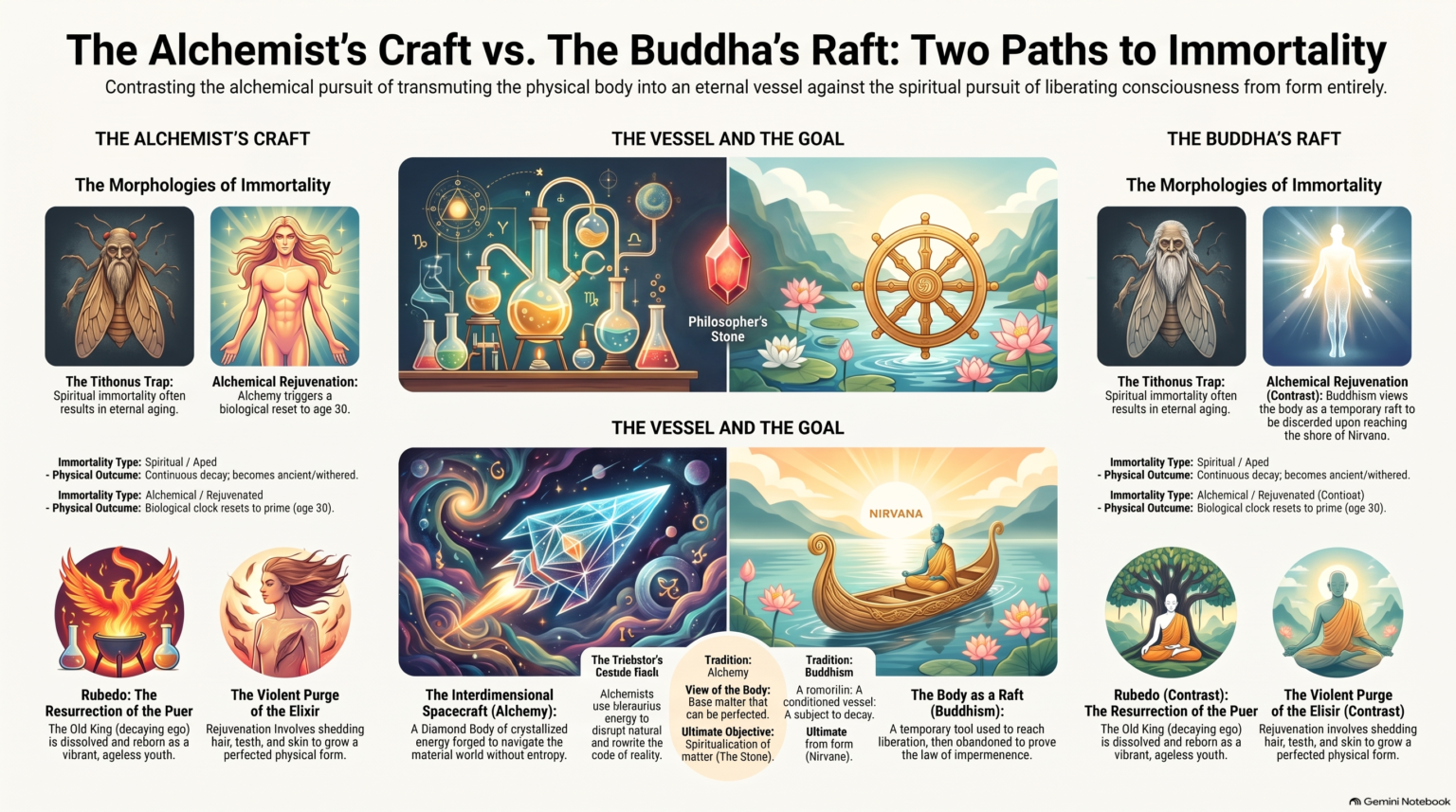
This episode begins by separating two desires that are often hidden inside the single word immortality. One is indefinite continuation: the person persists, but the ageing body may continue to deteriorate. The other is transmutation: the old form is broken down and renewed as a perfected vessel. The myth of Tithonus makes the first possibility terrible, while Western alchemical images of the dying king and reborn youth give the second its most vivid form.
The discussion then sets an alchemical ambition beside a Buddhist one. The alchemist, in the episode’s imaginative language, seeks to rebuild the raft as an “interdimensional spacecraft”; Buddhist liberation appears as release from the compulsion to continue within conditioned existence. From there, the comparison widens through Indian kāya kalpa, Daoist shijie or “corpse liberation”, Dzogchen rainbow-body traditions and stories surrounding the Buddha’s final days. These materials do not describe one shared historical technology. They provide contrasting religious and symbolic answers to the same human problem: whether mortality is escaped, accepted, outwitted or transformed.
Mercurius supplies the episode’s turning point. As poison and remedy, fixed matter and volatile trickster, he personifies the disruptive force that can dissolve an established order. The alchemist becomes a “spiritual hacker”, not because nature has been shown to contain a hidden technical exploit, but because alchemical change is imagined as a refusal to leave inherited structures untouched. The philosopher’s egg then brings the vast speculation inward: a sealed vessel in which pressure, decay and separation become conditions for transformation.
The final movement is psychological rather than biological. The grit in the oyster becomes a way of asking what suffering can become when it is neither denied nor passively worshipped. The episode does not promise physical immortality, and pain should never be sought as a spiritual fuel. Its sharper question is whether the unavoidable friction of a life must merely imprison us, or whether some of it can be worked, contained and transformed without pretending that mortality has been solved.
The movement of the episode
From the curse of continuation to the furnace of change
Immortality divides in two
The opening separates endless survival from rejuvenation, revealing that defeating death without defeating decay may turn the wish into a curse.
The old king must dissolve
Alchemical stage imagery makes transformation more radical than repair: the exhausted form passes through blackening and purification before any red resurrection.
The traditions choose different goals
Buddhist release is contrasted with the perfection of form, while Tithonus, kāya kalpa, shijie and rainbow body supply distinct stories rather than one universal doctrine.
The trickster crosses the boundary
Mercurius becomes the patron of transformation because his instability can move between opposites and unsettle what appears permanently fixed.
The cosmos becomes a vessel
The philosopher’s egg isolates a small world in which dissolution and recombination can occur, turning metaphysical ambition into a model of contained inner work.
Friction becomes the final test
The oyster’s grit reframes unavoidable difficulty as material that may be transformed, while leaving open whether wisdom releases the vessel or remakes it.
How the sources are used
Four lenses with different kinds of authority
Classical myth
Tithonus is a literary warning about immortality without youth. The episode uses the story to expose a conceptual problem; mythic narration is not evidence about human longevity.
Historical alchemy
The philosopher’s stone, elixir, sealed vessel and kingly transformations belong to varied alchemical traditions. Their psychological reading owes much to later interpretation, including Jung.
Buddhist and Daoist traditions
Canonical teachings, later-body doctrines and hagiographic accounts are brought together comparatively. Theravāda, Mahāyāna, Dzogchen and Daoist categories remain distinct.
Simon Robinson’s alchemical synthesis
The spacecraft, hacker, egg and oyster form the episode’s interpretive architecture. They are a contemporary map for inquiry, not a proven mechanism of physics or medicine.
Listen by chapter
The complete 39-minute journey
- 00:00The Dangerous Question of Immortality
- 02:40Two Paths: Escape or Transmutation
- 05:20The Great Work and the Old King
- 08:40Why the Alchemical Youth Is Thirty-Three
- 11:20Jung, the Ego, and the Reborn Self
- 13:50The Curse of Tithonus
- 16:20Kāya Kalpa and the Body Reboot
- 19:40Why Didn’t the Buddha Stay Forever?
- 22:50The Raft, Nirvāṇa, and Leaving the Body Behind
- 25:30Corpse Liberation and Cheating the Cosmic Ledger
- 28:10Rainbow Body and Dissolving Into Light
- 31:10Mercurius, the Trickster, and the Alchemical Hack
- 33:50The Philosopher’s Egg and the Grit in the Oyster
- 36:20Suffering as the Heat of Transformation
- 38:00Final Question: Escape or Transmute?
Study notes and routes onward
Terms, distinctions and reference points
Glossary
Immortality and longevity
Immortality can mean endless biological life, survival in another mode, freedom from rebirth, enduring influence or symbolic participation in something timeless. Longevity means unusually long life but does not necessarily imply immunity to ageing or death. The episode deliberately tests what changes when these meanings are separated.
Tithonus
In the Homeric Hymn to Aphrodite, Eos asks Zeus to make Tithonus deathless but fails to ask that he remain young. He continues ageing until she confines him away, his voice still flowing. Later tellings develop the cicada motif. The story is an ancient warning against confusing more time with undiminished life.
Nigredo, Albedo, Citrinitas and Rubedo
Blackening, whitening, yellowing and reddening are widely used modern names for an alchemical sequence of dissolution, purification, illumination and completion. Historical alchemy was diverse, and not every text presents one fixed four-stage system. The episode uses the sequence as a map of death and renewed form.
The old king and the rejuvenated youth
Death and renewal of royal or paired figures appear in Western alchemical imagery, especially in illustrated transformation sequences. Reading the restored figure as psychological renewal is associated with depth psychology. A universal rule that Rubedo produces a literal 30- or 33-year-old body is not established by the historical record; the age of Christ offers a suggestive Christian association rather than a single definitive explanation.
Philosopher’s stone and elixir
The philosopher’s stone was imagined as an agent capable of perfecting metals and, in some traditions, curing illness or prolonging life. Alchemical texts combine laboratory practice, natural philosophy, medicine, theology and coded imagery in changing proportions. The stone’s modern psychological meaning should not erase that material history.
Kāya kalpa
A Sanskrit expression associated with transforming or renewing the body, used for varied South Asian rejuvenation and ascetic practices. Traditional accounts may describe renewed vitality, hair or teeth, but they do not establish a reliable biological reset to a fixed age. It should not be attempted from an AI-generated description or treated as a substitute for healthcare.
The Buddha’s possible lifespan
In the Mahāparinibbāna Sutta, the Buddha tells Ānanda that someone who had fully developed the four bases of psychic power could remain for an eon or the remainder of one. Interpretations of kappa and the episode’s narrative setting require care. The passage concerns remaining alive; it does not state that the Buddha could become young again, and it should not be converted into a claim of scientifically verified life extension.
The raft and parinirvāṇa
In the Alagaddūpama Sutta, the Dhamma is compared to a raft used for crossing rather than grasping. The episode creatively transfers the image to the body, but this is not the canonical simile itself. Parinirvāṇa names the final nirvana of an awakened being at death; Buddhist traditions resist describing it as an eternal self or consciousness travelling elsewhere.
Nirmāṇakāya
In Mahāyāna accounts of the three bodies of a buddha, the nirmāṇakāya is an emanation or manifested body appearing in the world for beings. The term belongs to later doctrinal developments than the Pāli Mahāparinibbāna Sutta. Using it for the historical Buddha can be legitimate within Mahāyāna, but it should not be silently projected into every Buddhist school.
Shijie or corpse liberation
Shijie is a Daoist category often translated as liberation by means of a corpse. Biographical and ritual traditions may describe a substitute object in place of the body and frame transcendence through the language of celestial or underworld administration. These are religious narratives with their own historical contexts, not documented methods for evading biological death.
Rainbow body and great transference
Rainbow body is a high attainment described in Dzogchen and Bön traditions, with hagiographies reporting the reduction or disappearance of the body. Great transference is presented as a still more exceptional mode. These claims are meaningful within their traditions but are not established by independent evidence as changes to atomic bonds, and Dzogchen practice should not be reduced to speculative physics.
Mercurius and the trickster
Mercurius is both the volatile alchemical substance and, in later symbolic interpretation, a contradictory figure joining poison with medicine, above with below and beginning with goal. Jung’s Mercurius is not simply identical with the historical god Hermes, and the episode’s “spiritual hacker” is a contemporary metaphor for boundary-crossing transformation.
The philosopher’s egg
The sealed vessel or ovum philosophicum provides a protected world for alchemical operations. In Simon Robinson’s wider synthesis it also represents containment in which identity can loosen without immediately dispersing. The transcript’s pouch, oyster and spacecraft extend that symbol rather than report one uniform historical doctrine.
Suffering as transformative heat
Difficulty can sometimes be interpreted, integrated or used in constructive change, but suffering is not automatically ennobling and severe distress can overwhelm rather than transform. The metaphor does not imply that people cause their pain, should remain in harmful circumstances, or should intensify distress to accelerate spiritual development.
Related reading on this site
- Death and alchemyThe site’s direct introduction to mortality, dissolution and the alchemical promise of transformation
- Buddhism and alchemyA wider account of the correspondences and differences that this episode pushes towards the question of the body
- ParanirvanaBackground on final nirvana and the difficulty of describing an awakened being after death
- Thoughts on RubedoThe final alchemical stage considered as completion, incarnation and return rather than mere escape
- The BardoA course chapter on death, transition and the interpretive risks surrounding Tibetan contemplative maps
- Buddha is a Job DescriptionA later dialogue page that distinguishes buddhahood as function from the wish to preserve a privileged personal identity
External reference points
- Homeric Hymn to Aphrodite — Theoi Classical TextsThe ancient account in which Tithonus receives deathlessness without enduring youth
- Mahāparinibbāna Sutta — SuttaCentralThe early Buddhist text behind the episode’s discussion of Ānanda, the Buddha’s lifespan and final nirvana
- The Simile of the Raft — SuttaCentralThe canonical setting in which the Dhamma, rather than the biological body, is compared with a raft for crossing
- The Whole of Nature and the Mirror of Art — Science History InstituteHistorical context for alchemy’s pursuit of the philosopher’s stone and an elixir capable of prolonging life
- Religious Daoism — Stanford Encyclopedia of PhilosophyA scholarly overview of the varied practices, cosmologies and self-transformative ambitions gathered under religious Daoism
- Dzogchen — Project Himalayan ArtMuseum context for the Great Perfection tradition, including its treatment of the body, bardo and pure awareness
A three-minute reflection
Separate what you want from what you fear
Take a blank page and write three headings: continue, renew and release. Beneath each, add one sentence about what that word means to you when you think about ageing or death. Then ask what each answer is trying to protect: bodily comfort, memory, relationship, identity, unfinished work, control, or something less easily named. Do not attempt to settle the metaphysical question. Notice instead how one word—immortality—can conceal several different wishes.
Continue the dialogues