
Dialogues II · Episode 08
What If Time Is Not a Line? | Dialogues II
Ancient cosmology and geological deep time meet as two different maps of recurrence, decline and renewal.
The central question
What can cyclical cosmology reveal when it is laid across the history written in rocks?
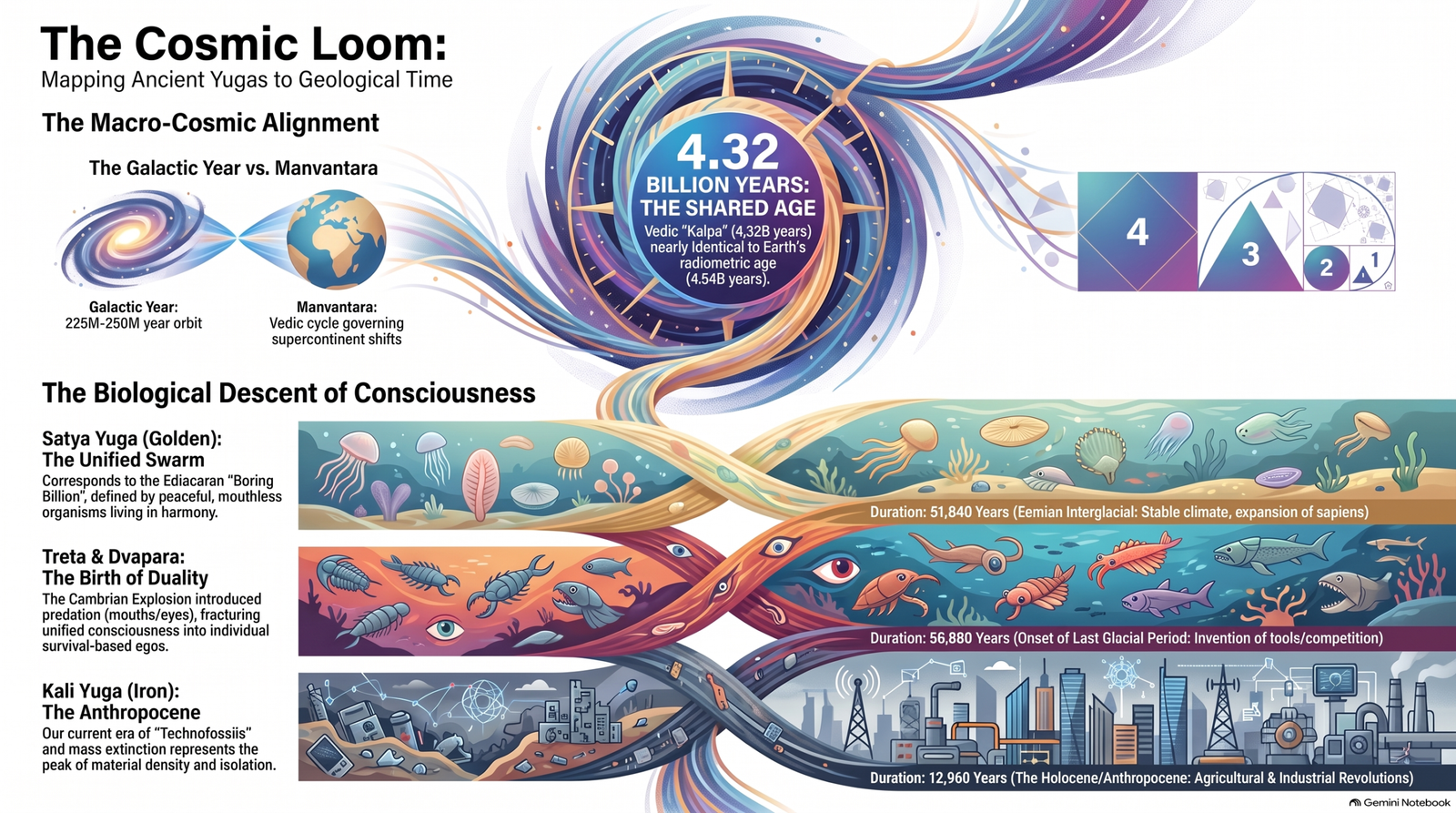
This episode begins by separating two immense but very different astronomical measures. Earth’s axial precession takes roughly 26,000 years; the Sun’s orbit around the Milky Way takes about 230 million years. Correcting that initial confusion opens a far larger imaginative experiment. Could the nested cycles of Hindu cosmology—yugas, mahāyugas, manvantaras and kalpas—be placed beside astronomical and geological time without reducing either map to the other?
The recording is drawn strongly towards numerical correspondence. A Purāṇic day of Brahmā is conventionally calculated as 4.32 billion human years, which is compared with Earth’s radiometric age of about 4.54 billion years. A manvantara is then brought near a galactic year and the broad rhythm of supercontinent assembly and dispersal. From there, the four declining yugas become an interpretive overlay for biological history: relative unity in early life, differentiation and predation around the Ediacaran-Cambrian transition, and the increasingly technological separation associated with modern humanity.
The scale narrows again to human evolution. Forbidden Archaeology, the Laetoli footprints, recurring catastrophe, the Younger Dryas and flood traditions are assembled into a cyclical alternative to a simple ladder of progress. This is where the episode’s most forceful claims require the greatest restraint. Laetoli records bipedal hominins, not anatomically modern humans millions of years out of place. The Younger Dryas was a real interval of abrupt climate change, but a single extraterrestrial impact remains disputed, and neither it nor postglacial sea-level rise verifies a universal civilisational reset described by ancient flood narratives.
The Anthropocene supplies the final image: technological humanity as Kali Yuga made visible in concrete, plastics, radionuclides, extinction and atmospheric change. The human planetary signal is well documented, although the Anthropocene was rejected in 2024 as a formal geological epoch and remains useful as an informal Earth-system concept. The page therefore preserves the episode’s real philosophical challenge while refusing its claim of scientific proof: if linear progress is only one story, can the wheel help us notice decline and responsibility without turning resemblance into revelation?
The movement of the episode
From a mistaken number to a cosmic philosophy of recurrence
Two cycles are separated
Axial precession and the galactic year establish how easily very large astronomical scales become confused.
The ancient clock expands
Yugas, mahāyugas, manvantaras and kalpas introduce nested religious timescales far beyond recorded human history.
Numbers invite correspondence
The 4.32-billion-year kalpa and other large cycles are set beside Earth’s age, galactic motion and tectonic recurrence.
Biology becomes a descent
Ediacaran and Cambrian life are recast as stages in a symbolic movement from imagined unity towards embodied competition.
Human history becomes cyclical
Anomalous archaeology, glacial change and flood stories are used to challenge the idea of uninterrupted civilisational progress.
The Iron Age enters the rocks
The Anthropocene is read as Kali Yuga: a powerful ethical metaphor whose force does not depend upon geological equivalence.
The interpretive lenses
Four clocks that should not be made into one
Astronomical cycles
Precession and the Sun’s galactic orbit are measured physical motions. Their approximate periods may vary with definition and improved evidence.
Purāṇic cosmology
Yugas and kalpas organise moral decline, cosmic creation and dissolution within Hindu traditions. Buddhist uses of kalpa have their own settings and need not share these exact calculations.
Geology and evolution
Stratigraphy, radiometric dating and fossils reconstruct Earth history through testable evidence. Similar durations do not establish dependence on a religious chronology.
The episode’s synthesis
The descent of consciousness into density is a contemporary philosophical overlay. It may provoke reflection while remaining distinct from palaeontology and evolutionary theory.
Listen by chapter
The complete journey
- 00:00Time as a Line vs Time as a Wheel
- 03:40The 26,000-Year Confusion
- 07:45Precession, Galactic Time, and Cosmic Scale
- 12:20Kalpas, Mahayugas, and Vedic Deep Time
- 17:30Manvantaras and Geological Ages
- 22:10Breath, Fractals, and the Galactic Year
- 26:30Yugas as Biological Descent
- 32:20The Golden Age, Ediacaran Life, and Non-Competition
- 37:10The Cambrian Explosion as the Fall into Duality
- 41:40Human Evolution, Forbidden Archaeology, and Knowledge Filtration
- 46:20Younger Dryas, Flood Myths, and Civilisational Reset
- 49:40The Anthropocene as Kali Yuga
- 52:00Closing Reflection: The Wheel Turns Again
Study notes and routes onward
Terms, distinctions and reference points
Glossary
Axial precession
The slow change in the orientation of Earth’s rotational axis, produced mainly by gravitational torques from the Moon and Sun acting on Earth’s equatorial bulge. The axis traces a cycle over roughly 26,000 years. This changes the celestial poles and the relation of the equinoxes to the stars; it is not Earth’s orbit around the galaxy.
Galactic year
The approximate time taken by the Sun and solar system to orbit the centre of the Milky Way. NASA gives about 230 million Earth years, while estimates vary somewhat with the model of galactic motion. It is an astronomical period, not a recognised subdivision of Hindu cosmology or a clock that directly determines geological boundaries.
Yuga and the 4:3:2:1 pattern
In a widespread Purāṇic scheme, the four yugas—Kṛta or Satya, Tretā, Dvāpara and Kali—form descending ages of virtue and duration. Including transitional dawns and twilights, their conventional lengths are proportional to 4:3:2:1. Traditions and later reinterpretations vary, so shortened precessional systems should not be silently substituted for the classical calculation.
Mahāyuga and kalpa
A mahāyuga is a complete set of four yugas, conventionally calculated as 4.32 million human years in the developed Purāṇic system. One thousand mahāyugas make a 4.32-billion-year day of Brahmā, often called a kalpa. This sacred cosmological duration is numerically near, but not equivalent to, Earth’s independently measured age.
Manvantara
A period governed by a Manu within a day of Brahmā. Fourteen manvantaras, together with intervening transitions, fill a kalpa in a familiar Purāṇic account. The episode maps their roughly 306.72-million-year spans onto geological and biological stages. That matching is a modern proposal, not part of the geological timescale or proof of encoded palaeontology.
Deep time
The immense duration of Earth history inferred from stratigraphy, fossils, radioactive decay and other converging evidence. Geological units are defined through physical records and internationally agreed boundaries, not equal numerical blocks. Deep time can resonate imaginatively with ancient aeons while remaining methodologically different from sacred chronology.
Wilson cycle
A geological model of ocean basins opening and closing through plate tectonics, often associated with continental rifting, seafloor spreading, subduction and collision. Individual cycles do not run on one exact universal period. Comparing the Wilson cycle with a galactic year or breath-derived number may be suggestive, but it does not demonstrate causal or historical identity.
Ediacaran biota
Diverse, mostly soft-bodied organisms known from the Ediacaran Period, roughly 635 to 539 million years ago. Some forms were unlike later animals, and ecological relationships remain actively studied. Describing the period as peaceful, mouthless or wholly non-predatory is too broad; interpreting these organisms as a unified field of consciousness is the episode’s metaphor rather than palaeontological evidence.
Cambrian explosion
A geologically rapid diversification of animal body plans and ecological interactions beginning around 539 million years ago, not the instantaneous appearance of complex life. It involved changes in preservation, development and ecology across millions of years. Eyes, mouths, skeletons and predation have different evolutionary histories, so the event cannot literally mark a single fall from unity into duality.
Laetoli footprints
Tracks preserved in volcanic ash at Laetoli, Tanzania, about 3.6 million years old. Their makers walked bipedally and are generally associated with Australopithecus afarensis. The footprints are important evidence about early hominin locomotion; their human-like features are not evidence that anatomically modern Homo sapiens existed at that date.
Forbidden archaeology and knowledge filtration
Forbidden Archaeology argues that evidence for extreme human antiquity has been excluded by a dominant scientific paradigm. Scientific communities can display bias, but disputed objects still require secure context, provenance, dating and reproducibility. Rejection is not itself proof of censorship. The book’s chronology is not accepted within mainstream archaeology or palaeoanthropology.
Younger Dryas
An abrupt return to colder conditions, especially evident around the North Atlantic, from about 12,900 to 11,700 years ago during the last deglaciation. Its regional causes and effects are studied through multiple climate records. A proposed extraterrestrial impact remains controversial; the Younger Dryas is not synonymous with postglacial sea-level rise or established proof of a lost global civilisation.
Anthropocene
A widely used term for the interval in which human activity has become a major planetary influence. In 2024 the relevant international bodies approved rejection of the proposal to formalise it as a geological epoch, so the Holocene remains the official epoch. Anthropocene remains valuable informally in Earth-system science, environmental humanities and public discussion.
Kali Yuga
The fourth and least virtuous age in the classical four-yuga sequence. A widespread traditional chronology places its beginning around 3102 BCE and gives it a duration of 432,000 years. Sri Yukteswar and modern cyclical systems use different, much shorter scales. Identifying technological modernity or the Anthropocene with Kali Yuga is an ethical-symbolic reading, not stratigraphic classification.
Related reading on this site
- Three TimesA contemplative approach to past, present and future that complements the episode’s challenge to a single linear picture
- Timeless AwarenessA route from cosmological measurement towards the phenomenological question of how time appears in awareness
- Does the Brain Create a Feeling of TimeA later Dialogues page examining temporal construction through neuroscience, philosophy and contemplative experience
- 3.3.7. VastnessThe course treatment of scale and the loosening of the viewpoint from which human time appears central
- Indra and the AntsA mythic encounter with cosmic duration and the repetition of worlds, lives and positions
- Causes and conditionsA useful counterweight to coincidence: patterns become explanatory only when relations and mechanisms can be established
External reference points
- Our Sun: Facts — NASA ScienceNASA’s current overview, including the Sun’s roughly 230-million-year orbit around the Milky Way
- Hindu Cosmology — Encyclopedia of ReligionContext for Purāṇic yugas, divine years, kalpas, manvantaras and the moral character of cyclical time
- International Chronostratigraphic Chart — ICSThe authoritative current hierarchy and boundaries of the geological timescale
- Laetoli Footprint Trails — Smithsonian Human OriginsEvidence for the age, discovery and likely Australopithecus afarensis makers of the famous bipedal tracks
- Independent evaluation of the Younger Dryas impact hypothesis — PNASA critical assessment illustrating why the proposed extraterrestrial trigger remains contested rather than established fact
- Joint statement on the Anthropocene — IUGS and ICSThe formal decision approving rejection of the proposed Anthropocene Epoch while leaving broader informal uses of the term available
A three-minute reflection
Hold the pattern beside the evidence
Choose one striking correspondence from the episode. Make two brief columns on paper: what the pattern helps me notice and what evidence would be needed to make it a causal or historical claim. Let both columns remain valuable. The first protects imagination; the second protects discrimination. Finish by naming one present action—however small—that responds responsibly to the world as it is, without requiring certainty about which cosmic age it belongs to.
Continue the dialogues