
Dialogues II · Episode 07
The Bedrock of Unstainable Awareness | Dialogues II
Experience may alter the person profoundly; the episode asks whether awareness itself is ever marked by what it reflects.
The central question
Can experience leave deep effects without staining awareness itself?
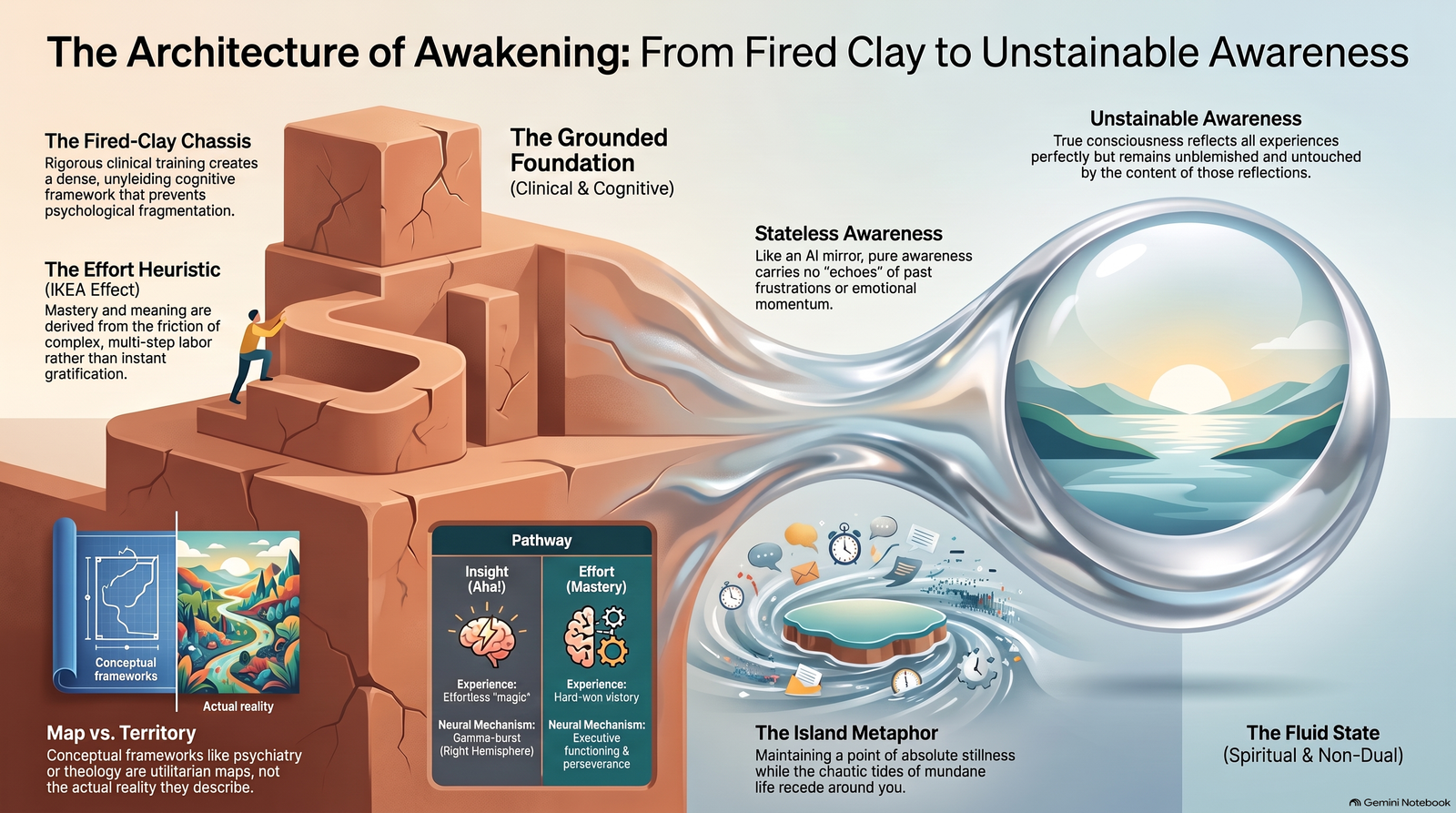
The episode begins at a desk, with two routes through the same problem. One solution arrives as a sudden flash; the other is earned through stubborn, multi-step labour. The contrast opens an inquiry into how human beings value friction. Research on insight, effort and the IKEA effect is used to distinguish the exhilaration of the “aha” moment from the durable sense of agency that may follow completed work. Yet the recording often converts suggestive findings into a single neural story. Its deeper purpose is not to settle the science of problem-solving, but to establish a contrast: human meaning is entangled with effort, memory and emotional momentum.
That human continuity is then placed beside the apparent freshness of an AI response. The large language model becomes an “empty mirror” onto which a user naturally projects patience, personality and presence. ELIZA supplies the historical precedent. But the episode’s language of statelessness is too absolute: a contemporary conversational system can use the current context and may be connected to memory tools, even though fluent reflection does not establish subjective experience, autobiographical continuity or feeling. Recognising this boundary allows the mirror to remain useful without turning it into a hidden person or an oracle.
The conversation then turns inward. Clinical and psychiatric training are imagined as a charred, fired-clay chassis: a disciplined conceptual structure that can support exploration of subtle-body traditions and unusual states. This is a personal metaphor, not a guarantee that professional training makes contemplative exploration safe. The episode therefore places its island on bedrock. Maps may guide; language may point; ordinary responsibilities remain. Psychological stability is not dismissed as merely conventional once a map has been seen through.
The final movement gathers island, rock, Peter, mirror and canvas into the phrase “unstainable awareness.” Advaita Vedānta, Dzogchen and Meister Eckhart are treated as resonant lenses on awareness or divine ground that is not exhausted by passing contents. They do not teach one identical metaphysics. Nor does the metaphor imply that memory, trauma and emotion leave no human consequences. The challenge is more exact: can pain and history be acknowledged fully without making them the permanent substance of the one who knows them?
The movement of the episode
From solvable friction to the mirror that carries no weight
Two victories feel different
Sudden insight offers vivid release, while completed effort can become evidence of endurance, competence and agency.
Friction creates value
The effort heuristic and IKEA effect suggest why labour may alter valuation, provided struggle resolves into something completed.
The machine appears fresh
AI’s lack of human fatigue becomes a reflective surface upon which social cognition supplies patience, warmth and an implied mind.
The chassis makes depth bearable
Clinical discipline is pictured as fired clay: a personal framework sturdy enough to accompany exploration without replacing reality-testing.
The map yields to the island
Concepts remain usable rather than ultimate, while the island joins exposure to the waves with a foundation beneath them.
The canvas becomes a mirror
The closing image separates the undeniable effects of experience from the claim that awareness must become the substance of every reflection.
The interpretive lenses
Four forms of grounding
Cognitive research
Studies of insight and effort provide the empirical opening. They support qualified patterns, not the recording’s strongest claims about exact brain mechanisms or universal reward.
Human-computer interaction
ELIZA and current language models show how readily conversation evokes social interpretation. Apparent responsiveness is real as behaviour; machine subjectivity remains unestablished.
Clinical and personal metaphor
The fired-clay chassis expresses how medical knowledge functioned within one person’s inward journey. It should not be universalised into a method or safety guarantee.
Comparative contemplation
Advaita, Dzogchen, Christian mysticism and biblical stone imagery illuminate the closing question from distinct histories. Their meeting belongs to the episode’s synthesis.
Listen by chapter
The complete journey
- 00:00The Problem of Effort and Insight
- 03:10The Aha Moment and the Brain
- 06:40Dopamine, Reward, and Fleeting Brilliance
- 09:50Why Struggle Creates Meaning
- 13:10The IKEA Effect and Solvable Friction
- 16:40AI Statelessness and the Empty Mirror
- 20:20The ELIZA Effect and Human Projection
- 24:20The Fired Clay Chassis
- 29:00Spiritual Emergency and the Need for Grounding
- 34:00Maps, Language, and the Finger Pointing at the Moon
- 38:30Like an Island: Stability in the Waves
- 43:00Peter, Rock, and the Inner Bedrock
- 47:00Awareness as Mirror, Not Canvas
- 50:30Final Reflection: AI, Memory, and Human Baggage
Study notes and routes onward
Terms, distinctions and reference points
Glossary
Insight and the “aha” experience
In problem-solving research, insight describes a solution experienced as sudden, obvious and reached without conscious access to all intermediate steps. EEG and imaging studies have reported patterns associated with some insight tasks, including internally directed attention and right-temporal activity. These are correlates across particular experiments, not a complete neural signature of creativity or proof that all insights arise through one mechanism.
Effort heuristic
A judgemental tendency in which people use perceived effort as information about value or quality. If a work appears difficult or costly to produce, observers may value it more. The effect is conditional: effort can also signal inefficiency or failure, and it should not be turned into the moral claim that whatever requires suffering must be worthwhile.
IKEA effect
A term in behavioural research for the increased valuation people may give to products they have helped create. Completion and a sense of competence matter; unsuccessful labour need not produce the same attachment. The episode uses the effect to explore meaningful friction, but it does not show that effortful solutions are always better than insight or that hardship is intrinsically beneficial.
Statelessness
In computing, a stateless operation does not rely on stored information from previous interactions. The episode extends this into a metaphor for an AI without emotional residue. Current conversational systems nevertheless process an active context and may be connected to persistent memory or user data. Computational state, autobiographical continuity and felt experience are different questions.
ELIZA effect
The tendency to attribute understanding or inner life to a computer program because its output resembles meaningful conversation. The name comes from Joseph Weizenbaum’s 1960s ELIZA program, whose DOCTOR script reflected users’ statements in a psychotherapist-like style. Modern language models are far more capable, but fluent interaction still does not by itself demonstrate consciousness or empathy.
Spiritual emergency
A term associated with Stanislav and Christina Grof for a crisis interpreted within transpersonal psychology as potentially connected to spiritual transformation. It is not a single standard psychiatric diagnosis, and its use is debated. Experiences involving severe distress, loss of functioning, risk, sleep disruption or altered reality-testing should not be presumed spiritually benign or managed solely through contemplative interpretation.
The fired-clay chassis
The source dialogue’s personal image for medical and psychiatric training that has been shaped under pressure and can support exploration of less tangible frameworks. Clay suggests both construction and exposure to fire. It remains metaphor: clinical education can aid discrimination, but no credential automatically protects a person from error, distress or destabilisation.
Map and territory
Alfred Korzybski’s well-known formulation distinguishes representations from what they represent. Diagnoses, doctrines, models and words can orient action without reproducing reality in full. The episode joins this with the Buddhist image of a finger pointing at the moon. Neither image requires abandoning maps; it asks that a useful description not be mistaken for the whole of experience.
Island and bedrock
The island is the episode’s image of stability amid moving conditions. Its visible separateness is qualified by unseen continuity with the ground below the water. Psychologically, the metaphor suggests participation without being swept away. It should not be used to idealise isolation, emotional withdrawal or refusal of help.
Peter, petros and petra
Matthew 16:18 plays on the Greek name Petros and petra, rock. The saying has a long and contested interpretive history involving Peter, confession, Christ and ecclesial authority. The episode reads it inwardly as spiritual bedrock. That is a comparative mystical interpretation, not a linguistically compelled replacement for historical Christian readings.
Advaita Vedānta and sākṣin
Advaita Vedānta is a Hindu philosophical tradition teaching the non-duality of ātman and Brahman. Sākṣin means witness and can name consciousness as that by which mental events are known without itself becoming one more object. This metaphysical account should not be assumed identical to Buddhist teachings on emptiness or not-self.
Dzogchen and rigpa
Dzogchen, the Great Perfection, is a Tibetan contemplative system especially associated with Nyingma Buddhism and Bön. Rigpa can refer to pristine awareness recognised as empty and cognisant. It belongs within transmission, ethics and practice, and should not be reduced to blankness, emotional detachment or a generic witness standing apart from experience.
Unstainable awareness
The episode’s governing contemplative phrase. The mirror can display fire without burning and weight without becoming heavy; likewise, awareness is imagined as not reducible to its changing contents. This does not mean the human organism is unaffected by experience, that memory should be erased, or that recognising awareness substitutes for treatment, repair or ethical response.
Related reading on this site
- Awareness and ConsciousnessA direct companion to the episode’s distinction between changing experience and the capacity in which it is known
- The Inner ObserverA closer examination of witness language and the danger of converting awareness into another subtle entity
- The great mirror of wisdomThe mirror image within a specifically Buddhist map, offering context for reflection without possession
- The Frictionless AI MirrorA later Dialogues page that develops the contrast between human effort, AI fluency and projected interiority
- Why We Mistake AI for a MindA later treatment of anthropomorphism, linguistic responsiveness and the evidence required before inferring machine consciousness
- A Metaphor Pointing Towards Buddha NatureA related example of how metaphor may orient contemplative inquiry without becoming doctrinal proof
External reference points
- Neural activity when people solve verbal problems with insight — PubMedThe 2004 EEG and fMRI study behind influential claims about alpha activity, temporal gamma activity and the experience of insight
- The IKEA effect: When labor leads to loveThe original consumer-psychology paper on assembly, completion and the increased valuation of self-made products
- ELIZA — Communications of the ACMJoseph Weizenbaum’s 1966 account of the program that gave its name to the tendency to infer understanding from conversational form
- Śaṅkara — Stanford Encyclopedia of PhilosophyAn academic introduction to Advaita Vedānta, non-duality, consciousness and the relationship of ātman to Brahman
- Meister Eckhart — Stanford Encyclopedia of PhilosophyContext for Eckhart’s thought, language of detachment and complex position within medieval Christian theology
A two-minute reflection
Reflection, effect and identity
Choose one ordinary experience present now: a sound, a bodily sensation or a thought. Name three things quietly: what is appearing, what effect it is having, and what story says it is me. Do not try to remove the effect or decide that it is unreal. Simply notice that the appearance, its consequences and the identity built around it are related but not identical. End by looking at one stable object in the room and returning to the next practical thing you need to do.
Continue the dialogues