
Dialogues II · Episode 10
The Matrix as a Roadmap to Awakening | Dialogues II
A splinter, a white rabbit and a red pill become symbols for the difficult moment when a familiar life can no longer explain itself.
The central question
Can a film chart the felt structure of awakening without becoming a literal spiritual map?
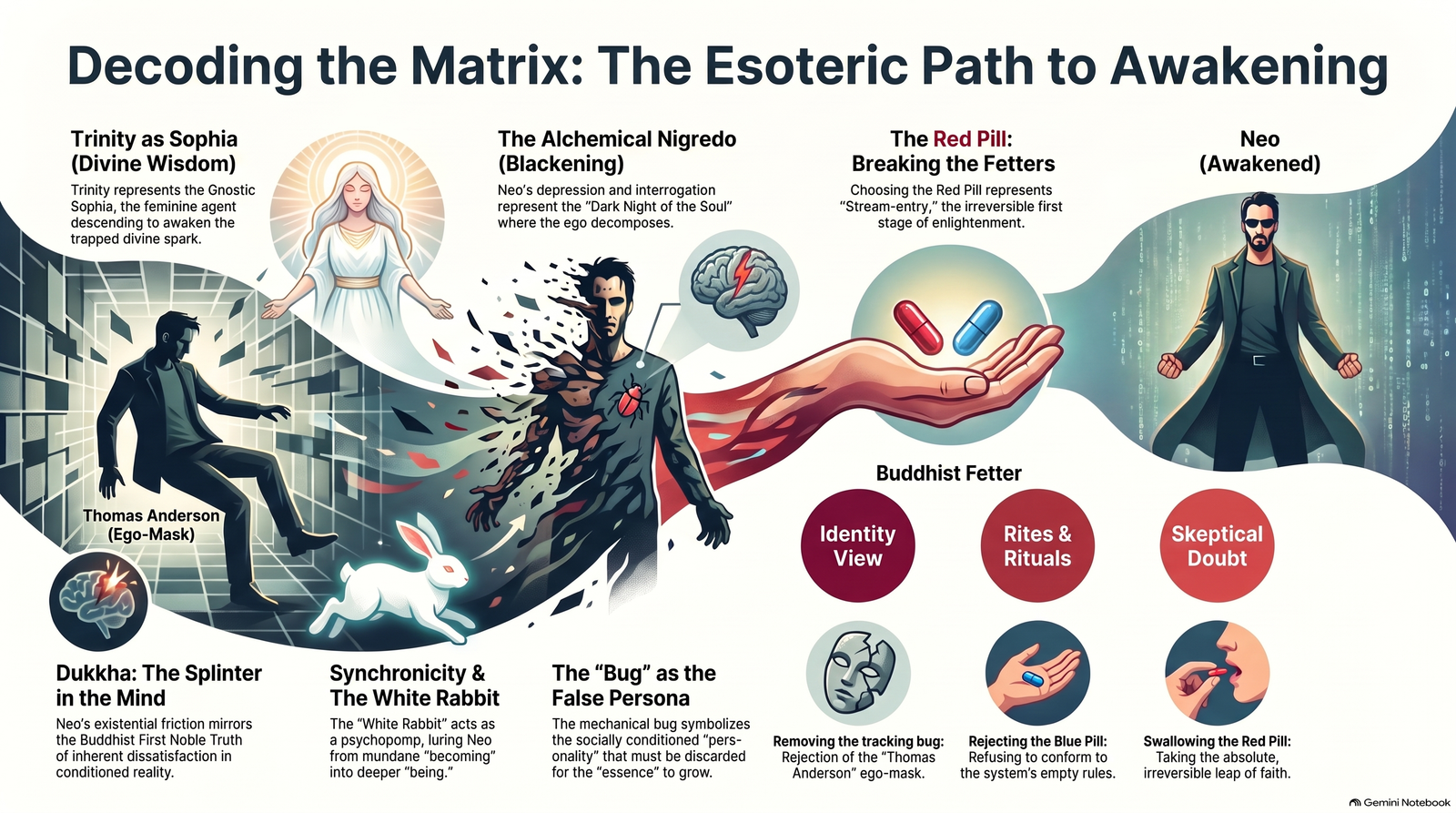
Before Neo meets Morpheus, The Matrix has already staged a complete crisis of orientation. Thomas Anderson cannot name what is wrong, yet ordinary life feels hollow. The episode begins with that “splinter in the mind” and reads it beside dukkha, alchemical Nigredo and the seeker’s inability to remain fully invested in a world whose terms have begun to fail. His hollowed copy of Baudrillard’s Simulacra and Simulation sharpens the irony: the book about signs displacing reality has itself become a container for contraband code.
The White Rabbit then turns vague dissatisfaction into movement. A message on a screen is echoed by a tattoo at the door, allowing the episode to explore synchronicity, the literary psychopomp and the awakening of an observing stance. Trinity is read through the figures of Sophia and the Jungian anima: not as proof of a hidden doctrine encoded by the Wachowskis, but as an interpretive way of understanding the person who validates Neo’s suspicion and draws him across a threshold. The sequence from nightclub to office shows the cost of living between narratives, where spiritual language, psychological distress and ordinary exhaustion can appear uncomfortably close.
The interrogation intensifies that ambiguity. Neo loses his voice, is invaded by a tracking bug and discovers that questioning the system carries consequences. Agents become cinematic counterparts for defensive forces: Gnostic archons, Buddhist Māras and the habits that protect a socially conditioned identity. The bug is then read through Gurdjieff’s distinction between essence and acquired personality. Its removal at the rain-soaked bridge marks Neo’s first deliberate refusal to return to the road he already knows.
Finally, Morpheus—the dream-shaper—offers the red and blue pills. The episode overlays this choice with Theravāda stream-entry and the first three fetters: identity view, doubt and distorted grasping at precepts and practices. That comparison is evocative but deliberately incomplete. A cinematic act of trust is not a Buddhist attainment, and rejecting convention is not itself liberation. The deeper challenge is whether one can let a story expose attachment and fear without confusing the story for the path it helps us see.
The movement of the episode
From unnamed dissatisfaction to an irreversible question
The familiar world loses its authority
Neo’s divided life gives form to dukkha: the sensed inadequacy of a routine whose surfaces no longer satisfy.
A coincidence becomes a summons
The White Rabbit joins inner unease to an external event and turns passive suspicion into the first movement of inquiry.
The guide confirms the threshold
Trinity gives Neo’s private question a relational answer, while the nightclub-to-office cut exposes the strain of standing between worlds.
The system defends the identity
Interrogation, speechlessness and the implanted bug dramatise how power and habit can preserve the persona they appear to threaten.
The tracked persona is relinquished
At the bridge, Neo chooses uncertainty over repetition and permits the symbolic machinery of Thomas Anderson to be extracted.
The choice opens rather than completes the path
The red pill becomes an image of commitment; the ten fetters remind us that seeing through one world is only a beginning.
How the sources are used
Four lenses, four different kinds of claim
The film as cultural text
Scenes, names and props provide the shared narrative. Their religious and philosophical resonances support interpretation, not a claim about the Wachowskis’ single intended doctrine.
Western philosophical and esoteric motifs
Baudrillard, Jung, alchemy, Gnosticism and Gurdjieff supply distinct accounts of signs, meaning, dissolution, hidden rule and acquired personality.
Buddhist frameworks
Dukkha, Māra, the Noble Eightfold Path and the fetters clarify attachment and release. They are doctrinal and practical categories, not film-production evidence.
Psychological and scientific language
Synchronicity, dissociation and quantum measurement explain particular theories or experiences. The episode extends them metaphorically beyond their evidential scope.
Listen by chapter
The complete journey
- 00:00The Splinter in the Mind
- 04:10Neo, Dukkha, and the Hollow Routine
- 08:20Simulacra, Nihilism, and the Desert of the Real
- 13:00The Merovingian and the Prison of Causality
- 17:10Follow the White Rabbit: Synchronicity and Meaning
- 21:30Observer Consciousness and the Laser Pointer Trap
- 26:00Trinity as Sophia and the Anima
- 31:40Awakening or Breakdown? DPDR, Nigredo, and Dissolution
- 36:30Agents, Archons, Māras, and the System’s Immune Response
- 41:30The Bug, False Personality, and the Extraction of Identity
- 45:30Morpheus, Dreams, and the Red Pill Choice
- 49:00Stream Entry and the First Three Fetters
- 51:00Closing Question: What Are the Other Seven Fetters?
Study notes and routes onward
Terms, distinctions and reference points
Glossary
Dukkha
A central Buddhist term often translated as suffering, stress or unsatisfactoriness. It includes obvious pain but also the instability of conditioned experience and the frustration produced by clinging to what changes. The episode uses Neo’s “splinter in the mind” as a cinematic image for this wider unease, not as a doctrinal definition.
Simulacrum and hyperreality
In Jean Baudrillard’s work, a simulacrum is not simply a bad copy of an original. Systems of signs and models can come to organise what counts as reality, producing the condition often called hyperreality. The Matrix borrows the imagery, but its clean division between simulation and external real world does not reproduce Baudrillard’s argument exactly.
Synchronicity
Carl Jung’s term for a meaningful coincidence in which an inner state and an external event are experienced as connected without an ordinary causal explanation. The computer message and White Rabbit tattoo make a vivid cinematic example. Meaningfulness to the observer does not by itself establish paranormal causation or a message sent by the universe.
Psychopomp
A guide who conducts souls or travellers across a boundary between worlds, familiar from many mythic traditions. The episode applies the term to the White Rabbit and later to Trinity because they draw Neo beyond his ordinary frame of reference. This is a literary function, not a claim that either figure belongs to one historical religious system.
Observer effect and witness-consciousness
In physics, observation means a measurement interaction that can change the system measured; it need not involve a conscious mind. “Witness-consciousness” is a contemplative idea, especially associated with the Sanskrit sākṣin in Hindu traditions, describing awareness of mental events without identification. Joining the two is a philosophical analogy, not a result of quantum mechanics.
Sophia and anima
Sophia, Greek for wisdom, appears in varied Jewish, Christian, Gnostic and philosophical contexts; there is no single Gnostic Sophia narrative. Jung’s anima names a feminine inner figure within his historically gendered model of the psyche. Reading Trinity through both images highlights guidance and mediation, but does not establish a direct identity or exclusive interpretation.
Nigredo
The blackening, a stage or operation in several alchemical schemes associated with decomposition and the breakdown of a prior form. Modern depth psychology and spiritual writing often use it metaphorically for crisis or disorientation. That symbolism may illuminate Neo’s experience, but clinical depression, dissociation and psychological breakdown are not alchemical accomplishments or necessary stages of awakening.
Depersonalisation and derealisation
Depersonalisation involves feeling detached from oneself; derealisation involves surroundings feeling unreal, distant or foggy. Brief experiences can occur under stress, while persistent or distressing symptoms may require professional assessment. The episode invokes them as analogies for Neo’s estrangement. They do not indicate that the external world is literally false or that awakening is occurring.
Archons and Māras
Archons are ruling powers described differently across late-antique Gnostic sources. In Buddhism, Māra personifies obstruction, temptation and death; later classifications include the Māra of the aggregates. The episode treats the Agents as resonant with both. These are separate traditions, and “skandha demons” is not a standard name for a single Buddhist class of beings.
Essence and personality in Gurdjieff
In teachings associated with G. I. Gurdjieff, essence refers to what is innate, while personality is acquired through education, imitation and social life. The episode interprets Neo’s bug as a vivid image of conditioned personality acting mechanically. The scheme is an esoteric psychological model, not a clinical account of personality or evidence for a hidden natural self.
Stream-entry
Sotāpatti, stream-entry, is the first of four stages of awakening in early Buddhist and Theravāda accounts. It is associated with insight into the teaching and abandonment of the first three fetters. The red pill resembles an irreversible threshold narratively, but swallowing it is not equivalent to Buddhist realisation, ethical training or contemplative understanding.
Identity view
Sakkāya-diṭṭhi is the view that identifies a self with the five aggregates or regards the aggregates as belonging to, containing or existing within a self. It is more precise than disliking one’s job title or changing a social persona. Neo’s loosening identification with Thomas Anderson functions here as an imaginative approximation.
Distorted grasp of precepts and practices
Sīlabbata-parāmāsa concerns clinging to rules, observances or practices in a mistaken way—especially treating them as sufficient for purification or liberation. It does not mean that ethics, discipline and ritual are useless. The blue pill represents conformity in the episode, but rejecting conventions is not by itself abandonment of this fetter.
Doubt
Vicikicchā is the fetter of obstructive uncertainty concerning the Buddha, teaching, community and training in early Buddhist frameworks. Its abandonment is not hostility to evidence or ordinary critical inquiry. Neo’s decision dramatises movement beyond paralysis, but unhesitating trust in a charismatic guide should not be confused with Buddhist insight.
Related reading on this site
- Why Your Reality Is a HallucinationThe preceding episode asks how constructed perception and the observing self prepare the ground for this cinematic inquiry
- 1.2.2. The Matrix of Conditioned RealityA course chapter on the conditioned structures that shape experience before they are recognised as structures
- What is the Matrix?The site’s broader account of the Matrix as a model for conditioned reality rather than a literal computer hypothesis
- What is the ‘personality?’A companion to the episode’s interpretation of the bug as acquired, socially maintained and mechanically defended persona
- The gross fettersA fuller introduction to the first five fetters, including the three associated with stream-entry
- Causes and conditionsA route into conditionality that complicates any simple opposition between mechanical causality and meaningful freedom
External reference points
- The Matrix: how the Wachowskis changed sci-fi — BFIFilm-historical context for the work’s fusion of cyberpunk, myth, religion, philosophy and popular cinema
- Postmodernism — Internet Encyclopedia of PhilosophyScholarly context for Baudrillard’s simulacra, models and logic of simulation beyond the film’s literal virtual world
- Ovid, Metamorphoses, Book XIThe classical passage in which Morpheus imitates human form, while Icelos and Phantasos assume animal and inanimate forms
- MN 2: Sabbāsava Sutta — SuttaCentralAn early Buddhist source connecting stream-entry with the abandonment of identity view, doubt and misapprehension of precepts and observances
- Dissociative disorders — NHSGrounded clinical information on depersonalisation, derealisation, possible causes and routes to assessment
A three-minute reflection
Notice the road you already know
Choose one small, ordinary decision you have been postponing—replying to a message, beginning a task, declining an unnecessary demand or asking for more information. Write down the familiar response that arrives first. Then separate three things: what you know, what you fear and what habit usually does. Do not ask whether your world is unreal and do not force a dramatic leap. Ask only: which next action is supported by evidence and values, rather than by the comfort of repeating the road I already know?
Continue the dialogues